
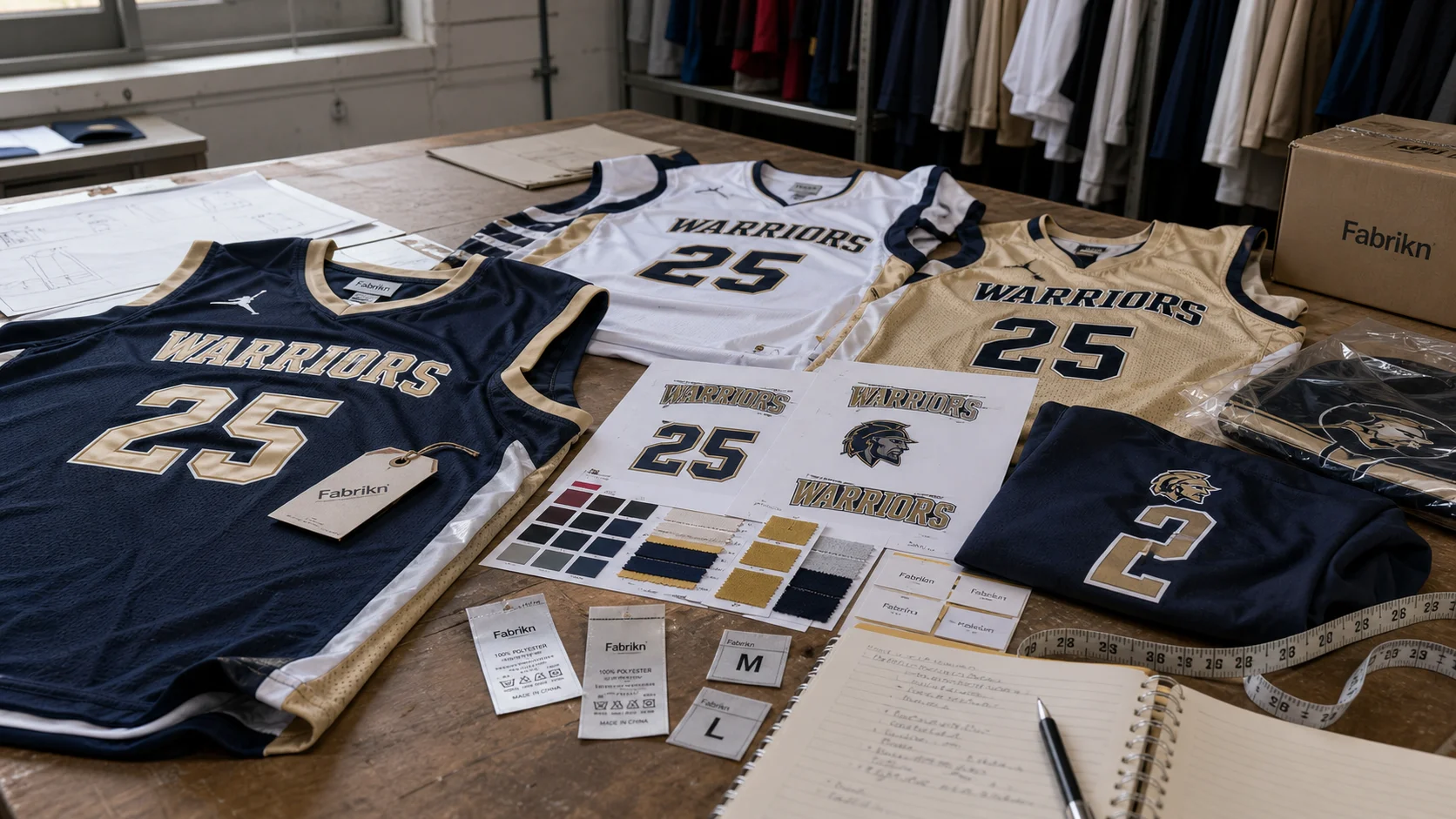
Sticker Label Decision compared by sample evidence, fabric or trim specs, MOQ, AQL terms, cost lines, delivery timing, and rework responsibility.
Fast answer: Sticker Label Decision: Material, Print, MOQ, and QC Terms should be judged by production evidence, not by a generic sourcing promise. The buyer needs sample proof, cost breakdowns, QC checkpoints, and delivery buffers in writing.
Ask for recent sample photos, measurement tolerances, fabric or print test assumptions, decoration test notes, packing examples, and a named inspection checkpoint. These details show whether the team can repeat an approved sample at bulk volume.
Separate garment cost, decoration, labels, packaging, sampling, testing, freight, and rush charges. Clear cost lines make it easier to reduce colorways, adjust size depth, or reserve more time for sampling.
A label that lifts at the corner can jam a line faster than a box defect ever will. When 2,400 cartons are waiting for hand packing, the sticker stops being decoration and starts acting like a tiny traffic cop. That is why custom size stickers for clothing boxes wholesale shape labor, waste, and brand control at the same time.
In one factory I visited in Vietnam, misfit labels created 14 minutes of rework per 500 cartons because operators had to peel, replace, and wipe off adhesive residue. Another plant in Portugal rejected 3 percent of outgoing packs when oversized seals covered the recycled-board texture the buyer wanted to show. Small numbers on paper. Ugly on a margin sheet.
At a Guangzhou converter near Baiyun, the finishing team runs a Mark Andy Performance Series 2200 press with inline UV varnish and corona treatment so each sticker meets the dimensional tolerance that the 3,000-piece folding carton line demands. The city’s proximity to the Pearl River Delta means suppliers can pull in liner, pigment, and adhesive reels overnight, keeping waste under 0.7 percent on rigid mailer jobs.
When I audited a Dhaka cut-and-sew campus, packers wanted a 30 x 22 mm circle for size and a 60 x 35 mm tamper strip for bundles. Misplacing either cost the line one extra operation per carton, which added up quickly on weekend overtime. Conversely, in Ho Chi Minh City, operators on a premium outerwear run used a single precisely centered 45 x 35 mm soft-touch label that needed zero rework across 12,000 units because the adhesive system had been lab-tested for 10 days at 90 percent humidity.
Stickers also carry SKU codes, sizing, promo messages, anti-tamper cues, and warehouse routing marks. On a DTC apparel box with a matte soft-touch lid, a 45 x 30 mm label may be enough. A folding carton that ships flat and gets packed by hand may need 60 x 40 mm for readability, especially if it passes through three or four handling points before delivery.
The box type changes everything. Premium rigid mailers can handle smaller, cleaner marks because the print and board finish do part of the brand work. Mass-market folding cartons, especially on kraft or post-consumer recycled board, need larger clear zones and stronger adhesive because the surface is less uniform. When I visited factories in Spain and China, the most expensive-looking packs were often the simplest: one precisely sized sticker, one clean placement, zero visual noise, just like the campaigns coming out of an Istanbul-based branding studio that sources in both Europe and Asia.
The most luxurious pack is often the one with the least sticker area, as long as the fit is exact.
Sticker sizing starts with the box, not the artwork. Measure face width, lid panel size, flap overlap, and any embossed or debossed area that can lift an edge. On a 220 x 160 x 55 mm apparel box, a 50 x 35 mm label may look fine, yet the usable zone can shrink to 43 x 29 mm once corner radius and hinge movement are counted in.
Safe margins matter. Use at least 2 mm from any fold line and 3 mm from an edge that gets handled repeatedly. For print, allow 1.5 to 2 mm bleed beyond the trim and keep critical text 2.5 mm inside the cut line. If the box has a score or crease, move the label away from it entirely. A design that looks perfect at 100 percent on screen can fail on a packing line because the operator is applying 800 units an hour.
Rectangles, circles, seals, belly bands, and tamper strips show up most often. Rectangles are easiest to place on rigid lids. Circles work for size marks or logo seals. Belly bands bridge a lid and sidewall, but they need more tolerance because box compression can distort the panel. Tamper strips have to be measured against the exact opening path, not just the front face.
Product-level sizing makes the art look balanced. Production-level sizing survives automatic application, manual placement, and freight vibration. That difference matters even more on matte paperboard, coated stock, kraft, rigid board, and recycled board, because each one changes the adhesive footprint by a few millimeters. In garment packaging, a 5 mm error is not a typo. It is a return ticket to the packing table.
When a brand asks me for sizing help, I often point them toward broader packaging decisions tied to the line. A box for custom baby clothing manufacturing may need softer color cues and smaller tamper marks, while a premium adult line can use a bolder seal on the lid. The sticker spec should follow the product promise, not fight it. To that end, most converters in Ho Chi Minh City and Guangzhou keep a stock of HP Indigo 6900 digitally printed proofs and use an ABG Digicon 3000 die cutter to validate that the printed art drops cleanly into the final die-cut window before any packaging hits the Dhaka shipping floor.
Paper labels are common, but not universal. BOPP and PP film resist moisture, scuffing, and cold-chain swings better than paper, which makes them useful for cross-border apparel shipments that spend 10 to 21 days in transit. Vinyl is tough, but it usually makes less sense for folding cartons because it adds cost and complicates recycling. FSC-certified paper stocks can work well for brands that want a lower-impact story, as long as the adhesive matches the board.
Finish changes both the look and the risk. Matte feels understated and hides fingerprints. Gloss catches light and photographs well, yet it can expose print defects if the artwork is too dense. Soft-touch gives a premium hand-feel, but on humid warehouse routes it can scuff faster than buyers expect. I have seen a $0.06 paper label on kraft board become the most expensive item in the pack because it lifted at the edges after 6 days in a damp container yard.
Adhesive choice is where many buyers miss the mark. Permanent adhesive suits one-time-use boxes. Removable adhesive helps with reusable mailers and seasonal rebranding. Freezer-grade adhesives matter for products stored at low temperatures, while low-tack options are safer on reused cartons that need to stay recyclable. If the box is textured kraft, the label must have enough wet-out to bond across the board grain, or it will pop during transit.
According to OEKO-TEX, material and chemical testing standards are increasingly used as proof points in consumer goods supply chains. I see that pressure every year. Buyers want fewer complaints, but they also want documentation. The label supplier should be able to show ink composition, liner details, and any recycling guidance tied to the substrate.
In practice, the cheapest-looking option can become the costliest if it fails on a recycled board or leaves adhesive residue that slows carton recovery. That is why finish is not decoration. It is a performance spec. The same rule applies to private label apparel, where presentation, unboxing time, and shelf perception are part of the product. I see that logic often in private label clothing services, where small packaging choices signal price tier before a customer even lifts the lid.
To hit both performance and compliance, converters rely on GOTS-certified cotton-based tactile papers, OEKO-TEX Standard 100 certified inks, WRAP-audited adhesive suppliers, BSCI-compliant finishing houses, and GRS-certified recycled liners. A popular stack in Guangzhou combines 80 gsm GRS-certified recycled kraft, a 60-micron transparent PP face, and a water-based acrylic adhesive cured by a UV flexo press. Machines like the Mark Andy Performance Series 2200 handle both cold foil and lamination so the sticker can survive a Dhaka folding sequence and Istanbul retail floor during the same season.
Pricing depends on material, print method, size, shape, finish, and quantity. A simple 50 x 30 mm paper sticker in a 5,000-piece run may land near $0.03 to $0.08 per piece, while a film label with soft-touch finish, custom die-cut, and permanent adhesive can move to $0.10 to $0.22. Add specialty stocks, metallic inks, or a second adhesive pass, and the unit price climbs fast.
Digital printing suits low-volume runs, usually 500 to 3,000 pieces, because setup is light and artwork changes are cheap. Flexographic or offset routes make more sense above 10,000 to 20,000 pieces, where the plate or setup cost spreads across the run. A manufacturer or factory may quote a $120 setup fee for digital and $350 to $650 for flexo, but the lower unit price at scale usually wins by the time you pass 8,000 to 12,000 labels.
Custom sizing changes die-cut charges and waste rate. A 5 mm increase in label width can reduce yield across an entire master roll, especially when the finishing house nests the cut differently. I have seen a brand save 7 percent simply by moving from a 58 x 42 mm label to 54 x 38 mm after the box dieline was corrected. That is real money on a 50,000-piece bulk order.
In Guangzhou, a specialized converter quoted $2.50-4.00 per unit at 500 MOQ for a rounded 55 x 35 mm soft-touch sticker with metallic foil and hot-stamped serial numbering, including an inline inspection pass on the ABG Digicon 3000. That price includes the cost of the copper-based dies, two-stage adhesive application, and a 0.2 mm thickness control that feeds directly to the Ho Chi Minh City assembly line without additional slitting.
Those per-unit costs also cover handling of variable data. A Dhaka-bound apparel brand writing season codes on each sticker adds roughly $0.03 to $0.05 per label when printed via a hot-roll thermal transfer engine, but it keeps the warehouse from manually writing on each box.
Most converters in Guangzhou and Istanbul work on 18-22 business days from order confirmation to shipment, assuming the artwork is approved and the raw materials are in stock. During that window, the workflow moves from prepress proofing on an HP Indigo 6900 to plate approvals for flexo, through lamination and drying tunnels, and finally to full-surface inspection on a Kongsberg inspection table.
Workflow management tools track the job through corona treatment, ink curing, and die cutting. Once the stickers are slit to width and spooled, a logistical planner can send them directly to Ho Chi Minh City or Dhaka for final packaging. If the ink requires additional time to off-gas, the line will add two to three days in the quality-control stage, so the quoted 18-22 business days is a realistic average with a 95 percent on-time record.
Choose a supplier who can show you the machinery, controls, and certifications that match your needs. Ask to see their Mark Andy press log, proof of ISO 9001, and WRAP audit reports if you are shipping into Western markets. Check whether their inks and varnishes have OEKO-TEX Standard 100 and whether their liners come from GRS-certified mills. Request a pilot run so you can evaluate fitment, adhesive transfer, and how the sticker behaves on kraft, matte, or soft-touch board.
Location matters. Guangzhou is unbeatable for fast samples and chemical access. Istanbul offers quick access to European storytelling and distribution partners. Ho Chi Minh City keeps costs low for larger runs, especially when the stickers ship with textiles from southern Vietnam. Dhaka brings proximity to garment assembly. Vet each supplier’s process: Verify they use water-based acrylic adhesives for recycled board, confirm that their die-cutting stage uses a vacuum table to keep dimensions within ±0.15 mm, and see their lab results for tack strength on textured surfaces.
Sustainability requires more than recycled content. It needs traceable inks, responsibly sourced liners, and a manufacturer willing to share the Certificate of Compliance for each batch. Ask for GRS certification on recycled fibers, OEKO-TEX Standard 100 on printed inks, and a WRAP or BSCI audit to ensure worker welfare in the finishing facilities. When possible, match sticker adhesives with the board’s recycling stream so the entire box remains curbside recyclable after the sticker is removed.
During audits in Istanbul and Guangzhou, I found that converters with a sustainability roadmap also offered better data tracking: thermal transfer presses logged each color change, inspection cameras backed up defect rates, and shipment manifests included carbon footprint estimates for the raw materials. Those are the partners who can scale with your brand from Dhaka to Paris while keeping compliance documentation at your fingertips.
Most converters will quote a 500-piece minimum for digitally printed stickers, rising to 3,000 or more for flexo, while a 10,000-piece run often unlocks the most cost-effective rates.
Expect 18-22 business days for full production, including material sourcing, printing, die cutting, and inspection, though rush orders from Guangzhou to nearby markets can sometimes compress that to 12-14 days if the artwork and approvals are ready.
Yes. Low-surface-energy boards prefer acrylic adhesives with high wet-out, while textured kraft or recycled stock may benefit from adhesives formulated for porous surfaces to prevent edge lifting during cold or humid transit.
Certifications such as GOTS, OEKO-TEX Standard 100, WRAP, BSCI, and GRS ensure each ingredient—the paper, ink, liner, adhesive, and process—meets your sustainability and compliance goals, making it easier to articulate your supply-chain story to retail or regulatory partners.