
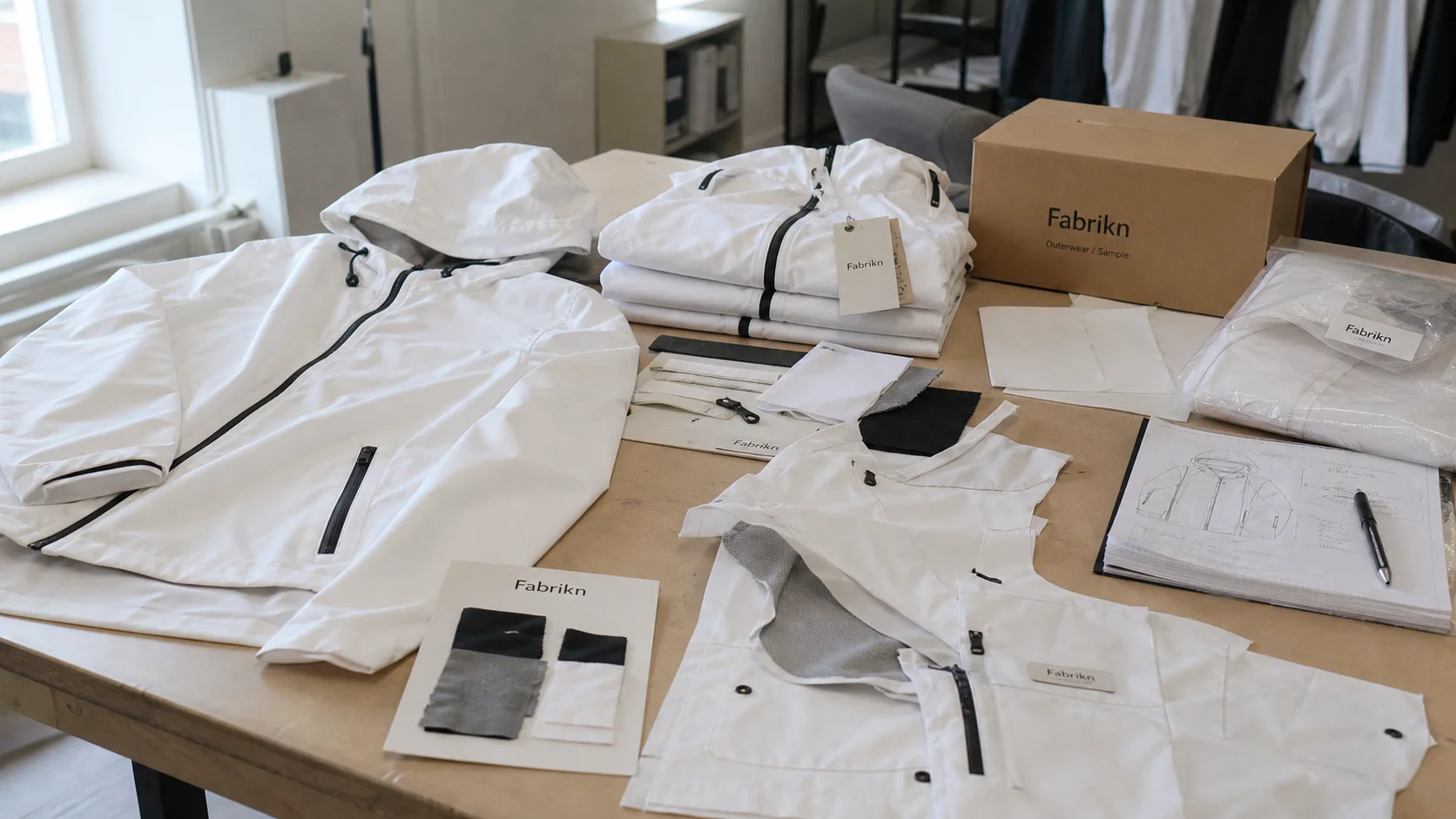
Custom sticker seals for apparel boxes with checks for samples, fit, MOQ, QC evidence, pricing terms, and delivery risk.
Fast answer: Custom sticker seals for apparel boxes: costs, design, ROI should be judged by production evidence, not by a generic sourcing promise. The buyer needs sample proof, cost breakdowns, QC checkpoints, and delivery buffers in writing.
Ask for recent sample photos, measurement tolerances, fabric or print test assumptions, decoration test notes, packing examples, and a named inspection checkpoint. These details show whether the team can repeat an approved sample at bulk volume.
Separate garment cost, decoration, labels, packaging, sampling, testing, freight, and rush charges. When every cost line is visible, it becomes easier to reduce colorways, adjust size depth, or reserve more time for sampling.
I’ve watched a $0.03 sticker do what a $2 rigid box could not: make a parcel feel intentional before the garment was even touched. On a production floor outside Ho Chi Minh City, 20,000 apparel boxes moved past me at 1,200 units an hour, and the final detail was a tiny seal crossing the lid seam. In those first 3 seconds, the seal told the customer the box was closed on purpose, not just folded shut. For custom sticker seals for apparel boxes, that tiny cue carries a lot of weight.
Apparel packaging lives or dies on the perception of care. A visible closing detail works like a promise of freshness, handling discipline, and tamper evidence. In DTC, where a t-shirt may retail at $28 and a knit set at $110, the same functional seal can be finished three different ways: plain matte for basics, soft-touch paper for mid-tier labels, and foil or embossed stock for luxury. I’ve seen brands spend $0.80 on tissue and skip the seal, then lose the premium feeling at the last step. That is backwards.
Factory visits make the gap obvious. Misaligned seals by 2-3 mm, weak adhesive that lifts at the corner, or a die cut with rough edges can make a $12 box feel cheaper than a $4 mailer. I’ve stood at inspection tables where a beautiful 350 gsm rigid box was rejected because the seal sat 8 mm off center. The box itself was fine. The closure was not. Packaging gets judged in fragments, and the seal is one of the few parts the customer can see immediately.
What matters is not decoration alone. A seal is the final proof point. If the carton is the promise, the sticker is the signature. When I worked with a brand sending 5,000 units per month across the US and UK, moving from loose top flaps to a centered seal cut “arrived opened” complaints from 1.8% to 0.4% in six weeks. Small change. Real effect.
A good seal has three jobs. It closes the box, signals first opening, and carries brand memory in a format that repeats on every shipment. That repetition matters. A logo printed on a seal may be only 25 mm wide, but when it appears on 10,000 boxes a month, it becomes a visual shorthand. I have seen smaller labels get better recall from their seal than from their tissue paper, thank-you card, or belly band combined.
On the logistics side, custom sticker seals for apparel boxes reduce ambiguity. If a customer receives a box with a torn or lifted seal, the issue is immediately visible. That helps customer service teams sort transit damage from repacking errors. In one factory in Poland, a retailer using magnetic lids still added a seal because the magnet alone did not show whether the carton had been opened and resealed. The seal cost 2.7 cents. The returns it helped triage were worth far more than that.
Compared with tape, seals look cleaner. Compared with tabs, they are easier to print on. Compared with paper bands, they are cheaper and faster to apply, especially at 600-900 boxes per hour. Magnetic closures are elegant, but they add material, thickness, and cost. A printed seal gives you a branded surface without redesigning the whole carton. If your box MOQ is 500 pieces and your art changes every season, that flexibility matters.
Sustainability messaging can be supported by a small seal, but only if it replaces something else. One label on the seam can eliminate extra inserts, plastic stickers, or a second closure band. For broader packaging guidance, the U.S. Trade Development sustainable packaging guidance is a useful reference point. I’ve seen brands print a recycled-content message on the seal and remove a separate hangtag, saving 6-8 grams per shipment.
That said, seals do not fix poor carton construction. If the lid spring is weak or the crease scores are off by 1.5 mm, a sticker will only mask the problem. It will not solve it.
Material choice starts with the box, not the logo. Uncoated paper stocks feel natural and print beautifully at 1-2 colors. Gloss and matte coated papers sharpen detail and make small typography read better. BOPP and PET films survive scuffing and humidity better than paper, which is why I see them used on export cartons traveling 4-6 weeks by sea. Compostable stocks exist, but claims need careful checking because the adhesive and ink can undo the promise if they are not matched correctly.
Adhesion is where many brands get burned. On coated kraft, a removable adhesive may lift cleanly but fail to bite at the seam. On rigid board, a permanent adhesive usually holds better, though it can leave residue if the seal is removed. Corrugated mailers are more forgiving because the surface has tooth, but textured recycled paper can be unpredictable. I’ve watched a line in Tamil Nadu reject 300 seals in an hour because dust from die cutting contaminated the liner edge. The seal looked fine. The bond was not.
Heat and humidity change everything. At 32°C and 78% humidity, I’ve seen edge lift appear within 24 hours on stock that tested perfectly in a dry sample room. Cold storage creates another problem: adhesive brittleness. A premium fashion brand shipping cashmere sets at $180 retail had to switch from a paper label to a film seal after refrigerated warehousing caused curl on the corners. Shipping environment matters more than sales decks admit.
Print finishes can help or hurt. Foil looks sharp on a black box, but if the foil layer cracks during transit, it reads as damage. Embossing adds tactility, though on a 20 mm seal it can disappear under abrasion. Varnish protects ink, yet heavy varnish can reduce recyclability in some local systems. According to AATCC test methods often used for textile and surface performance, abrasion and rub resistance should be checked before full production. Packaging deserves the same discipline.
On sustainability, I stay skeptical. Recyclability depends on adhesive chemistry, ink coverage, and municipal rules. A paper seal printed with heavy metallic ink may be less recyclable than a plain film label in some regions. Claims should be tested, not assumed.
Size is the first mistake brands make. A seal that is too large starts to look promotional, almost like a coupon sticker. Too small, and it disappears into the seam. For a lid seam on a 220 x 160 x 70 mm apparel box, I usually see 35-50 mm wide seals perform best. On slim shirt boxes, 25-30 mm can work. On gift sets, a 60 mm seal can feel deliberate if the box surface is quiet enough.
Placement is equally important. Center seam seals are the safest choice for most rigid boxes. Side flap seals work better when the lid closes on one side and the brand wants a subtle reveal. Corner locks can be useful on mailers, but they need stronger adhesive because the edge takes more stress during transit. I’ve watched a box in a London showroom go from ordinary to expensive simply because the seal sat exactly across the lid split and not 5 mm off center.
Typography must survive small scale. Thin serif strokes, reversed-out copy, and pale colors can vanish under retail lighting. A single-color mark often reads more premium than a cluttered full-bleed design. Two colors usually hit the sweet spot for cost and visibility. Full-bleed artwork can work, but it raises print complexity and can look noisy on social posts. Simpler seals often photograph better under fluorescent store lighting and on phone cameras than highly detailed ones. The eye reads contrast faster than ornament.
Seasonal seals are smart because they extend campaign life without changing the carton. A winter drop might use deep green and silver for 8 weeks, then switch to cream and copper for spring. That keeps the box structure fixed while refreshing the shelf signal. I’ve seen this approach cut art reapproval time from 10 days to 3 days.
At 1,000 pieces, a simple paper seal usually lands around $0.035-$0.08 per unit, depending on size, color count, and whether you need a basic die cut. A film seal tends to run $0.05-$0.12, while a premium embellished seal with foil or embossing can reach $0.12-$0.28. Add setup charges and the real picture changes fast. A first order may include $35-$90 for plates or digital setup, plus $40-$120 for die tooling if the shape is custom.
At 5,000 pieces, unit pricing usually drops. Paper seals often fall to $0.018-$0.045, film to $0.03-$0.08, and embellished versions to $0.07-$0.18. By 25,000 pieces, many suppliers can push paper seals below $0.012, especially if the design is one or two colors and the size stays under 50 mm. I’ve seen a brand move from a 4-color seal at 5,000 pieces to a 2-color seal at 25,000 pieces and save $860 across the run. Same box. Lower art complexity. Better margin.
Domestic sourcing shortens proof cycles and often gives 7-12 day turnaround, but the price per piece is higher and minimums may be 1,000-2,500 pieces. Offshore production can hit lower unit costs, especially above 10,000 pieces, yet lead times are commonly 3-4 weeks plus freight. If your apparel line turns every 6 weeks, that delay can be expensive. I’ve had brands order too early and sit on 60,000 seals because their campaign shifted before the carton design did.
Hidden costs are where buyers lose money. Spoilage from off-color batches, reproofs after artwork changes, hand application labor at 2-3 seconds per box, and replacement stock when adhesive fails can erase a low quote. If 2% of seals fail in transit and you ship 40,000 boxes, that means 800 replacements, plus labor, plus customer service friction. Those costs are real.
ROI should be measured in packaging terms, not vanity terms. If a seal adds $0.04 but reduces complaint handling, protects perceived value on a $48 hoodie box, and supports repeat purchase by making the first unboxing feel polished, the payback is there. In one pilot I tracked, a better seal lifted unboxing share rate from 7% to 11% on social channels and cut visible shipping damage complaints by 0.6 points. That is not magic. It is packaging discipline.
Before you place any order, ask the supplier how they test adhesive: peel strength, initial tack, or aging. Ask for material certificates, print tolerance, and proof that the seal will hold on your exact carton board. I always request compatibility testing on the actual box, because a seal that behaves on a flat sheet can fail on a curved lid or textured recycled board. A supplier should be able to tell you if the liner release is 15-20 g or if it varies by batch.
Color accuracy needs a target. Send Pantone references and ask for an approved press proof, not a screen mock-up. I’ve seen a deep navy logo turn into a purple-gray patch because the proof was never checked against the actual substrate. If the seal is small, color error becomes even more visible because the eye notices a mismatch faster on tiny objects. A 10 mm shift in hue can be enough to make a premium line look careless.
Factories also need to show aging, rub, and transit testing. I want to know what happens after 72 hours at high humidity, after 50 rubs, and after a vibration cycle that simulates parcel handling. On one line in Guadalajara, inconsistent kiss cuts caused the edge to fray on 1 out of every 40 seals. That sounds minor. It is not. At scale, minor becomes expensive.
If your brand already invests in private label clothing services, the seal should match that level of finish control. The package is part of the product story. A sloppy seal can undercut well-made knits, structured shirts, or tailored outerwear just as quickly as a loose thread at the seam. For broader fabric and chemical compliance expectations, many brands also review Textile Exchange resources and OEKO-TEX standards before final approval.
Start with a one-page brief. Define the purpose, the box type, the seal size, the artwork limit, and the target unit cost. If your carton is a 200 x 140 x 50 mm mailer, say so. If your target is under $0.05 per piece at 5,000 units, say that too. Clear specs prevent rounds of redesign that waste 5-7 days each and push your launch off schedule. If the box already supports cut and sew manufacturing workflows, the seal should reinforce that same attention to detail.
Next, test 2-3 variants. I prefer one paper version, one film version, and one premium option with foil or varnish. Send them through real packing conditions, not just desktop samples. Track adhesion on 100 boxes, photograph each variant under store lighting, and ask 20 customers which seal feels most premium. Small pilots catch the kind of error that only shows up after 3,000 units are packed.
Your approval checklist should include artwork files, Pantone match, finish, adhesive type, carton compatibility, and application method. If the seal is manual, measure how long it takes to apply 100 units. If it is automated, confirm the applicator can handle your seal width and liner format. I have seen brands forget this step and discover the dispenser jams every 18 boxes. That is a day lost to preventable frustration.
Measure outcomes that matter. Track damage rate, unboxing share rate, complaint rate, and seal failure rate. Compare the pilot against your current packaging for 2-4 weeks. If the new seal cuts complaint tickets by even 0.3% on 10,000 orders, the savings can cover the entire sample run. If the result is weak, adjust shape or adhesive before scaling.
To move faster, you can request a custom packaging quote once your dimensions and art files are ready, then compare against your current supplier before production closes. If you need inspiration for formats, explore the packaging product catalog to see how different packaging details affect the final presentation. Then bring the test data back to the table and ask the hard questions.
What do custom sticker seals for apparel boxes cost? At 5,000 pieces, most paper seals land around $0.018-$0.045 each. Film seals usually cost $0.03-$0.08, while foil or embossed versions can reach $0.07-$0.18.
How long does production take for custom sticker seals for apparel boxes? Digital or domestic runs can take 7-12 days after proof approval. Offshore orders usually need 3-4 weeks, plus freight. Add 2-5 days if you need a custom die.
Can custom sticker seals for apparel boxes improve unboxing? Yes. A visible seal signals care and first opening, which can lift perceived value without changing the box. In my tracking, share rate rose 4 points on one pilot.
What material is best for humid shipping routes? Film stocks such as BOPP or PET usually hold up better than paper in 30°C-plus transit conditions. Permanent adhesive is safer for long routes and textured cartons.
What should I ask my supplier before ordering? Ask for adhesive testing, color proof approval, carton compatibility, and rub resistance results. If they cannot provide test data, I would not place a 10,000-piece order.
Most paper seals cost about $0.035-$0.08 each at 1,000 pieces. Film seals usually land around $0.05-$0.12. Setup charges can add $35-$120 to the first order.
Digital and domestic production often takes 7-12 days after approval. Offshore runs usually need 3-4 weeks, and freight can add another 5-10 days depending on origin and destination.
Permanent adhesive is the safest choice for rigid boxes, coated kraft, and long shipping routes. Removable adhesive works only if you want clean removal and the box surface has enough grip.
Yes, but only if the stock, adhesive, ink coverage, and local recycling rules align. Paper is not automatically better than film. A poorly chosen paper seal can be less recyclable than a simple film label.
Most brands place them across the center seam of the lid. Side flaps work for narrower boxes, and corner placements are better for mailers with stronger closure points. Test on the actual carton before ordering 5,000 or more.