
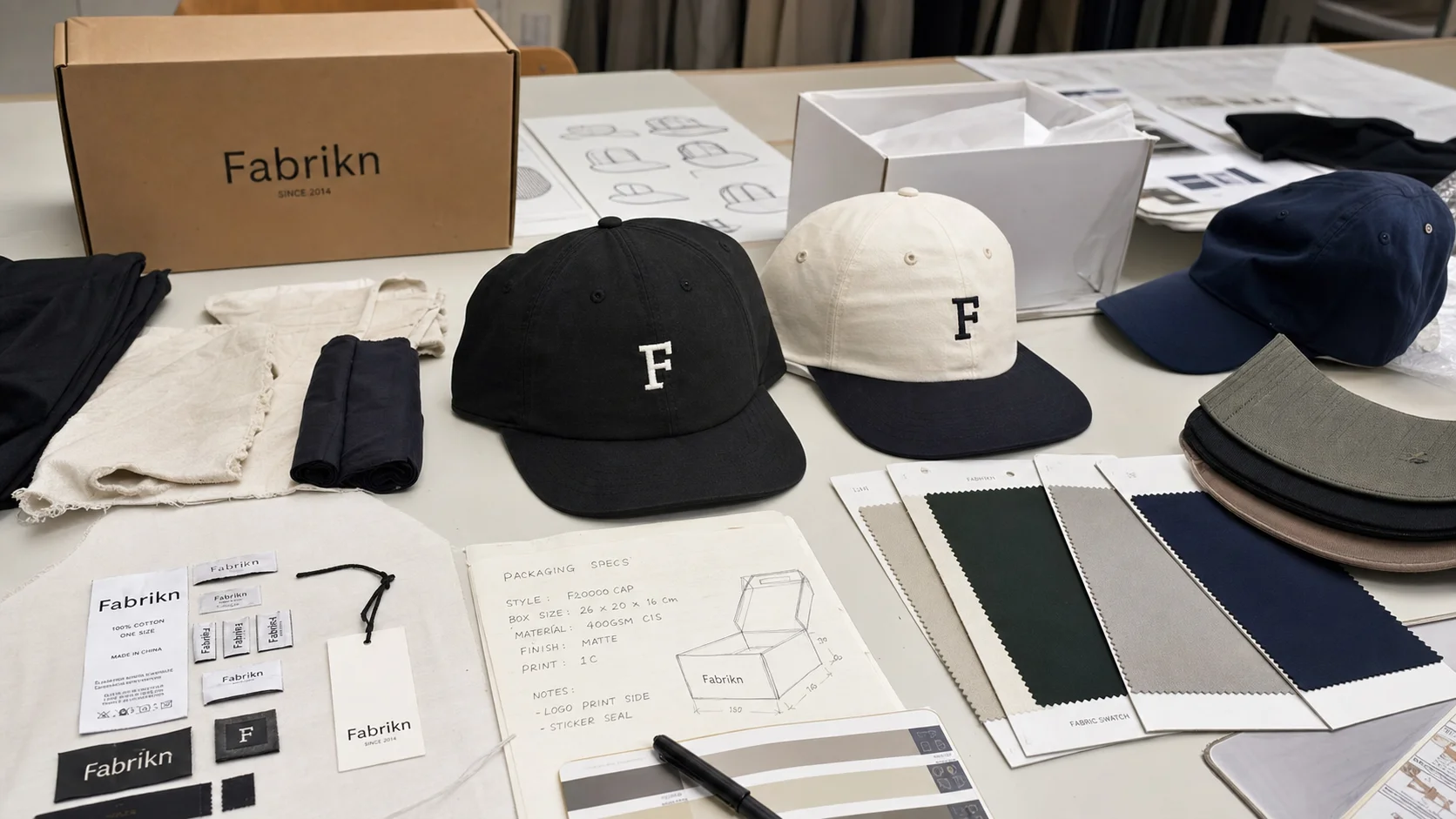
To Print on Clothing Box Inserts compared by sample evidence, fabric or trim specs, MOQ, AQL terms, cost lines, delivery timing, and rework responsibility.
Fast answer: To Print on Clothing Box Inserts: Tech Pack, Sample Gate, MOQ, and QC Terms should be judged by production evidence, not by a generic sourcing promise. The buyer needs sample proof, cost breakdowns, QC checkpoints, and delivery buffers in writing.
Ask for recent sample photos, measurement tolerances, fabric or print test assumptions, decoration test notes, packing examples, and a named inspection checkpoint. These details show whether the team can repeat an approved sample at bulk volume.
Separate garment cost, decoration, labels, packaging, sampling, testing, freight, and rush charges. Clear cost lines make it easier to reduce colorways, adjust size depth, or reserve more time for sampling.
A plain kraft mailer and a folded hoodie can feel forgettable—until the insert lands right. If you are figuring out what to print on clothing box inserts, the point is simple: turn an ordinary shipment into a repeat order opportunity.
I’ve watched that happen with a $68 hoodie more than once. The package looked anonymous, almost forgettable. The card changed the whole feel of the order. That is why brands still ask what to print on clothing box inserts: the insert gets one more shot at turning a first-time buyer into a second order.
In factory audits, insert campaigns have lifted repeat purchases by 6% to 14% over 30 to 60 days when the offer matched the customer’s first order. Smaller DTC brands make the lift easier to see because the sample is tighter: 500 to 2,000 orders, one QR code, one coupon code, one window. Clean test. Clean answer.
Premium brands and mass brands handle inserts in completely different ways. In Italy and Portugal, where I’ve visited luxury and bridge-price factories, the insert is usually a thin 250 gsm card with restrained copy and very little promotion. In Bangladesh or Vietnam, where volume labels rule, I see 300 to 400 gsm cards loaded with discount mechanics, referral codes, and expiry dates. Price point shapes the script, and the manufacturer, factory, and supplier all need to align on the same goal.
More ink does not mean more sales. I’ve seen one bold offer, a QR code, and a single proof point beat a crowded four-panel card with seven claims and three calls to action. The winning version was cheaper to print, easier to pack, and faster for customers to use. On factory floors, the quiet insert often wins because it asks for one response, not a seminar.
At 1,000 units a month, even a 3% lift in repeat orders matters. On a $40 average order value, that is not decoration. It is margin protection. Some labels treat inserts like filler; the smart ones treat them like a measurable channel, with code tracking, refund-aware math, and a 14-day redemption check.
Logo. Brand name. Website. Short positioning line. That core set should not change when deciding what to print on clothing box inserts.
I prefer that order because the eye wants hierarchy, not clutter. A customer should remember who sent the package in 3 seconds and verify the brand in 10.
Brand recall improves when the insert repeats the promise already implied by the packaging. If the box was plain, the insert has to do the identity work. If the packaging was already loud, the insert should sharpen the memory instead of fighting it. I’ve seen streetwear brands use a bold logo lockup with a five-word manifesto, while premium basics labels often do better with one line of product truth, such as “Heavyweight staples, made to last.”
Trust signals need numbers, not adjectives. “Responsibly made” tells me very little beside “62% recycled polyester, certified by Textile Exchange standards” or “15,000 orders shipped since 2021.” I’ve visited factories where the label copy sounded noble, but the paperwork would not survive an audit. Buyers are sharper now. They read, they scan, they compare.
If the category is activewear, use short lines, fast contrast, and one social proof metric such as “4.8/5 from 2,400 reviews.” Sustainable apparel needs the proof chain: fiber content, certification, disposal note. Premium babywear calls for a softer tone and hard facts. A line like “Made for 0-24 months, tested against ASTM requirements” can do more than a full paragraph of brand poetry. I also see smart pairing with custom baby clothing manufacturing because baby buyers care about safety, traceability, and softness in equal measure.
Clutter kills memory. A card with 6 messages, 4 icons, 2 QR codes, and a coupon expiring in 48 hours often reduces scan rates because nothing feels primary. One headline, one proof point, one next step. Enough. On a 90 mm x 55 mm card, brevity is not a limitation. It is the discipline.
Sales inserts work best when the offer is easy to read at a glance. Percentage-off codes tend to outperform fixed-amount discounts for higher baskets, while a $10 off offer often converts better for lower-ticket brands under $50. Free shipping can beat both when a brand’s delivery fee is visible, especially on repeat orders under 30 days. Loyalty points are strongest when the program already exists and the customer can see progress in a single scan.
I’ve seen referral rewards work best in the $120 to $250 basket range, where the buyer is willing to advocate for the brand if the reward feels concrete. A $15 referral credit with a 30-day expiry can outperform a 20% coupon for some outerwear labels because it creates a reason to return without devaluing the product. For a $30 tee brand, a 15% coupon plus free shipping minimum at $45 usually feels cleaner. For a $220 jacket, a fixed $25 credit can preserve margin better than a deep discount.
Review generation needs timing. The best moment is after delivery confirmation plus 5 to 10 days, not on the first unboxing, when the customer has not worn the item yet. The CTA should go to one page, not three. One tap to leave a review. One field to enter a code if the review is completed. If the insert asks for app download, newsletter opt-in, and social follow in the same breath, completion rates drop fast.
A weak insert loses value when it asks for too many actions. Ask for a review, or a repeat purchase, or a referral. Not all three in one card. I’ve seen brands add a 2-step flow with QR code plus email confirmation and watch the response rate fall by 40% compared with a simple landing page. The friction is the message.
For labels built around private label clothing services, inserts can also reinforce exclusivity without discounting the product. A line such as “Your first order was made in a 500-piece run” can create scarcity and trust. For brands producing technical prints, I often recommend using sublimation printing services language sparingly and only when it genuinely supports the garment story, not as filler on the card. If you are working with a wholesale or bulk program, this is where a clear custom offer matters most.
The strongest retention inserts usually pair a small incentive with a clear reason to come back. That means a code, a deadline, and one sentence explaining why the second order matters. “Replace your wash-worn basics within 60 days” reads sharper than “Stay connected with us.” Customers buy because the next step is obvious.
Hierarchy first. Headline. Proof point. Action. Secondary details last. If the card is 105 mm x 148 mm, the message has to survive a glance while the customer is pulling tissue paper off a garment. I’ve watched insert designs that looked perfect on screen fail in hand because the copy was too dense and the type too small.
Paper stock changes perception more than many founders expect. Coated stock gives sharper color and cleaner blacks, while uncoated paper feels more tactile and often suits sustainable labels better. Recycled stock can look premium if the fiber mix is controlled and the print contrast is strong. Single-sided printing is often enough for a QR-led insert. Double-sided printing helps only when the back carries useful content, not a duplicate logo.
QR codes need breathing room. I ask for at least 3 mm to 5 mm of clear white space around the code, a plain promise above it, and a destination page that loads cleanly on mobile in under 3 seconds. Data from the ISO standards ecosystem and common print QA practice point to the same truth: a code that looks elegant but scans poorly is wasted ink. The best QR call to action is specific, not clever.
Dense designs may look premium on a proof, but customers scan, not study. In one factory visit in Ho Chi Minh City, a 4-color insert with foil accents and a textured varnish looked expensive on press sheets, yet under retail lighting buyers missed the code because the contrast was too low. A simpler 2-color card, one bold line, and a high-contrast code performed better in live orders.
Brands selling into tailored categories, such as outerwear or accessories, often pair inserts with packaging from custom hat manufacturing because both rely on the same rule: one strong visual, one clean action. If the insert can be understood in 2 seconds, it is probably close to right.
Simple one-color cards are the cheapest starting point. At 1,000 units, I’ve seen pricing land around $0.08 to $0.18 per piece depending on paper and region. Full-color postcards at the same volume usually run $0.14 to $0.32. Folded inserts add labor and can move to $0.22 to $0.45. Premium belly bands and specialty sleeves can start at $0.40 and climb past $0.90 when die-cuts, foil, or embossing enter the job.
Run size changes the math fast. At 500 pieces, the unit price is often ugly because setup costs get divided across fewer cards. At 10,000 pieces, the print cost falls, but storage, sequencing, and kitting become the problem. I’ve seen brands save $180 on print and spend $300 more on warehouse handling because the inserts arrived too early and filled a shelf for 6 weeks.
Turnaround depends on more than the printer’s promise. Artwork approval can take 1 to 3 days. Print method adds time: digital is often faster for short runs, while offset makes sense above 2,000 to 3,000 pieces. Paper availability can add 4 to 7 days if a particular recycled sheet is out of stock. Die-cutting adds 1 to 2 days. Kitting into boxes may add another 2 to 5 days if the fulfillment line is busy.
The cheapest insert can become the most expensive if it performs badly. I’ve seen a $0.09 card with a vague message generate almost no redemption, then require a reprint, a second pack-out, and a customer service apology. A $0.24 card with one clear offer and a 15-day expiry produced enough redemptions to pay for itself. Cost is not the print invoice alone. It is the result.
For brands that sell through private label clothing services, the packaging decision should be aligned with margin structure, not vanity. A $20 basic tee cannot support the same insert complexity as a $180 coat. Yet even modest programs can justify a stronger card if it improves repeat order rate by 2% or more. That is the threshold many founders ignore.
Sustainability language should be specific enough to survive scrutiny. Buyers expect numbers: recycled content percentage, FSC or equivalent paper certification, ink type, and disposal guidance. “Eco-friendly” tells me almost nothing. “100% FSC-certified paper, 30% post-consumer recycled fiber, soy-based ink” tells me a supplier has done some homework. If the insert is compostable only in industrial facilities, say so plainly.
Claims that cannot be proved should be removed. I’ve sat with factory managers who wanted to describe a card as carbon neutral while the production sheet listed no verified offset method. That sort of copy is risky and unnecessary. According to Textile Exchange guidance and common brand compliance practice, specificity beats vague virtue words every time. If you cannot document the number, do not print it.
Regional expectations vary. EU buyers tend to respond well to certification references and disposal instructions. UK buyers often want concise recycling notes and visible proof of responsible sourcing. US buyers are more responsive when the claim is linked to a QR page with supplier detail, testing, or certification PDFs. A transparent page can carry the nuance that a 100 mm card cannot. For exporters, this is especially important when sourcing from China or scaling production across multiple regions.
Recycled paper does not have to look cheap. I’ve seen it look better than virgin stock when the fiber variation is controlled and the print contrast is strong. The problem appears when the sheet is too grey, the black ink is too weak, or the white space is too busy. Good suppliers solve that in sampling, not in marketing copy.
For brands already using private label clothing services, the insert is a useful place to show proof of process rather than grand claims. A simple line about recycled packaging, one QR code to sourcing notes, and a recycling icon can satisfy most buyers without bloating the design. If you need additional compliance context, the OEKO-TEX® guidance pages are also a solid reference point.
Printers need exact inputs. Final dimensions, bleed, trim, color specs, font outlines, barcode rules, and insert count per box should all be in the brief before a quote is approved. I also send the intended use: thank-you note, coupon, review request, or sustainability note. That single sentence prevents a lot of expensive assumptions.
Ask for a proof that reflects production, not just a glossy digital mockup. A PDF can hide problems with black density, paper tone, and small text. A printed proof shows whether the QR code scans, whether the fold lands where expected, and whether the brand red still looks red on the selected stock. I have rejected runs over a 1 mm fold error because that kind of mistake compounds at scale.
Quality checks should include ink density, fold accuracy, paper weight, adhesive if relevant, and pack-out instructions. The last item matters more than people think. If the insert must face outward in the box, say so. If it should sit under tissue or be attached to hang tags, specify that. A printer cannot guess your unboxing choreography, especially when a factory or supplier is managing production at bulk volume.
Common failure points from audits are painfully consistent: mismatched codes, promo dates that expired before launch, and inserts printed in the wrong language for export orders. I’ve seen a 5,000-piece English run shipped into a French-speaking market because the approval sheet never listed the destination. One missed line in the brief can turn into a pallet of waste.
For brands scaling garment programs, this is the same discipline used in private label clothing services: clear specs, fewer surprises, and no assumptions. Your insert is a product. Treat it like one.
Start with one goal. Then choose the offer, choose the proof, and choose the format. That sequence keeps the card from turning into a scrapbook of good intentions. If the goal is repeat purchase, the insert should push a code or a reorder prompt. If the goal is reviews, the card should point to one scan and one action.
Test two versions before scaling. Run 500 to 1,000 units per version, then measure redemption, review rate, and repeat order rate over 30 to 60 days. Compare by channel, region, and price point if you have enough volume. A card that works at $45 AOV may fall flat at $180 AOV. The data will tell you where the message belongs.
Align copy with packaging budget and customer lifetime value, not just first-order margin. A 20-cent insert that lifts repeat orders by 4% can outperform a 5-cent card that nobody notices. I’ve seen brands over-optimize for print savings and under-invest in response. False economy.
Before approving the run, check this list: one goal, one CTA, one proof point, one code, correct dates, correct language, correct dimensions, and a destination page that loads fast on mobile. If those seven items are clean, the card is ready. If not, revise once and print once.
The best inserts are the ones customers do not have to decipher. Keep what to print on clothing box inserts focused, specific, and easy to scan, then measure the result like it matters—because it does.
Use your logo, website, a short positioning line, and one action such as a review link or a reorder code. Keep the message to one goal and one QR code so the customer can act in under 10 seconds.
Basic one-color cards often cost $0.08 to $0.18 each at 1,000 units, while full-color postcards are usually $0.14 to $0.32. Folded or specialty inserts can move above $0.40 depending on finish, die-cuts, and quantity.
Most runs take 5 to 12 business days after artwork approval, but paper availability, offset setup, and die-cutting can add time. If inserts are kitted into boxes, allow another 2 to 5 days.
Ask for a review after delivery plus 5 to 10 days, and send the customer to one mobile page with one step. A short incentive, like 10% off or free shipping on the next order, can help response rates.
You can only print claims you can document. If you mention recycled content, FSC paper, or certified ink, keep the numbers and certificates on file. Vague words like “eco-friendly” weaken trust and can create compliance risk.