
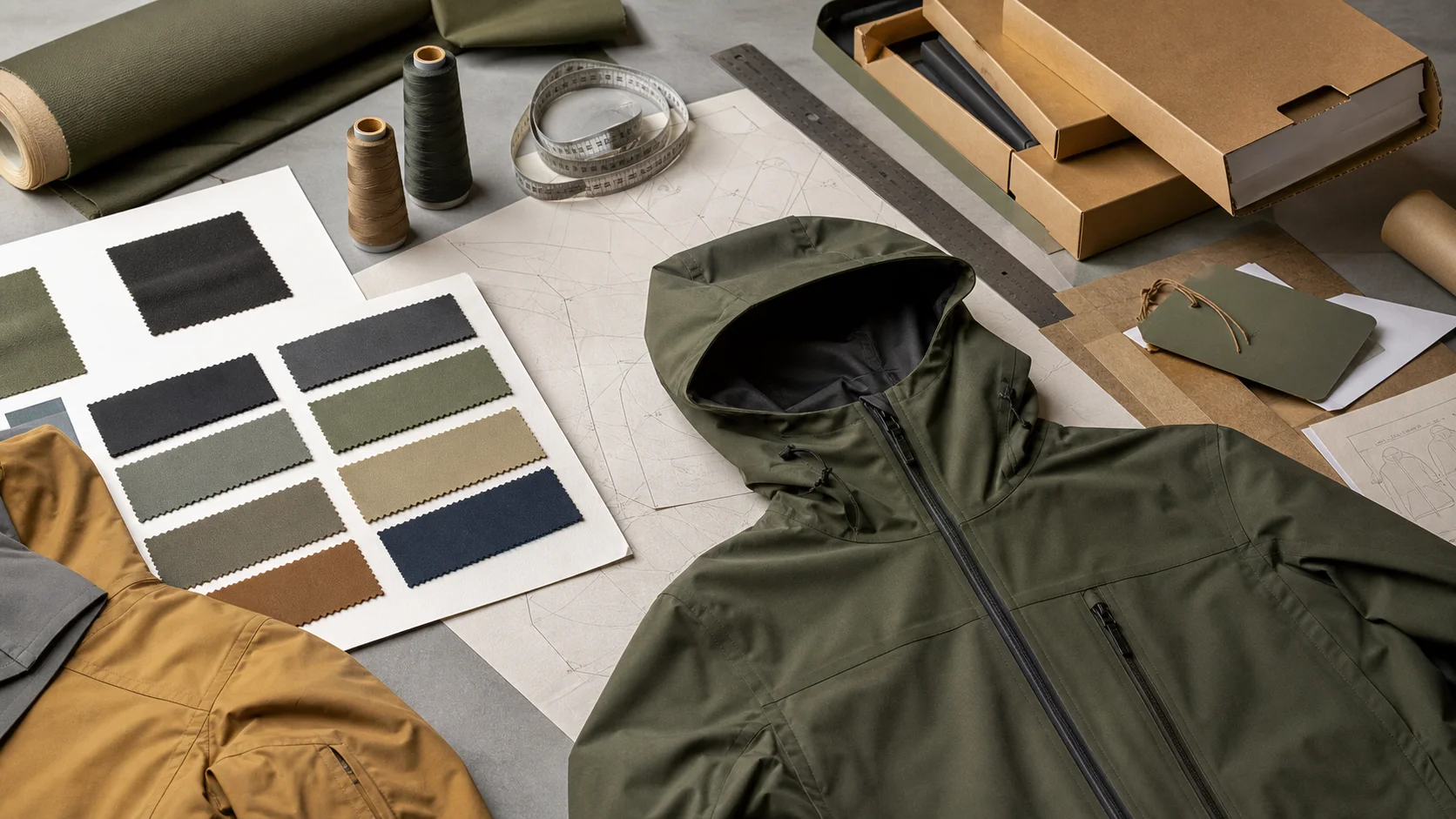
Branded Sticker Seals for Apparel Boxes with checks for samples, fit, MOQ, QC evidence, pricing terms, and delivery risk.
Fast answer: Branded Sticker Seals for Apparel Boxes: Cost, Uses, and ROI should be judged by production evidence, not by a generic sourcing promise. The buyer needs sample proof, cost breakdowns, QC checkpoints, and delivery buffers in writing.
Ask for recent sample photos, measurement tolerances, fabric or print test assumptions, decoration test notes, packing examples, and a named inspection checkpoint. These details show whether the team can repeat an approved sample at bulk volume.
Separate garment cost, decoration, labels, packaging, sampling, testing, freight, and rush charges. When every cost line is visible, it becomes easier to reduce colorways, adjust size depth, or reserve more time for sampling.
The first thing most customers notice is not the box. It’s the seal. That is why branded sticker seals for apparel boxes matter so much at first touch. I’ve watched brands spend $1.20 more per carton on rigid board and premium coatings, then sink the effect with a seal that curls in humid storage or lands 3 millimeters short of the flap. That mismatch shows immediately.
It says the packaging plan got approved in a meeting and never met a packing table. Shipping labels are functional. Seals feel personal. Clean closure, sharp logo, intact adhesive — all of it can raise perceived value more than a carton upgrade that costs five times as much. In factories across Vietnam, Portugal, and India, the pattern kept repeating: premium DTC brands treated the seal like a signature, mid-market retailers used it to signal consistency, and discount labels leaned on it mostly as a closure.
Same object. Very different promise. And that promise matters because apparel gets judged fast. A customer opens a $48 T-shirt order and a $220 coat order in the same apartment, on the same day, under the same light. If the seal lifts cleanly and the box opens without tearing, the brand looks deliberate. If the sticker peels, the box looks old before the garment is even touched.
I’ve seen a $2.50 seal rescue a plain kraft mailer and a $6 carton fail because the lid flaps buckled after the first shipment. Factory floors reveal what marketing decks skip. Many programs fail not because the print looks bad, but because the fit is wrong. The seal arrives 2 mm too narrow, the adhesive softens after 48 hours in humid storage, or the release liner slows packers by 6 to 8 seconds per box.
Real cost. Real friction. That’s why branded sticker seals for apparel boxes should be treated as decoration and operational control at the same time. They can reduce casual returns, support tamper evidence, and nudge repeat purchase behavior when the customer remembers a box that felt properly finished.
According to ISO, packaging performance is judged through transport and storage conditions, not only appearance. In apparel, that distinction matters. A 500-piece pilot run can pass through 3 climates before it reaches a customer.
A seal has four jobs: close the flap, signal tamper evidence, reinforce brand recognition, and carry seasonal or campaign messaging. Once a box leaves the packing station, the seal keeps working long after the carton has left the building. I’ve watched operators in Los Angeles and Shenzhen pack 120 to 180 boxes per hour, and the gap between a centered seal and a fussy one shows up in missed placements, rework, and complaints from warehouse leads.
Rigid apparel boxes, fold-up mailers, folded cartons, gift packaging — each one changes the logic. A rigid lid often takes a wider seal because the seam is flat. A mailer box can handle a smaller strip because the flap tension is tighter. Gift packaging may call for a round or oval mark that reads like a finishing detail instead of a warning. The goal is not decoration alone. The goal is closure that looks intentional.
Shape and peel strength affect line speed. A 40 mm x 120 mm strip can be easier to place than a large die-cut badge, even when the badge photographs better. Here’s what most people miss: larger seals can slow packing more than they improve perceived luxury if workers need to reposition them after the first placement misses the seam by 2 or 3 millimeters. I’ve seen one brand lose 11 minutes per 1,000 boxes because the art director approved a complex contour that needed two-hand alignment.
Common failure points are predictable. Coated paper can resist low-tack adhesive. Soft-touch lamination can create a slick surface that reduces grab. Recycled board fibers can shed dust. Winter shipments in cold-chain transit may make the adhesive brittle for the first 24 hours, then too aggressive once the carton reaches room temperature. Data from ASTM testing standards helps buyers specify peel, shear, and adhesion conditions instead of guessing from a sample sheet.
So branded sticker seals for apparel boxes are less like stickers and more like process control. When the seal fails, the box tells on the operation.
Paper-based stickers stay the easiest option for many apparel brands, especially when the box stock is kraft, uncoated white board, or recycled paperboard. They print well, cost less, and can be specified with FSC paper and water-based inks. I’ve sourced paper seals at $0.03 to $0.08 each in 10,000-piece runs, and they’re often enough for basics, denim, and seasonal capsules. The catch is durability. Paper scuffs faster, and the edge can lift if the carton face has too much dust or fiber bleed.
BOPP film changes the equation. It resists moisture, scratches, and the small abrasions that happen when cartons rub together in a fulfillment center. For activewear, swimwear, or anything shipped through damp warehouses, BOPP can be the safer choice. Vinyl is stronger still, though I rarely recommend it for apparel unless the brand needs extreme durability or ships through rough logistics channels. Compostable and recyclable alternatives have improved, but buyers should ask how the adhesive, liner, and inks affect end-of-life sorting. A material can sound responsible and still be difficult for municipal recovery systems.
Finishes should match the product and the price tag. Matte works well for minimal premium apparel, especially black, ivory, or tonal branding. Gloss reads louder and suits promotional drops, youth labels, and gift packaging. Foil adds flash, but it can crack on tight bends and may look inconsistent if the press run spans multiple days. Tactile emboss or soft-touch lamination can feel expensive in hand, yet I’ve seen both fail in transit when cartons slide against each other for 5 to 7 days across regional distribution routes.
Color accuracy shifts with finish too. A deep red on matte paper can mute by 8 to 12 percent in visual saturation compared with the same file on glossy film. That matters if your brand relies on exact shade consistency across 3,000-box replenishment runs. Last year I worked with a label using private label clothing packaging where the seal color matched the garment hangtag instead of the box. Small detail. Not really small. It cuts the feeling of random sourcing.
Sustainability claims need evidence. Recycled content, FSC certification, and water-based inks help, but they don’t erase the trade-off between visual impact and sorting simplicity. For brands that want to benchmark material claims, Textile Exchange provides useful guidance on preferred fibers and sourcing language at textileexchange.org, while OEKO-TEX explains chemical safety considerations at oeko-tex.com. Cleaner material mix means easier handling after use. Flashier seal, messier recovery.
Pricing changes sharply with volume. In my experience, 1,000 seals can cost 2x to 5x more per unit than 50,000 or 100,000 units because setup, plates, and proofing are spread over fewer pieces. A small digital run might land at $0.14 to $0.28 per seal, plus a $45 to $150 setup fee. A mid-tier flexo run at 10,000 to 25,000 units may fall to $0.05 to $0.11 per unit. At 100,000 units, premium paper or film seals can drop to $0.02 to $0.06 each, depending on size, finish, and adhesive.
Economy options usually use standard paper, one-color print, and a simple kiss-cut. Mid-tier programs add matte varnish, better die-cut accuracy, and more reliable adhesive. Premium options can include foil, custom shapes, and higher-grade liners. If the order needs a specialty adhesive for soft-touch cartons or cold storage, expect another $0.01 to $0.03 per piece. Design setup often runs $60 to $250, and plate fees for flexo can add $80 to $300. Digital proofing is cheaper upfront, though repeat color matching on large runs can increase rejection risk.
I’ve seen a $0.09 seal beat a $0.02 seal on total cost because it replaced a printed belly band costing $0.12 and cut a separate tissue wrap step. Higher unit cost, lower landed cost. That mattered at 20,000 units per month. It also reduced complaint emails about loose packaging by 18 percent over 2 cycles. When packaging trims labor and secondary materials, the sticker isn’t an ornament. It’s a line item that changes the math.
The operator warning is simple. A cheap quote can turn expensive after overruns, misprints, and color variation. One order of 30,000 seals swallowed 4,000 waste pieces because the PMS red drifted between proof and production. The $0.03 quote became a much higher landed cost. Good buyers ask for overrun tolerances — usually 3 to 8 percent — and ask who pays for reprints if the adhesive fails on the exact carton stock.
If production includes sewn apparel with higher trim standards, the packaging needs to match that discipline. A brand investing in cut and sew manufacturing shouldn’t send product out with packaging that looks improvised.
Good sourcing starts with blunt questions. Ask for adhesive performance on your exact carton stock, not on a generic white sample. Ask whether the manufacturer or supplier has tested coated paper, recycled board, soft-touch lamination, and dusty kraft. Ask for lead times in days, not promises. I want to hear 7 to 10 business days for digital samples, 2 to 4 weeks for production, and a direct answer on whether rush jobs add 15 percent or 35 percent.
Sampling should be physical. I never approve from a sticker swatch sheet alone. Put the seal on the real box, fold it, leave it in a hot room at 32°C for 48 hours, then open it by hand. That test finds curl, corner lift, and edge memory a screen render will never show. Compliance checks matter too. For cross-border orders, ask for recycled-content claims, ink safety documentation, and export paperwork that matches the destination market. Data from trade.gov helps with import documentation differences by region, especially when shipments pass through multiple customs gates.
Regional production patterns vary. Some digital vendors in Europe and North America can turn small runs in 5 to 8 days. Lower-cost flexo programs in parts of Asia, including China, may need 3 to 5 weeks but deliver better unit economics at 25,000 pieces and up. Neither model wins in every case. The right choice depends on urgency, MOQ, and how strict your color standards are.
Warning signs show up quickly on factory visits. Vague QC language. No peel-test data. No batch traceability. A supplier who can’t tell you which lot used which adhesive shouldn’t be trusted with a season launch. I also watch how samples are stored. If they’re stacked in a humid corner, the production room is telling you something honest.
For brands balancing packaging with garment development, supplier discipline in apparel is often the same discipline needed for custom bra manufacturing: precise specs, repeatable inputs, and no tolerance for improvisation. In short, branded sticker seals for apparel boxes should be audited with the same rigor you would use for any factory process.
Artwork should be built around the flap geometry, not a pretty flat mockup. A seal that looks centered on screen can drift 4 mm off-center once the carton is folded, and that’s enough to make a premium box look careless. I specify the actual seam width, the fold tolerance, and the hand-placement area before any creative rounds begin. If the seal needs to bridge a rigid lid and a side panel, the art has to respect the bend.
Typography should be legible at arm’s length, roughly 50 to 70 cm away. That usually means one logo element, one secondary line at most, and enough white space for the seal to breathe. Dark-on-dark branding fails more often than teams admit. I’ve seen beautiful navy seals disappear on charcoal cartons because the contrast ratio was too low under warehouse lighting.
Versioning keeps the system useful. Create a permanent brand seal, a campaign seal, a limited-edition seal, and a holiday seal. That gives marketing room without creating chaos on the line. File prep should include bleed, spot colors where needed, cut lines, and an approval checkpoint after the first proof and after the box fit test. Reprints cost more than the original order surprisingly often, especially when a 2,000-piece correction is needed for a 20,000-piece season.
Good packaging teams think in reuse, not novelty. A seal system that works across 4 box sizes and 2 closure styles saves hours of approvals. It also keeps the look coherent when the product mix changes. That matters if the line includes both apparel and accessory packs. It matters even more if the brand is scaling from small-batch drops into weekly replenishment.
Start with a 30-day rollout plan. Days 1 to 3: define box type, seam width, carton stock, and target finish. Days 4 to 7: choose material, shortlist 2 suppliers, and request samples on the actual carton. Days 8 to 14: test adhesion in normal room conditions, then in heat and humidity. Days 15 to 18: confirm artwork, die lines, and color targets. Days 19 to 24: place a pilot order of 500 to 5,000 units. Days 25 to 30: pack, ship, and measure.
Track the numbers that matter. Packing time per box. Seal failure rate. Damage or tamper complaints. Customer service mentions of packaging. I also watch how often staff need to reposition the sticker and whether the liner slows throughput. A premium seal shouldn’t reduce speed by more than 3 to 5 seconds per box. If it does, the design may be too ambitious for the operation.
Compare one premium version against one cost-efficient version before scaling. The premium option may use foil, a heavier face stock, or a custom shape. The cost-efficient option may use a simple matte paper seal with a strong adhesive. Choose the winner based on data, not taste. If your product line is growing and packaging needs to align with manufacturing, it can help to get a free quote and compare the packaging scope with the garment program in one conversation.
Use a simple decision matrix. Approve the seal if it passes adhesion, fits the box, keeps pack speed stable, and stays within budget after waste. Reject any supplier who can’t provide batch traceability, peel-test data, or a realistic lead time. That’s how branded sticker seals for apparel boxes move from nice detail to a dependable operating tool.
They close the box flap, show tamper evidence, and reinforce brand identity at first touch. Many brands also use them for seasonal messages or limited-edition drops. In practice, they can reduce loose-pack complaints and improve the unboxing experience.
Small digital runs often cost $0.14 to $0.28 per seal, while 10,000 to 25,000 unit flexo runs may fall to $0.05 to $0.11 each. At 100,000 units, costs can drop to $0.02 to $0.06 depending on stock and finish. Setup fees usually add $45 to $300.
Digital samples can take 5 to 10 business days. Production is commonly 2 to 4 weeks, while larger flexo runs may need 3 to 5 weeks. Rush orders often cost 15 percent to 35 percent more.
Yes, but you should test the adhesive on the exact recycled board first. Recycled fibers can shed dust and weaken grip, especially on uncoated kraft. A physical sample on the real box is the safest way to confirm performance.
Digital vendors usually handle faster small runs, often in 5 to 8 days, while flexo suppliers tend to offer better unit pricing on 25,000 pieces and up. Ask for peel-test data, batch traceability, and physical samples on your carton stock before placing an order.