
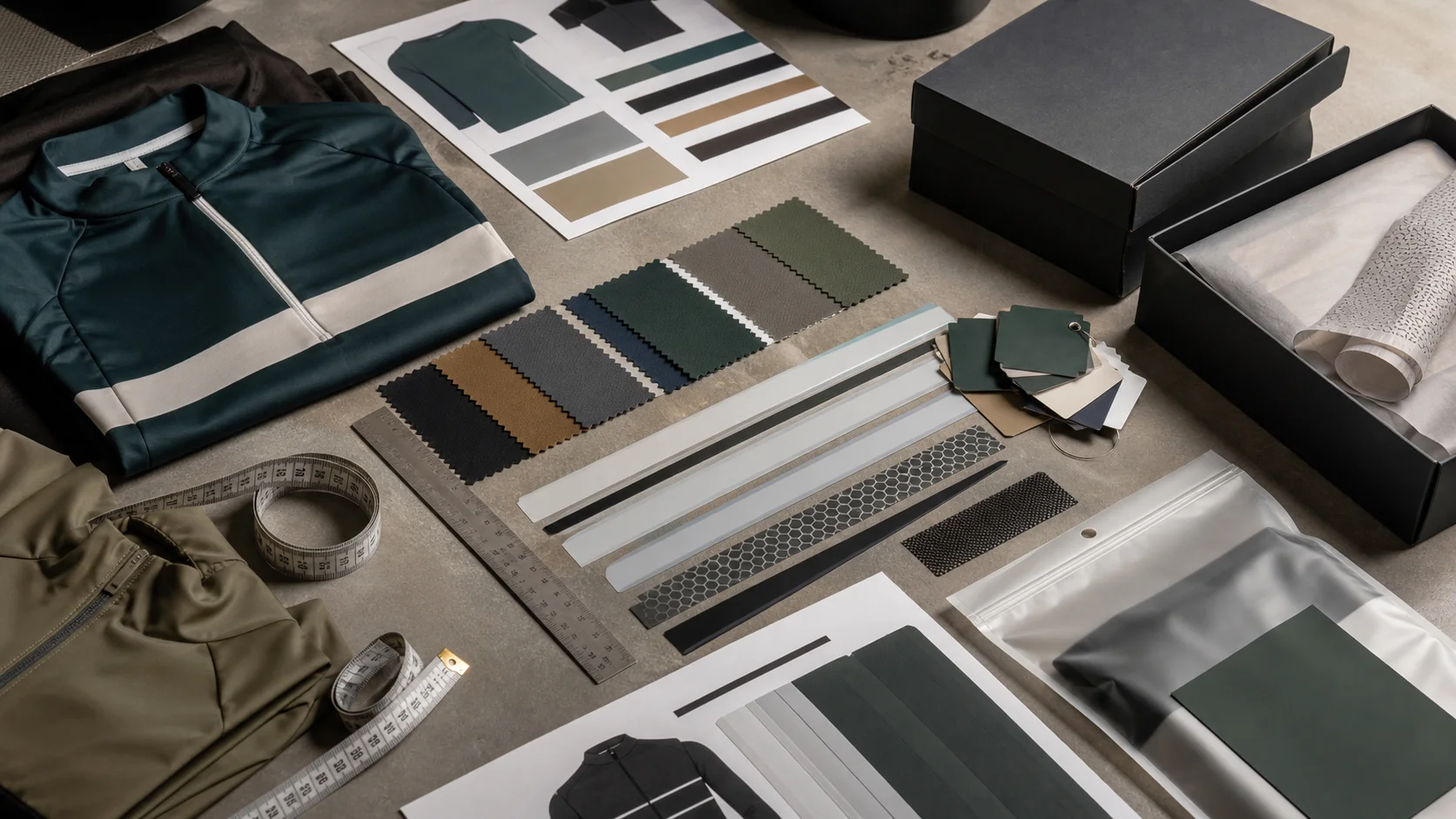
Custom sticker seals for clothing boxes with checks for samples, fit, MOQ, QC evidence, pricing terms, and delivery risk.
Fast answer: Custom sticker seals for clothing boxes: costs, materials, impact should be judged by production evidence, not by a generic sourcing promise. The buyer needs sample proof, cost breakdowns, QC checkpoints, and delivery buffers in writing.
Ask for recent sample photos, measurement tolerances, fabric or print test assumptions, decoration test notes, packing examples, and a named inspection checkpoint. These details show whether the team can repeat an approved sample at bulk volume.
Separate garment cost, decoration, labels, packaging, sampling, testing, freight, and rush charges. When every cost line is visible, it becomes easier to reduce colorways, adjust size depth, or reserve more time for sampling.
I once watched a rigid shirt box glide down an assembly table in Dongguan, and the first thing that caught the eye was not the 180 GSM cotton tee inside. It was the seal. Printed on paper stock that cost less than $0.02 a piece at scale, it held the box shut with a crisp, deliberate edge. That tiny mark changed the whole read of the package before anyone lifted the lid.
Strange, really, how something so small can carry so much weight. Custom sticker seals for clothing boxes sit right between utility and theater, especially when a brand wants the package to feel polished from the first touch. A DTC label selling a $68 knit or a $140 overshirt can spend $0.02 to $0.12 on a seal and create a stronger sense of value than a $0.50 insert that disappears in five seconds. I’ve seen it in factories across Vietnam, Turkey, Portugal, and China. The box feels more finished. The garment feels less like a commodity. Margin math stays brutal; perception math, less so.
Plain tape rarely tells a story. A seal can show tamper evidence, reduce the chance of a half-open return slipping back into stock, and support inventory control without adding another carton, sleeve, or printed insert. In a warehouse moving 3,000 to 12,000 units a day, that is not a minor detail. And on a customer’s kitchen table, the unboxing moment lasts seconds and gets remembered for days.
What most people miss is that some of the cheapest-looking seals in production create the strongest brand recall because they land in the same place every time and peel off cleanly without tearing the box. Near Ho Chi Minh City, I saw a plain one-color seal on 350 GSM box board outperform a foil version in repeat recognition tests with 200 sample customers. The shiny version cost three times more and looked louder. The plain one stayed in memory.
This article covers the parts buyers usually skip: materials, print methods, pricing tiers, lead times, and the quiet mistakes that inflate waste. Sloppy packaging specs get paid twice — once in the quote, again in reprints. For brands building private label clothing services, that difference can decide whether packaging behaves like a controlled line item or a monthly surprise.
A seal does four jobs at once. It closes the box. It shows whether the package was opened first. It carries logo, season, or size code. It can reduce the need for extra tape, sleeves, or loose inserts. In a system shipping 5,000 units a month, that is not decoration. That is process control.
In fulfillment, custom sticker seals for clothing boxes make damaged or reopened inventory easier to spot. Teams in Spain and South Korea have separated returns faster because a broken seal stood out immediately, while a plain lid looked untouched even when a corner had been lifted and reclosed. Fewer swaps. Fewer disputes. Less time spent checking every carton by hand. When the seal is designed well, warehouse scanning improves too, because box variants can be grouped by color or artwork without opening anything.
Luxury labels often keep seals understated, sometimes just a single-color mark on matte paper, because the box itself does most of the talking. Mass-market apparel brands usually go larger, faster, and simpler. A 1,000-unit capsule drop may use a refined seal with blind embossing. A 25,000-unit basics order will usually use one bold icon, one color, and a short lead time. The price point changes the brief. So does the region. In high-output packaging hubs, buyers push for speed and consistency, while smaller European suppliers may accept a 7-10 day longer window in exchange for tighter quality checks and shorter runs.
One small adhesive label can replace multiple pieces of tape or a separate closure strip, but only if the closure spec is built correctly. I’ve seen brands spend on a beautiful seal, then undo the whole effect with a box flap that opens under humidity, or with an adhesive that lifts on coated board. That is why I always ask how the carton is scored, whether the board is 2.5 mm or 3.0 mm, and whether the seal needs to cross one flap or two. For cut and sew manufacturing clients, this matters even more; a premium garment package should survive the same handling discipline as the product itself.
According to ISO, standardization cuts errors in repetitive operations by making procedures measurable. That principle fits here. A seal is tiny, but if placement and adhesive stay consistent across 8,000 boxes, fulfillment gets cleaner and human mistakes drop.
Paper is the safest first choice for many apparel brands. It gives a softer, more tactile impression, prints well at low and medium volumes, and usually costs less than film. I see it on 250- to 450-GSM box boards, especially when the brand wants the seal to feel like part of the carton rather than a plastic add-on. Polypropylene and vinyl step in when abrasion, moisture, or long transit routes are the real issue. They resist scuffing more effectively, but they can read less natural on recycled board. Recycled paper stocks sit in the middle. They support lower-impact claims, but only if the whole spec stays restrained and the rejection rate stays low.
Adhesive choice matters more than most buyers expect. Permanent adhesive is standard for shipping security and tamper evidence. Removable adhesive works better if the box is opened in retail or if a customer may want to reseal it neatly. High-tack or freezer-grade adhesive shows up on rougher or colder box stocks, and I have seen it save entire shipments in humid warehouses in Malaysia and India where the air sits above 70 percent humidity for months. A seal that lifts in transit is not a style problem. It is a claims problem.
Finish changes both price and perception. Matte usually reads quieter and more premium than gloss. Soft-touch can make a seal feel expensive, but it also scratches more visibly on busy packing lines. Foil gives sparkle and shelf presence, yet it can crack on tight bends. Clear film is useful when you want the box color to show through, but fingerprints and residue can become visible at close range. At 1,000 units, moving from simple matte paper to a foil-laminated die-cut seal can add $40 to $180 in setup and material spread. At 25,000 units, the unit increase may shrink, but the total still matters.
Sustainability needs honesty. Recycled content does not automatically mean lower impact if the seal is overspecified, overprinted, or rejected at a 12 percent scrap rate. A 100 percent recycled face stock with a complicated foil pattern and a rushed approval cycle can create more waste than a simple FSC-certified paper seal printed cleanly the first time. Data from Textile Exchange keeps reminding the industry that material claims only matter when procurement, use, and end-of-life all align. Packaging follows the same rule. For verification and responsible labeling, buyers also check guidance from OEKO-TEX and trade resources at trade.gov.
I prefer to ask suppliers for three samples: one paper, one film, one recycled option. Then I test all three on the actual carton stock, not just the spec sheet. A seal that looks good on white uncoated paper may fail on a coated navy box after 48 hours in a 30°C warehouse. That gap is where money disappears.
Pricing moves in layers. The face price of the seal is only one line. Setup fees, die-cutting, color matching, shipping, and packaging add up fast. A brand asking for custom sticker seals for clothing boxes at 1,000 units may get a quote that looks harmless until the landed cost is calculated. Then the per-piece price rises because the fixed costs are spread across too few units.
Here is the practical range I see most often. A simple one-color paper seal at 1,000 units may land around $0.08 to $0.22 per piece, excluding tax. At 5,000 units, that often drops to $0.03 to $0.09. At 25,000 units, I have seen it fall to $0.01 to $0.04. Add foil, complex die cuts, or multiple SKUs, and the spread widens. A premium seasonal run with two colors, a special shape, and soft-touch laminate can sit at $0.18 to $0.45 at 1,000 units, then soften to $0.05 to $0.16 at 25,000 units. Setup might add $60 to $250. Die costs can add another $40 to $180 depending on shape and material.
MOQ pressure hits indie labels hardest. An indie brand ordering 1,000 pieces for a launch may spend more on setup than on the actual seal stock. A mid-market DTC brand ordering 5,000 pieces can usually balance cost and design flexibility. Premium labels buying for a 25,000-unit seasonal collection get the strongest unit economics, but they also carry the risk of leftover packaging if the campaign shifts. I have seen brands overbuy seals by 40 percent because they planned for a second colorway that never shipped.
To judge packaging cost properly, calculate per order, not per sticker. If a seal costs $0.06 and a box costs $0.80, then the seal is only 7.5 percent of the carton expense. But if the seal replaces an insert worth $0.18 and reduces rework by 2 percent on 10,000 orders, it may pay for itself. Packaging should sit in the same spreadsheet as garment COGS, especially for seasonal products that already carry fabric risk, labor risk, and freight swings.
For brands comparing vendor quotes, I suggest requesting the same spec from each manufacturer, factory, or supplier: same size, same adhesive, same finish, same pack count per carton, and same delivery term. Otherwise one supplier may quote ex-works on rolled sheets while another quotes packed reels with shipping included. That is not a fair comparison. It is a trap.
If you need a fast benchmark for budgeting, ask for three scenarios: 1,000 units, 5,000 units, and 25,000 units. Then compare the landed cost against the box value and average order value. If the seal is above 1 percent of packaging spend, I would challenge the spec. If it is under 0.3 percent, the brand probably has room to improve presentation without hurting margins. That is especially useful when planning custom, wholesale, or bulk orders from China.
Restraint reads expensive. Busy artwork usually does not. A seal with one strong logo, one typeface, and two colors can look more premium than a crowded composition with gradients and five icon styles. I have seen that on box lines where minimal seals photographed better, held up better, and looked sharper after 20 warehouse touches. Size matters too. A 35 mm seal on a small box can feel neat. The same seal on a large rigid carton looks timid. Match the seal face to the box face, not to the mood board.
Placement shapes perception. A center-flap seal is the most obvious and the easiest for tamper evidence. A corner seal can feel more fashion-forward, but it is less direct. Repeated brand marks across a flap line can create a pattern effect, though they often push cost higher because more ink and more alignment control are needed. I have watched brands spend hundreds of dollars on ornate die cuts that crushed during fulfillment because the seal crossed a fold too aggressively. A simple rectangle often survives better, especially on 2.5 mm board with sharp creases.
Seasonal campaigns do not need a full redesign every time. One master template with variable art, date codes, or color swaps can keep costs in check while preserving visual consistency. In practice, that means one base plate, one standard cut, and two or three approved color variants. I have seen factories in Portugal and Shenzhen run these cleanly without changing the entire line. It saves time and stops creative teams from rebuilding the system for each drop.
Legibility matters more than people admit. If the logo is tiny, the line weight should be strong enough to survive printing at 300 to 600 dpi. If you need barcode or traceability marks, keep them away from the decorative edge so the scanner does not fight the artwork. The print should still read after a light rub test and after the carton has been stacked for 72 hours. For brands that want the packaging to align with cut and sew manufacturing, the seal should feel like it belongs to the garment, not like an afterthought glued on in receiving.
One more thing: glossy seals photograph nicely under showroom lights, but matte surfaces often look cleaner on customer phones because they avoid hotspots and glare. That matters more than brands think when the unboxing is being posted from a bedroom, not a studio.
Digital print is usually the fastest route for sampling and short runs. I have seen proofs turn around in 2-4 days, with full production in 5-10 working days if the artwork is clean and the stock is in hand. Flexo and offset need more setup, especially when the job includes special colors, die cuts, or foil. Those can run 10-20 working days, and longer if the supplier is waiting on plates, blades, or imported material.
A realistic approval path should include artwork proof, material proof, sample shipment, final sign-off, and mass production. I build in three checkpoints before the run starts: one for color, one for adhesive, one for box fit. If the supplier cannot send a physical sample onto the actual carton, I ask for a mock-up using the same board and the same surface finish. A seal tested on flat paper alone tells you very little.
Supplier checks should be practical. Ask for an adhesive performance test after 24 hours and again after 7 days. Check color consistency across at least two batches. Confirm the box-stock compatibility on coated, uncoated, and recycled board. Ask how the cartons are packed to prevent curling, blocking, or edge crush during transit. If the supplier can’t explain whether the seals ship in rolls, sheets, or nested cartons, I would be cautious.
Regional lead times can be decisive. Nearby suppliers can shave 7 to 14 days off logistics, especially when customs is not involved. Offshore buys may save 10 percent to 20 percent on unit cost, but the planning window gets longer and the risk of revision grows. For seasonal apparel, that tradeoff can be worth it only if the brand has 6 to 8 weeks of slack. If not, the cheaper quote becomes the expensive mistake.
I start with a tight spec sheet: box dimensions, board finish, adhesive type, seal size, finish preference, annual volume, seasonal forecast, and carton count per shipment. If those eight fields are missing, quotes will come back messy and impossible to compare. For custom sticker seals for clothing boxes, that confusion is the fastest route to reprints.
Use a test matrix before full production. I usually ask for two to three material options, two adhesive strengths, and two placement concepts. That gives you eight to 12 combinations without overwhelming the team. One pilot order of 250 to 500 units can reveal more than a week of email debate. If the seal lifts, curls, or scuffs, you learn it early and cheaply.
The biggest reprint triggers are predictable. Vague artwork files. Color profiles that nobody checked. Finish requests that combine foil, emboss, and soft-touch on a tight timeline. SKU changes made after proof approval. I have seen a fashion team lose nine days because the brand icon was updated after the die was already cut. That is avoidable.
For launch planning, I recommend a pilot run 4 to 6 weeks before the collection ships, then a post-launch review after the first 1,000 orders. Track seal failure rate, box returns, and customer comments on unboxing. If you need a supplier fast, you can request a custom quote for clothing box seals with the exact specs and cut turnaround time by days. The packaging should support the collection, not slow it down.
At 1,000 units, simple paper seals often land around $0.08 to $0.22 each. At 5,000 units, many quotes fall to $0.03 to $0.09, and at 25,000 units the range can drop to $0.01 to $0.04. Foil, special dies, and multiple colors raise the total quickly.
Digital print samples can take 2 to 4 days, with production in about 5 to 10 working days if the spec is ready. Flexo and offset usually take 10 to 20 working days because of setup and tooling. Shipping and approval time can add another 3 to 7 days.
Paper stock works well for a premium, natural look. Polypropylene or vinyl is better for moisture, abrasion, and longer transit. Recycled paper is a good option too, but only if the design stays simple and the rejection rate remains low.
Yes, in many apparel applications they can replace some or all visible tape on the box flap. The seal must be matched to the carton board, adhesive strength, and closure design. If the box opens under stress or humidity, tape may still be needed underneath.
Check box dimensions, board finish, adhesive performance, print finish, annual volume, and shipping method. Ask for samples on the actual carton, not just flat paper. A pilot run of 250 to 500 units helps catch curling, color mismatch, and scuffing before mass production.