
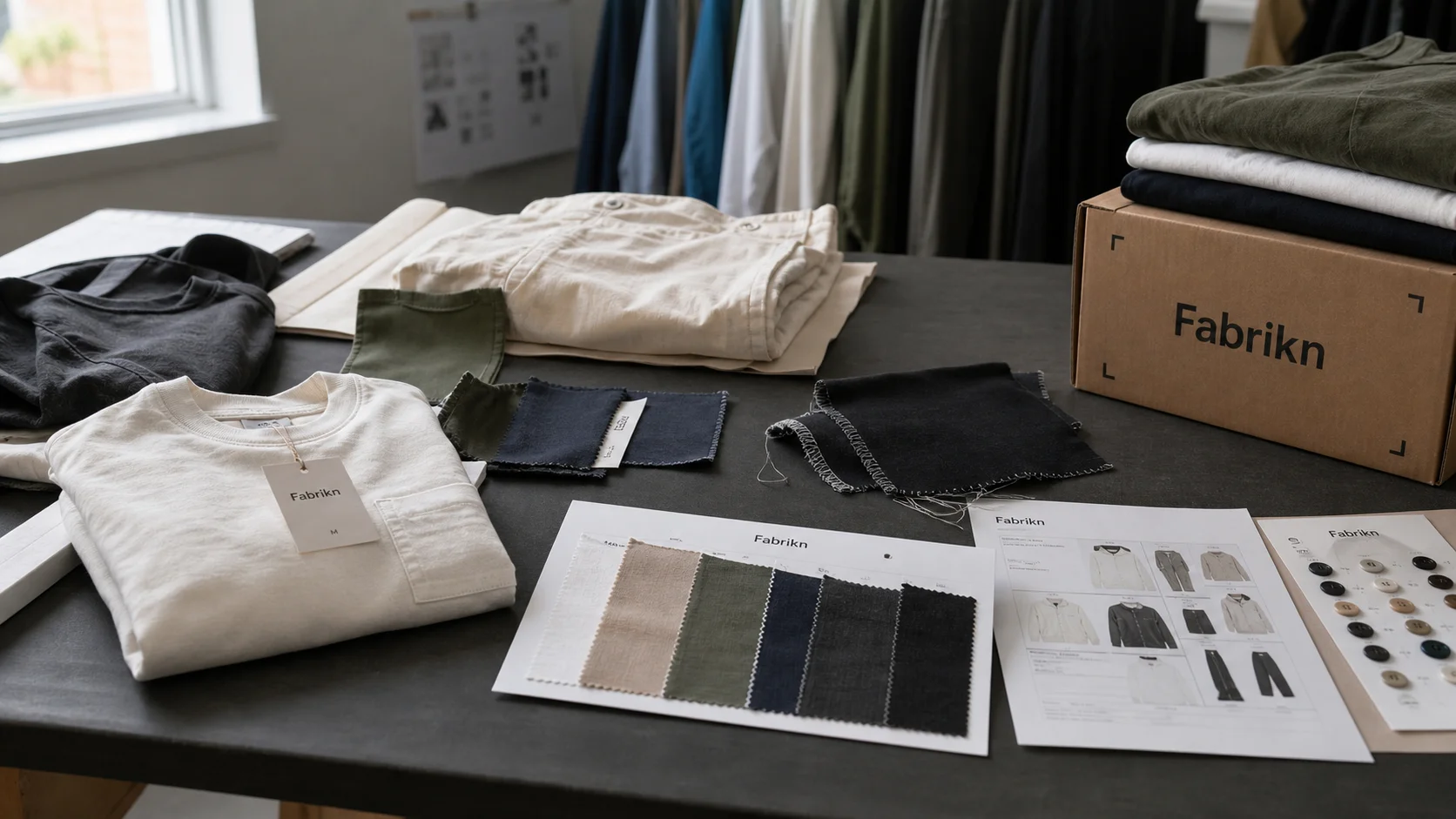
Clothing Launch Branded Boxes with checks for samples, fit, MOQ, QC evidence, pricing terms, and delivery risk.
Fast answer: Clothing Launch Branded Boxes: Cost, Timing, Inserts, and MOQ should be judged by production evidence, not by a generic sourcing promise. The buyer needs sample proof, cost breakdowns, QC checkpoints, and delivery buffers in writing.
Ask for recent sample photos, measurement tolerances, fabric or print test assumptions, decoration test notes, packing examples, and a named inspection checkpoint. These details show whether the team can repeat an approved sample at bulk volume.
Separate garment cost, decoration, labels, packaging, sampling, testing, freight, and rush charges. When every cost line is visible, it becomes easier to reduce colorways, adjust size depth, or reserve more time for sampling.
I have watched a $68 French terry hoodie lose its premium feel in seven seconds because the box arrived dented, oversized, and printed like a free sample carton. The garment was fine. The packaging was not. That mismatch matters more than founders want to admit, especially for custom branded boxes for clothing launches, where the customer has no prior trust and no store staff to bridge the gap.
Buyer behavior is brutally fast. Nielsen Norman Group has long shown that people scan rather than read, and package testing studies from retailers repeatedly show that the first touchpoint shapes price perception before the product itself does. In practice, I have seen consumers rank the same $42 tee as “mid-market” in a plain mailer, “worth more” in a rigid box, and “cheapened” in a box that looked large but held too much air. Across DTC sites, unboxing clips also travel farther than product images. A single clean reveal can pull 3,000 to 20,000 organic views on short-form platforms; a dull one rarely gets past the first swipe.
In wholesale, the stakes shift but the logic stays the same. Buyers at a 12-store boutique chain told me that packaging influences whether a line feels shelf-ready or return-prone. They see damaged corners, crushed lids, and awkward inserts as signals that the brand will also underdeliver on replenishment. I have seen a plain carton work for a $24 basic tee if the print, tissue, and fold are clean. I have also seen a rigid box fail a $180 shirt because the interior insert let the collar collapse during transit. The outer shell impressed the buyer; the inside told the truth.
Some higher-end brands overspend on box weight, choosing 1200 gsm rigid board and soft-touch lamination, while neglecting the insert geometry. A 2 mm foam-free insert that holds a folded knit at 110 mm high often does more for presentation than a heavier lid. During factory visits in Portugal and Vietnam, the strongest packaging programs were not the heaviest. They were the ones that held shape in a 3-4 week ocean lane and still opened cleanly after a 1.2 meter drop test.
Packaging spend is not vanity. It is a pricing signal. A $1.10 mailer can support an entry-level basics line if the brand story is simple and the product is tight on fit. A $3.80 printed rigid box can help a premium denim label justify a $148 jean, especially when top-stitching, wash treatment, and hardware already carry visual weight. At the luxury end, I have seen capsule collections use packaging worth 4% to 7% of COGS because the box becomes part of the collectible object. That sounds excessive until you compare it with markdown cost from weak perceived value.
New labels without retail placement need packaging to reduce buyer risk. Retailers do not know your return rate yet. Consumers do not know your fabric provenance, your pattern blocks, or your shrink performance. A strong box acts like a proxy for discipline. When I worked with a new label launching 900 units of ponte pants and woven shirts, the brand moved from a flat poly mailer to custom branded boxes for clothing launches with a printed carton and a 1-color insert, and saw repeat purchase rate rise from 18% to 24% over two drops. Social sharing also climbed. About 1 in 5 DTC buyers posted or sent a photo when the box had a coherent opening moment, versus roughly 1 in 12 for a generic shipper.
Regional expectations are not identical. North American DTC brands often chase the reveal, the tissue pull, and the branded card. European buyers I interviewed in Milan and Amsterdam wanted restraint. They favored kraft paper, low-ink printing, and visible material honesty over glossy spectacle. That preference is not anti-premium. It is anti-noise. A German buyer told me he would rather see an FSC board stamp and a crisp fold than a foil logo that chips in transit.
Damage rates also track packaging quality. For lightweight tees, a box that is too thin or too oversized can push corner crush rates from around 2% to 6% in parcel networks. For accessories, a sloppy insert can double the chance of scuffing. The gap seems small until you run 2,000 units and eat the rework cost on every damaged return.
Three structures dominate apparel launches: folding cartons, rigid boxes, and mailers. Folding cartons are light, efficient, and ideal for shirts, babywear, and small accessories. They usually run 250-350 gsm paperboard, ship flat, and print well at low unit cost. Rigid boxes use wrapped chipboard, often 1000-1500 gsm, and feel premium in-hand, but they cost more to make, more to ship, and more to store. Mailers sit in the middle. They protect better than a soft bag and often beat rigid boxes on freight efficiency by 20% to 40%.
According to Textile Exchange, material choices are increasingly judged through traceability and fiber origin, and packaging buyers should think the same way. FSC paper, recycled fiber, and plastic-free coatings are the baseline now, not the bonus. Water-based varnish is widely recyclable. Soft-touch lamination, glitter film, and heavy foil stamps complicate recovery and raise unit cost. Embossing is usually friendlier than lamination, but it adds tooling time and can raise scrap if the board grade is too soft.
Carbon is where aesthetics meets arithmetic. A heavier box can look luxurious while quietly increasing freight emissions. I have seen a 350 g rigid setup add nearly 18% to outbound parcel weight versus a flat mailer for the same sweatshirt. If the product itself ships at 550 g, packaging becomes the emissions story very quickly. The ISO approach to lifecycle thinking is useful here: test the system, not just the sample. A beautiful sample on a showroom table tells you almost nothing about how the box behaves inside a master carton with 24 units and two weeks of humidity swings.
From factory visits, the finishes that survive best are simple ones. A matte aqueous coat, a tight fold, and a well-measured insert outperform hot foil on the lid when cartons are stacked 8 high. Foil looks great in a sample room. In outer cartons, especially on routes with rough pallet handling, it can scuff within 400 to 600 kilometers of transport. I have watched brands spend on a metallic logo and then lose the effect because the lid rubbed against the insert. Better structure. Better board. Less theater.
Packaging costs swing hard with order size. For 500 units, a budget folding carton might land at $0.85 to $1.40 per unit before freight, while a rigid box can hit $3.20 to $6.50. At 2,000 units, the same carton often drops to $0.45 to $0.95, and the rigid box to $2.10 to $4.40. By 10,000 units, you may see cartons at $0.22 to $0.55 and rigid boxes at $1.25 to $2.80, depending on finish. These are not vanity numbers. They decide margin.
Here is a practical breakdown I use when brands ask for quotes on custom branded boxes for clothing launches:
Compare that with the product mix. A tee in a flat-pack mailer may only need a 300 gsm sleeve and a single-color print, so the packaging cost can stay under 3% of landed goods. A knitwear launch with folded sweaters, tissue, and a lift-off lid can justify 5% to 8%. Accessories are trickier. A belt, scarf, or bra set often needs inserts and tighter tolerances, especially for custom bra manufacturing, where shape retention matters more than outer branding.
When I worked on a 2,000-unit premium denim launch, the brand chose a rigid box priced at $3.75 each instead of a $1.10 mailer. On paper, it looked expensive. In practice, the rigid box cut damage claims from 4.8% to 1.6%, reduced repacking labor by 11 hours per week, and supported a $12 higher average selling price. The reverse happens too. A cheap box can cost more overall if dimensional weight jumps the shipping bill or if crushed corners trigger 150 returns on a 10,000-unit run. The box price is only one line on the invoice.
Standard lead time from brief to delivery usually runs 4-8 weeks for domestic production and 6-12 weeks for offshore production, not counting surprise delays. Artwork and structural design take 3-7 days if the team is responsive. Sampling often needs 5-10 days. Approval can take 2-5 days. Mass production ranges from 10-25 days for cartons and 15-30 days for rigid boxes, depending on finishes and queue length. Then comes transit. Ocean freight can add 2-6 weeks. Air freight is faster but punishing on cost.
Color matching is one of the most underestimated steps. Pantone references are not magic; paper stock, coating, and ink absorption all shift the result. A deep green on coated board can swing 8 to 12 Delta E points between sample and production if the supplier rushes the proof. Structural approval matters too. A lid that fits on a CAD file can fail once the board is cut, wrapped, and folded. Carton testing should include compression and drop checks, especially for shipping routes that use 12 to 16 handling touchpoints.
For seasonal launches, I advise brands to back-plan from the drop date. If you need boxes for a September release, the brief should land by early July for offshore work or mid-July for domestic. That gives you room for one revision cycle and a transit buffer. Rush orders can compress everything into 2-3 weeks only if the design is simple, the supplier has board in stock, and the finish is minimal. Foil, embossing, or custom inserts erase the advantage fast.
I have seen founders lose a launch because they approved artwork before confirming carton dimensions. The boxes arrived 20 mm too deep, the product shifted, and the retail photos had to be reshot. That kind of mistake costs more than the shipping delay. It hits calendar marketing, press seeding, and wholesale confidence at once.
A useful brief saves money immediately. Suppliers need garment dimensions, folded thickness, shipping method, target landed cost, print method, finish target, and the number of units per carton before they can quote accurately. If you are launching private label clothing, the box spec should also state whether the item is sold online, wholesale, or both, because the handling demands are different. I have seen quote variance shrink by 30% once brands stopped sending vague requests and started sending actual measurements.
Your packaging brief should include the board grade, closure style, insert requirement, and expected moisture exposure. If the product is knitwear, say so. If it is structured tailoring, say so again. A cotton poplin shirt and a 320 GSM French terry hoodie do not need the same cavity. If the brand also sells intimate apparel through custom baby clothing manufacturing or private label clothing, mention the full assortment, because one box system may need to handle several sizes without expensive retooling.
Common briefing mistakes are repetitive and expensive. Vague Pantone targets force reprints. Mismatched product dimensions force new inserts. Asking for “eco-friendly” without naming FSC, recycled content, or coating type invites a sales pitch instead of a quote. I also see founders forget the shipping method. A box designed for pallet freight often fails when it goes through parcel networks with automated sorters. If the item will be produced through cut and sew manufacturing, align the packaging brief with the final fold, not the sample room prototype.
Factories quote faster when you send one clean file packet: dieline, artwork, product photos, target MOQ, and a sample approval deadline. Missing pieces slow everything down. Expect three to five extra email rounds and a slower price. Time is a cost line, even before production starts. If you are sourcing from a China factory or working with a wholesale supplier, ask for production photos, QC checkpoints, and an order-specific quality plan before you approve the run.
The smartest launch teams work in ten-day sprints. Day 1 to 2, define product dimensions, shipping method, and target landed cost. Day 3, request two or three samples with full spec sheets. Day 4 to 5, compare quotes against board grade, finish, insert design, and freight assumptions. Day 6, test transit with 1 meter drops and a 24-hour compression check. Day 7, tighten artwork. Day 8, approve the sample. Day 9 to 10, lock production and confirm the delivery buffer.
Red flags are easy to spot once you know them. If a supplier cannot explain coating choice, refuses structural testing, or sends quotes that swing by more than 25% without clear reasons, move on. A strong partner will talk about board strength, transit damage, and storage efficiency, not just print shine. For brands deciding between premium feel and sustainability, I usually favor the option that saves space, reduces defects, and still photographs well. That is the balance that survives the season.
For most launches, the winning box is not the fanciest one. It is the one that arrives flat, opens cleanly, protects the garment, and keeps unit economics intact. Start with the product, then the route, then the box. That order prevents expensive regrets. If you are comparing manufacturers, ask for sample photos, FSC documentation, and proof of production quality before you place a bulk order.
For 500 units, expect about $0.85 to $1.40 for a folding carton and $3.20 to $6.50 for a rigid box before freight. At 10,000 units, cartons often fall to $0.22 to $0.55 and rigid boxes to $1.25 to $2.80, depending on finish and insert design.
Domestic production usually takes 4-8 weeks from brief to delivery. Offshore runs often take 6-12 weeks, including transit. Rush orders can be done in 2-3 weeks only if the design is simple, the board is in stock, and finishes stay minimal.
Folding cartons suit tees, shirts, and babywear because they are light and flat-pack efficiently. Rigid boxes work better for premium capsules and accessories, while mailers are the most efficient for parcel shipping. FSC paper and recycled fiber are common baseline choices.
Yes. A properly sized box with a secure insert can lower damage claims from around 4% to under 2% on some apparel programs. Oversized boxes and thin board increase corner crush, while poor inserts let garments shift and crease in transit.
Compare defect rate, sample turnaround, MOQ flexibility, and documentation quality. Ask for dielines, Pantone references, test notes, and freight estimates that include dimensional weight. A supplier who cannot explain board grade or coating choice is usually a weak fit.