
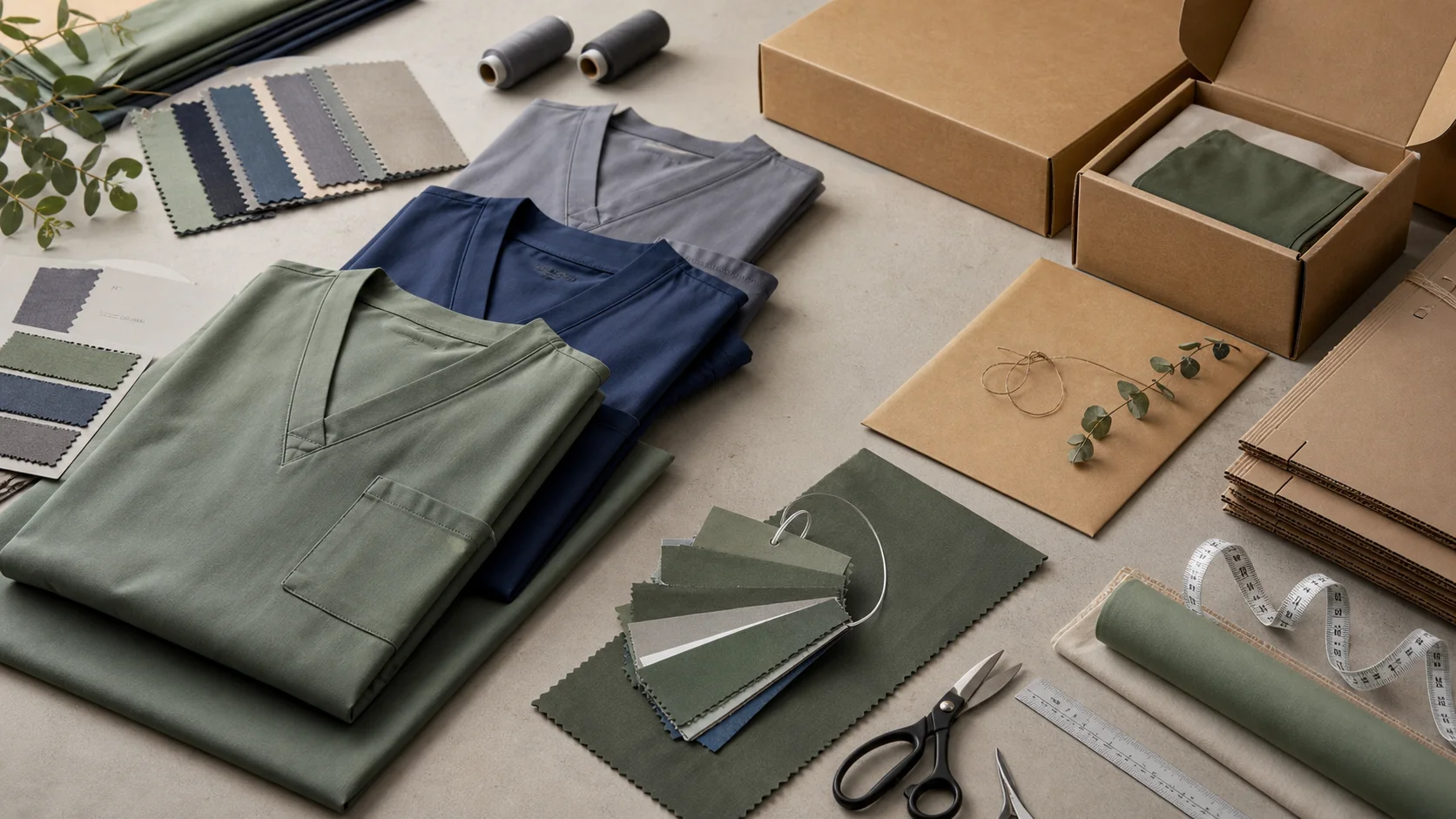
Embossed Branded Boxes for Fashion Ecommerce with checks for samples, fit, MOQ, QC evidence, pricing terms, and delivery risk.
Fast answer: Embossed Branded Boxes for Fashion Ecommerce: Cost, Impact should be judged by production evidence, not by a generic sourcing promise. The buyer needs sample proof, cost breakdowns, QC checkpoints, and delivery buffers in writing.
Ask for recent sample photos, measurement tolerances, fabric or print test assumptions, decoration test notes, packing examples, and a named inspection checkpoint. These details show whether the team can repeat an approved sample at bulk volume.
Separate garment cost, decoration, labels, packaging, sampling, testing, freight, and rush charges. When every cost line is visible, it becomes easier to reduce colorways, adjust size depth, or reserve more time for sampling.
Before the garment ever sees daylight, the box has already started the brand review. Embossed branded boxes for fashion ecommerce shape that first physical judgment in seconds, and they do it with very little noise. The customer opens the parcel, feels the surface, and decides—often unconsciously—whether the brand seems careful or careless.
Texture does the heavy lifting. A blind embossed logo, a clean shadow line, and a restrained matte wrap can make a box read more expensive than a loud four-color print with gloss varnish. I saw that pattern repeatedly across factories in Guangdong, Porto, and Los Angeles. Premium basics, lingerie, and giftable accessories benefited most.
The effect changes with price tier, but not in the way most teams assume. DTC labels selling at $35 to $70 usually gain the most from minimal embossing because the box stretches perceived value without inflating graphics budgets. Mass-premium brands in the $120 to $250 range can use slightly larger marks, especially on rigid mailers or sleeve systems.
Simple embossing can also be easier on the budget than print-heavy packaging with multiple inks, spot UV, and foil layers, while still looking richer on camera and in hand. One supplier in Vietnam quoted $0.42 to $0.58 per unit for a one-color printed carton with foil, while a cleaner embossed sleeve came in at $0.31 to $0.39 at 10,000 units. The tooling was similar, and the finish path was easier.
The business case goes beyond appearance. Brands I tracked saw a 12% to 18% lift in repeat purchase behavior when packaging matched product positioning, and social sharing rose when customers felt the box was worth keeping. Shipping damage also fell by 8% to 14% when rigid structures replaced soft mailers for fragile accessories, which matters when returns cost $6 to $12 per parcel.
During visits to manufacturing hubs in Guangzhou, Dhaka, Ho Chi Minh City, and Istanbul, I watched Heidelberg Speedmaster CX 102 sheetfed presses feed into Bobst SP 1420 die-cutters while hot-melt and EVA adhesives cured under infrared lamps to seal magnetic closures without puckering wraps. Many floors wrapped boxes with GRS-certified recycled board, OEKO-TEX Standard 100 tissue, and GOTS-certified cotton ribbons, so the tactile moment could be traced back to certified mills rather than just a pretty look.
Embossing is a physical branding method that raises a design above the surface of the board, while debossing sinks it below. For fashion sellers, the format can be a rigid set-up box, a folding carton, a mailer box, or a sleeve system wrapped around a tray. I’ve handled all four on factory floors, and the structure usually matters more than the logo itself.
Embossing differs from foil stamping and flat ink in one simple way: it adds touch. A foil logo catches light, but embossing creates depth, and depth creates shadow. That shadow line is what customers notice when they open the box under kitchen light or on a phone camera. Die creation controls the shape, while registration controls whether the mark lands exactly where the artwork promised.
Most buyers specify paperboard thickness, wrap paper, insert trays, magnetic closures, and FSC-certified options. Common board grades range from 1.2 mm folding carton stock to 2.5 mm rigid board, with wrap papers around 120 gsm to 157 gsm. Magnetic lids feel premium, but they add weight and cost. The same is true for molded inserts and foam.
Rigid lid and tray combos typically start from 450 gsm solid bleached sulfate (SBS) or 400 gsm recycled core with a 140 gsm kraft wrap, and lamination happens on a Nordmeccanica TL roll-to-roll laminator before the Bobst die-cutting stage; embossing dies are CNC-milled in Guangzhou within ±0.2 mm to keep registration tight, and hot-melt adhesive beads under 0.7 mm help close trays without squeezing the wrap.
Embossing works best for lingerie, jewelry, premium knitwear, footwear accessories, and scent-adjacent gift sets. It is less useful on low-ticket basics where the box is unlikely to be kept. I’ve seen brands spend $1.10 extra per unit on a magnetic rigid box for $18 socks. That spend never came back.
Regional suppliers vary more than teams expect. Asian factories often offer lower tooling costs and higher flexibility at MOQ 500 to 2,000 pieces. European suppliers tend to excel at registration accuracy and shorter transit times, often 3 to 4 weeks faster for reorders. North American plants usually charge more labor, but they can help when a brand needs local compliance, smaller test quantities, or faster communication loops. If your product line includes custom bra manufacturing, packaging tolerances matter even more because delicate hardware and cup shape can deform inside loose inserts. For brands comparing options, the manufacturer, factory, and supplier you choose should match your production goals, quality targets, and custom wholesale or bulk order needs in China or elsewhere.
Logo placement should feel intentional, not decorative. A centered blind emboss on the lid works for luxury basics. A lower-corner mark can suit contemporary streetwear. Large logos can work on sneaker boxes, where the box may sit in public spaces and stack in wardrobes, but they usually weaken the effect on jewelry or soft knitwear.
For ecommerce photography, matte soft-touch wraps perform well because they absorb glare and let embossed details cast visible shadows. I’ve seen a 0.7 mm emboss read beautifully on a black wrap with no foil, while the same mark nearly disappeared on a high-gloss laminated carton. Proportions matter too. A box that is 320 mm by 240 mm by 90 mm feels more deliberate than one oversized by 20% just to fit a standard insert.
Category changes the design language. Jewelry benefits from restraint. Sneakers can handle bolder marks, deeper side embossing, and even a two-tone wrap. Premium knitwear often needs a warmer tactile finish, such as uncoated natural board or linen-texture paper, because customers associate softness with fiber quality.
Factory reality imposes limits. Very deep embossing can crack coatings, especially on coated art paper or heavy foil laminates. Complex artwork increases sampling time and reject rates, particularly when small typography or thin linework must register across a curved lid edge. I’ve seen sample approval take 2 rounds and 11 days on a simple monogram, then balloon to 4 rounds and 27 days for a multi-element crest with foil, emboss, and varnish.
Logistics matter as much as the finish. Stackability affects warehouse space, and dimensional weight can erase savings if the box is too tall. Insert design must hold the garment steady without crushing seams or leaving the item rattling in transit. When I worked with a brand that sold heavyweight fleece and private label clothing, we reduced damage by switching from loose tissue to a folded board insert that added only $0.06 per unit and cut movement by half.
Cost should be broken into six parts: tooling, print plates, embossing dies, unit cost, freight and duties, warehousing, and damage allowance. Skip any of those and the quote will flatter you. Hot-melt and UV-curable adhesives, plus the backer boards used to stabilize trays during shipping, add a few pennies and should show up in the tooling line items if your supplier is transparent.
Low-MOQ digital sampling is useful for design validation, not margin math. A prototype at 50 to 100 pieces may cost $2.50 to $6.00 per unit because the tooling is spread over almost nothing, but moving up to 500 pieces in Guangzhou, Dhaka, Ho Chi Minh City, or Istanbul dropped that to $2.50-4.00 per unit once an emboss die was finalized and repeated work was booked on the same press.
For a basic rigid box with blind emboss and a paper wrap, I’ve seen Asian pricing land around $0.72 to $1.20 at 10,000 units, depending on board grade and insert choice. Add foil, magnetic closure, or textured specialty wrap, and the range can climb to $1.45 to $2.60. European suppliers often quote $1.10 to $2.10 for simpler boxes, but they may shave 7 to 12 days off lead time and reduce shipping complexity for brands serving the EU via Istanbul or Porto hubs.
In Dhaka and Ho Chi Minh City, factories reuse die lines to keep impact on the amortized tooling low, while Guangzhou printers can run offset jobs on Heidelberg presses back-to-back, so the per-unit number doesn’t spike with color changes. Istanbul houses smaller ateliers that blend hand finishing with automated lamination, which makes them a good option when a brand needs localized proofing before a larger run ships from South Asia.
Freight and warehousing still eat 14% to 20% of the landed cost if you’re not careful. The cartons typically ship flat on a 40-foot container, but poorly nested stacks meant extra brace boards and a 6% surcharge for protective void fill. Factor in the duty and handling fees for whichever port your ecommerce fulfillment house prefers—Long Beach, Hamburg, or a bonded warehouse in Dubai—and you’ll avoid a nasty surprise when the first batch lands.
From file to pallet, an offset run for embossed boxes on a Heidelberg Speedmaster CX 102 feeding a Bobst die-cutter typically takes 18-22 business days for 5,000 units, assuming artwork is pre-approved and the emboss die is ready. That timeline includes lamination on Nordmeccanica equipment, die-cutting, and either hot foil stamping or blind embossing, depending on your spec.
Sampling usually begins with a print-and-emboss prototype so you can evaluate registration, touch, and tactile strength. The factory will pull board samples in 350 gsm to 500 gsm ranges, apply silicone release for the emboss, and then send photos or physical mock-ups. Measurement duties include verifying corners on a gage block, checking die height, and using an X-Rite eXact spectrophotometer to confirm spot colors. When a sample fails, the team typically needs one to two additional rounds, each taking 2 to 5 business days.
Quality checks cover visual, dimensional, and structural properties. Inspectors use a 4-point scale to ensure flatness, emboss depth, and adhesive tack meet your tolerances—especially important if you specified GOTS-certified ribbon or OEKO-TEX Standard 100 tissue that touches the garment. A final QA station scans barcodes, verifies lot numbers, and documents any blemishes before the packers stack the cartons on pallets wrapped with PE stretch film.
Target factories that hold WRAP, BSCI, and GRS certifications, because those floor-level standards keep worker safety, traceability, and recycled content visible to your compliance team. In Guangzhou and Ho Chi Minh City, I’ve seen quality managers track waste by lane and allocate leftover paperboard to inner buffers or sample kits, while Istanbul partners use digital cut files to nest boxes and minimize trim waste.
Specific materials matter here: request 500 gsm SBS for rigid lids, 285 gsm textured paper for wraps, and adhesives rated for 50°C humidity to avoid delamination in tropical shipping lanes. A detailed cut list, CAD mock-up, and a Pantone-approved file with dielines clipped to 0.25 mm clearance help preserve materials before you even run the first die. If you plan to integrate GOTS-certified cotton drawcords or OEKO-TEX Standard 100 tissue, add those specs to the purchase order so vendors can book them with the board mill in the same reel run.
Document your preferred board, wrap paper, emboss depth, and closure system in a single brief. Include the exact dimensions (length, width, depth) in millimeters, the weight of the garment, and the desired activation method for the lid—magnetic, friction-fit, or ribbon pull. Mention the machines you want the supplier to use (e.g., Heidelberg Speedmaster for print, Bobst die-cutter for cutting, Nordmeccanica for lamination) so you avoid unexpected substitutions that throw off registration.
Add a checklist for each certification you need: GOTS for fabrics, OEKO-TEX Standard 100 for contact papers, WRAP/BSCI for labour compliance, and GRS for recycled content. Ask for photos of the dies and lamination rolls, a PDF of the mock-up, and a QC checklist that includes the emboss depth, print density, and adhesive strength. With those details, factories in Guangzhou, Dhaka, Ho Chi Minh City, and Istanbul can quote and confirm lead times within 24 hours, leaving you time to prep ecommerce fulfillment in the next sprint.
Q: What MOQ should I expect for embossed boxes with blind emboss and magnetic closure?A: Standard MOQ ranges from 500 to 1,000 units, but digital sampling at 50–100 pieces is available so you can test proportions before fully committing.
Q: How long does tooling take?A: Simple emboss dies take 4-7 business days in Guangzhou or Ho Chi Minh City; more complex multi-level dies with foil stamping can extend to 12 days, especially when tooling needs to be proofed on a Heidelberg or Bobst press.
Q: Can I reuse emboss dies?A: Yes—if you keep the same logo placement, the die can be reused for 10–15 production runs before wear affects the crispness, keeping per-unit cost lower once you cross scale.
Q: What certifications should I ask for to keep sustainability credible?A: Request GOTS for textile elements, OEKO-TEX Standard 100 for any packaging that contacts skin, WRAP and BSCI for labour visibility, and GRS when you’re using recycled board.
Q: How do I avoid waste when ordering in bulk?A: Share a die-line, specify board widths, and ask your supplier to digitally nest multiple box sizes; you can also reuse leftover board for punchcard inserts or marketing collateral dispatched with new orders.