
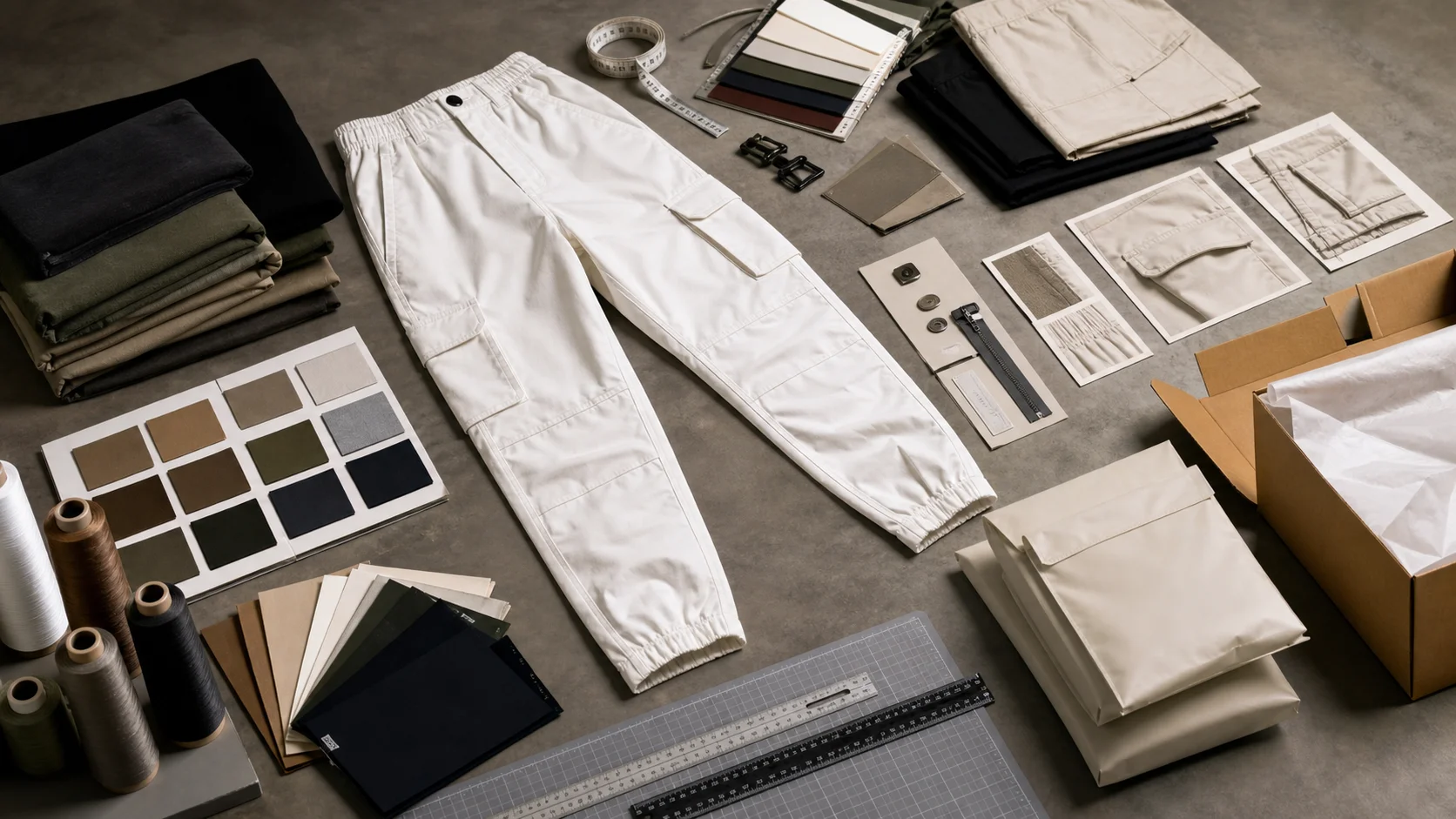
Embossed Premium Clothing Packaging with checks for samples, fit, MOQ, QC evidence, pricing terms, and delivery risk.
Fast answer: Embossed Premium Clothing Packaging: Board, Die, Finish, and Cost should be judged by production evidence, not by a generic sourcing promise. The buyer needs sample proof, cost breakdowns, QC checkpoints, and delivery buffers in writing.
Ask for recent sample photos, measurement tolerances, fabric or print test assumptions, decoration test notes, packing examples, and a named inspection checkpoint. These details show whether the team can repeat an approved sample at bulk volume.
Separate garment cost, decoration, labels, packaging, sampling, testing, freight, and rush charges. When every cost line is visible, it becomes easier to reduce colorways, adjust size depth, or reserve more time for sampling.
Three seconds. That’s all a package gets before a shopper decides whether it feels worth a second look. In audits across London, Los Angeles, Seoul, and Milan, embossed clothing packaging for premium brands kept winning that first glance before anyone touched the garment. On shelf, in a unboxing video, or flattened into a product-page image, the package often speaks first.
I’ve seen it at $38 and at $380. Lower-priced premium lines need proof they belong; higher-priced ones need restraint, not spectacle. Embossing gives both a tactile signal that reads as effort, calibration, and cost. Buyers don’t sit there counting finish layers. They notice weight, depth, and whether the edge looks clean.
After more than 200 factory visits, a regional pattern kept repeating. North America leans toward heavier rigid boxes, usually 1.5-2.0 mm greyboard, because mass still reads as value. Germany and the Nordics often go the other way: FSC paperboard, 350-450 gsm, blind embossing, and very little else. Tokyo and Seoul are trickier. A 0.8-1.2 mm emboss on uncoated stock can feel more premium there than foil-heavy decoration that looks crowded from arm’s length.
Quiet embossing beats shiny treatment more often than brands expect. In visual merch tests, shoppers called foil boxes “trying too hard,” while a plain debossed logo on a matte sleeve pushed price perception higher. The emboss cost only $0.12-$0.28 more per unit in those runs. Full foil added $0.35-$0.70 and, oddly enough, looked cheaper.
When I visited a manufacturer and supplier serving clothing packaging solutions, the strongest samples weren’t the loudest ones. They used form instead of decoration. That’s the useful bit: packaging is not wrapping paper. It’s a conversion tool, and for embossed clothing packaging for premium brands, the first impression has to do real work.
Embossed clothing packaging for premium brands starts with the dieline. That file decides more than most brands realize. A box for a folded knit set, a bra set from custom bra manufacturing, or a baby bodysuit from custom baby clothing manufacturing each needs different board strength, insert geometry, and closure tolerance. If the dieline is off by even 1-2 mm, the emboss can drift or the lid can bow.
Once the dieline is approved, pre-press begins. Printers test substrate thickness, fiber direction, ink holdout, and the intended relief. Paperboard, greyboard, kraft, FSC-certified stock, and coated papers all react differently under pressure. Greyboard around 1200-1800 gsm takes deep embossing well. Coated stock at 250-350 gsm can flatten the detail unless the die is calibrated with care.
The machinery is simple and unforgiving. A metal die gets machined to the design, then mounted in a press with heat and pressure tuned to the substrate. Blind embossing raises the design without ink. Registered embossing lines up the raised form with printed artwork. Debossing pushes it inward. On a good line, the press is checked in 0.1-0.2 mm increments, because crisp and muddy can be separated by that much.
That’s where failures show up. Crushed fibers make the mark look tired. Misalignment between print and relief sends logos drifting. Shallow emboss loses impact under retail lighting. On coated black stock, scuffing can appear in less than 24 hours if stacking is sloppy. I once saw a line of 10,000 sleeves rejected because humidity pushed the board from 8% moisture content to 12%, and the relief collapsed by nearly a third.
Factory-floor conditions matter more than many brands want to admit. High humidity softens fibers. Heavy ink coverage near the emboss area can crack. A 2 mm board from one mill may behave like 1.7 mm board from another. So samples should be tested in the same season, at the same temperature, with the same carton weight. Not theory. Visible. In production, consistency matters as much as the artwork.
Material choice decides whether embossing feels sharp or faint. Matte coated paperboard around 300-400 gsm gives a clean surface for detail, though a heavy coating can make it read a little too glossy. Soft-touch stock feels expensive in the hand, but it adds a polymer layer that complicates recycling. Uncoated stock, especially warm white or natural kraft, often gives the most honest texture. It also hides scuffs better during a 3-4 week shipping cycle.
Blind emboss on uncoated board has beaten foil in blind tests by 12-18 percentage points when shoppers were asked which package looked “most premium.” Not every market reacts the same way, but the pattern repeats enough to matter. A deep emboss on FSC board can signal confidence without the noise of spot UV and metallic accents. For brands selling at $45-$120, that restraint often reads as more expensive than piling on decoration.
Foil, spot UV, and embossing can work together, but only when each effect has a job. Foil adds shine and grabs attention. Spot UV creates contrast. Emboss adds tactility. Put all three on a narrow panel and the design starts fighting itself. I’ve seen brands spend $0.60-$1.20 per unit on mixed finishes that looked busier, not better, than a $0.18 blind emboss.
Sustainability complicates the finish debate. Plastic lamination protects against abrasion, but in many municipal systems it blocks straightforward recycling. Mixed-material constructions — rigid boxes with magnets, EVA inserts, laminated wraps — push disposal into the hard-to-sort pile. Water-based inks and FSC-certified board reduce the burden, but only if the package is designed as a single material stream from the start. According to OEKO-TEX, material transparency and reduced harmful substances still sit at the center of credible product claims, and packaging decisions are being judged with the same scrutiny.
Regional taste still matters. North America often prefers a heavier rigid box, usually 1.5 mm-2.0 mm board, because it sells premium fast. In parts of Europe, buyers want restraint, fewer coatings, visible recyclability. For intimate apparel, premium knitwear, or toddler basics, I usually recommend pairing embossing with one material family, not three. That fits well with private label clothing services, where brand consistency across categories matters as much as the garment itself.
Pricing shifts quickly once tooling enters the picture. For an entry premium run at 1,000 units, embossed clothing packaging for premium brands in the form of a folding carton or sleeve can land around $0.55-$1.10 per piece, depending on print method, board weight, and whether the emboss is blind or registered. Move into a luxury rigid box, and the range jumps to $2.40-$6.50 per unit at 1,000 pieces, with tooling often adding $300-$1,200 before production even begins. Limited-edition runs under 500 units can push per-unit costs above $8.00 when the design includes deep emboss, custom inserts, and specialty board.
The hidden costs usually stop being hidden as soon as you know where to look. Tooling can add $150-$800. A multi-stage print job adds setup charges of $120-$400. Emboss depth beyond 0.8 mm often needs a stronger die and slower press speed, which means more labor. Freight notices the weight too. A rigid box at 180-250 grams can cost 20%-35% more to ship than a folding carton at 40-70 grams, especially on air freight.
At 5,000 pieces, unit pricing usually softens. Entry premium cartons can drop to $0.30-$0.75 each. Luxury rigid boxes often settle around $1.50-$3.80. At 20,000 pieces, the same formats may fall to $0.18-$0.45 and $1.10-$2.90 respectively, assuming the artwork stays fixed between lots. Short runs hurt because you’re paying for setup, not just materials. Setup doesn’t care that the brand is small.
Domestic production usually costs more per unit, but it shortens lead time and speeds revisions. In the U.S. and parts of Western Europe, a 3-6 week turnaround is common for simpler embossed cartons. Offshore production in China, Vietnam, or India can cut unit cost by 15%-40%, yet lead times often stretch to 6-10 weeks once sampling, freight, and customs are included. I’ve seen brands save $0.22 per unit offshore and lose the margin in late air freight because the boxes missed launch.
What most people miss: a slightly simpler structure can cost less overall, even when the material grade is higher. A 350 gsm FSC carton with blind emboss may beat a laminated 1.5 mm rigid box on total landed cost because labor, freight, and packing efficiency all drop together. Smart brands compare the full bill, not just the print quote. For embossed clothing packaging for premium brands, wholesale and bulk orders only make sense when the design is stable enough to repeat.
Supplier evaluation should start with measurable checks, not sales decks. I ask for emboss depth consistency across 10 samples, print registration within 0.2-0.3 mm, color variance within a Delta E range the supplier can actually hold, corner crush resistance after stacking, and drop-test performance from 60-80 cm depending on route. If a vendor can’t show test data, that’s a warning sign.
Sample books tell part of the story. Pilot runs tell the rest. A factory can produce five immaculate mockups and still struggle with a 5,000-piece order if it lacks press discipline or folding accuracy. I review audit photos for the press line, the die storage area, the humidity controls, and the packing station. Apparel packaging suppliers often perform differently from cosmetics or spirits box makers because clothing cartons need faster assembly and higher dimensional tolerance, not just visual polish.
Communication speed matters more than many procurement teams admit. If a supplier takes 3 days to answer a correction on a dieline, they won’t suddenly become fast after PO approval. I also look at revision tolerance. A good factory will accept 2-3 sample rounds without drama and will own the tooling file instead of trapping it inside a chain of informal promises. That ownership protects the brand when a reprint is needed 8 weeks later.
The most polished sample room is not always the most reliable production floor. I’ve walked through immaculate reception areas with spotless shelves, then found uneven die pressure, worn platen pads, and no calibrated humidity log in the back room. Meanwhile, a less glamorous plant with plain offices and basic furniture sometimes had the best defect rate because the operators tracked every press run and rechecked boards every 30 minutes. That is why a real factory audit matters more than brochure language.
If you are sourcing in China, ask about tooling maintenance, press calibration, and in-line inspection frequency before discussing price alone. A strong supplier should be able to quote MOQ, suggest a practical custom structure, and explain how quality holds from sample to mass production.
Embossing does not automatically make packaging unsustainable. A raised logo on FSC-certified board with water-based ink and no lamination can be recycled in many curbside systems. Problems begin when embossing gets paired with plastic film, magnetic closures, foams, or multiple glued layers that turn one box into six waste streams. The design choice matters more than the effect itself.
Mono-material structures are the safest route. A single paperboard family, ideally 300-500 gsm for cartons or certified greyboard for rigid formats, is easier to sort and reuse. I’ve seen brands cut packaging weight by 18%-27% by switching from laminated rigid boxes to well-designed folding cartons with a sleeve. That reduced material use without making the product look cheap.
According to Textile Exchange, buyers are increasingly pressure-testing sustainability claims across the apparel supply chain, and packaging is now part of that scrutiny. Real reduction shows up in grams saved, material eliminated, and shipping volume lowered. Marketing language shows up in adjectives and leaves the carton untouched.
Retail teams still want presentation. Fair enough. But a 20% lighter package that still carries a crisp emboss often performs better with sustainability-minded consumers than a heavier box that merely looks expensive. If the choice is between a 200-gram rigid box and a 90-gram folding carton with a precise deboss, the lighter route is often the smarter one. For brands that need reassurance on claims, OEKO-TEX and Textile Exchange are useful references, while U.S. exporters should also review trade.gov guidance on shipping and market entry.
Start 10-14 weeks before launch, not 4. The sequence usually runs like this: concept and structural brief in week 1, dieline and artwork in week 2, sampling in weeks 3-4, tooling approval in week 5, pre-production in weeks 6-7, and mass manufacturing from weeks 8-10. Add 2-4 weeks if freight is ocean-bound or customs paperwork gets messy. Seasonal drops leave no room for improvisation.
Your artwork checklist should include dielines, vector logo files, Pantone targets, emboss map, substrate sample, and test quantities at 25, 50, and 100 units. I also ask for a packing spec that shows carton count per shipper, shipper weight, and pallet pattern. Those details reduce surprises at receiving. Brands that skip them usually pay later in rework or repacking.
Plan around your calendar, not the factory’s convenience. If your launch is in September, lock samples by late June, not mid-July. If the goods move by air freight, keep the box count low enough to avoid chargeable-weight creep. If they move by sea, allow at least 14 days for port delays and 7 days for local distribution. Apparel launches are won by boring discipline.
My simple decision framework has three routes. Choose route one, a lightweight embossed carton, if budget is tight and the brand wants clean presentation. Choose route two, a rigid box with restrained emboss, if the price point sits above $150 and unboxing is part of the promise. Choose route three, the most minimal FSC board with blind emboss, if sustainability is a selling point and the product already carries enough margin. For brands balancing categories, the same logic can be extended across clothing packaging solutions without redesigning the whole system each season.
It’s apparel packaging that uses raised or recessed surface detail to create a tactile brand cue. Common formats include folding cartons, sleeves, and rigid boxes with blind embossing or registered embossing. The effect is usually subtle, with emboss depth around 0.3-1.0 mm.
At 1,000 pieces, entry premium cartons often run $0.55-$1.10 each, while luxury rigid boxes can reach $2.40-$6.50. At 5,000 pieces, costs usually fall by 20%-40% depending on tooling, board weight, and print method. Limited runs under 500 units often cost the most per piece.
Simple cartons can take 3-6 weeks domestically and 6-10 weeks offshore once sampling, tooling, and freight are included. Rigid boxes or multi-finish designs often need an extra 1-2 weeks. Add more time if you require revised emboss dies or color matching across multiple SKUs.
Yes, if it uses one paper-based material stream, water-based inks, and no plastic lamination or mixed closures. FSC-certified board is a strong choice. Recycling becomes harder when the design includes foil-heavy wraps, magnets, EVA inserts, or soft-touch film.
Check emboss depth consistency, print registration, color variance, corner crush, and drop-test results. Ask for pilot runs, not only mockups, and confirm who owns the tooling files. If the supplier can’t share measurable QC data, that’s a clear reason to slow down the order.