
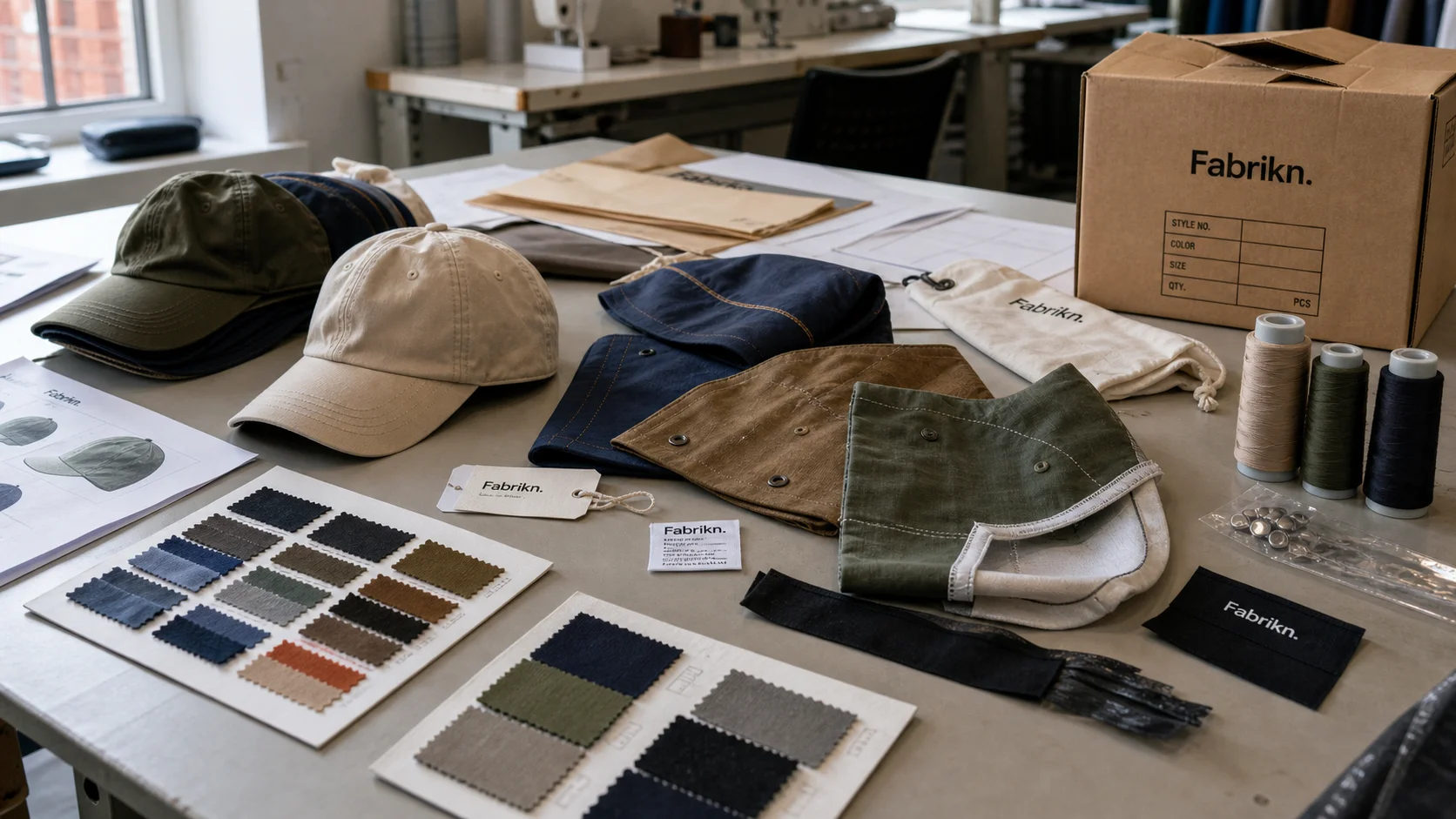
Retail Clothing Packaging Labels with checks for samples, fit, MOQ, QC evidence, pricing terms, and delivery risk.
Fast answer: Retail Clothing Packaging Labels: Barcode, Size, Country, and Care Text should be judged by production evidence, not by a generic sourcing promise. The buyer needs sample proof, cost breakdowns, QC checkpoints, and delivery buffers in writing.
Ask for recent sample photos, measurement tolerances, fabric or print test assumptions, decoration test notes, packing examples, and a named inspection checkpoint. These details show whether the team can repeat an approved sample at bulk volume.
Separate garment cost, decoration, labels, packaging, sampling, testing, freight, and rush charges. When every cost line is visible, it becomes easier to reduce colorways, adjust size depth, or reserve more time for sampling.
One wrong label can trigger a five-digit SKU mistake, a retailer chargeback, and a week of chaos on the packing line. If you are figuring out how to label clothing packaging for retail, design for the factory floor first and the presentation deck second. I watched a mixed-size run of 12,000 units go sideways because the outer polybag sticker carried the wrong color code. By the time anyone caught it, three pallets had already been sealed.
That is the part buyers do not see. Sample-room approval looks neat on paper, then the factory jumps from hand-packing 50 pieces to a line pushing 800 pieces a shift. Humidity sits at 28°C, the adhesive changes behavior, matte overprint kills barcode scans, and one worker drops the label 2 cm too low because the carton flap hides the guide mark.
In Dhaka and Ho Chi Minh City, I saw speed everywhere and control almost nowhere. Labels arrived in loose bundles, not counted by SKU, so a packer had to sort size stickers from a shared tray. Premium factories in Vietnam and Portugal were tidier, but they still missed a costly detail: they over-specified labels for every channel, then had to redo work when the retailer changed pack-out instructions 48 hours before ex-factory.
The sticker itself is not the real cost. A thermal label may run $0.02 to $0.05, while a reprint, relabel, and repack cycle can hit $0.18 to $0.45 per unit once labor, delay, and carton reopening are included. On a 20,000-piece order, that hurts. Department stores usually punish mislabels with fines and receiving delays. Marketplace orders can be worse — one bad carton mark can freeze the whole inbound appointment.
Factory workflow decides whether labels survive contact with production. Apply them after final pressing, and steam can weaken the adhesive. Apply them before folding, and the print may scuff. Put the barcode across a seam, and the scanner reads two values or none. I have watched factories fix this with nothing flashy: a placement jig, two sample scans at line start, and one supervisor assigned only to label verification. That discipline matters more than fancy artwork — or a higher price tier. A $180 blouse can be labeled badly, and a $12 tee can be labeled perfectly.
Retail buyers want a system, not a sticker pile. The cleanest programs run on three layers: product label, packaging label, and shipping or carton label. Each layer has a job, and each should be readable in two seconds or less.
Closest to the garment sits the product label. For clothing, that usually means style number, size, color, fiber content, country of origin, SKU, and care info where required. On the polybag, tissue wrap, belly band, hangtag packet, or mailer, the packaging label helps warehouse staff and store associates identify the unit without opening it. Carton labels serve receiving, replenishment, and traceability, so they need carton count, style, size run, PO number, and scannable barcode data.
Private label programs make that hierarchy even more important because the retailer often controls the content order. I have seen private label clothing lines fail a pre-pack audit because the color name was printed in marketing language first and the SKU second. The buyer wanted functional data up front, not branding poetry. If you work with private label clothing, assume the retailer’s template wins unless the spec sheet says otherwise.
Channel changes the content list. Department stores often want barcode readability, origin marking, and size code alignment with their EDI system. Direct-to-consumer brands need a clearer packaging label for pick-and-pack teams, especially when orders ship individually. Wholesale buyers care about carton marks, case pack counts, and whether the size ratio matches the POs. For babywear, the rules tighten fast because safety labeling, fabric content, and age-grade references may face stricter review; that is why I advise teams working on custom baby clothing manufacturing to keep a separate compliance checklist.
Clutter ruins good labels. A panel stuffed with 14 data points looks thorough, then fails in real packing because the barcode is too small or the text disappears into the layout. I use a simple hierarchy: style and size in the largest field, color and SKU next, then origin and fiber content, then care or legal text in the smallest approved type. That structure keeps how to label clothing packaging for retail readable and still satisfies buyers and compliance teams.
Build one master template for each garment family, not a new label for every season. That is how teams stay buyer-ready without rebuilding the file cabinet every six weeks.
US, EU, and UK rules overlap, but they do not match. The US leans hard on fiber content, origin, and care labeling; the EU and UK care more about fiber composition wording, multilingual needs, and where consumer information appears. Barcodes differ in practice too. North American apparel chains still rely heavily on UPC, while Europe uses EAN-13 or GS1 formats more broadly. According to ISO, identification standards exist to cut ambiguity, yet factories still stumble when teams mix internal SKU logic with retailer data structures.
Price point changes label behavior more than most brands admit. A $12 tee usually gets a basic polybag label, size sticker, and carton mark, printed in one pass with one color and one barcode. A $48 knit needs a cleaner finish: sharper typography, a tougher adhesive, and a pack label that survives folding without smudging. A $180 blouse often carries a hangtag set, tissue-wrap mark, origin label, and premium carton labeling. And even then, higher price does not guarantee better execution.
The thing nobody tells you: premium brands often waste more on rework than mid-market brands. I audited factories where luxury clients approved four label versions, then changed the shade name after SMS fit comments. Mid-market buyers were stricter upfront, locked templates in seven to 10 days, and saved 12% to 18% on relabeling labor across the season. Precision beats vanity.
Here is the comparison I use on site visits:
Multilingual labels are where teams underbudget first. Add French and German panels, and text often shrinks 1-2 mm and forces a second proof round. In the UK, buyers still expect clean country-of-origin marking and readable fiber claims. In the EU, the conversation usually shifts to translated care language and package disposal symbols. I have seen factories in Spain and Poland handle this better than cheaper suppliers because they work from a library of approved label shells instead of redrawing every order.
For cut-and-sew programs, label strategy starts before production, not after finishing. If your development process is tight, your packaging work should be tight too. That is one reason I ask factories to align label specs with cut and sew manufacturing schedules, not treat labels as a last-minute accessory.
Packaging material changes how a label behaves. Glossy film takes adhesive differently from uncoated paper, and recycled mailers often need a stronger tack than standard polybags. On a coated folding carton, a paper label can look sharp and sit flat. On a soft polybag or textured compostable mailer, the same paper may curl at the edges within 24 hours.
For short runs, digital printing is usually fastest. It handles 100 to 5,000 pieces well, with low setup cost and two- to five-day turnaround once artwork is approved. Thermal printing is cheap and efficient for variable data like carton marks, size tickets, and warehouse labels; cost can fall below $0.01 to $0.03 per print on high-volume lines. Flexographic printing makes sense at 20,000 pieces and up because plate setup is harder but unit cost drops, often landing near $0.005 to $0.02 depending on colors and substrate.
I see more failures from adhesive than from ink. Smudging usually comes from poor drying or a coating that does not match the print. Peeling shows up when the factory ships labels into humid conditions without enough tack. Barcode distortion can happen when glossy laminate throws back light or a low-resolution file gets enlarged past its limit. Label lift is common on cold-chain or humid transit routes, especially when cartons sit in storage for three to four weeks before retail receiving.
Specialty options are worth using deliberately, not as decoration. Tamper-evident labels fit certain premium goods and returns-sensitive ecommerce channels. Recycled paper stocks can support sustainability goals if the print contrast stays strong. Compostable materials sound appealing, but they still have to survive packing, transport, and shelf handling. Water-resistant films help when cartons cross ports in rainy seasons or sit in warm warehouses where condensation appears overnight.
For sustainability verification, many brands also review guidance from Textile Exchange before approving recycled content claims. I tell buyers to test three things before bulk release: adhesion after 24 hours, scannability from 30 cm, and edge lift after compression. If a label fails any one of those, the material spec is wrong, even when the art looks beautiful. Packaging labels are engineering decisions first.
Compliance errors usually start with a tiny assumption. Someone thinks a symbol is “standard,” or a claim is “obvious,” and then a retailer or customs reviewer asks for proof. I have seen shipments held because the fiber content line used a trade name instead of the legal fiber term, and I have seen cartons rejected because the barcode format did not match the warehouse system.
According to OEKO-TEX, material claims need clear documentation before downstream partners can trust them. That matters if your label says recycled content, organic cotton, or non-toxic dye process. A claim is only as solid as the file behind it: mill certificates, test reports, and a version-controlled approval trail.
Barcode validation should happen before bulk printing, not after. I test at least 10 samples from every barcode family and scan them on two devices: one handheld warehouse scanner and one retail receiving unit. If two of 10 fail, I stop the job. That short pause keeps 2,000 or 20,000 bad labels out of the pack line.
Brands slip on sustainability language here too. “Recyclable packaging” sounds neat, but if the retail market has no collection stream for that material, the claim gets weak. “Organic cotton” needs proof tied to the fiber itself, not just the mill. “Recycled content” should show the percentage, the source, and the certification chain. I have seen factories print claims on swing tags two weeks before the documents arrived, which forced a reprint and a pile of dead stock.
For market access questions, the U.S. International Trade Administration also provides useful guidance on labeling and import requirements at trade.gov. The sign-off workflow has to be boring. Design approves content layout. Sourcing confirms supplier capability. QA checks barcode and legal text. Logistics verifies carton marks and pack quantities. Then one person owns final release. I tell teams to avoid parallel approvals after bulk starts, because that is how “small” edits turn into six-hour production stops.
Cost depends on label type, quantity, and how many people touch the file before printing. For low-volume runs of 500 to 2,000 units, a simple packaging label may cost $0.10 to $0.35 each, especially when digital print and manual application are involved. Mid-volume orders of 5,000 to 20,000 pieces often fall to $0.04 to $0.12 per unit. High-volume programs above 50,000 pieces can reach $0.01 to $0.05 if the artwork is fixed and one substrate is used across the season.
Extra expense hides in places buyers overlook. Artwork revisions can add one to three days per round. Color matching for branded backgrounds can turn one proof pass into three. Special inks, matte laminates, and metallic finishes all add cost. Compliance reprints are the real budget killer because they hit both material and labor. A bad label file can cost $150 in print charges and $900 in repack labor, then push the shipment back by two to four days.
Turnaround changes sharply with complexity. A plain carton mark program with approved templates can move from artwork to production in three to five days. A multi-language retail label set with regional SKUs, retail swing tags, and carton marks may need 10 to 14 days, especially when legal text and barcode testing are involved. During peak season, early template lock-in saves inventory waste because factories do not have to hold blank stock while waiting for late changes.
When you ask how to label clothing packaging for retail at scale, the answer is usually discipline, not decoration. Freeze the label system when you freeze fabric, not after. One file for the season. One barcode family. One placement map. One approval trail. Severe? Maybe. Cheaper than panic, definitely.
Start with one master spec sheet. Put dimensions, placement rules, content hierarchy, approved materials, barcode format, and print method in a single document. Share it with the factory, the buyer, and the QA team before sampling begins. I have seen labels fail because each department held a different version of the same file.
Then set four approval checkpoints: sample approval, barcode test, carton verification, and final sign-off. If you want a retail label system that survives real production, keep the process narrow. Too many edits create errors. Too few checks create chargebacks. The best factories I visited did not use more decoration; they used better control. That is the mark of serious packaging work, and it shows up long before the goods reach the shelf.
Use a product label, a packaging label, and a carton label. The product label carries style, size, color, fiber content, and origin; the packaging label helps packing and retail teams identify the unit; the carton label handles receiving and traceability. Most buyers want all three layers aligned before bulk production starts.
For 500 to 2,000 units, expect about $0.10 to $0.35 per label on simple digital runs. At 5,000 to 20,000 units, costs often drop to $0.04 to $0.12, while very large runs can go as low as $0.01 to $0.05. Artwork changes, special inks, and compliance reprints can raise the total fast.
Use one master structure, then adjust the legal text for each market. The US usually needs clear fiber content, origin, and care information, while EU and UK orders often need multilingual wording and closer attention to barcode format. Keep separate market-approved templates so the factory does not improvise at packing.
A simple approved label can move from file lock to print in three to five days. A multi-market program with barcode testing, legal review, and multiple packaging components usually takes 10 to 14 days. Late artwork changes are the main reason timelines slip.
Yes, but only if the material suits the pack type and the claim is documented. Recyclable packaging claims need proof of material composition and end-of-life handling, while compostable labels must still survive shipping, humidity, and retail handling. Test adhesion, scannability, and edge lift before production.