
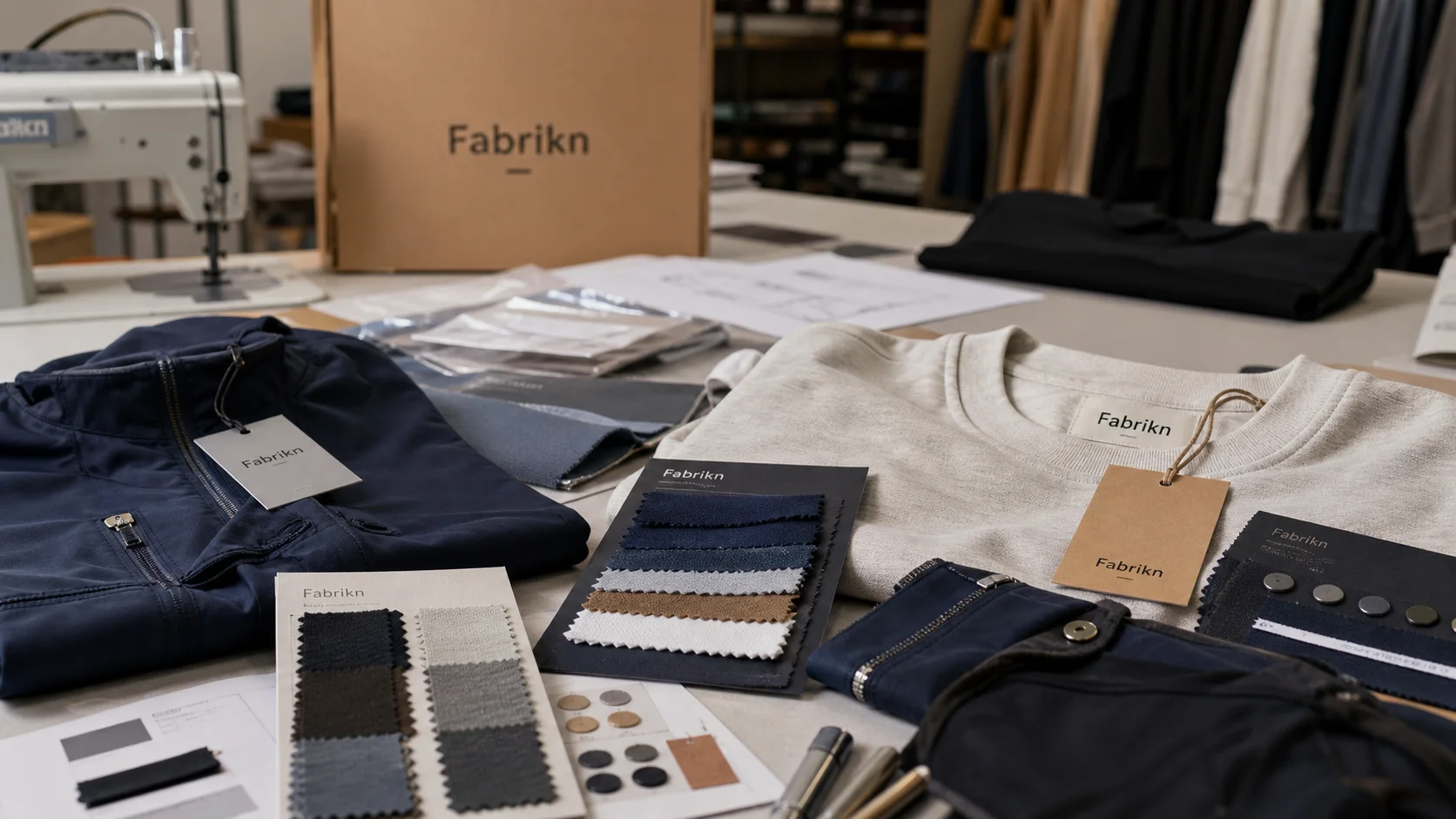
Garment Sampling and Production Factory with checks for samples, fit, MOQ, QC evidence, pricing terms, and delivery risk.
Fast answer: Garment Sampling and Production Factory: Fit Approval, QC, Cost, and Timing should be judged by production evidence, not by a generic sourcing promise. The buyer needs sample proof, cost breakdowns, QC checkpoints, and delivery buffers in writing.
Ask for recent sample photos, measurement tolerances, fabric or print test assumptions, decoration test notes, packing examples, and a named inspection checkpoint. These details show whether the team can repeat an approved sample at bulk volume.
Separate garment cost, decoration, labels, packaging, sampling, testing, freight, and rush charges. When every cost line is visible, it becomes easier to reduce colorways, adjust size depth, or reserve more time for sampling.
The first sample is where profit either starts behaving or starts bleeding. In any garment sampling and production factory, the calls made around fit, construction, and trims can decide whether an order stays clean or gets buried in rework.
I have watched a 2% sample error snowball into a 20% bulk loss, and the bill gets ugly fast: 1,000 units can turn into 1,200 units of actual cost once rework, air freight, and missed launch dates are counted.
Factories in Vietnam, Turkey, and Bangladesh told the same story in different accents. Small export shops often moved faster on first samples, sometimes returning a proto in 3-5 days, while larger mills took 7-12 days but delivered tighter measurements and fewer fabric surprises.
Speed looks impressive in the showroom. Accuracy lives on the floor.
A polished reception area tells you almost nothing. I have walked through marble lobbies, then found sample rooms where pattern comments lived in WhatsApp screenshots and trim cards were handwritten on scrap paper. That gap matters.
If a sleeve measurement is off by 1.5 cm at sample stage, the same mistake can become 3,000 bad units in bulk, plus $800-$2,500 in extra freight if correction garments have to be flown in.
I treat sampling as a cost center with a measurable return. Spend $150 on a disciplined fit sample, save $15,000 in avoided rework on a 10,000-unit order. No romance there. Just margin protection.
If a supplier offers product catalog support, I still verify every style against the tech pack, because catalog language is marketing; the sample room is where the truth appears.
Regional behavior changes the risk profile. In Portugal and Italy, sampling is slower and more expensive, often $90-$250 per style, but workmanship consistency is high. In South Asia, I have paid $25-$80 for a sample and then spent another $40-$120 correcting it twice.
The factory that saves you $30 on day one can cost you $3.00 per unit later. That math is brutal, and common.
The sample path is not mysterious, but it is easy to distort. In every garment sampling and production factory worth trusting, I look for a clear chain: tech pack review, pattern making, first sample, fit sample, size set, and pre-production sample. Each stage has a job. Each stage can fail.
Pattern makers translate the sketch into measurements and seam logic. Sample machinists sew the garment, usually on 2-6 industrial machines dedicated to development work. Merchandisers chase trims, fabric, and approvals. QA staff compare the result to the spec sheet. Production planners decide whether the approved method can actually be repeated at 500, 5,000, or 50,000 units.
Delays usually start in predictable places. Unclear construction notes add 2-4 days. Missing zippers or buttons add another 3-7 days. Late lab dips can stall color approval for 1-2 weeks.
Vague grading comments are poison; “make it a little slimmer” can mean five different things to five different technicians. I insist on measurement points, not mood.
Fast sample rooms are not always the strongest. The best teams I have seen slow down at approval points. They pause for a 10-minute construction review, retest a neckline, or recheck a wash recipe before signing off.
That extra day can save 14 days in bulk and $2,000-$5,000 in avoidable corrections. Speed without control is just expensive motion.
My checklist is blunt. For fit sample, I want 8-12 key measurements within tolerance, usually ±0.5 cm on small points and ±1.0 cm on longer lengths. For trims, I verify color, gauge, and finish against a sealed swatch set.
For wash testing, I want shrinkage under 3% on key panels and no torque that exceeds the tolerance in the spec. If a factory also handles cut and sew manufacturing, I ask how they move from sample machines to bulk lines without changing seam allowance, thread count, or operator method.
Who owns the decision matters too. A sample room run by merchandisers alone can miss engineering flaws. A room led only by pattern makers can ignore market fit.
The balance is what matters. In my experience, the strongest teams have one person speaking for construction, one for commercial timing, and one for quality. Three voices. One approved result.
Price bands tell only part of the story. Budget factories often quote $18-$45 per sample, mid-tier exporters $45-$120, and premium specialty units $120-$300 or more depending on fabric and finishing. That spread is not random. Labor skill, machine time, fabric sourcing, and the number of revisions baked into the process all sit inside it.
A French terry 320 GSM sweatshirt is cheap to sample if the fabric is already in stock. Add enzyme wash, flatlock seams, a rib collar, and embroidery placement, and the same style gets pricier fast.
Add a size range from XS to XXL and the sample cost can rise by 30%-60%. A knit tee is easy. A tailored blazer with fused canvas, lining, and horn buttons is not.
Turnaround times vary by region and factory type. In Bangladesh and Pakistan, I have seen first samples in 5-8 days when fabric is available, but 12-18 days when mills are overloaded. In China, a strong export factory can return a sample in 4-7 days, though peak season can stretch that by 1-2 weeks.
In Turkey, premium units are often quicker on complex tailoring, yet labor cost may run 15%-30% higher than South Asia. Lower unit cost can still mean a higher landed cost if you pay for 2 rounds of courier, 1 air shipment, and a delayed sales window.
Capacity matters more than promises. A supplier that produces 20,000 units a month may still struggle if 14 styles hit the sample room on the same Tuesday. I have heard too many factories promise “3 days” when the real answer was 9-11 days.
Ask how many sample machinists they have, how many styles are active, and whether the same line handles bulk. If their answer changes with each manager, that is a warning sign.
Here is a practical comparison framework I use on factory visits:
For brands building a private label clothing services program, this comparison is not academic. A $60 sample that prevents two bulk revisions is cheaper than a $25 sample that sends the order into chaos. I would rather pay for certainty than for repeat courier labels.
Verbal approval fails because memory is elastic. Written standards keep everyone honest. According to ISO guidance on quality management, process control depends on documented requirements, not shared assumptions.
I ask for the tech pack, BOM, construction sheet, measurement chart, test reports, and approved trims list before any bulk order moves. That is the minimum proof a garment sampling and production factory should provide.
The difference between approval and production-ready is paperwork discipline. A fit sample might look right on a mannequin. A production-ready sample proves the garment can survive 500 units with the same seam strength, same color, and same shrinkage.
I want allowable tolerances set in writing: ±0.5 cm for critical widths, ±1.0 cm for body length, and no more than 2% shrinkage on key panels unless the fabric family justifies a different standard.
Inspection must start early. Incoming fabric QC checks shade band, GSM, and defects per roll. Inline inspection catches machine drift before 100 bad pieces accumulate. Final inspection confirms packing, measurement, and presentation.
A factory should show me defect thresholds, usually AQL-based, and explain what happens when rework exceeds 3%-5% on a line. If they cannot answer that, bulk is not ready.
I also watch for test discipline. Color consistency matters across dye lots. Seam strength should be tested on stress points like armholes and crotch seams. Wash durability has to survive 3-5 cycles with no print cracking or excessive spirality.
Shrinkage should be checked at sample stage and again in production, because a 4% miss on a cotton jersey can mean a 2 cm length problem on every shirt. For sustainability and chemical safety, I also look for alignment with the OEKO-TEX certification framework when relevant to the product and market.
Data from AATCC standards is useful here, especially for wash and colorfastness testing. I do not need a factory to recite test names like a textbook. I need them to show me that fabric, construction, and finishing were measured against the same benchmark twice: once in development, once in production.
The first sample round tells the truth if you know where to look. Missing specs, trim substitutions, weak grading, fabric shrinkage surprises, and fit comments that never get translated into pattern updates are the usual suspects.
I have seen a $2.20 button swapped for a $0.70 version without sign-off, then watched the buyer spend $600 in air freight to fix the fallout.
The warning signs appear fast. In the first 48 hours, vague comments like “please advise” or “similar quality okay” usually mean the factory does not have control. Recycled samples with only one label changed suggest they are improvising.
If workmanship improves in photos but not in the physical sample, someone is hiding a process change. That is not harmless.
Low-cost suppliers often accept more revisions, but they may bury the real issue until bulk. Higher-priced factories tend to flag problems earlier, which feels slower and is often cheaper.
I would take a supplier who says “this seam will pucker after wash” over one who smiles and ships 300 flawed units. The honest answer saves money. The flattering answer burns it.
Hidden costs pile up quickly: extra pattern charges of $25-$80, repeated courier fees of $35-$120 per parcel, delayed approvals that miss a 4-week sales window, and markdowns on late product.
I have seen one lost launch cut sell-through by 18% in the first month. That pain started with a rushed sample approval.
A good sample is not a guarantee of scale. I have visited factories that could sew one perfect jacket and then collapse on 10,000 units because the bulk floor used different machines, different operators, and different quality checks.
To move from 1 sample to 10,000 units without drift, I want sample-to-bulk continuity, not just a pretty prototype.
Ask about machinery mix first. Does the factory have single-needle, overlock, coverstitch, bartack, and buttonhole machines in both sample and bulk areas? Who signs off on compliance certificates? How are operators trained on knits versus tailoring?
A denim plant without chainstitch discipline is a red flag. A blazer factory without fusing control is another.
Specialization matters more than buyers admit. Denim needs wash knowledge, leg twist control, and pocket placement accuracy. Knits need stretching discipline and relaxed seam tension. Activewear needs bonded seams, stretch recovery, and consistent elastane handling.
A factory can be excellent in one category and mediocre in another. That is normal. Pretending otherwise is expensive.
I use a scorecard with 5 fields: responsiveness, transparency, audit history, sample-to-bulk consistency, and capacity reliability. On a 1-5 scale, anything below 18 total points deserves caution.
For buyers sourcing in regions with variable infrastructure, I ask how power cuts, port delays, or labor peaks affect lead time. Factories with a scheduling system that tracks line load by week usually beat those relying on verbal promises.
If the supplier also offers clothing packaging solutions, I check whether packing mockups are reviewed alongside the pre-production sample. Packaging errors can add 7-14 days if cartons, polybags, or hangtags are approved too late.
Scale is not only sewing. It is timing, logistics, and discipline.
Sample approval is not the finish line. It is the point where discipline has to harden. Before bulk cutting, I sign off a pack that includes the approved swatches, sealed sample, final tech pack, production timeline, inspection plan, and shipment terms.
If any one of those is missing, the bulk order is exposed.
I lock fabric lots, trims, seam allowances, and measurement tolerances in writing. I also ask for the first 100 units to be checked against the approved sample, not just the final shipment.
That small batch exposes needle tension issues, pattern drift, and operator shortcuts early, when correction still costs $100-$300 instead of $3,000.
On the first production run, I want photos, in-line measurements, and one live conversation with the production manager. The buyer’s job changes here. Creative approval is over.
Control starts. A factory that knows you will inspect the first 100 units behaves differently from one that expects silence until shipment.
Hold the line after approval. The strongest garment sampling and production factory will expect that discipline, and the weaker ones usually reveal themselves when you ask for it.
Most sample costs fall between $18 and $120, depending on garment complexity, revisions, and fabric availability. Premium tailoring, embroidery, or wash treatments can push samples to $300 or more. Courier fees and extra revision rounds can add another $35-$120 per shipment.
Fast factories can deliver in 4-7 days if fabric and trims are ready. More complex styles usually take 7-12 days, and peak-season delays can stretch that to 2-3 weeks. If a supplier promises 3 days on a difficult style, I would verify capacity carefully.
Ask about sample-to-bulk continuity, machine setup, operator skill, compliance certificates, lead time, and revision policy. Also ask who owns fit approval and what happens if rework exceeds 3%-5%. A clear answer usually comes with documents, not just reassurance.
Check whether the sample room and bulk floor use comparable machines, methods, and QA standards. Review past order sizes, line capacity, and whether they have handled 5,000, 10,000, or 50,000 units in the same category. A strong factory shows continuity, not just capability on paper.
The main risks are spec drift, trim substitution, poor grading, fabric shrinkage, and weak communication during approvals. These issues often start in the first sample round and become expensive in bulk. A 2% measurement miss can turn into thousands of flawed units if nobody catches it early.