
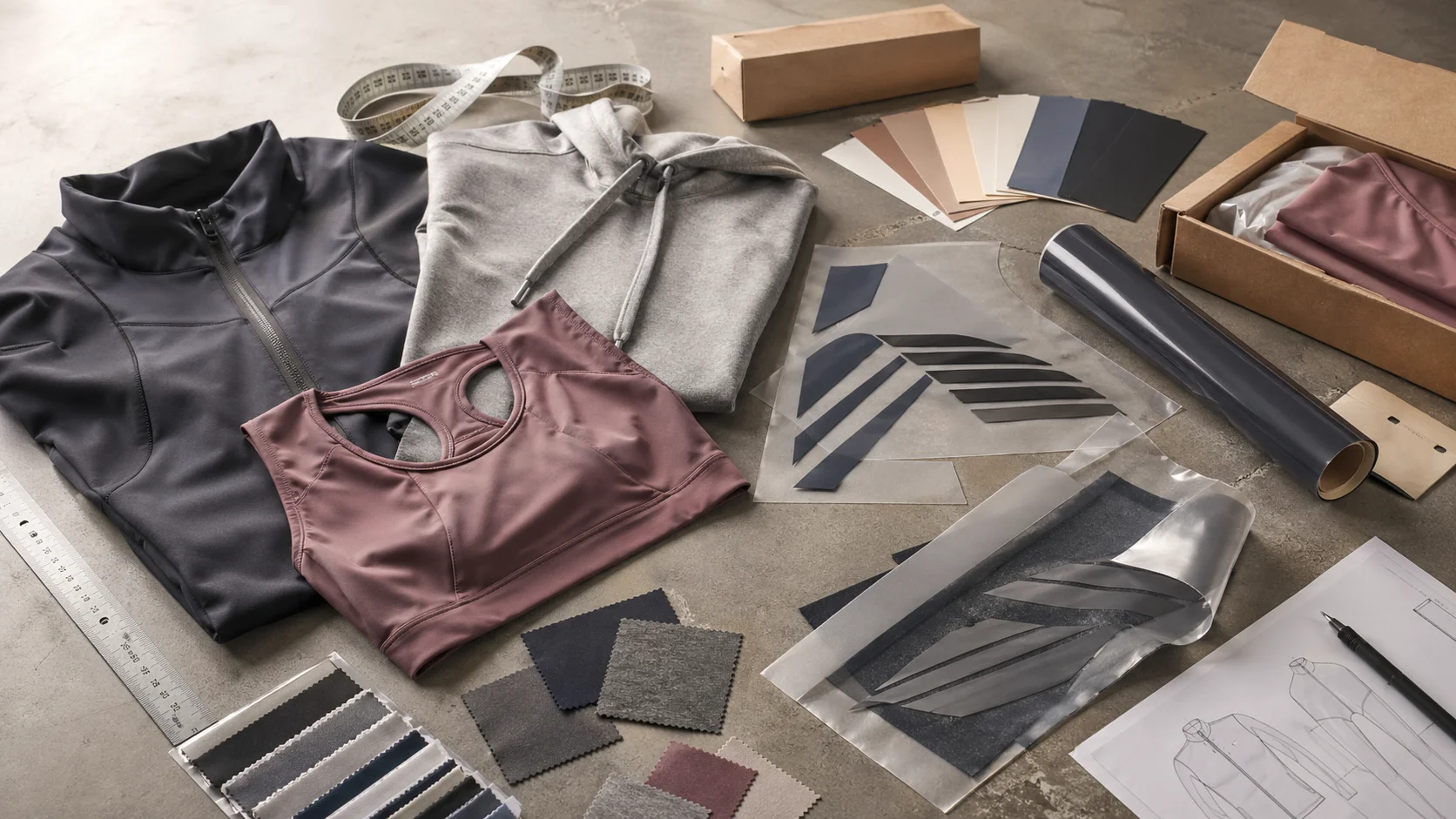
Much Does Clothing Manufacturing Cost compared by sample evidence, fabric or trim specs, MOQ, AQL terms, cost lines, delivery timing, and rework responsibility.
Fast answer: Much Does Clothing Manufacturing Cost: Tech Pack, Sample Gate, MOQ, and QC Terms should be judged by production evidence, not by a generic sourcing promise. The buyer needs sample proof, cost breakdowns, QC checkpoints, and delivery buffers in writing.
Ask for recent sample photos, measurement tolerances, fabric or print test assumptions, decoration test notes, packing examples, and a named inspection checkpoint. These details show whether the team can repeat an approved sample at bulk volume.
Separate garment cost, decoration, labels, packaging, sampling, testing, freight, and rush charges. Clear cost lines make it easier to reduce colorways, adjust size depth, or reserve more time for sampling.
The first quote is never the whole story. If you're asking how much does clothing manufacturing cost, the real answer depends on the factory, its production model, and the product brief. A tee can come in at $3.40 in Bangladesh, $6.80 in Portugal, and $11.50 in Los Angeles from the same design spec. I have seen that exact spread. Labor, fabric, trims, quality, and overhead all get priced differently from manufacturer to manufacturer, then freight, duties, and margin pile on top. The quote is a stack, not a sticker.
On factory floors, the same garment can swing wildly because one plant buys 10,000 meters of jersey at once while another is chasing 800 meters at a time. A pattern maker may charge $75 in one place and $250 in another. Sampling can be $35 for a basic tee or $180 for a washed hoodie. Packaging might add $0.18 per piece. QA, carton labeling, and freight can tack on another $0.60 to $2.40 depending on route and urgency.
Small order quantities twist the math. A 100-piece run can cost 2-4x more per unit than a 1,000-piece run because setup charges, marker making, and machine time are spread over too few units. I have watched brands celebrate a $7 sample, then stare at a $19 production unit, only to learn the sample was never meant to reflect scalable pricing. Samples pull in handwork, one-off fabric sourcing, and repeated approvals. Production does not.
Here’s the part people miss: in several higher-wage factories I visited, the total landed cost was lower because they wasted less fabric and rejected fewer units. One Portuguese plant ran a ladies’ knit dress at 92% first-pass approval, while a lower-cost subcontractor in another country came in at 78% and burned through 11% more fabric in rework. That matters. A $1.20 labor premium can vanish fast when defects fall from 8% to 2%.
According to Textile Exchange and trade data compiled by trade.gov, sourcing decisions increasingly hinge on compliance, lead time, and waste, not only hourly wages. Brands that understand the full cost stack buy better. In the pages that follow, I’ll show what drives price, what a fair quote looks like, and where hidden fees show up before the invoice lands.
Garment type changes the bill faster than most founders expect. A basic tee with 160-180 GSM jersey, overlock seams, and a rib neck can land at $2.50-$5 in Asia, $5-$9 in Eastern Europe, and $8-$15 in the US or UK depending on volume. A sweatshirt made from French terry 320 GSM usually sits higher: $6-$12 in Asia, $9-$16 in Eastern Europe, and $16-$28 in the US or UK.
Construction drives cost. A woven shirt with a collar stand, placket, cuffs, and topstitching costs more than a tee because it uses more operations and tighter tolerances. Jeans add even more through pocket bags, rivets, waistband construction, and wash work. A standard five-pocket jean can cost $8-$18 in Asia, $14-$26 in Turkey or Portugal, and $22-$40 in the US. A dress with lining and an invisible zipper often lands at $7-$15 in Asia and $15-$35 in Europe or North America.
Activewear behaves differently again. Leggings with flatlock seams, bonded waistbands, and nylon-spandex fabric usually range from $5-$11 in Asia and $10-$18 in Europe. A technical jacket with lining, waterproof zippers, and seam taping can jump to $18-$45, depending on membrane, testing, and hardware. Knitwear and denim do not follow the same cost logic because machinery, wash processes, and finishing vary so much. One factory may own knitting machines but outsource denim washing. Another may do the reverse.
I see brands misread quotes when they compare a sample to production. A tee sample can cost $45-$120 on a small run, which is 3-10x the factory unit cost once production scales. A hoodie sample may be $80-$220 if it includes embroidery, enzyme wash, or custom drawcords. The sample is a prototype. The production line is a different beast. For brands building private label clothing services, the pricing logic changes again because label application, packaging, and brand standards become part of the repeated workflow.
Even “simple” garments can surprise you. A basic tee with twin-needle hems, woven labels, and garment dyeing can outprice a plain sweatshirt if the dye lot is small enough. Same answer, different day. how much does clothing manufacturing cost depends on what the garment asks the factory to do, not just what it looks like on a flat lay.
China, Bangladesh, Vietnam, Portugal, Turkey, and the US each price work differently, and buyers often misunderstand what the number covers. Bangladesh and Vietnam usually win on labor. China still wins on coordination, especially for complex or tightly managed runs. Portugal and Turkey often cost more per unit, yet they can deliver faster turnaround, fewer communication gaps for EU buyers, and lower defect risk. That changes the real answer to how much does clothing manufacturing cost.
For a basic tee, I have seen factory quotes around $2.20-$4.20 in Bangladesh, $2.80-$5.00 in Vietnam, $4.50-$7.50 in China, $5.50-$9.50 in Turkey, $6.00-$10.50 in Portugal, and $8.00-$15.00 in the US. Those numbers are useless until freight, duties, and quality control are added. A lower unit price can become a higher landed cost if the port adds 3 weeks, customs holds the carton, or the factory misses the fit spec and needs rework.
China remains cost-efficient for complicated runs because its ecosystem is deep. One factory may source zippers, knitting, wash treatments, and packaging within a 60-kilometer radius. That reduces coordination cost. I have seen a Chinese jacket program with 14 separate components land below a Turkish quote because the Chinese vendor could control trims and subcontracts in one chain. Wages were higher, yes, but the workflow was tighter and the defect rate was 1.8% versus 4.6%.
Portugal and Turkey often make sense for brands selling into Europe because lead time matters as much as unit price. A nearshore factory may quote 10-20% more per unit, yet cut total lead time by 30-45%. That can reduce stockout risk, markdowns, and airfreight spend. I worked with a brand that moved a jersey dress program from Asia to Turkey and saved two missed retail windows. The freight bill rose by $0.40 per unit, but the sell-through improved enough to offset it.
Geography also affects MOQs, port congestion, and rework. A small order in Bangladesh may need 1,000 pieces per color to get a sane price. A Portuguese factory may accept 300 pieces but charge more per unit. The best choice is rarely the cheapest country on paper. Data from the WTO and factory audits from WRAP both show that compliance, labor stability, and transit reliability shape total cost just as much as wage rates do.
A factory quote should be readable line by line. I want to see fabric yardage, trim sourcing, cut-and-sew labor, sampling, pattern grading, labeling, packaging, and inspection. If those items are missing, the quote is incomplete. For a 200-piece tee order, fabric might account for $1.35 per unit, labor $0.95, trims $0.22, and packaging $0.18. Clean enough on paper. Then the factory adds $140 for pattern grading, $80 for screen setup, and $60 for carton labels.
MOQ changes the whole structure. A factory may add setup charges of $100-$500 on a small run, which can inflate each unit by $0.50-$2.50 before the garment even leaves the cutting table. Strike-offs, lab dips, embroidery digitizing, hanger packs, and port-to-port freight all show up later if they were not defined in the brief. I have seen a quote at $4.20 turn into $7.90 landed after packaging, freight, and duty. The product did not change. The paperwork did.
There are also pricing terms that blur comparisons. CMT means cut, make, and trim only. FOB includes delivery to the port and often more handling. EXW leaves more of the transport burden with the buyer. If one supplier quotes $3.90 CMT and another quotes $5.10 FOB, the second may actually be cheaper once inland freight and export docs are counted. That is why buyers must normalize pricing before comparing.
Sampling is not production, and factories know the difference. A sample might include hand-finished details, stitch corrections, and multiple fit rounds that never appear in bulk. For more complex programs, such as cut and sew manufacturing, the pattern, marker, and assembly path all affect the quote. If a supplier does not explain those steps, expect surprises later.
According to AATCC, testing and colorfastness requirements can also alter cost, especially for dyed knits and washed denim. A cheap quote that excludes testing is not cheap. It is unfinished.
Order size changes everything because fixed costs need a base to sit on. A 100-piece order absorbs sampling, setup, and admin into a very small run, while 1,000 pieces spread those costs much more efficiently. That is why brands often see a 40-70% drop in unit price as they move from 100 pieces to 1,000 pieces. If you are evaluating how much does clothing manufacturing cost, quantity is one of the first numbers to pin down.
Here is the practical pattern I see most often. A basic tee at 100 units may land at $6.50-$9.50, at 500 units at $3.80-$6.20, and at 1,000 units at $2.90-$4.80. A hoodie might be $14-$24 at 100 units, $9-$16 at 500, and $7-$13 at 1,000. A dress with lining and zipper can run $18-$34 at 100 units, $12-$22 at 500, and $9-$18 at 1,000. Those ranges move with fabric choice, country, and finish level.
Timeline does not rise in a straight line. Small runs can ship faster if the manufacturer has open capacity, but they can also stall because the setup cost is not worth prioritizing. Larger runs may take longer in total days, yet they often finish more smoothly once cutting, sewing, and finishing are locked. I have seen a 1,000-piece tee order complete in 4 weeks because the plant was organized, while a 120-piece run dragged to 6 weeks due to constant interruptions.
For a quick comparison, I would map the order like this:
The buyer takeaway is simple. Pick a realistic order size before asking for quotes. If your sales plan only supports 200 units, do not pretend 2,000 is the target. The supplier will know, and the quote will show it.
Factories quote accurately when the spec sheet is precise. I send a tech pack with measurements, grading rules, fabric composition, trims, artwork placement, sewing details, target quality level, and packaging requirements. If any of that is vague, the factory pads for risk or returns with revision charges later. A weak brief invites guesswork.
Send these items together: flat sketches, point-of-measure chart, fabric swatches or references, GSM, composition, color standards, logo files, trim callouts, care label text, hangtag copy, carton dimensions, and required incoterms. If you want kidswear or infantwear, specify compliance clearly, especially for programs involving custom baby clothing manufacturing. A missing fiber content line can delay quotes by 3-5 days. A missing size spec can double the revision round.
Compare three quotes only after normalizing the variables. Check MOQ, fabric, quality standard, and whether the number is CMT, FOB, or landed. I have seen a “cheap” supplier omit finishing, testing, or packaging, then add them back in the final invoice. The cheapest line item is often the most expensive relationship.
If you need clarity fast, ask for a unit price, setup fee, sample fee, fabric source, and payment terms in writing. Then ask the factory to confirm what is excluded. The fastest way to get a reliable answer is to request a manufacturing quote from Fabrikn after you have locked the spec. A clean quote beats a vague promise every time.
Cost reduction works best when it simplifies the garment rather than damaging the brand. Reduce trim count. Standardize fabrics across styles. Consolidate colorways from six to three. Raise order size where demand supports it. A sweatshirt with one woven label, one care label, and one print is cheaper to build than one with three labels, two embroideries, and a custom bag.
Negotiation should focus on alternatives, not pressure. Ask for a lower-cost fabric option with the same handfeel. Request open-cost breakdowns so you can see where the margin sits. Reprice at 500, 1,000, and 3,000 units to understand volume leverage. In my experience, a brand that asks for one more fabric width, one less trim, and a cleaner finishing spec can save 8-15% without changing the consumer experience.
Quality control protects margin. A 2% defect rate is expensive. A 6% defect rate is brutal. I would rather pay $0.12 more per unit for better inspection than eat remake costs, returns, and customer complaints later. That is especially true for fashion basics, where buyers judge fit and feel within seconds. For premium lines, nearshore sourcing can make sense. For repeat basics, offshore production often wins. For mixed margin tiers, use both.
The sticker price is only the first number. The true cost is landed, repeatable, and tied to sell-through. If a factory quote cannot survive freight, duty, and a second production run, it is not a good quote. It is a trap with neat formatting.
A basic tee usually costs $2.50-$5 in Asia, $5-$9 in Eastern Europe, and $8-$15 in the US or UK at workable volumes. Small runs of 100 pieces can push that much higher because setup, sampling, and packaging are spread across fewer units.
At 500 units, a tee often lands 15-30% above the 1,000-unit rate. Hoodies and dresses can show even bigger gaps because labor, trims, and setup fees are absorbed more efficiently at higher volume. The exact difference depends on fabric width, wash work, and MOQ.
Fabric weight, garment complexity, order quantity, and country of origin drive most of the price. After that come trims, finishing, testing, freight, and duties. A simple tee with 160 GSM jersey is far cheaper than a lined dress or a washed hoodie with custom hardware.
Basic production often takes 3-8 weeks after sample approval, but complex garments can run 8-12 weeks or longer. Freight can add 5-35 days depending on origin and destination. Nearshore factories may cut total lead time by 30-45% even if the unit price is higher.
Yes. Simplify construction, reduce trim count, standardize fabrics, and increase order volume where demand supports it. Ask factories for open-cost breakdowns and alternate material options, then compare landed cost instead of unit price alone. Better planning usually saves more than aggressive price bargaining.