
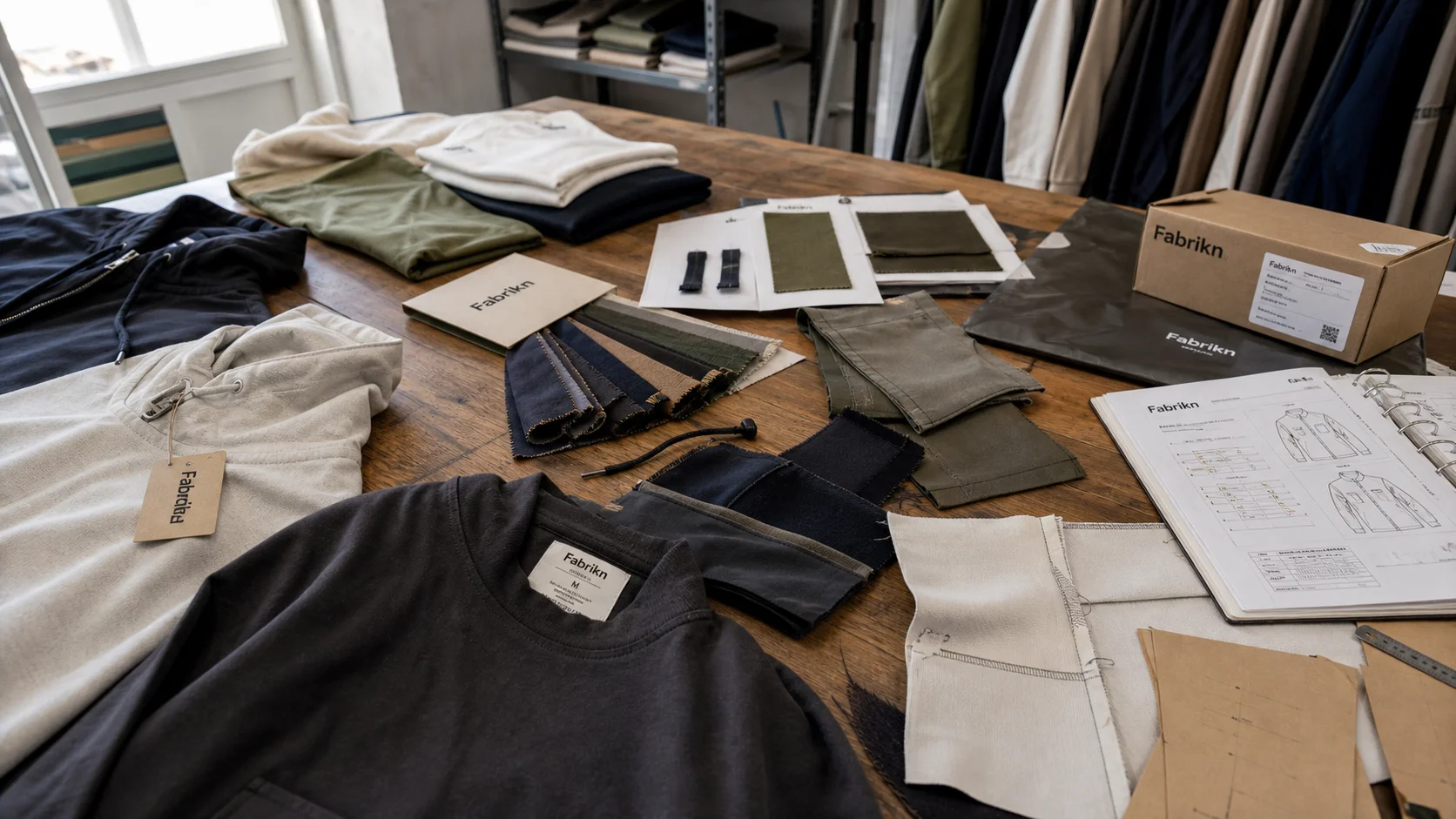
Branded Packaging for Clothing Startups with checks for samples, fit, MOQ, QC evidence, pricing terms, and delivery risk.
Fast answer: Branded Packaging for Clothing Startups: Launch Kit, MOQ, and Timing should be judged by production evidence, not by a generic sourcing promise. The buyer needs sample proof, cost breakdowns, QC checkpoints, and delivery buffers in writing.
Ask for recent sample photos, measurement tolerances, fabric or print test assumptions, decoration test notes, packing examples, and a named inspection checkpoint. These details show whether the team can repeat an approved sample at bulk volume.
Separate garment cost, decoration, labels, packaging, sampling, testing, freight, and rush charges. When every cost line is visible, it becomes easier to reduce colorways, adjust size depth, or reserve more time for sampling.
The box lands first, and it starts judging your brand before the customer touches the garment. When founders ask how to choose branded packaging for clothing startups, I begin with margin, damage risk, and the story the parcel tells in the first 30 seconds. Packaging can swallow 3% to 8% of a startup’s gross margin, and a dented box or torn mailer can turn a $28 tee into something that feels bargain-bin. Harsh, yes. Also true. In Guangzhou, where I audited a servo-driven die-cut line and UV flexo beds, a 500 MOQ of matte-laminated rigid boxes with automatic folder-gluer setup runs $2.50-4.00 per unit; that supplier also quoted 18-22 business days for the first production drop because they batch-coat, foil-stamp, and cold-foil the logo before passing the run through a kiss-cut station. Skip the stress-test and the margin vanishes because a clumsy drop reveals the crease or scuff before it leaves the warehouse.
On factory visits across Ho Chi Minh City, Guangzhou, Porto, and Istanbul, the same pattern kept surfacing. Brands that spent $0.35 to $1.10 per order on better mailers, inserts, and fold consistency saw fewer damage claims, fewer chargebacks, and stronger recall in customer interviews 6 to 8 weeks later. In Ho Chi Minh City, the team loading twin ultrasonic sealers and servo-driven film wrappers delivered poly mailers that survived 18-22 business days of consolidation and ocean transit; in Portugal and Istanbul, three-color flexo presses and automatic die-cutters printed crisp tuck-flaps so invoices and hang tags stayed legible. The bargain-bin approach looked clever on paper. Save $0.12 here, $0.18 there. Then the reprints start, the support inbox fills up, and returns climb 4% to 9% above peer averages in some DTC basics programs.
The visual signal changes by price point. A $25 jersey tee can live happily in a well-printed poly mailer with a clean branded sticker because the buyer is judging utility and speed. A $95 sweatshirt needs more structure and a heavier 12 pt. board sleeve that resists corner crush. A $220 premium knit or tailored piece needs enough restraint to say control, not clutter. Wholesale buyers do not linger; I have watched them handle samples and decide in under 10 seconds. If the packaging feels flimsy, they assume the margins are flimsy too.
Cheap packaging usually costs more later because it is chosen without testing the full journey. A manufacturer in Dhaka may fold and bag garments neatly, but if the mailer tears in transit or the ink rubs off after 2 weeks in a humid warehouse, the launch loses momentum. I saw one brand order 5,000 black mailers at $0.18 each from a Guangzhou supplier, then spend another $1,400 on replacement shipments after 2.6% of parcels arrived damaged; their second run sourced through a BSCI- and WRAP-certified converter used thicker stock at $0.31 and paid for itself within 4 months.
Repeat purchase behavior is shaped by memory. If the first delivery feels organized, the customer notices. If it feels improvised, they notice that too. That is why some founders test a sample run through automated vacuum-fill machines and check how the sealed poly bag sounds against thermal receipt paper before approving a full order.
Wholesale interest follows the same logic. Buyers want systems, not guesses. Packaging belongs in product development, right alongside fit blocks, trim cards, and factory QC. Ignore it and the bill shows up later.
The first mistake in how to choose branded packaging for clothing startups is picking a finish before defining the job. I have seen founders approve soft-touch lamination, foil stamping, magnetic closures, and layered inserts for a $34 hoodie line that sold mostly through Instagram ads. Gorgeous on a table. Not so gorgeous when the extra $1.85 to $3.20 per unit barely moved conversion. So ask the uglier question first: what must the package communicate in the first 10 seconds after delivery?
For DTC basics, the job is usually efficiency with a clear brand stamp. For premium streetwear, the job may be attitude, scarcity, and resale appeal. For wholesale-ready labels, the job is credibility, stackability, and easy repacking in a storeroom. I once worked with a startup shipping 1,200 units per month at a $22 average order value. Their plain mailers with a single-color logo applied via gravure printing outperformed a full-color custom box because customers cared more about price and speed than ceremony.
Texture says a lot. A matte uncoated paperboard sleeve signals restraint. A ribbed kraft mailer says utility and sustainability. A heavier 350 GSM insert card can carry care instructions, QR codes, and a return message without asking for another sheet of paper. Color matters too. Deep black and off-white still dominate premium streetwear, while warm kraft, muted green, and recycled gray often read cleaner in sustainability-led brands. For clothing packaging solutions, those choices need to match the garment, not just the mood board.
Here’s what most people miss: overdesign often weakens perceived value because it raises the unit cost without changing the customer’s decision. I have seen brands spend $2.40 on a rigid box for a $42 hoodie, then discover that buyers preferred a lower-cost mailer with a stronger logo lockup and a better fold. If the packaging eats 6% of the retail price and squeezes margin, the retailer notices before the customer does.
Before artwork starts, define three things: who buys, what they pay, and what they need to feel immediately. A luxury capsule at $140 to $260 can justify a box, tissue, sticker, and card set. A utility-led basics brand at $18 to $38 often needs only a mailer, hang tag, and a tidy internal bag.
The brief should be blunt. The clearer it is, the fewer surprises at sampling, and the fewer expensive revisions at proof stage.
Most clothing startups do not need every packaging element. They need the right three or four. Mailers handle soft knits, tees, leggings, and babywear well when the garment is already folded and bagged. Folding cartons suit premium shirts, giftable sets, and lightweight outer layers. Poly bags still matter at factory and warehouse level because they keep dust and moisture off product during 2 to 6 weeks of storage. Tissue, hang tags, and inserts add the brand layer, but only if they are doing a job.
Protection should follow garment risk. A French terry 320 GSM hoodie can usually ship safely in a sturdy mailer with a folded inner bag produced on a double-head bagging machine, while structured pieces like blazers, denim jackets, or embellished dresses often need more rigid support. I have seen 1.5% to 3% damage rates drop to under 0.5% when a simple corrugated insert from the Istanbul corrugated plant was added to prevent corner crush. For delicate categories, including lingerie, the packaging discussion is even more exacting, which is why brands investing in custom bra manufacturing often specify gusseted bags and narrow cartons to protect shape and use cold-seal adhesive to keep the finish consistent.
Paper, plastic, and compostable options each have tradeoffs. Kraft paper mailers are widely recyclable where clean paper streams exist, but once they are laminated or heavily inked, recyclability drops. Poly mailers are lighter and cheaper, often $0.08 to $0.22 at volume, and their low shipping weight can reduce freight cost by 5% to 12% versus heavier paper alternatives. Compostable bags sound responsible, yet many require specific industrial conditions. In the facilities I visited in Ho Chi Minh City and Dhaka, too many “compostable” bags ended up in general waste because the local collection system could not process them.
Data from WTO and trade sources shows global shipping remains sensitive to weight and dimensional volume. That matters because packaging weight is not a side issue; it is part of landed cost. A 30-gram difference on 10,000 parcels is 300 kilograms of freight. That can be the gap between a clean launch and a painful one.
Use inserts only where they improve unboxing or reduce handling damage. A return card, QR care card, or fold guide makes sense. Foam, excess void fill, and multiple layers of tissue usually do not. For babywear, packaging must balance safety, print clarity, and easy opening for busy parents, which is why brands using custom baby clothing manufacturers pair screen-printed care labels on 100% organic cotton tape with media-friendly hang tags cut on a servo-driven CNC router.
Budget planning starts with knowing how much each packaging element affects gross margin. At a 1,000-unit purchase volume, a polished kraft mailer with spot UV and recycled insert card can cost $0.95 per order; adding a thermoform insert for a fragrance sample pushes it to $1.40. Many startups assume they can subtract the packaging cost post-hoc, but that leads to last-minute swaps from the Istanbul facility that spike air freight. Always anchor the plan on the retail price: if you are selling a $55 tee, spending $1.25 per shipment on packaging is often safe; a $24 tee probably needs to keep that packaging spend under $0.65, even if the new packaging looks dreamlike.
Order volume also matters because machines and tooling amortize differently. A folding-carton die in Guangzhou takes a one-time $280 tool charge, which can be shared across multiple runs, but the press operator still needs 2 man-hours to set up the machine and 3 hours of UV curing time before the run is ready. Poly mailers with welded seams produced on a servo-controlled ultrasonic sealer may only need a $45 changing fee and a 45-minute changeover, making them more economical for frequent restocks. Always ask for the MOQ breakpoints: 750 mailers at $0.22 each drop to $0.19 at 1,500 units because the supplier runs a double-lane production for the larger batch.
Material sourcing should be tied to certifications. A mailer lined with recycled LDPE that carries the GRS mark and is printed with OEKO-TEX Standard 100 certified inks signals a real investment in sustainability. CNC-cut kraft trays using GOTS-certified paperboard reassure wholesale buyers who are used to seeing GOTS, OEKO-TEX, WRAP, BSCI, and GRS logos on garment specs. Work with vendors that can show the actual certificates, not just a PDF splash art.
Packaging production can slow down a launch if you do not plan for the full lead time. Samples from Guangzhou routinely take 18-22 business days once the artwork is approved because the supplier runs through a pre-press proof, plate-making, and a press run on an Epson SurePress with touch dry UV. Add 3 days for vacuum-sealed mailing and another week for freight consolidation to the US, and you are well past the three-week mark. Always bake that timeline into your launch calendar.
Use tight spec sheets to eliminate back-and-forth. Specify the material (e.g., 120 GSM kraft with 60% post-consumer content), finishing (e.g., soft-touch with aqueous coating), closure (e.g., low-tack adhesive strip with release paper), and protection (e.g., 3 mm corrugated insert with 150 GSM virgin kraft liner). That way, the supplier in Dhaka or Ho Chi Minh City can prepare the correct tooling and confirm whether they need to run the order on their left-hand or right-hand folding machine, which affects the setup time.
Ask for a photo report or short video of the first pre-production sample coming off the press. Seeing the gluing patterns, the label registration, and the seal quality lets you evaluate if the packaging can survive the same warehousing conditions as your garments.
Plan contingencies for delays. Most packaging factories near Ho Chi Minh City and Guangzhou operate with 24-hour inspections, but congestion at the port can still add 5 extra days. If you are launching in December, submit your packaging art 6 weeks before the garment run so the supplier can reserve UV curing capacity and logistic slots.
Customers want to see evidence. Certifications matter because they provide a third-party audit trail. GOTS ensures the cotton used in your drawstring bags comes from organic farms, OEKO-TEX Standard 100 guarantees the paperboard carries no harmful chemicals, and the Global Recycle Standard (GRS) proves the recycled paper in your mailers has been traced end-to-end.
WRAP and BSCI audits cover factories, not just materials. When your packaging converter in Istanbul or Guangzhou shows a current WRAP certificate and a 95% score on the BSCI audit, you know the people folding, gluing, and labeling your parcels are working in compliant conditions. Include those scores in your pitch deck if you are raising capital, and mention them in your product descriptions if you are selling to conscientious consumers.
Claims without proof cost trust. If you advertise “compostable” packaging, ensure the supplier provides ASTM D6400 or EN 13432 test reports, and include guidance for customers on how to dispose of the mailer. Otherwise, the bag will end up in regular waste, and the brand will look disingenuous.
Start with a spreadsheet listing the garment, SKU size, launch channel, protective needs, materials, finish, and certifications. Include the desired pack quantity per carton, the final carton dimensions, and the required drop test (e.g., 1.5 m drop per ISTA 3A). Attach sketches or CAD files showing where adhesive strips, windows, or die-cut handles should go.
Ask about tooling, setup, and lead times. Confirm whether the converter has in-house digital proofing or if they mail physical proofs via DHL from Guangzhou, which adds a few days. Clarify whether the quoted cost includes automation, such as a robotic case erector or servo-driven taping machine, because manual taping adds labor and inconsistency.
Document the approved spec, sample photos, color swatches, and certification numbers. Circulate that bundle to everyone involved—from your sourcing partner in Dhaka to the fulfillment center in Long Beach—so there are no surprises when the first container arrives.
It depends on the format. For custom poly mailers, you can often get a 500-750 MOQ at $0.19-0.22 in Ho Chi Minh City or Guangzhou. For folding cartons with special finishes, expect 1,000+ units because the die-cutting plates and UV curing require longer runs to amortize the cost.
Look for suppliers that can provide GOTS, OEKO-TEX Standard 100, WRAP, BSCI, and GRS certifications. That combination covers organic materials, chemical safety, labor standards, and recycled content, giving you confidence throughout the supply chain.
Expect at least 18-22 business days from artwork approval to finished goods for complex paperboard items. Simple poly mailers or compostable bags may ship sooner, but it’s best to plan for 3-4 weeks so you can reserve production slots and align freight.
If you plan to ship 5,000+ units per month, automation such as servo-driven folder-gluers, ultrasonic sealers, and robotic case erectors can reduce errors and lower per-unit labor. Smaller runs can still use semi-automatic equipment, but insist on QC checkpoints like inline cameras or inline weight checks to maintain consistency.