
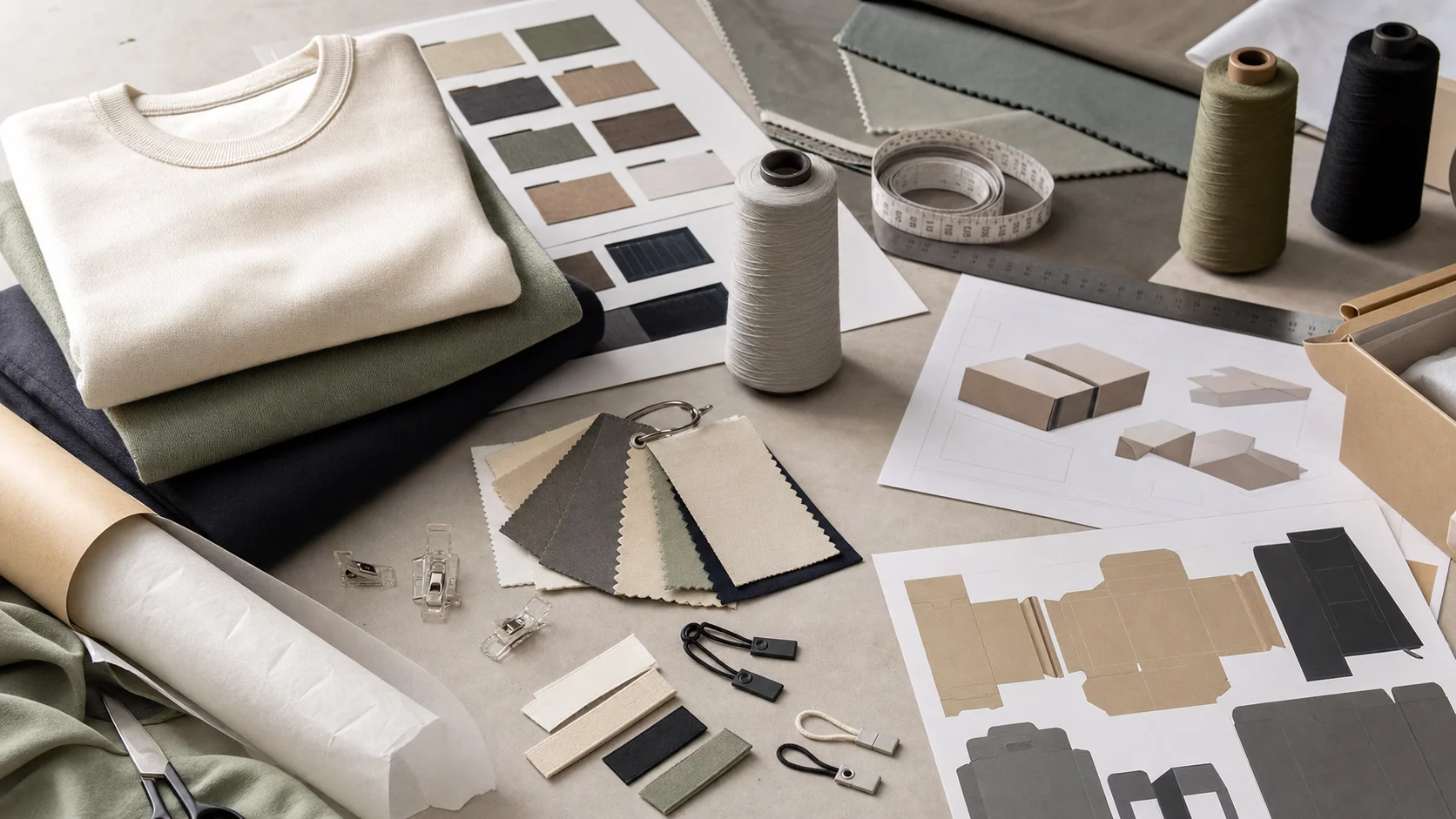
Startup Clothing Packaging Inserts with checks for samples, fit, MOQ, QC evidence, pricing terms, and delivery risk.
Fast answer: Startup Clothing Packaging Inserts: Message, Size, Paper, and Unboxing Impact should be judged by production evidence, not by a generic sourcing promise. The buyer needs sample proof, cost breakdowns, QC checkpoints, and delivery buffers in writing.
Ask for recent sample photos, measurement tolerances, fabric or print test assumptions, decoration test notes, packing examples, and a named inspection checkpoint. These details show whether the team can repeat an approved sample at bulk volume.
Separate garment cost, decoration, labels, packaging, sampling, testing, freight, and rush charges. When every cost line is visible, it becomes easier to reduce colorways, adjust size depth, or reserve more time for sampling.
The smallest piece in the parcel is often the one that does the heaviest lifting. A single insert can answer questions, calm doubt, and make a customer feel seen before the garment has even been tried on. For custom branded packaging inserts for clothing startups, that matters because the first order has to do the work of a brand that has not yet had time to become familiar.
Factories in Vietnam, Portugal, and Turkey told the same story over and over. Founders would spend $1.80 to $3.50 per parcel on a rigid mailer or printed box, then try to save $0.08 on the insert that actually got read. Backwards. A startup selling at a $38 to $120 price point may only have a 2.5x to 3.5x markup after freight, duties, and returns, so every post-purchase touchpoint has to pull its weight.
What shoppers remember after the first wear is not the corrugated carton. They remember whether the card showed how to wash a rayon blend, whether the size guide reduced doubt, and whether the return window felt fair. A tidy insert can carry a care cue, a sizing reassurance, and a referral offer in 12 to 24 square inches. That is not branding theater. That is conversion support.
In my experience, the brands with the best repeat rates treat the insert as a sales tool inside the parcel. They use it to explain why a French terry 320 GSM sweatshirt pills less after three washes, or why a baby romper needs cold wash and line dry. For categories with fit anxiety, such as denim, bras, and infantwear, clear post-purchase guidance can cut avoidable returns by 8% to 18% over 3 to 6 months. That is especially relevant if you already sell through clothing packaging solutions and need each component to earn its place.
The commercial angle is simple. Inserts are not decoration. They are a conversion tool hidden in plain sight.
The best inserts do three jobs at once: they make the brand memorable, they reduce friction, and they pull the customer back for another order. I have seen a 6 x 4 inch card outperform a 12-page booklet because it answered the questions people actually had within 10 seconds of opening the parcel. That is the real value of custom branded packaging inserts for clothing startups.
Start with the basics. A thank-you message should feel human, not scripted. Care instructions need to be readable at a glance. Sizing tips should remove doubt for first-time buyers, especially where fit varies by fabric, such as modal jersey versus structured twill. A referral prompt can ask for a review, a photo, or a second purchase without sounding desperate. QR codes work well when they lead somewhere useful, like a fit guide, a reorder page, or a 45-second brand video.
Premium labels can use a textured story card, a stitched-edge hang tag, or a folded note with foil only on one accent. Mass-market startups need a utility-first insert that lowers returns and boosts trust. I worked with a brand selling at $24 to $48 that cut exchanges by 11% after replacing a decorative postcard with a size-and-care card that used larger type and a clearer fit map. The lesson was blunt: utility sells.
Here’s what most people miss: the most effective inserts I saw were often plain, highly legible, and information-rich. Not pretty. Effective. A 1-color kraft card with 9-point minimum type outperformed a busy four-color design in three factory-side tests because customers could read it under poor bedroom lighting at night.
That same logic supports sustainability claims, but only if the insert states facts. “Printed on 100% FSC-certified paper” is useful. “Eco-friendly” is not. “Made with 30% post-consumer recycled fiber” carries more weight than vague language, and it gives the buyer proof without a lecture. For brands selling intimate apparel or essentials, including lines that sit near custom bra manufacturing, a precise insert can also reduce the awkwardness of fit-related questions after delivery.
If you are comparing custom branded packaging inserts for clothing startups across a manufacturer, factory, or supplier, ask how the production workflow handles proofing, quality control, and MOQ before you approve artwork. A good partner will explain custom options, wholesale pricing, and bulk production without hiding the trade-offs.
Format matters because the piece has to survive handling, shipping, and the mess of real-life unboxing. A thank-you card is fast and cheap. A folded booklet gives room for a sizing chart, a return policy, and a short origin story. A belly band can wrap around a folded tee or knit set. A tissue card adds polish when the garment is packed in tissue, but it should still carry a purpose beyond ornament.
I usually sort the options into six buckets: thank-you cards, care cards, folded booklets, size guides, coupon cards, and story cards. Thank-you cards work best for lower-complexity products and higher-volume drops, where the message has to be absorbed in under 15 seconds. Size guides do more heavy lifting for categories like denim, sleepwear, and infantwear, where one wrong size can create a return costing $6 to $14 in outbound and reverse shipping. For baby ranges, the same insert logic applies to brands using custom baby clothing manufacturing, where safety, fabric care, and age guidance all matter.
On material choice, recycled kraft is the budget favorite. It signals restraint, prints well with soy inks, and often comes in at 250 to 350 gsm. FSC paper is a cleaner signal when the brand wants documented sourcing, and uncoated stock usually feels more honest than glossy board for apparel. Coated stock has its place for image-heavy campaigns, though it can make writing on the card impossible and may weaken recyclability if the coating is excessive.
Specialty papers, soft-touch lamination, embossing, foil stamping, die-cuts, and spot UV all add polish. They also add friction. Foil and heavy lamination can complicate recycling, while die-cuts increase waste if the layout is inefficient. I saw one brand spend an extra $0.22 per insert on spot UV and still confuse customers because the care instructions sat in a shaded corner. Pretty, yes. Useful, no.
Regional sourcing changes the equation. In parts of Asia, especially around Guangzhou and Ho Chi Minh City, factories can deliver premium finishes at MOQ 500 to 1,000 pieces, with sampling in 7 to 10 days and full runs in 2 to 4 weeks. Nearby domestic suppliers may sample faster, often in 3 to 5 days, but offer fewer decorative options and higher unit pricing. In Dhaka the best bindery partners run Heidelberg Speedmaster CX 102 presses linked to automatic die-cutters, allowing 4-color plus varnish at $2.50-4.00 per unit at 500 MOQ for simple cards after freight. Istanbul houses binderies capable of stacking UV-coated inserts with water-based adhesives that comply with OEKO-TEX Standard 100 and WRAP audits, keeping lead times around 18-22 business days when textiles and inserts ship together. If you need private label clothing services, the insert spec should match the production rhythm, not fight it.
The practical trade-off is simple. Choose the material that supports the claim, survives the trip, and still feels worthy of the product inside.
Insert pricing changes faster than founders expect, and setup fees can quietly eat the margin on a small run. For a simple 2-sided 4 x 6 inch card on 300 gsm uncoated stock, run through a Heidelberg sheet-fed press with aqueous coating, you can expect factory prices from Guangzhou to start at around $0.35 per piece for 2,000+ units; the same specification cut in Dhaka might land around $0.30 per piece if you step up to a Komori Lithrone press and pull foil accent only on the logo panel.
Higher-quality finishes such as soft-touch lamination, rounded corners, and thermography change the equation. Spot UV over a laser-etched background requires a curing tunnel, adding $0.12 to $0.18 per piece, and digital die cutting on a Bobst machine is another $0.08 when the layout requires an irregular shape. These costs are offset when you bundle inserts with tissue, stickers, and hang tags, and when the binder runs 1,250 to 1,500 units in a single pass.
City-specific pricing matters. In Ho Chi Minh City, suppliers often offer bundled services (design, prototyping, and shipping consolidation) that keep per-unit costs at $0.45 to $0.75 for multi-card kits with foil/tacit finishes, while Istanbul-based providers focus on compliance-heavy segments and maintain margins around $0.65 for cards that include serial codes and QR-enhanced finishes trusted by GRS-certified yarn suppliers. Each location also has different shipping windows: Guangzhou factories ship samples in 5 to 7 business days, whereas Dhaka and Ho Chi Minh City may need 10 to 14 business days for custom dies. Istanbul providers usually hit 18-22 business days for a completed stack when they align with rail-and-sea connectors to Europe.
For start-ups, the right call is to game out the lifetime cost. Choose the insert that matches your packaging rhythm, produces repeatable quality with registered printing, and still leaves room for the margin that lets you buy another run.
Design starts with the story you want to tell in the 10 seconds between unboxing and first glance. Secure a solid grid, use legible typography at 9-point minimum, and allocate 60% of the card to actionable messaging—care tips, size charts, or next steps. Reserve the remaining 40% for brand cues: logo, texture, or pattern that mirrors the garment inside.
Think about how the insert interacts with other production steps. If the apparel run is on a 320 GSM French terry printed on a GOTS-certified fabric in Ho Chi Minh City, your insert should echo that tactile feel. A textured 300 GSM recycled board with a blind emboss or a raised foil element can be executed on the same Komori press used for hang tags, reducing changeovers. Offset printing is best for solid areas and spot colors, while digital UV is great for short runs and variable data (QR codes, serials). For foil accents, pair your design with a hot-stamping plate made on a laser engraver; when the plate is ready, the machine applies metallic foil under 1.2 MPa pressure, giving you the premium finish without slowing the overall schedule.
Use materials that complement the garment: linen touch for elevated basics, kraft for utilitarian lines, or transparent Polylite acetate for swimwear reminders. Finishing touches such as rounded corners (achieved via automatic corner rounds on a Heinzelmann machine), metallic staples for folding booklets, or a chisel-cut tear strip (made by rotating shear knives) can elevate the tactile experience.
Don’t forget to align the insert with your returns policy, care instructions, and referral program. Include a simple icon grid showing wash/dry settings, followed by a bulleted reminder about your 30-day return window, and finish with a bold CTA encouraging shoppers to tag you on social, scan the QR for reorders, or book a personal styling call.
Every material claim needs proof. When a supplier mentions recycled content or eco-friendly inks, ask to see the certificates. GOTS and OEKO-TEX Standard 100 cover the textiles that share the same story as your inserts, while the WRAP and BSCI audits prove the factory’s labor policies. For recycled fibers or blended papers, request the GRS certificate. Those documents ensure the board meets the environmental claims you print on the card.
Ask your printer for mill certificates showing the percentage of post-consumer recycled content if you’re claiming “30% PCR fiber,” and confirm the adhesives are water-based and compliant with OEKO-TEX Standard 100 so they don’t leach on sensitive fabrics. Factories in Guangzhou and Istanbul often stock FSC and PEFC papers as standard, while Dhaka’s mills can layer 220-280 gsm paper with soy-based inks certified by WRAP auditors.
Beyond materials, evaluate the process. Are they using vegetable-based washes for cleaning rollers on the Heidelberg press? Does the die-cutting waste get recycled, or is it burned? Machines like the Bobst SP 104-E ensure tight registration and reduce runoffs, but only if operators monitor CPI (charge per inch). A precise insert can carry the care, referral, and trust cues your brand needs without costing the earth.
Start with a brief that includes the product story, required certifications, dimensions, and target price. State whether the insert needs to fold, be spark-proof for travel garments, or sit inside tissue with a belly band. Share volumetric forecasts so the supplier can match tooling, ink coverage, and finished weight to your box size.
Once you approve the brief, request a hard sample. Partner factories in Guangzhou, Dhaka, or Ho Chi Minh City can often ship samples in 7 to 12 business days, while Istanbul partners may need 18-22 business days because they batch job lots with apparel production. Use these samples to confirm finishing, readability, and how the insert sits with the garment—especially for dense knits or padded bras where the card can shift in transit.
With the sample in hand, run an A/B test. Send version A with care-first messaging, and version B with a bold referral offer. Track repeat purchases, return rates, and post-delivery reviews for 30 days. This data, paired with a cost breakdown that includes die charges, plates, and shipping, helps you decide whether to scale the insert, tweak the messaging, or iterate on the material.
How much should my first run cost? Depending on finish, expect $2.50-4.00 per unit at 500 MOQ for a double-sided care & thank-you card with spot UV. Offset printing in Guangzhou or Ho Chi Minh City often gives the best blend of price and polish, while Istanbul tends to cost more but delivers WRAP/BSCI oversight.
Can I bundle inserts with my apparel run? Yes. Align your insert production with garment batching. In Dhaka, for example, printers often finish inserts alongside hang tags and garment labels using the same die setup, which keeps lead times at 10 to 14 business days for a sample and 18-22 business days for a full run.
Do I need certifications for the insert? If you’re claiming recycled or organic content, ask for GRS or GOTS documentation, and ensure inks/adherents meet OEKO-TEX Standard 100 standards. WRAP and BSCI certifications add transparency on working conditions.
What machines should I ask about? Look for suppliers using Heidelberg Speedmaster, Komori Lithrone, or Bobst SP presses with inline spot UV, die-cut, and foil capabilities. These machines maintain registration better than digital presses, especially for multi-color or variable-data jobs.
How long before I can reorder? Once the tooling is locked, shelf-ready inserts can be reordered in as little as a 10-business-day turnaround from Ho Chi Minh City or Guangzhou. Istanbul suppliers may require 18-22 business days, especially for compliance-heavy runs tied to textiles.
What materials should I avoid? Steer clear of heavy vinyl laminates and overly thick coatings that resist recycling. Instead, choose 250-320 gsm recycled kraft or uncoated stock that prints clearly with soy inks and stands up to handling.