
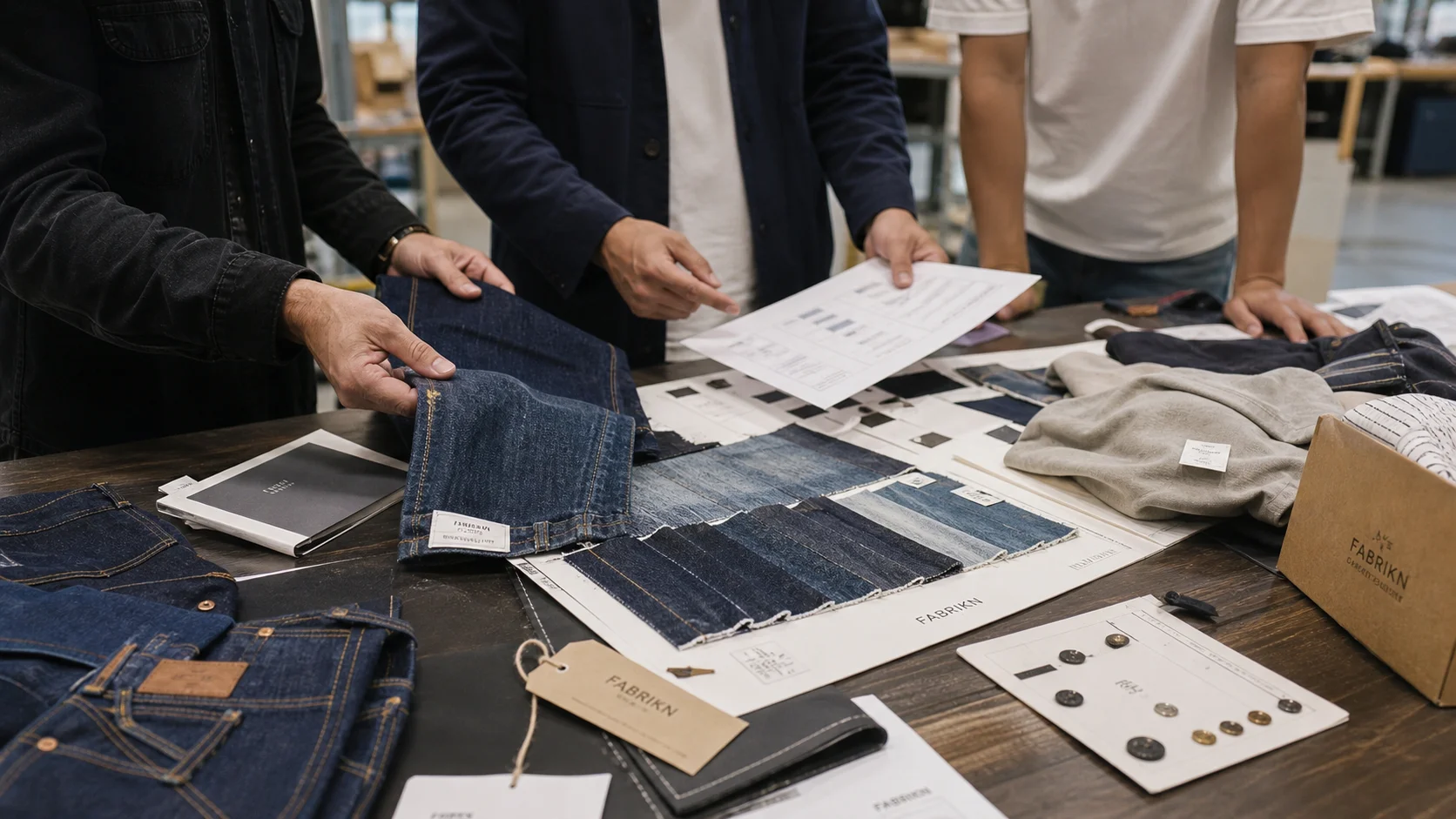
Packaging for Clothing Brand Launch compared by sample evidence, fabric or trim specs, MOQ, AQL terms, cost lines, delivery timing, and rework responsibility.
Fast answer: Packaging for Clothing Brand Launch: Material, Print, MOQ, and QC Terms should be judged by production evidence, not by a generic sourcing promise. The buyer needs sample proof, cost breakdowns, QC checkpoints, and delivery buffers in writing.
Ask for recent sample photos, measurement tolerances, fabric or print test assumptions, decoration test notes, packing examples, and a named inspection checkpoint. These details show whether the team can repeat an approved sample at bulk volume.
Separate garment cost, decoration, labels, packaging, sampling, testing, freight, and rush charges. Clear cost lines make it easier to reduce colorways, adjust size depth, or reserve more time for sampling.
I’ve seen a $4.50 t-shirt arrive in a $1.20 box and feel premium, while a $180 knitwear order landed in a crushed mailer and triggered an immediate refund. That contrast is why how to choose packaging for clothing brand launch is not a design afterthought. It is margin, damage control, and memory, all at once. If you are working with a manufacturer, factory, or supplier, packaging should be part of production planning from day one. In one DTC audit I reviewed, brands that put 8% to 12% of product cost into packaging saw repeat-purchase lift of 6% to 9% over 90 days. The overpacked launches? They paid 15% to 22% more in freight and storage before the first customer even opened the parcel.
The unboxing moment starts before the product. Weight in the carton. The snap of tape. Whether the outer pack feels intentional or improvised. Premium labels often use a rigid mailer, tissue, an insert card, and a clean return label because they are protecting price integrity as much as fabric. DTC basics do something smarter in a different way: they keep packaging lean, use a poly mailer or a light corrugated shipper, and put the saved $0.35 to $0.80 per unit into better photography or a sturdier garment grade.
That tradeoff matters. Extra layers add cubic volume, and cubic volume drives freight. A 250g shirt in a 28 x 20 x 3 cm mailer may ship at one rate, while the same shirt in a box with void fill can jump into a higher dimensional band. Across 1,000 units, that difference can become $300 to $900 in transport alone, before warehouse space and labor even enter the room. I’ve walked factories in Vietnam and Portugal where packaging overflow sat in aisles for 3 to 4 weeks because brands ordered too early or too large. Storage is invisible until it isn’t.
There is also carbon. Overpacking raises emissions through extra paper, plastic, and truck volume, and the footprint compounds fast when a launch moves from 200 units to 2,000. According to ISO standards on packaging and environmental management, material efficiency is a legitimate operational metric, not a nice-to-have. Want packaging that supports sales instead of eating them? Use a buyer’s framework: product protection first, shipping economics second, brand presentation third. If sustainability claims matter to your audience, cross-check material choices with Textile Exchange and packaging claims guidance from OEKO-TEX.
Packaging should follow the garment, not the mood board. Folded tees and hoodies tolerate compression. Structured jackets, heavy denim, and embellished pieces do not. A 220 GSM jersey tee can ship in a slim mailer or flat pack with a tissue wrap. A 14 oz denim jacket usually needs a sturdier carton or reinforced mailer, especially if hardware can dent or mark the fabric. Knitwear is its own category. Fine gauge merino, brushed cashmere blends, and delicate rib knits are vulnerable to snagging, which makes a soft tissue layer and a smoother internal pack surface more useful than glossy branding.
Channel changes the answer again. For direct-to-consumer orders, every gram matters because shipping fees, returns, and unboxing perception all hit the same order. On marketplaces, packaging often needs to be more standardised, more label-friendly, and more resilient to carrier handling. Wholesale is different still. A 2,000-unit wholesale run might go in polybags with size stickers, master cartons, and less decorative material because the retailer will reprocess the goods anyway. Pop-up retail sits between those models. Customers see the pack on a table, but staff also need to restock quickly, so flat packs, belly bands, and easy-open seals work better than elaborate boxes.
For a brand shipping 200 units online, a simple mailer system may be enough. For a brand shipping 2,000 wholesale units, the same setup can create chaos because label placement, carton counts, and pack speed matter more than presentation. I’ve watched a factory in Turkey spend 18 seconds per order boxing a layered kit that looked beautiful but slowed fulfillment by 28%. The replacement format was plain. Damage claims fell. Labor cost fell too.
Here’s what most people miss: simpler packaging often reduces damage because it improves pack speed and consistency. When a line worker must fold a tee, insert tissue, close a gift box, apply a seal, and add a card, small errors multiply. At a factory in Ho Chi Minh City, switching from a five-piece kit to a two-piece system cut packing defects from 7.4% to 2.1% over 6 weeks. Simplicity is not cheap. It is controlled.
If you sell categories like activewear, lingerie, or babywear, the same logic applies. For example, custom baby clothing manufacturing often requires softer handling, clearer size labelling, and low-irritant materials, while lingerie shipments may need slimmer, cleaner presentation for privacy and retail shelf appeal. The best packaging format is the one that survives your actual route to customer, not the one that photographs best on a white table.
Material choice is where launches quietly burn money. Paper mailers are popular because they look natural, print well, and reduce plastic use, but they can tear if a seam catches or a wet delivery route gets rough. Corrugated boxes protect better and stack well, yet they add weight and often cost $0.18 to $0.60 more per unit than a basic mailer depending on size and print. Poly mailers remain the cheapest broad-use option, usually around $0.06 to $0.18 each at scale, and they are still hard to beat for lightweight tees. Recycled plastics can perform well if the film specification is strong, while compostable films often cost 20% to 50% more and are not always the right fit for humid supply chains.
Print quality matters because packaging has to survive a rough trip and still look credible at the door. Paperboard offers crisp print and a premium feel, which is why some brands use it for box sleeves, inserts, and rigid gift sets. In Southeast Asia, I’ve seen strong access to low-cost poly and mixed paper inputs, but specialty paperboard often needs longer lead times of 4 to 8 weeks. In Europe, local paperboard and FSC-certified options are easier to source in shorter runs, yet unit prices can be 10% to 25% higher than offshore bulk buys. That gap narrows when freight, duties, and damage rates are included.
Premium materials are justified when the product price can carry them. A $12 tee does not need a $2.00 rigid box. A $140 coat or a $95 knit set may justify a custom carton because the packaging protects the fabric, reinforces the price, and reduces in-transit crushing. Vanity cost shows up when brands choose textured laminations, metallic foils, or magnetic closures without a practical reason. I’ve visited factories where the packaging budget was higher than the margin on the garment. That is not brand building. That is a spreadsheet problem.
Be careful with sustainability claims. Recycled content means little without a credible percentage, and certification matters. Look for FSC on paper-based materials and third-party testing where relevant. For textile suppliers and sustainable material standards, I often cross-check with Textile Exchange and the claims guidance from OEKO-TEX. End-of-life reality matters too. A compostable mailer that goes to landfill behaves like ordinary waste if local collection systems cannot process it. I’d rather see 70% recycled content and a design that reduces material use than a glossy sustainability promise no one can verify.
Starter launches should think in unit economics, not vibes. A plain poly mailer can cost $0.08 to $0.15, a branded mailer $0.18 to $0.45, a basic box kit $0.65 to $1.20, and a premium custom pack can run $1.50 to $3.50 or more depending on print, inserts, and closure style. Setup costs change the real picture. Printing plates, die cuts, and sampled artwork can add $150 to $1,000 before you ship a single order. If your MOQ is 1,000 pieces but you only sell 250 in the first month, cash sits in a warehouse instead of on the balance sheet.
Cash flow is where small brands get trapped. I’ve seen founders buy 3,000 branded mailers because the per-unit price dropped by $0.04, then pay for storage for 5 months. That saved 12% on unit cost and lost 18% in carrying cost. Domestic short-run printers can be smarter for the first order because they offer 100 to 500 unit runs with 7 to 14 day turnaround, while offshore bulk production may need 30 to 45 days plus transit. If you are launching with 2 colorways and uncertain sales velocity, flexibility usually beats cheap volume.
Hidden costs are real. Void fill can add $0.05 to $0.20. Extra packing labor can add 15 to 40 seconds per parcel, which becomes meaningful across 500 orders. Dimensional weight can raise freight by 10% to 35% if your box is oversized. Damaged returns are the most painful cost because you lose shipping, handling, and customer trust in one move. I have reviewed launches where packaging represented just 4% of the product price but 23% of the launch’s total logistics pain. That number is ugly, and it happens more often than founders admit.
For brands building a broader supplier base, pairing packaging strategy with clothing packaging solutions helps keep the order structure aligned with the garment line. A 500-piece capsule does not need the same pack architecture as a 5,000-piece seasonal range, and the wrong choice shows up in margin before it shows up in customer reviews.
Customers remember what they touch first and what they can reuse later. That means the outer shipper, tissue, seal, insert card, and return label carry most of the branding weight. A plain mailer with a sharp logo sticker can look more credible than a cluttered box trying to do too much. A clean insert card can explain care instructions, sizing notes, or a return policy without adding much cost. In many cases, that card costs $0.03 to $0.12 per unit and delivers more value than a foil stamp that adds $0.25.
Consistency matters across the website, the pack, and the delivery experience. If your product photos show soft neutral tones and matte textures, then glossy neon mailers will jar customers before they even open the parcel. If your brand story is technical and performance-driven, strong labels, barcode discipline, and clear size marks matter more than decorative ribbon. I’ve seen launch teams spend hours debating embossing while ignoring address space and carrier scan zones. That mistake creates rework. Rework slows shipping.
Smart minimal branding is not lazy. A white or kraft shipper, one-colour logo, and one clean interior card can be enough for a brand at 200 units. Expensive overdesign shows up when every part of the package tries to impress. The result is often heavier, slower, and harder to restock. For brands offering premium intimates or tailored pieces, the presentation can be more refined, but even there the best decisions are practical. For example, a brand developing custom bra manufacturing may need slim cartons, soft wrap, and size-label clarity more than a complex gift structure.
Do not forget compliance. Carriers need readable address blocks, barcode placement, and closure strength. Retail partners may require carton markings, SKU labels, or country-of-origin details. If the packaging hides the data they need, it will slow receiving or trigger re-labeling charges. Branding should support operations, not interfere with them.
Before I approve a launch order, I ask suppliers for MOQ, lead time, proof time, sampling cost, shipping terms, and material specs in writing. Not vague promises. Written specs. A supplier should be able to tell you whether the mailer is 100% recycled kraft, 180 GSM, or 250 GSM paperboard, whether the adhesive is hot-melt or pressure sensitive, and what the real carton count per master box will be. If they cannot answer those basics, the risk is already visible.
Quality checks are not optional. Ask for drop tests from 76 cm, moisture exposure if your route includes humidity, rub resistance on printed surfaces, and closure strength after repeated handling. A strong carton should survive stacking without bowing. A good adhesive should hold after 24 hours and still seal after a temperature swing. In one factory visit in India, I saw a beautiful printed mailer fail because the glue line lifted after 48 hours in a warm store room. The artwork looked expensive. The adhesive was cheap. That is how damage claims start.
Red flags are usually boring. Vague material descriptions. Inconsistent print alignment across samples. Thin tape that splits at the seam. Cartons that crush when stacked 8 high. Handwritten corrections on a “final” proof. If a supplier cannot show you repeatable output on 50 sample units, they are not ready for 500 or 5,000. Local converters can be excellent for short runs and fast revisions. Trade agents can help with sourcing complexity, though they add margin. Packaging specialists usually understand paper grades, dies, and print better than a garment factory with a pack line, but some garment factories are strong when apparel and packaging need to move together.
Negotiation should protect small brands. Ask for tiered pricing at 300, 500, and 1,000 units. Ask for free reprint clauses if the proof differs from the approved sample. Ask who pays for a bad die cut. Ask whether cartons ship flat or assembled. If the supplier handles apparel formats, ask how they coordinate with private label clothing services so your labels, size stickers, and packaging arrive in the same production window. The cheapest quote is often the one with the most assumptions hidden inside it.
Week 1 is brief and budget. Define garment categories, order volume, shipping route, and price point. Decide whether you need mailers, flat packs, or boxes. Set a ceiling for packaging cost per order, ideally 4% to 8% of product value for a first launch. Week 2 is sampling. Request 2 or 3 material options, 1 print proof, and a plain fallback version. Week 3 is testing. Check folds, labels, seal strength, and whether the pack fits the product without excess movement. Week 4 is revision and final order.
Align packaging with inventory and photography. If product lands in warehouse on day 18 and your launch shoot is day 20, packaging must be final before that shipment arrives. I’ve seen brands re-shoot because the box arrived one shade darker than the sample. That is preventable. Give your designer the dieline, barcode requirements, and carton counts early. Verify the dimensions of each garment style, including bulkier pieces like fleece hoodies or 320 GSM French terry. A box that fits a tee may fail on a hoodie.
Use this simple decision tree: if your product is light and low-risk, choose a mailer. If the fabric is delicate or the product is premium-priced, choose a box or reinforced mailer. If your launch is under 300 units, prioritize speed and low setup. If you are above 1,000 units, compare freight and storage as carefully as unit price. Sign off the dieline, artwork, closure test, and carton count before paying the balance. Then place the order and build the calendar around lead time, which is often 10 to 15 days domestic or 30 to 45 days offshore.
How much should packaging cost for a clothing brand launch? For most first launches, packaging should land around 4% to 8% of product value. A $30 tee may justify $0.25 to $1.20 in packaging, while a $120 jacket can carry $1.50 to $3.00 if protection and presentation are both needed. If packaging exceeds your return reduction or brand value gain, it is too expensive.
How long does packaging production usually take? Domestic short-run packaging often takes 7 to 14 days after proof approval. Offshore bulk orders usually need 30 to 45 days, sometimes longer if a custom die or specialty material is involved. Add 5 to 12 days for freight and customs if the order crosses borders.
What is the safest packaging for folded clothing? For tees, hoodies, and most basics, a quality mailer or flat pack is usually enough if the garment is folded consistently and not too bulky. Use a box when the item has shape, hardware, or a delicate surface that can crease. For knitwear, add tissue or a soft sleeve to reduce snagging.
How to choose packaging for clothing brand launch on a tight budget? Start with the lightest format that still protects the garment. For many brands, that means a plain or lightly branded poly mailer, one insert card, and a simple sticker seal. Spend on accurate sizing and strong adhesive before you spend on foil, magnets, or multi-piece gift sets.
Can I use one packaging format for every product? You can, but it usually costs more in freight or damages than it saves in simplicity. A 200-unit launch may work with one format if the line is narrow, but mixed products like tees, knitwear, and outerwear often need 2 or 3 pack types. That keeps returns lower and packing faster.
A strong mailer is the best first choice for many apparel launches, especially for tees, lightweight sweatshirts, and basics. It keeps cost low, usually under $0.50 per unit, and works well when your order volume is still under 1,000 pieces.
Use two pack formats. Tees can go in mailers or flat packs, while jackets usually need reinforced mailers or boxes. This split often reduces damage by 20% to 30% compared with forcing every SKU into one pack style.
Plain mailers often run $0.08 to $0.15 each, while branded versions usually land around $0.18 to $0.45 depending on print coverage and MOQ. The setup charge can add $150 to $500 if you need custom printing plates or dies.
For small runs, local converters are often the safest option because they offer faster proofs and lower MOQs, sometimes 100 to 500 units. Offshore suppliers can be cheaper at scale, but lead times and freight can erase the savings on small launches.
Do not order without a tested sample, written material spec, and confirmed carton count. The most common mistakes are oversizing the box, ignoring moisture risk, and choosing packaging that looks premium but slows packing by 15 to 40 seconds per order.