
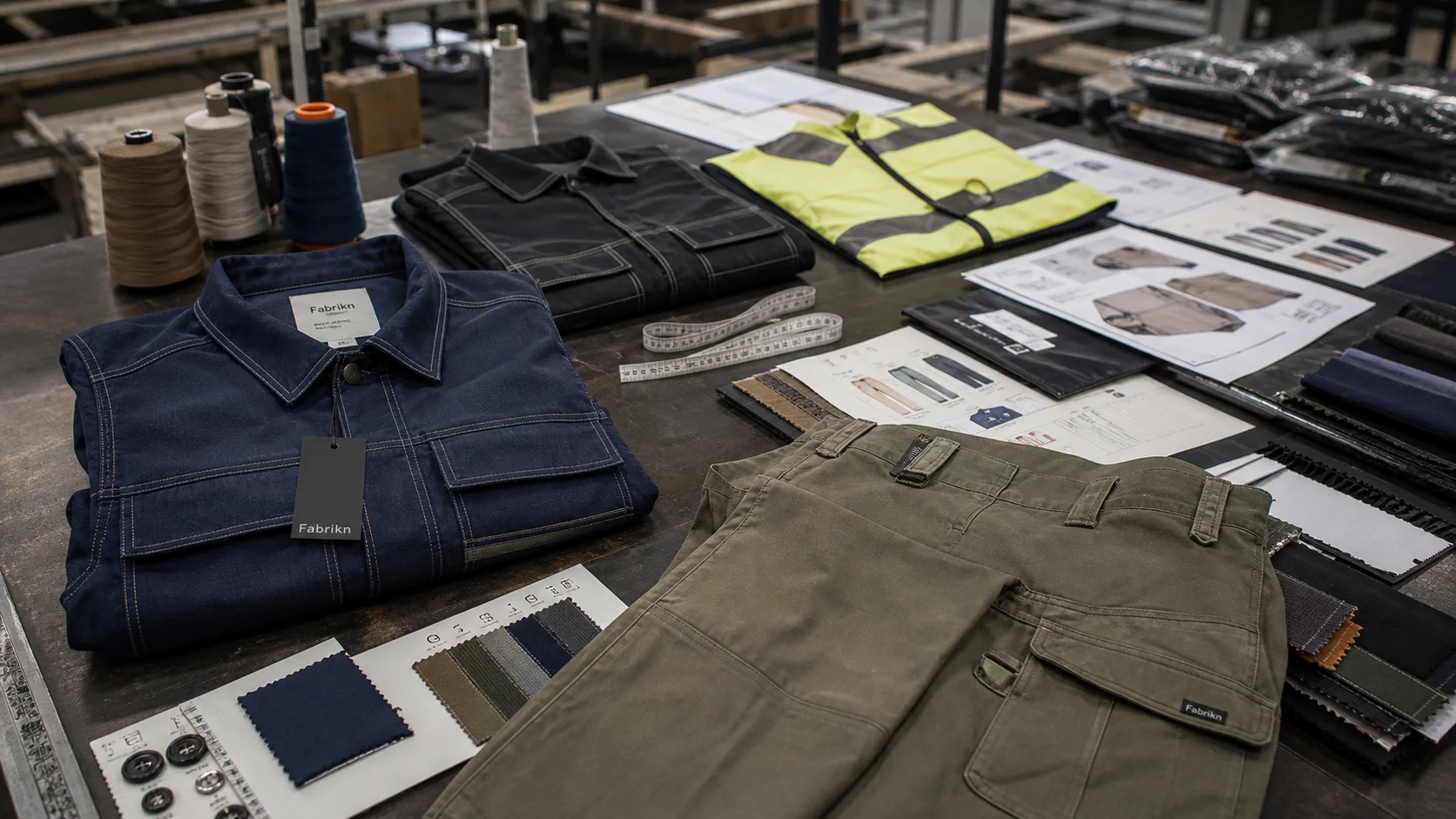
Private Label Packaging Supplier Review with checks for samples, fit, MOQ, QC evidence, pricing terms, and delivery risk.
Fast answer: Private Label Packaging Supplier Review: Capacity, Samples, Cost, and Risk should be judged by production evidence, not by a generic sourcing promise. The buyer needs sample proof, cost breakdowns, QC checkpoints, and delivery buffers in writing.
Ask for recent sample photos, measurement tolerances, fabric or print test assumptions, decoration test notes, packing examples, and a named inspection checkpoint. These details show whether the team can repeat an approved sample at bulk volume.
Separate garment cost, decoration, labels, packaging, sampling, testing, freight, and rush charges. When every cost line is visible, it becomes easier to reduce colorways, adjust size depth, or reserve more time for sampling.
The first clue is usually a dented carton and a disappointed silence. Open enough shipments in Guangzhou, Porto, and Los Angeles, and the pattern becomes hard to ignore: what looks polished on a screen can crack, crush, or mildew before it reaches a customer. If you are learning how to choose clothing packaging materials for brands, start with the bruise test, not the branding deck.
Across more than 200 factory visits in 8 countries—including assembly lines in Dhaka, thermoforming bays in Ho Chi Minh City, and die-cut workshops near Istanbul—the same mistakes keep showing up. In Asia, where labor can run $1.80 to $4.50 per hour in cut-and-sew hubs, brands often lean into more manual folding and prettier inserts because extra hands are affordable. In Europe, where labor can sit near €15 to €25 per hour, factories favor simpler pack-outs, faster throughput, and fewer SKUs per packing line. North America sits somewhere in between, but order volume matters more than geography. A 500-piece run tolerates custom printed cartons; a 50,000-piece run punishes inconsistency across suppliers.
Premium brands lose margin here because packaging drifts from necessity into theater. A $4 tee cannot carry a $0.85 package stack without chewing through the margin. A $240 knitwear item can, yet even there I’ve seen brands spend $1.40 on rigid boxes, magnetic closures, and tissue, then lose $8 to $12 in damage, returns, or re-shipments because the carton failed edge compression. Money leaking through vanity.
Common failure points repeat. Moisture ruins tissue and adhesive labels on routes with 70% to 90% humidity. Scuffing shows up when matte coated paperboard rubs against denim hardware. Overboxing adds cost, more void fill, and dimensional weight penalties. Brand inconsistency is the quiet killer: one supplier uses 250 gsm paper, another ships 180 gsm, and the customer gets two different unboxing experiences in the same season. According to the World Trade Organization, global trade flows keep pushing apparel across longer routes, which raises the stakes on packaging durability.
Standardizing three packaging specs instead of twelve solved most of this for one brand I worked with. Fewer stock-outs. Less MOQ stress. Cleaner handoffs between factories, 3PLs, and regional DCs. Packaging is not decoration. It is a controlled failure point.
Garment category changes the packaging brief faster than most founders expect. A 180 gsm jersey tee can ship in a lightweight poly mailer or a kraft envelope if the route is short and dry. A brushed French terry hoodie, especially at 320 GSM, needs better corner protection because bulk and fold memory make it prone to abrasion. Lingerie and swimwear need cleaner presentation and stronger privacy; outerwear needs bulk tolerance; accessories like belts or hardware-heavy bags need scuff resistance more than elegance.
For direct-to-consumer parcels, I usually look at parcel weight, fold count, and the last-mile carrier’s damage rate. Wholesale cartons shift the priority to pallet efficiency, master carton strength, and how many units can survive 3 to 5 handoffs. Export shipments add another layer: humidity, stacking pressure, customs delays. A 3-week domestic route from Chicago is not the same as a 6 to 8 week ocean shipment into Rotterdam or Manila.
Price point changes what customers will tolerate and what margin can absorb. A $28 basics program might allow packaging at 1.5% to 2.5% of COGS. A $120 sweater can stretch to 3% or 4%. A $250 outerwear piece may justify 5% if the packaging protects surface finishes, zippers, and trims. That ceiling matters. I’ve seen brands celebrate “luxury” packaging while ignoring that they just turned a 62% gross margin into 56%.
Some premium markets expose a counterintuitive truth: the cheapest mailer can cost more in the end. A mailer that costs $0.18 less but causes a 2% rise in returns becomes expensive fast once re-shipping, restocking labor, and customer service are counted. The best packaging is usually the one that survives the route with the fewest touches.
That logic also shapes my work with custom bra manufacturing projects, where cups can deform, straps snag, and delicate trims need flatter pack-outs. For categories with intimate or technical construction, the packaging spec should protect shape first, then brand image. The order matters.
If you want a practical answer to how to choose clothing packaging materials for brands, start by comparing paper, poly mailers, recycled plastic, corrugate, compostables, and reusable options against three tests: cost, damage resistance, and supply consistency. The cheapest unit price is rarely the cheapest real cost.
Paper mailers and kraft envelopes. These often run about $0.12 to $0.45 per unit depending on print, size, and MOQ. They work well for tees, lightweight knitwear, and flat accessories. Wet transit and edge crush are their weak spots. In humid markets, I’ve seen paper soften, seams fail, and labels peel after 24 to 72 hours in uncontrolled depots.
Poly mailers. Standard versions can land around $0.06 to $0.20 per unit, while recycled-content versions often sit higher, roughly $0.10 to $0.28. They are light, cheap, and strong in wet conditions. Perception is the trade-off, especially for brands positioning themselves as premium or low-waste. Consistency is good because resin supply is broad, though print quality varies widely by supplier.
Corrugate. Rigid mailers and boxes often cost $0.28 to $1.20 each, with custom printed luxury cartons moving well above that at low volumes. Corrugate protects shape, supports premium presentation, and handles long routes better than thin paper. It also takes more storage volume and drives dimensional weight costs. I’ve watched a brand increase carton size by 18% to protect a sweater set, only to add $0.70 per shipment in carrier charges.
Compostables. These can cost $0.14 to $0.40 per unit, sometimes more if sourced in small runs. They sound elegant in a pitch deck, but I’ve seen them fail in humidity, tear during manual packing, or get rejected because the sealant film was incompatible with local collection systems. “Compostable” means very little if the destination market has no industrial processing.
Reusable packaging. Returns pouches and reuse programs can make sense at scale, especially for subscription or repeat-buy customers. But they need reverse-logistics discipline, barcode tracking, and a real recovery rate above 50% to justify the spend. A reusable pouch that disappears after one use is just an expensive poly mailer with a conscience.
Hidden economics matter. Dimensional weight can add 10% to 40% in shipping costs if the packaging is oversized. Storage volume can be just as punishing: 100,000 folded mailers may occupy 8 to 12 pallets, while the same unit count in cartons may require 15 to 20. Minimum order quantities also change the game. A printed box program may demand MOQ 1,000 to 5,000 units per size, while a stock mailer can start at 500 or even 250.
For brands sourcing in China, a good factory and supplier will usually stock 60- to 80-gram recycled kraft in Guangzhou, backed by a six-color flexo press and a folding-gluing line that runs at 120 meters per minute. In Dhaka and Ho Chi Minh City, I’ve audited production cells using automated banding machines and ultrasonic sealers, which keeps poly mailer quality consistent. Istanbul-based plants often focus on specialty textiles and finishers that double as packaging converters, blending corrugate liners with foam inserts for accessories.
Certifications matter. Ask for GOTS or GRS for organic cotton tie-ons, OEKO-TEX Standard 100 or WRAP for coated tissue paper, and BSCI for labor transparency. When a supplier in Guangzhou showed me the WRAP audit report, they could trace a 280 gsm recycled kraft rigid mailer from pulping to die cutting, with each roll numbered and matched to a certification batch. Certifications give you leverage with 3PLs and customs agents in Rotterdam, Hamburg, or Long Beach.
The best factories integrate digital prepress, vacuum-form prep stations, hydraulic die cutters, and CNC rule tooling to keep cutting tolerances within ±0.3 millimeters. Watch for inline quality systems: weight sensors, barcode scanners, and digital calipers on every pallet. That level of control is what keeps a $2.50-4.00 per unit premium rigid carton at 500 MOQ from showing ugly warpage after ocean transit.
Greenwashing happens when a brand swaps “biodegradable” for “biodegradable enough” without checking destination infrastructure. You can slap a PLA window on a mailed card, but if your customer base in Istanbul, Milan, or Vancouver can’t compost it, you simply confuse them. Transparency requires verifying certifications, providing fiber content, and tracking life-cycle emissions from your carton supplier’s bonded warehouse in Guangzhou to your DC in Miami.
Ask: is the poly mailer resin blended on-site with PCR feedstock? Does the recycled paperboard have a chain of custody? Can the converter produce a COA showing FSC or PEFC backing for the paper, or at least the GRS stamp for recycled input? Genuine sustainability messaging connects to operations—if you promise GOTS-certified tissue, you should be able to tell a customer which factory in Dhaka folded it, which plastic-free glue stick was used, and how many joules of energy the flexo presses consumed.
Traceability also prevents double-counting. If your supplier ships matte paperboard from Ho Chi Minh City and washes it with water-soluble inks at their Istanbul finishing hub, your carbon calculator must account for both freight legs. Don’t forget adhesives and tapes. Water-based adhesives with low-VOC content are common at compliant factories, but you need to verify that the polymer stays stable between 18°C and 30°C, especially if your cartons cross the tropics on a 18-22 business days ocean voyage.
Cost and timeline are levers, not fixed ceilings. Here’s a working breakdown for a brand simplifying its line from twelve pack-outs to three:
Brands that want to lower waste must treat packaging as part of reverse logistics. Reusable delivery tubes, washable drawstring bags, and mailers with tear-away perforations force even couriers to handle them with care. Pair reusable sack programs with barcode tracking and incentives like partial refunds for returns shipped in the original pouch.
Damage reduction starts on the factory floor. Multi-axis folding machines, servo-driven banders, label applicators, and inline sealing systems in Guangzhou or Istanbul can apply the right tension so garments sit flat yet breathe. Combine that with packed counts tested on drop towers, and you lower breakage and returns.
Waste reduction also ties into material choice. Switching from single-use poly to compostable or PCR-coated paper reduces landfill contributions, but you must measure recovery rates and educate the customer. Fabrics packed with OEKO-TEX Standard 100 tissue, numbered for each shipment, make it easier to prove compliance and prevent greenwashing accusations.
Start with three specs: your “baseline” mailer, the “premium” rigid option, and any reusable pouch you want to pilot. For each, identify the minimum required certification (OEKO-TEX Standard 100 for liners, GOTS for fabric tags, GRS for recycled board, WRAP/BSCI for labor compliance). Request MOQs, tooling charges, and lead times in writing. Include specific location preferences, like Guangzhou for high-volume corrugate, Dhaka for flexible mailers, Ho Chi Minh City for quick-turn laminations, and Istanbul for specialty finishing.
Visit or audit the top contenders. Look for six-color flexo units, CNC rule cutting, automatic banding, and inline inspection cameras. Sample their material reels; request third-party lab tests for tensile strength, tear resistance, and humidity tolerance. Track those samples through the route you intend to use—20 kilometers inland to a distribution center, followed by a 18-22 business days ocean passage, then first-mile delivery.
Finally, define your recovery plan. How will you track returns, repackage, or recycle? Link your packaging choices to real processes on the factory floor, and the story goes from marketing fluff to measurable results.
Q: What certifications should I prioritize when evaluating packaging suppliers? A: Aim for OEKO-TEX Standard 100 for contact materials, GOTS or GRS for organic or recycled content, and WRAP or BSCI for ethical labor practices. Certifications prove accountability in Guangzhou, Dhaka, or anywhere your goods are assembled.
Q: How long does it take to get packaging from a factory to my distribution center? A: Expect 14-16 business days production plus 18-22 business days ocean transit if you ship from South China to Rotterdam, plus 2-5 days for customs clearance. Plan additional buffer for inspection holds.
Q: What is a realistic MOQ for custom packaging? A: Small runs can start at 500 with standard mailers; more complex rigid cartons often require 1,000 to 5,000 per size. High-precision finishes or foil-stamped panels typically slide toward the higher end because specialty tooling and longer machine setups are involved.
Q: Do reusable packaging programs actually reduce waste? A: Yes, if governed by reverse logistics and a recovery rate above 50%. Track the reuse cycle, barcode each pouch, and incentivize customers with loyalty points. Without operational discipline, the “reusable” pouch becomes a single-use poly mailer with extra marketing.