
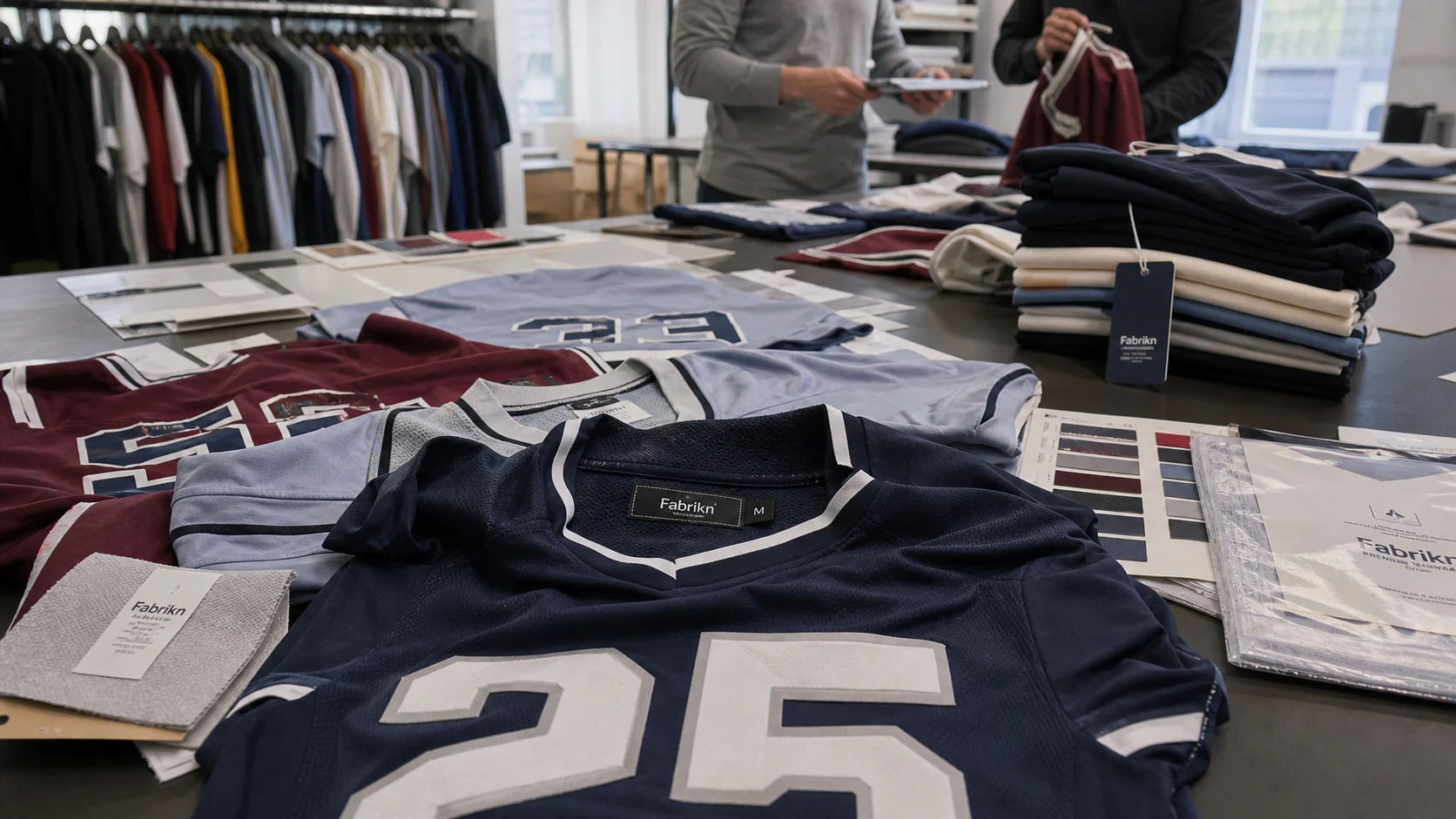
Clothing Packaging Materials with checks for samples, fit, MOQ, QC evidence, pricing terms, and delivery risk.
Fast answer: Clothing Packaging Materials: Product Fit, Claims, Cost, and MOQ should be judged by production evidence, not by a generic sourcing promise. The buyer needs sample proof, cost breakdowns, QC checkpoints, and delivery buffers in writing.
Ask for recent sample photos, measurement tolerances, fabric or print test assumptions, decoration test notes, packing examples, and a named inspection checkpoint. These details show whether the team can repeat an approved sample at bulk volume.
Separate garment cost, decoration, labels, packaging, sampling, testing, freight, and rush charges. When every cost line is visible, it becomes easier to reduce colorways, adjust size depth, or reserve more time for sampling.
I’ve seen $28 shirts packed in $0.09 poly bags and still rejected on arrival. The box crushed, the hanger hook punched through, and the print rubbed off before the carton cleared the port. That is the hard lesson behind how to choose packaging materials for clothing: the cheapest component is often the one that creates the most expensive mess.
Across 200-plus factory visits in eight countries, the same pattern kept showing up. In Bangladesh, bulk-packed tees moved cleanly in 200 gsm kraft mailers, then got damaged in last-mile handling because the mailers were oversized by 18%. In Vietnam, premium knitwear looked flawless on the production line but picked up moisture stains during a three-week sea-freight leg. Portugal was different: higher labor costs did not mean higher packaging costs; it meant better packing discipline, fewer wrinkles, and less rework.
Bad packaging is not just a disappointed customer. Returns rise. Rebagging labor climbs. Freight penalties tied to dimensional weight show up. Chargebacks do too. I’ve reviewed orders where packaging added $0.22 per unit, but oversized cartons pushed air-freight charges up by $1.40 per piece. A brand selling 12,000 units a month does not shrug that off.
And here’s the part buyers miss when they stare at unit price. A $0.05 saving on a mailer can trigger a 2% damage rate, while a better spec can cut claims to 0.4%. On 50,000 units, that gap can wipe out thousands in gross margin. Packaging is not decoration. It is a control point.
I build the decision around three variables: garment behavior, shipping route, and retail promise. A French terry 320 GSM hoodie needs different protection than a silk camisole. Domestic parcel has different risks than cross-border air freight. A $14 basics brand can live with a simpler presentation than a $180 outerwear label, but both still need moisture resistance, tear strength, and fill-speed compatibility on the packing line.
First question I ask: handling constraints. How many touches does the parcel face? Does the carton go by pallet, loose parcel, or mixed warehouse transfer? Is transit three to four weeks long or three to four days? That answer decides whether you need a gusseted poly mailer, a corrugate box, tissue wrap, or a two-layer system.
The cleanest packaging spec I’ve seen on a factory floor was not the priciest. It was the best matched. A simple poly mailer worked for 180 gsm cotton tees moving domestically at low damage risk, while a premium folding carton added nothing but weight. That is the core of how to choose packaging materials for clothing: match the material to the garment’s behavior, not to your mood board.
For T-shirts, thin knits, and accessories, a 50-75 micron poly mailer or a 120-150 gsm kraft mailer is often enough for domestic parcel. Denim is heavier, harsher on seams, and less forgiving to abrasion, so I prefer a stronger outer, often a corrugate box or reinforced mailer, especially for cross-border routes. Knitwear needs wrinkle control more than crush resistance, which is why tissue wrap and a rigid fold can beat extra plastic. Outerwear needs volume control, moisture defense, and sometimes a hanger or garment bag. Baby clothing, especially small bundles with soft trims, benefits from clean, low-ink packaging; it is one reason brands working with custom baby clothing manufacturing teams often specify gentler internal wraps than adult basics.
Route changes the spec. Air freight punishes dead volume. Sea freight punishes moisture and time. Last-mile delivery punishes weak closures and thin corners. A package that survives a 20-day ocean leg may still fail in a courier van if the adhesive softens at 40°C or the flap tears at a hot depot. In Europe, I’ve seen recycled paper mailers hold up well in urban delivery networks. In humid parts of Southeast Asia, the same paper stock can warp before it leaves the warehouse.
Some premium knitwear needs less internal packaging than cheaper fashion goods. A $95 merino sweater packed in overstuffed tissue can trap humidity and crease at the fold, while a cleaner, lighter fold with one moisture barrier performs better in transit and storage. I learned that after a brand sent me samples from two factories, one in Italy and one in India; the simpler pack from the better-controlled production line arrived in better condition after 2,300 km of inland movement and 11 handling points.
For bulk programs, I compare three routes before approving any material: domestic parcel, cross-border parcel, and warehouse transfer. A warehouse move often tolerates simpler protection because it is short and controlled. Cross-border needs stronger seals and clearer labeling. Retail presentation matters too, especially for brands using private label clothing services, where the packaging is part of the first brand impression and not just a transport shell.
Sustainability claims on packaging are often flimsy because buyers confuse recycled content, recyclability, and compostability as if they were the same thing. They are not. A mailer with 80% recycled content may still go to landfill if local collection systems cannot sort it. A compostable pouch may be technically correct and practically useless if the buyer lives in a city with no industrial composting access. According to Textile Exchange, material sourcing decisions can materially affect footprint claims, but only when the data is complete and the chain of custody is documented.
Paper feels safer, plastic looks worse, and fiber-based alternatives sit in the middle. But paper usually has higher weight, which can raise shipping emissions on long routes. Plastic film can have a lower transport footprint and better moisture resistance, yet recycling rates depend on local systems and the exact resin mix. I have seen brands print “eco” on a molded fiber mailer, only to discover that the pulp source was unverified and the coating made it unrecyclable in 19 out of 20 municipal streams. That shortcut is cheap only until a retailer audit lands.
For buyers, the proof should be boring and specific. Ask for resin identification, recycled content certification, and test data for tear, water resistance, and seal strength. If a supplier claims FSC paper, request chain-of-custody documents. If they claim recycled PET, ask for the test method and the percentage by weight, not just marketing language. Standards bodies such as ISO and certification programs like GOTS matter because they define the rules behind the label, not the label itself.
Regional reality matters too. In Germany or the Netherlands, a paper-based mailer may be easier to recover than a mixed-material pouch. In parts of the US and the Gulf, flexible plastic recycling is patchy, so a mono-material film with clear disposal guidance can be more defensible than a mixed paper-plastic hybrid. I prefer claims that can survive a customs officer, a retailer compliance team, and a skeptical customer.
Watch the print layer. Soy ink, water-based ink, and uncoated paper are not automatic proof of low impact. Ask what the ink rub-off score is after 24 hours, whether the adhesive is solvent-free, and whether the packaging survives a 48-hour humidity test at 85% RH. If the supplier cannot answer, the sustainability story is probably only half built.
I have compared packaging quotes from Cambodia, Poland, and Mexico on the same 10,000-unit order, and the cheapest unit price rarely won. The lowest quote was $0.11 for a thin poly mailer in Cambodia. The highest was $0.42 for a printed corrugate box in Poland. Yet the landed cost gap narrowed once I added freight, damage, and repacking labor. That is why unit cost is the wrong first metric.
Here is the practical math. Unit cost is what the supplier charges for the item. Landed cost is that price plus freight, duty if applicable, warehousing, and waste. Dimensional weight can turn a bulky box into a carrier penalty. If a carton inflates parcel volume by 12%, you can lose more in courier charges than you saved in packaging procurement. On a 25,000-unit program, that can mean a swing of $6,000 to $18,000 depending on the service level.
Material choice changes perception too. A rigid box signals formality. A kraft mailer says lower impact and speed. A clear garment bag communicates retail readiness but can look cheap if the film is thin or cloudy. Premium branding does not always require premium packaging materials. I worked with a contemporary label that moved from a printed rigid box to a well-folded 140 gsm kraft mailer with tissue and a branded sticker. Packaging spend dropped from $0.58 to $0.31 per unit, and customer ratings on “arrival condition” improved by 7 points because the garments stopped shifting in transit.
For return-heavy categories, protection beats theatrics. Activewear and denim usually need stronger seams, while soft tees can travel safely in lighter packaging if the fold is tight and the fill-speed on the line is consistent. One factory in Turkey was packing 1,200 units per hour with near-zero rub-off because the adhesive spec matched the climate and the workers were trained on 2-fold versus 3-fold methods. I’ve also seen factories burn money by adding tissue to every order, even when the tissue added no protection and only delayed packing by 18 seconds per unit.
The customer impact can be measured, not guessed. I track complaint rate, return reasons, and unboxing images. A difference of 0.5% in crush damage looks small on paper, but on 80,000 units it means 400 avoidable incidents. If each incident costs $8 to reship or refund, that is $3,200 before you count the brand damage. A material that costs 3 cents more can be the cheaper choice. A material that costs 3 cents more and saves 80 cents in freight may be even better.
My rule of thumb is simple. Spend more on protection when the route is rough, the garment is fragile, or the customer pays above $60. Spend less when the item is basic, dense, and low return risk. The middle ground is where buyers should demand samples, not slogans, and where clothing packaging solutions can be tailored to the exact mix of cost, print quality, and transit risk.
A brilliant material on a supplier’s sample table can fail in production if the factory cannot run it at speed. MOQ, lead times, and print complexity decide whether your packaging idea is real or decorative. I’ve seen buyers approve a gorgeous soft-touch box, then discover the supplier needed an MOQ of 20,000 units, a six-week print slot, and climate-controlled storage that the factory did not have.
For smaller brands, 500-1,000 units is often the threshold where custom print becomes viable. For larger retailers, 10,000-50,000 units is where color consistency and adhesive performance start to matter more than one-off aesthetics. If you use spot UV, foil, or multi-color print, expect longer lead times and more waste. Flexographic printing can be faster for simple logos; offset can deliver sharper detail, but it also increases setup complexity and plate costs. The real question is whether your supplier can maintain batch consistency across three runs, not just one sample.
Storage conditions are part of the supply chain, not an afterthought. Paper that sits in a damp warehouse for eight weeks may warp. Film can cling or lose seal integrity in heat. Adhesives can fail if cartons are stacked under pressure for 30 days. I ask factories to show me where packaging is stored, how they control humidity, and whether the line can pack at the expected fill speed without tearing or misfolding. If they are also handling cut-and-sew programs, as with cut and sew manufacturing, the packing schedule has to be integrated with sewing output or the whole order backs up.
Testing should be boring and repetitive. Run 30 samples. Check the same thing every time: moisture resistance, seam strength, ink rub-off, and closure reliability. A good supplier should also prove that the material fits the machine. If the mailer jams at 900 pieces per hour or the box flap slows the line by 12 seconds per bundle, the labor cost quickly eats the material savings. That is the difference between a spec and a functioning program.
The fastest way to choose badly is to approve a sample before defining the use case. Start with product size, fabric behavior, route, and price tier. Then request two or three sample options: one low-cost, one mid-spec, one protection-first. For a 220 gsm jersey tee, I might test a 60 micron poly mailer, a 140 gsm kraft mailer, and a small corrugate box. For a structured jacket, I would test tissue, hanger support, and a moisture barrier.
Before approval, collect the documents that make claims testable: material spec sheet, recycled content statement, chain-of-custody certificate, print proof, adhesive data, and transit test results. If the supplier talks about eco credentials but cannot provide a test report, treat that as a red flag. If they cannot say how much the print varies from batch to batch, I would not move to bulk. Small deviations in shade can be harmless on a tee pack and disastrous on a private-label outerwear line.
Run a pilot order. Not five pieces. At least 100-300 units, enough to see real handling patterns. Measure breakage, rebagging time, customer complaints, and return reasons. I also check whether the packaging slows the line by more than 5%. If the pilot performs well in summer and winter storage, then scale. If it only performs in a showroom, it is not ready. In factory audits, I look for moisture beads on paper stock, weak seam corners, and ink that transfers after a 10-second rub test.
The best packaging decision is often the one that looks slightly less luxurious on a shelf sample and performs much better after 14 days in transit.
Use this decision tree. If the garment is fragile, choose stronger outer protection. If the route is humid or long, prioritize moisture resistance. If the price point is low, simplify print and reduce weight. If the brand story depends on sustainability, verify the claim with documents, not adjectives. That is the structure I use when I review private label clothing services orders that need to balance margin, compliance, and customer perception. For brands sourcing from a manufacturer or factory in China, I also confirm whether the supplier can support custom and wholesale bulk runs without quality drift across production batches.
Basic poly mailers usually run $0.05-$0.14 per unit, kraft mailers $0.10-$0.22, and corrugate boxes $0.25-$0.70 depending on size and print. Freight, dimensional weight, and waste can add 15%-40% to the real cost.
T-shirts usually do well in lighter mailers or folded paper packs, while outerwear needs stronger protection, moisture resistance, and more structure. I look at fabric weight, wrinkle risk, and route length before deciding.
Simple printed mailers can take 2-4 weeks after approval, while custom boxes or multi-color print often need 4-8 weeks. Add another 7-10 days for sampling and corrections if color or adhesive testing is required.
Yes. Premium branding does not require virgin material. A well-printed recycled kraft mailer or certified recycled film can look high-end if the fold, finish, and transit performance are consistent.
Ask for MOQ thresholds, print method limits, and proof that the supplier can keep color and seal performance stable across 2-3 batches. Small brands often need 500-1,000 units, while larger programs start at 10,000 units or more.