
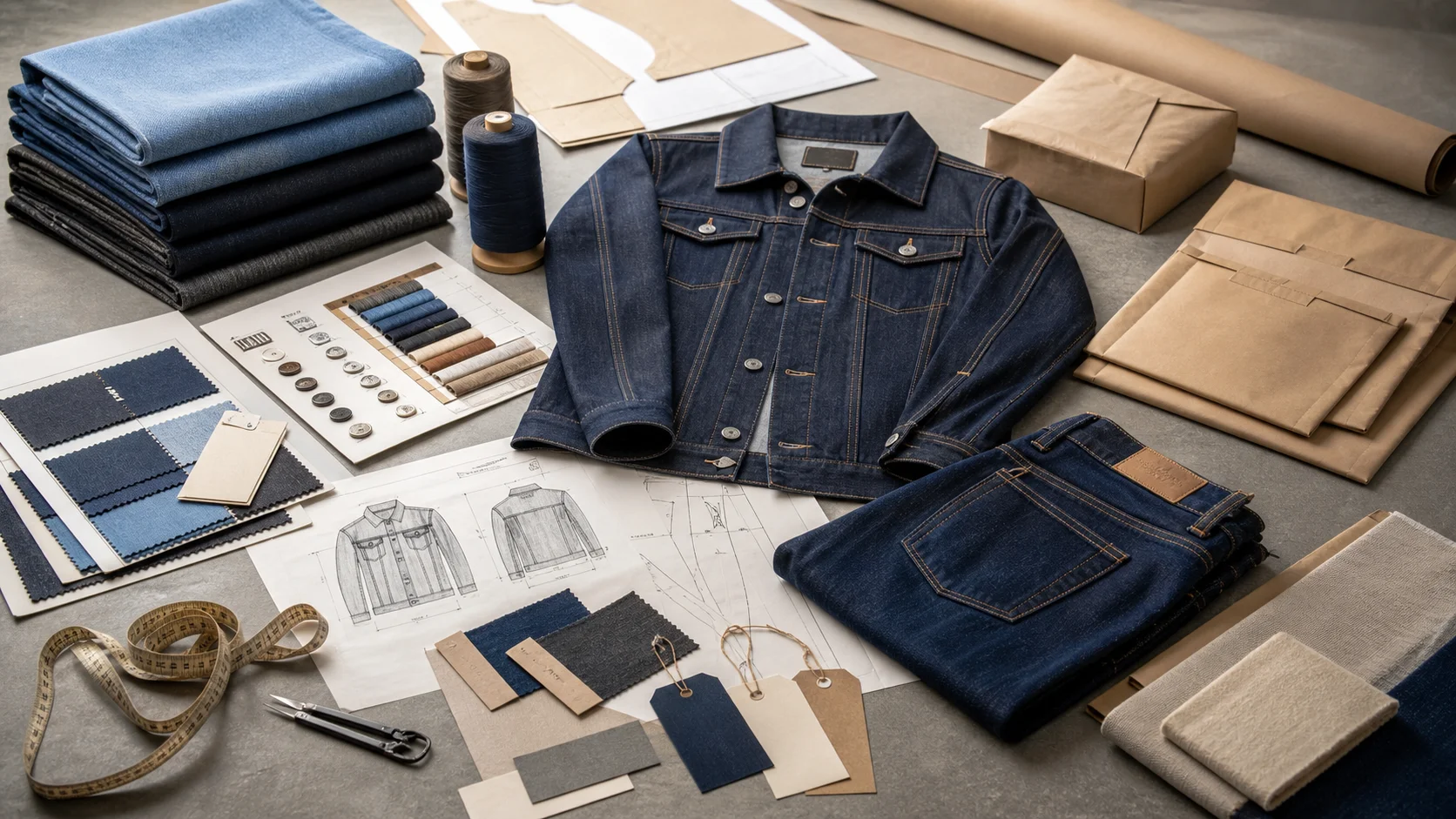
Small Batch Jeans Production in China with checks for samples, fit, MOQ, QC evidence, pricing terms, and delivery risk.
Fast answer: Small Batch Jeans Production in China: MOQ, Cost, and Lead Time should be judged by production evidence, not by a generic sourcing promise. The buyer needs sample proof, cost breakdowns, QC checkpoints, and delivery buffers in writing.
Ask for recent sample photos, measurement tolerances, fabric or print test assumptions, decoration test notes, packing examples, and a named inspection checkpoint. These details show whether the team can repeat an approved sample at bulk volume.
Separate garment cost, decoration, labels, packaging, sampling, testing, freight, and rush charges. When every cost line is visible, it becomes easier to reduce colorways, adjust size depth, or reserve more time for sampling.
In Guangdong, I watched a 300-piece jean run slip past a 30,000-piece export order on the same floor, and the contrast was impossible to miss. Two senior operators handled the small run, plus one washer and a technician checking shade bands with a light box. Bulk machinery owned the larger order. Attention owned the smaller one.
That was the day I stopped treating low MOQ as shorthand for weak capability. After more than 200 factory visits across 8 countries, I’ve seen that a small batch jeans manufacturer china can outpace bigger suppliers on precision because skilled labor gets assigned to the line, not just oversized equipment. In Guangzhou, Dongguan, and Ningbo, labor costs more, yet sample speed often runs 3 to 7 days faster than in inland regions. Wash coordination is tighter too.
In inland hubs, sewing labor may look 8% to 15% cheaper. Then the trim delay shows up. Or the wash partner is 60 kilometers away and rejects the lot for shade drift. I’ve watched a factory wipe out the buyer’s savings because the second sample, the re-cut, and the air freight erased the difference. Coastal denim clusters in China usually keep fabric, trims, pattern rooms, and laundries inside the same provincial radius. That matters.
Small batches in China can also come out with better wash consistency than larger runs because technicians can watch each lot more closely. On a 300-piece program, one wash engineer can inspect every bundle. On a 30,000-piece order, control leans more on statistical checks. Not perfect. Just tighter. Problems get caught before they spread.
The real point is simpler: cost, quality, and speed need to be judged together, not as separate wish lists. If you’re comparing custom jeans manufacturing quotes, the question is not which factory posts the lowest number. It’s which one can deliver the fit, wash, and timing you actually need.
Most factories call 100 to 500 pieces a small batch. Some will take 50-piece pilot runs for repeat clients if the fabric is stock-supported and the fit block already exists. For a first-time buyer, 300 pieces usually lands in the sweet spot: big enough for a proper sewing line, small enough to change the design without burying inventory.
The style sets the MOQ more than the country does. A five-pocket jean in 12 oz rigid denim can sometimes be made at 100 pieces with modest customization. Wide-leg fits, stacked hems, and barrel silhouettes usually want 300 pieces because the pattern engineering gets touchier. Selvedge pushes higher, often 500 pieces or more, since mills and looms have narrower output windows. Stretch denim adds its own complications: elastane content, recovery testing, and shrinkage behavior all need closer control.
In Zhejiang, I saw a factory treat a 300-piece order with enzyme wash, one embroidery placement, and a branded jacron patch as routine. Another shop in Guangdong handled 100-piece black denim runs with laser whiskering and ozone wash, but only because the fabric was already on hand. Want a custom 14 oz Japanese-look denim? The MOQ can jump to 600 or 800 pieces fast, especially if the mill requires 1,000 meters per color.
Fabric weight from 10 oz to 14.5 oz? Normal. Rivets, tack stitching, woven labels, leather or paper patches, embroidery, patchwork panels—also normal. Fit blocks can shift too. I’ve approved waist rises, inseams, and thigh grades on orders as low as 200 pieces. Trouble starts when buyers ask for multiple fits, four washes, two hardware finishes, and a bespoke fabric all at once. Then low MOQ gets expensive.
private label clothing services help because the factory already knows label placement, hangtags, and carton marking. Limits still exist. Guangdong and Zhejiang usually support faster sampling, while some inland hubs may offer lower sewing costs but slower trim sourcing. A 300-piece order can move in 2 to 3 weeks if the fabric is stocked. The same order can drift to 6 weeks if every button and patch has to be sourced from scratch.
Factory price is the headline. Landed cost is the real number. Sampling fees, fabric, trims, labor, wash costs, QC, packaging, freight, duties, banking charges—those all belong in the stack. On a small run, every fixed cost bites harder because it gets spread across fewer units. A 300-piece order can easily run 20% to 35% higher per unit than a 1,000-piece order at the same factory, even before shipping.
Fabric usually takes 25% to 40% of unit cost. Washing and distressing can add another 15% to 30%, depending on whether the brief calls for enzyme wash, stone wash, hand sanding, tinting, or laser whiskering. Labor on a basic five-pocket jean may sit at $2.20 to $4.50 per piece in China, while premium wash programs can tack on another $1.50 to $3.00. With selvedge or sustainable denim, fabric alone can jump 30% to 60% above standard dyed denim.
Buyers miss the hidden costs, then blame the factory. Pattern revisions may cost $30 to $120 each. Size set samples often run $25 to $80 apiece. Shrinkage tests and colorfastness tests can add $40 to $150, depending on the lab and the number of fabrics. Freight from mill to factory—especially split deliveries—often lands at $60 to $200 per shipment. Rework after a failed wash hurts most of all. One bad batch can wipe out the savings from a lower quote.
Budget denim on a 300-piece run might land around $7.50 to $12.00 FOB per unit if the wash is simple and trims are standard. Mid-market premium denim usually sits at $12.00 to $22.00 once better fabric, sharper fit work, and a more complex finish enter the picture. Higher-end selvedge or sustainable denim can run from $22.00 to $40.00 and beyond. Not random. It comes down to fabric sourcing, labor intensity, and the number of times the garment gets touched before packing.
In my experience, buyers who stare only at the ex-factory figure underbudget by 15% to 25%. Ask for a full cost stack and compare it line by line. A quote that looks $1.20 higher per pair may actually be cheaper once testing, carton packing, and better wash yield are included. Need tighter cut-and-sew control? cut and sew manufacturing with clear consumption data can keep surprise fabric losses from sneaking in later. Data from Textile Exchange, OEKO-TEX, and AATCC shows why fabric performance and testing matter so much: denim is not just a garment, it is a chain of measurable variables.
China is not always the cheapest place to make jeans. Fast, though? Often yes. Against Bangladesh, Vietnam, and Turkey, China usually wins on trim access, wash capability, and development speed. Bangladesh can beat it on labor cost for basic denim. Vietnam is strong on factory discipline and export compliance. Turkey has real fabric depth and close access to European buyers, but smaller programs can get pricey.
For a 300-piece run, China may quote $10.00 to $18.00 per pair where Bangladesh quotes $8.50 to $14.50, depending on wash complexity. Turkey might sit at $14.00 to $24.00, especially for fashion-forward fits and premium finishes. Those numbers matter only if sample speed gets included too. In China, first samples often take 2 to 4 weeks. In some competing hubs, the same process can take 4 to 6 weeks because fabric, trims, and wash trials come from different suppliers.
Quality control is where the difference shows up. In some low-cost hubs, wash consistency can swing more because specialized laundries sit farther away or aren’t as integrated into production. I’ve seen four shade levels on one order from a factory that promised uniform finishing. In China’s denim clusters, laundries often test enzyme strength, abrasion, and shade correction daily. That proximity matters when you’re making 100 to 500 units and every unit is visible.
China also lowers development risk for small collections. A higher quote can still create a lower launch cost if it prevents failed samples, missed approvals, and late freight. Last year, I worked with a brand that chose a Chinese factory quoting $3.00 more per pair than a Southeast Asian competitor. The Chinese factory delivered approved samples in 18 days, bulk in 41 days, and passed third-party inspection on the first attempt. The cheaper option failed fit twice and missed the selling window by 5 weeks.
Labor rate alone doesn’t tell the story. Speed, wash control, and trim coordination are the hidden variables. If your line depends on precise tapering, vintage fading, or a specific 13 oz hand feel, China often protects the calendar better than the spreadsheet suggests. WTO trade data and government sourcing guides from International Trade Administration and World Trade Organization help explain why regional production strengths remain so uneven.
I never trust a glossy showroom. I trust evidence. Before I send a tech pack, I ask for recent production photos, wash lab capabilities, QC records, audit reports, and references for similar denim styles. A factory can have a smooth salesperson and still fail at sewing a clean inseam or keeping wash shade stable across 300 units.
Business license, export experience, and compliance documents should be basic, not bragging rights. If the factory supplies EU or US accounts, ask for social responsibility audits, Restricted Substances List familiarity, and product testing records. If they can’t explain shrinkage behavior on 12 oz rigid denim or stretch recovery on 1% elastane, I keep walking. The technical floor matters more than the marketing deck.
Red flags tend to be small: vague MOQ claims, no pattern room, no in-house wash partner, refusal to quote sampling separately, sizing charts that change from one email to the next. If a factory won’t give exact fabric consumption, they probably don’t have the grading discipline you need. I also watch how fast they answer a technical question versus a sales question. The first one tells me whether they know the product.
Checklist:
Simple list. Effective filter. The best factories answer in numbers: $1.80 for sampling, 14 days for fabric booking, 0.78 meters consumption for size M, 3 wash options, 2 QC checkpoints. The weak ones answer in adjectives.
A normal small-batch timeline runs from tech pack to delivery in 45 to 90 days, depending on fabric and wash complexity. First samples usually take 2 to 4 weeks. Revisions add 1 to 3 weeks. Bulk production on many small runs takes 30 to 60 days, then shipping adds another 7 to 25 days depending on whether you choose air, rail, or ocean.
The timeline starts with development. Pattern making, fit comments, and sample stitching usually eat up the first 7 to 14 days. If the factory has to source fabric, tack on 5 to 20 days. Stock denim shortens the whole process, sometimes by 2 full weeks. Custom-dyed fabric or a sustainable mill order can stretch lead time by 15 to 30 days because the mill minimum and lab dips slow everything down.
Bulk cutting and sewing aren’t usually the bottleneck. Washing is. A factory can cut and stitch 300 pairs in 5 to 8 days, but wash approval may take 3 rounds if the indigo shade or abrasion level misses the target. Port congestion can add another surprise. I’ve seen a clean production run sit 6 extra days because the shipment missed its booked sailing. Not a factory failure. Still a launch problem.
Urgent runs only save time in a few places. Stock fabric, pre-approved wash recipes, and simple trim packages are the fastest path. You cannot rush color approval on raw denim without risking a mismatch. You cannot compress fit revisions if the jean is still cutting into the thigh. Those delays cost more than a few extra days of planning. Buyers who accept that early usually launch on schedule.
Build the calendar backward from the retail date. If shelves need product in 16 weeks, a 60-day bulk window leaves very little room for errors. A 300-piece order can move quickly, but only if the fit, wash, and trim decisions are locked before the line starts.
Start with a tighter brief than most buyers think they need. Define the target market, target retail price, fabric weight, wash effect, and order quantity before reaching out. A factory can quote a 320 GSM French terry hoodie in an hour; jeans take more precision. For denim, I want the fit block, inseam, rise, hardware, and wash reference all in one file.
Send the same tech pack to 3 to 5 factories and compare their responses on price, fabric suggestions, and technical accuracy. The best quote isn’t always the lowest. It’s the one that explains why a 300-piece run costs $9.80 instead of $8.90, then proves the math with fabric consumption and wash details. Ask for a pilot run or sales sample set before scaling. That cuts the risk of finding a fit problem after 1,000 pairs are already booked.
Structure payment milestones around proof points. I prefer 30% deposit, 40% after sample approval, and 30% after inspection for smaller programs, though some factories will want 50/50. Put rework clauses in writing. Use third-party inspection on the bulk lot, especially if the wash is complex. Then repeat only after the data checks out. If you need to start the conversation quickly, get a free quote and compare it against at least two others before you commit.
Most factories treat 100 to 500 pieces as a small batch. Some will do 50-piece pilot runs for repeat buyers, but that usually requires stock fabric and a simple wash program. Complex styles, like selvedge or heavy distressing, often start at 300 to 600 pieces.
Basic runs can land around $7.50 to $12.00 FOB per pair, while mid-market premium jeans often sit at $12.00 to $22.00. Selvedge or sustainable denim can rise to $22.00 to $40.00 or more. Fabric, wash, and trims drive most of the spread.
First samples usually take 2 to 4 weeks. Revisions may take 1 to 3 weeks, and bulk production often runs 30 to 60 days. Add 7 to 25 days for shipping depending on whether you choose air, rail, or ocean.
Yes. Most can handle enzyme wash, stone wash, laser whiskering, rivets, embroidery, patches, and custom labels. The catch is quantity: every extra wash or hardware finish raises cost and can push MOQ from 100 units to 300 or 500.
Start with Guangdong and Zhejiang if speed matters, because sampling and trim sourcing are usually faster there. Inland hubs may offer lower sewing costs, but trim coordination can be slower by 5 to 10 days. Ask each factory for recent denim references before you compare quotes.