
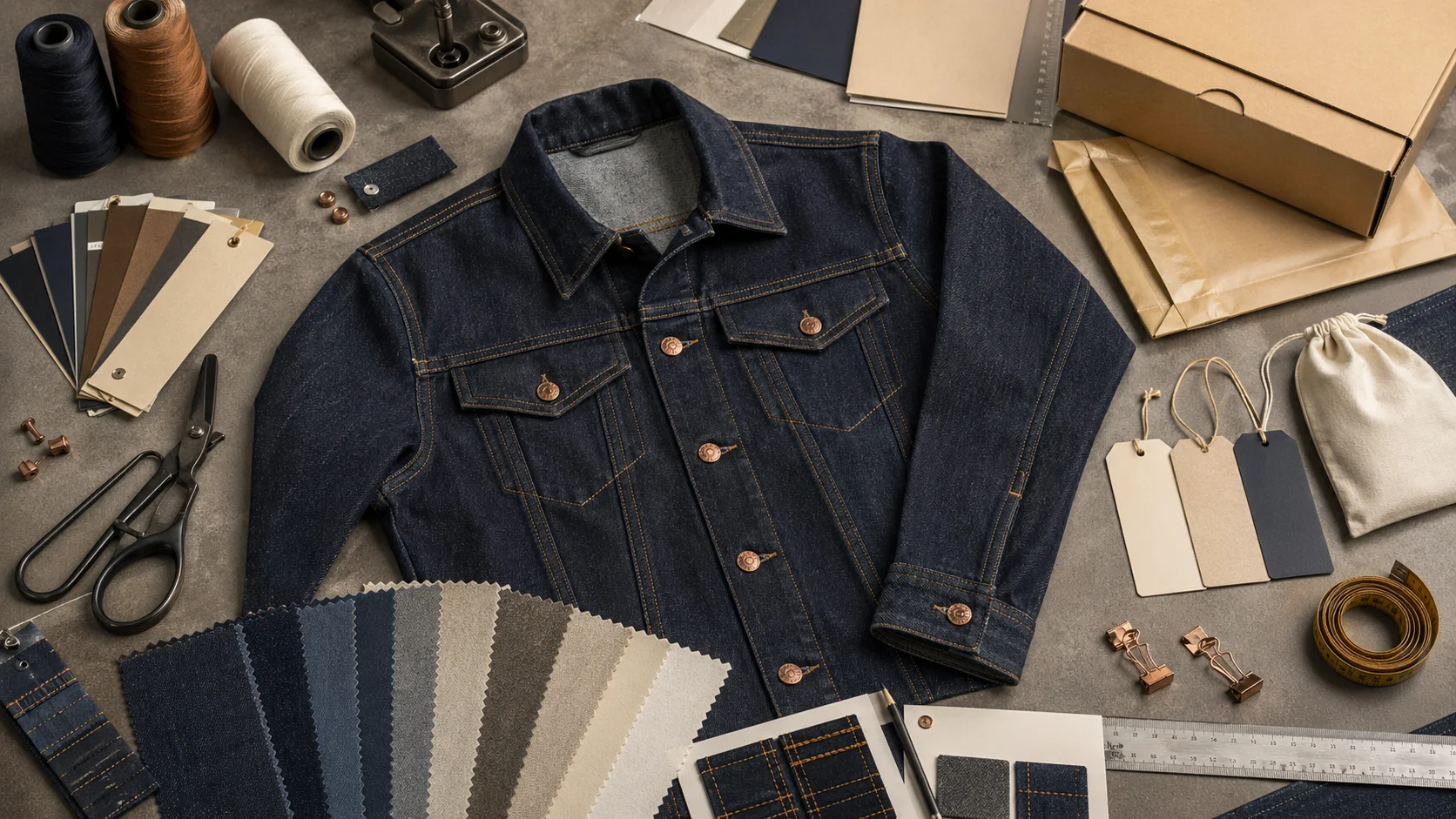
Garment Vendor Capacity Review with checks for samples, fit, MOQ, QC evidence, pricing terms, and delivery risk.
Fast answer: Garment Vendor Capacity Review: Samples, Cost Lines, and Risk should be judged by production evidence, not by a generic sourcing promise. The buyer needs sample proof, cost breakdowns, QC checkpoints, and delivery buffers in writing.
Ask for recent sample photos, measurement tolerances, fabric or print test assumptions, decoration test notes, packing examples, and a named inspection checkpoint. These details show whether the team can repeat an approved sample at bulk volume.
Separate garment cost, decoration, labels, packaging, sampling, testing, freight, and rush charges. When every cost line is visible, it becomes easier to reduce colorways, adjust size depth, or reserve more time for sampling.
One weak mailer can eat the profit from a hundred perfect orders. Packaging can swing a clothing shipment by 8% to 18% in DIM weight, and knowing how to choose packaging materials for clothing ecommerce can turn that spread into real savings. On a 120,000-order run, a shift from a bulky box to a tighter mailer can save thousands in freight, but a flimsy pack can push return handling costs up by $1.25 to $3.50 per order once damage, repackaging, and customer service are counted. That is why how to choose packaging materials for clothing ecommerce is no longer a branding question. It is a margin question.
At factories shipping 5,000 units a month, the pack table often looks almost casual: poly mailers, one sheet of tissue, a barcode, done. Move up to plants handling 500,000 units monthly, and the differences sharpen. In Vietnam, I saw mailer lines built for speed, 2 to 3 seconds per pack, while a Polish facility serving EU brands used paper-based systems with printed recycling marks and stricter batch checks. North American programs sat in the middle, mixing corrugated boxes for premium drops with branded wraps for basics.
That trade-off is not subtle. Light packaging cuts freight; weak packaging increases damage. In my audits, lightweight mailers reduced DIM weight by 8% to 18%, especially on tees, leggings, and underwear. But overly flimsy mailers raised damage-related returns by 1.5% to 4% in routes with rough handling, which erased the savings. I have seen a brand celebrate a $0.08 pack reduction only to spend $0.42 more per order on replacements and support tickets.
Premium packaging can fail in a counterintuitive way. More layers do not always mean better protection. Rigid gift boxes create void space, and knitwear collapses in transit, then creases against a hard edge. A prettier box can travel worse than a tight mailer if the garment is light, compressible, and poorly blocked. Founders miss that part when they buy packaging by mood board instead of by parcel physics.
The right pack starts with garment weight, fold volume, and snag risk. A 180 GSM jersey tee does not need the same protection as a 900 GSM wool coat. I’ve seen brands waste $0.18 to $0.60 per order on overspecified packaging because they chose by collection theme rather than product behavior. If you are learning how to choose packaging materials for clothing ecommerce, product type has to lead the brief.
T-shirts, tanks, and other lightweight basics usually ship well in poly mailers or paper mailers if the seam strength is sound and the fold is consistent. Knitwear is trickier. A 320 GSM French terry hoodie can tolerate a mailer, but a loose gauge sweater needs crush protection and better shape control, especially on long-haul routes. Denim sits in the middle. Jeans can ride in reinforced mailers for domestic trips, yet premium washes, rivet-heavy styles, and boxed sets often justify a corrugated flat pack.
Outerwear is where the cube bites back. A quilted jacket with a 2.5 cm loft can push parcel dimensions past a lower freight tier, so a paperboard box may cost more than the garment’s factory packing budget suggests. I have watched a $14.00 jacket ship in packaging that cost $1.10 because the carton occupied too much space. For lingerie and delicate accessories, protection is less about crushing and more about presentation and friction control; a tissue wrap plus slim mailer often works better than a rigid carton that rattles.
Single-SKU orders and mixed baskets need different logic. Single-size basics reward standard packs and fast picking. Mixed baskets, especially 3 to 5-item orders, need separation or compression planning so zippers, hooks, and buttons do not mark adjacent garments. A factory can run the same body in two pack specs, and the material spend can shift 20% to 35% between a basic tee program and an outerwear program without changing the garment spec at all.
For returns-heavy categories, choose the pack that is easiest to reseal and least likely to wrinkle. For giftable items, focus on a clean opening experience and a stable shape. For subscription orders, standardization wins because repeat packing drives labor savings of 10% to 15%. If your assortment includes babywear, the rules tighten again; I’ve covered custom baby clothing manufacturing projects where clean fiber-safe packing mattered more than glossy print.
Materials do different jobs, and they do not age the same way in transit. Poly mailers remain the workhorse because they are light, puncture resistant, and cheap to ship. A basic 2.5 mil poly mailer may cost $0.06 to $0.14 in volume, while a comparable paper mailer can land at $0.11 to $0.22. Poly also wins on moisture resistance, which matters on rainy last-mile routes and in humid ports where cartons sit for 24 to 48 hours before injection into carrier networks.
Paper mailers and corrugated boxes score higher on brand perception and, in some markets, curbside recycling. Europe is stricter on paper-based compliance, and brands selling into Germany, France, and the Netherlands often prefer a paper-first program because it aligns more easily with retailer requirements. Boxes give better crush protection for jackets, boots, and premium knits, but they also add weight and cube. A 180-gram box may seem small until you multiply it across 80,000 orders and watch freight and storage bills climb.
Tissue, garment bags, and inserts finish the job. Tissue adds little weight, usually under 10 grams, and helps reduce scuffing on satin, viscose, and printed surfaces. Garment bags protect tailored pieces, but they can be overused. A suit bag for a $42 blazer can be justified; the same bag for a $12 tee is waste dressed up as luxury. I’ve seen private label programs use subtle packaging to support margin, especially on private label clothing services where the pack becomes part of the product story.
Recycled content is useful, but it is not free of trade-offs. High-PCR plastic can vary in seal strength, especially when supply fluctuates between 30% and 80% post-consumer resin. Recycled paper can increase stiffness, which sounds positive, but it can also create dusting and print inconsistency on dark ink or fine line art. ASTM-style tests and supplier data sheets help here. According to ASTM, material performance should be verified against measurable standards, not assumed from recycled claims alone.
Compostability sounds clean until the pack is oversized or over-inked. A compostable mailer with 25% extra air volume and heavy black ink may carry a worse footprint than a smaller recycled poly option. The same is true for print performance: more color coverage means more ink, more drying time, and more risk of rub-off. For brands that build garments through cut and sew manufacturing, I usually recommend matching pack print to the line’s actual price tier, not the fantasy tier.
Buyers keep asking for a single packaging answer, but the economics only make sense in a matrix. I compare three routes most often: a low-cost poly mailer, a recycled paper mailer, and a corrugated box. The cheapest pack rarely stays cheapest after returns, chargebacks, and customer complaints.
Low-cost poly mailers usually run $0.06 to $0.16 per unit, with packing labor at 8 to 12 seconds and very low freight impact because the parcel stays compact. Typical damage rates sit around 0.5% to 1.5% for basics if the seal is solid. Recycled paper mailers often cost $0.10 to $0.24, take 10 to 14 seconds to pack, and can nudge damage up to 1% to 2% if corners or zippers protrude. Corrugated boxes range from $0.22 to $0.65, depending on flute, print, and board grade, with packing times of 15 to 25 seconds and damage rates of 0.3% to 1% for structured garments.
The freight math gets more interesting. A 15-gram material difference sounds trivial, but at 100,000 orders it equals 1.5 metric tons of product moved through a network. On air-heavy parcels, that can mean several thousand dollars in annual freight savings, especially when carriers charge by dimensional weight and zone. If the box grows by even 2 cm in one direction, the rate jump can be larger than the material cost itself. That is why total landed cost matters more than pack price.
Region changes the answer again. Brands shipping domestically can use lighter materials because there are fewer handoffs and less cross-border documentation. Cross-border shipping demands stronger cartons, better moisture resistance, and a closer read on recycling fees and import rules. Data from trade.gov shows packaging compliance expectations vary sharply by market, and that difference shows up in the bill. A carton that works in Chicago may fail a retailer spec in Amsterdam.
For budget brands, poly mailers win if the garments are low-risk and the return rate is under 8%. Premium brands often tolerate box costs because presentation supports conversion. Eco-led brands need to test whether a recycled paper mailer reduces complaints or merely raises cost. The key is to model total landed cost per order, not pack unit cost alone. On one 70,000-order program, a $0.09 pack became the most expensive option once 2.8% of orders came back damaged and customer care time doubled.
Packaging signals price before the customer touches fabric. A plain kraft mailer says value and efficiency. A soft-touch insert or rigid lid says premium, sometimes even before the garment earns it. Minimal ink and muted tones fit eco-first labels because they reduce visual noise and can cut print complexity. I have seen a $28 tee feel more credible in a simple recycled mailer than in a shiny laminated box that screamed waste.
The regulatory side is moving faster than many founders expect. Extended producer responsibility fees, plastic taxes, and recycled-content claims now affect real cash flow. In the UK and EU, reporting rules are becoming more detailed, and proof matters. Claims need supplier certificates, resin statements, and, in some cases, third-party test reports. If a vendor cannot show documentation for PCR content, moisture resistance, or recyclability language, treat the claim as marketing, not compliance.
North America is patchier, but not relaxed. State-level rules can differ on labeling and fee structures, and retailers are pushing their own restrictions even faster than legislators. A brand selling into wholesale accounts may need one spec for DTC and another for retail distribution. I have seen founders lose a month because a label on a mailer lacked the right disposal language for one major chain.
The brand choice should match the route, not the ego. A luxury label can justify a refined insert, but it still needs to keep total weight under control. A sustainability-led label should avoid over-inking and oversized finishes that undercut the message. If the pack cannot pass a compliance file review, the story will not survive procurement scrutiny. The market is less forgiving than the mood board.
For teams comparing supply options, it also helps to know whether the manufacturer, factory, or supplier can support custom, wholesale, and bulk production without slipping on quality or MOQ. In China and other high-volume sourcing markets, the documentation and production discipline you see at the quoting stage should match what you receive on the line.
For brands aligning packaging with sustainability goals, third-party standards can help validate claims. Textile Exchange guidance on preferred fibers and traceability is useful context for broader sourcing decisions, and OEKO-TEX certification helps teams check chemical safety expectations for packaging-adjacent materials and trims. You can review them at Textile Exchange and OEKO-TEX.
Suppliers love samples. Buyers should love data. Before I approve a packaging partner, I ask for basis weight, burst strength, seal temperature, recycled-content proof, ink migration details, and moisture resistance. If a supplier answers with vague phrasing like “strong enough” or “eco-friendly,” I keep digging. I have seen factories quote 7 to 10 days for sampling, then take 3 to 4 weeks once the artwork lands and the first proof fails.
MOQ is where many brands lose control. A low MOQ of 2,000 units looks friendly, but the per-unit cost can be 15% to 30% higher than a 20,000-unit run. On the other hand, ordering 100,000 mailers at once can lock in a better price and trap cash in storage for 6 to 9 months. The right answer depends on launch velocity, SKU volatility, and the probability that the pack will change again in one season.
I build a QC checklist that tests the pack like a real parcel, not a showroom sample. Drop tests from 1 meter, seal tests after 24 hours, humidity checks at 75% RH, print rub resistance, and dimensional tolerances within 2 to 3 mm are the basics. Only then do I look at artwork. A pretty print on a weak substrate is still a weak substrate.
Across regions, the factory reality varies. Some suppliers quote fast and ship fast, but only one in four samples may pass the first round without rework. Others are slower at the start and more reliable at scale. That is the difference between a pretty sample and repeatable production. The best partner is the one who can hold quality across 50,000 units, not the one who can impress you with a single perfect mockup.
Week 1 is audit week. I list every SKU, measure folded dimensions, record weight, and note damage history by category. Then I pull current pack sizes, labor seconds per order, and freight per zone. If the team cannot tell me how many grams are inside each parcel, the system is not ready for a redesign.
Week 2 is sampling. Ask for two or three pack formats, then test them across 200 to 500 orders each. Track damage rate, packing time, freight cost per order, customer review sentiment, and packaging spend as a share of revenue. I also like to watch one night shift and one day shift, because speed changes when the supervisor changes.
Week 3 is approval. Procurement checks price, operations checks throughput, and sustainability checks claims and certificates. If you need a quick benchmark, compare your samples against actual clothing packaging solutions from established suppliers, then decide whether the lowest-cost format survives real handling. This is also the moment to confirm if returns can be resealed cleanly and whether labels survive abrasion.
Week 4 is rollout. Launch one pack on a defined SKU cluster first, not the whole catalog. Hold back a control group, then compare against the pilot for 30 days. If damage stays flat or drops and freight improves, scale. If not, revise the spec and retest. Packaging should earn its keep in cost, carbon, and customer retention, not just on Instagram.
Start with garment type, shipping lane, and return risk. For lightweight basics, a poly mailer or recycled paper mailer is often enough, while jackets, denim, and premium knits may need a corrugated box. Test the pack in real orders before you scale. That is the practical core of how to choose packaging materials for clothing ecommerce.
Typical unit costs run from $0.06 to $0.16 for poly mailers, $0.10 to $0.24 for recycled paper mailers, and $0.22 to $0.65 for corrugated boxes. Add labor, freight, and returns, and total pack-related cost can swing by $0.30 to $1.20 per order.
Sampling often takes 7 to 10 days, but first-round corrections can extend that to 3 to 4 weeks. If the artwork is complex or the recycled-content claim needs documentation, build in another 1 to 2 weeks for proofing and compliance review.
Not always. Paper mailers work well for light, low-snag items, but they are weaker on puncture resistance and moisture protection. Structured jackets, denim with hardware, and humid shipping lanes often perform better in plastic or boxed formats.
Ask for basis weight, seal strength, recycled-content proof, humidity performance, and print rub tests before you sample. Then run drop tests, seal checks, and dimensional checks on 50 to 100 units. The supplier that can repeat quality at 50,000 units is usually the safer choice.