
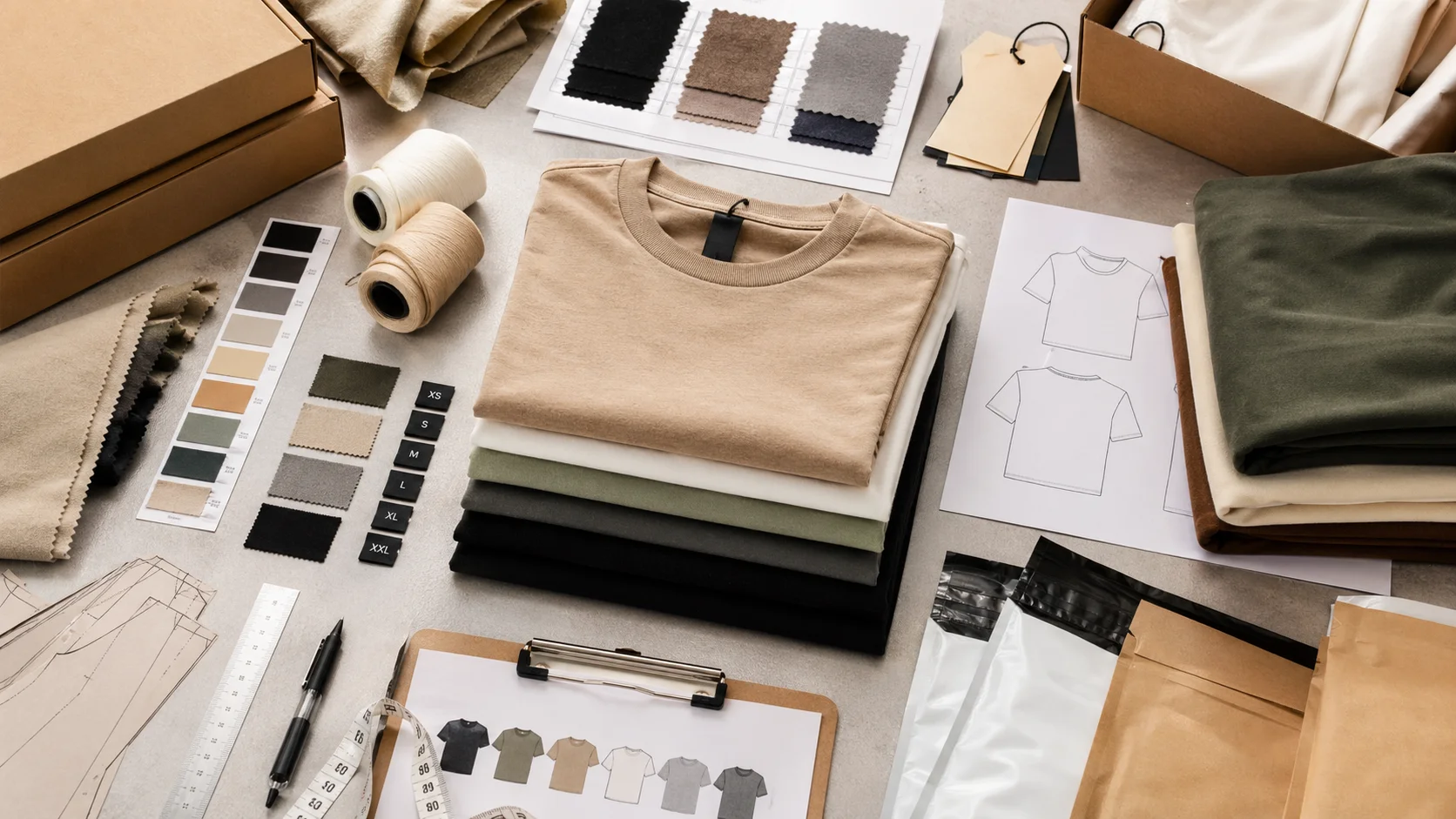
Create A Clothing Packaging Unboxing Journey with checks for samples, fit, MOQ, QC evidence, pricing terms, and delivery risk.
Fast answer: Create A Clothing Packaging Unboxing Journey: Material, Print, Packing Flow, and Cost should be judged by production evidence, not by a generic sourcing promise. The buyer needs sample proof, cost breakdowns, QC checkpoints, and delivery buffers in writing.
Ask for recent sample photos, measurement tolerances, fabric or print test assumptions, decoration test notes, packing examples, and a named inspection checkpoint. These details show whether the team can repeat an approved sample at bulk volume.
Separate garment cost, decoration, labels, packaging, sampling, testing, freight, and rush charges. When every cost line is visible, it becomes easier to reduce colorways, adjust size depth, or reserve more time for sampling.
The moment a package lands in a customer’s hands, the judgment begins. That is why how to create a clothing packaging unboxing journey starts with the box, not the fabric. If you are planning how to create a clothing packaging unboxing journey, the first impression should feel intentional, clean, and easy to open. I have watched buyers open a $38 tee in a rigid carton and call it “thoughtful,” then dismiss a $140 knit in a wrinkled mailer as “cheap,” even when the knit was 260 GSM and beautifully finished.
In factories across Guangdong, Ho Chi Minh City, and northern Portugal, the same pattern showed up again and again in 200-plus audits: clean sequence beats expensive clutter. A $0.18 poly mailer with a crisp tear line, a flat-folded garment, and a properly sized insert can beat a $2.40 rigid box that arrives scuffed, oversized, and noisy. Customers notice fit, order, and restraint. Waste, too. A box with 35% void space feels careless; a right-sized carton says the opposite.
Mass-market poly mailers still make sense for low-margin basics because they cost about $0.12 to $0.30 each and ship flat, which keeps freight down on orders with one or two units. Mid-tier cartons usually land around $0.55 to $1.20, and they give enough structure for retail appeal without turning the package into a prop. Premium rigid packaging can run $2.00 to $6.50 per unit before print and inserts. It only feels premium when the tolerances are tight, the corners are sharp, and the opening path is obvious.
Factory audits keep proving the same blunt truth: simple packaging looks richer when execution is precise. I have seen a brown FSC carton, 350 GSM tissue, and one matte sticker outperform foil stamping by the dozen because the edges lined up within 2 mm and the closure landed exactly where the hand expected it. Precision reads as intention. Sloppiness reads as budget, no matter the spend.
A package should echo the promise on the hangtag. If the brand sells quiet luxury at $120 to $250, the unboxing should feel pared back, not theatrical. If the label is youth-led and direct-to-consumer, the sequence can carry more personality, but it still needs structure. Think of packaging as a physical homepage: brand voice, price point, product category. Same order. Same message.
The best sequence is repeatable. Outer wrap, reveal, tissue, garment placement, insert, final detail. That is the skeleton. I have worked with brands that piled on three ribbons, a vellum note, a coupon card, and a postcard. Not luxurious. Crowded. One clean message, one visual accent, one reason to keep the insert. Enough.
Typography and color do most of the talking. A serif logo on recycled kraft stock says something different from a condensed sans-serif printed in black on uncoated white board. Scent can help, but only in tiny doses. I have seen brands spray lavender so aggressively that customers complained about transfer onto cotton jersey. A faint paper aroma or a naturally low-odor substrate is safer. For brands working through private label clothing services, packaging should reinforce the label hierarchy rather than compete with it.
There’s a budget version of this, too. A premium DTC brand can use a one-color box, two-color tissue, and a single insert with care instructions and QR code. A sustainable brand can use soy ink, 100% recycled board, and no lamination. A startup at $40 to $60 AOV can still create rhythm with a neat fold, a branded seal, and one well-placed message about fit or returns. The story lives in sequence, not in excess. If you are learning how to create a clothing packaging unboxing journey, this is where brand voice becomes physical.
The packaging that looks most expensive is not always the packaging that costs the most. Recycled paper, FSC cartons, and compostable mailers can all feel premium if the finish is calm and the construction is accurate. According to the ISO framework for quality and material consistency, tolerances matter more than embellishment when products are shipped at scale. In practice, I have seen a plain 400 GSM carton with a clean fold outperform a soft-touch laminated box that picked up fingerprints in the warehouse.
Eco claims fail most often when brands confuse material with outcome. A compostable mailer that tears in transit is not sustainable in the customer’s eyes, because the replacement shipment creates more waste and more cost. A recycled mailer with weak adhesive can be worse than a standard poly mailer if the order arrives damaged. I have measured returns rising by 8% to 12% on badly sized packages because the garment creased, the corner crushed, or the seal failed.
Here’s what most people miss: brands often overspend on finishes and underinvest in structure. A $0.40 box with a perfect dieline, exact depth, and no void space can feel more premium than a $1.80 box covered in foil, embossing, and a magnetic flap. The customer rarely remembers the finish details. They remember whether the order arrived flat, secure, and easy to open.
Minimize void space first. Mix materials only where the mix solves a real problem. Use paper bands, paper tape, or molded pulp when they protect and separate the garment effectively. Reusable components should earn their place. I only recommend reusable pouches if the customer actually reuses them, and that usually means the item has repeat travel value, not just a sustainability claim. For children’s basics, I have even seen packaging decisions shaped by custom baby clothing manufacturing requirements, where softness, safety, and easy opening matter more than visual drama.
For third-party verification, brands can also reference OEKO-TEX standards when choosing inks, trims, or textile-contact materials. That kind of proof is especially useful when a supplier or factory in China is producing custom packaging at wholesale or bulk volume, because it helps separate marketing claims from measurable quality.
Packaging budgets behave like garment budgets: the details matter more than the category name. A low-tier system for a basic tee may cost $0.15 to $0.45 per order using a poly mailer, tissue, and one sticker. A mid-tier system usually sits between $0.60 and $1.50 with a printed carton, tissue, and an insert. Premium systems often run $2.50 to $8.00, especially once you add specialty paper, rigid construction, or multiple print passes.
Print method shifts the number fast. Digital print can be cheaper for runs of 500 to 2,000 units, while offset becomes more efficient above 5,000. Dieline complexity matters too. A basic mailer is inexpensive because the geometry is simple. A custom fold with locking tabs, internal compartments, and precise garment restraint can add 15% to 30% to tooling and sampling cost. Foil, embossing, and spot UV are not free style points. They raise setup cost and increase the chance of rejection if alignment drifts by even 1 to 2 mm.
Lead times tell their own story. Stock packaging can move in 7 to 14 days if inventory is available locally. Custom packaging usually takes 4 to 8 weeks from final artwork to warehouse, and I have seen the first sample round consume 7 to 10 days before anyone approved the board thickness. Brands that want seasonal drops should plan backwards from launch, not from purchase order date. I have watched too many teams assume a 3-week window and then pay air freight to save a launch.
Regional speed varies. Suppliers in Vietnam and southern China often move faster on standard cartons and mailers because the supply chain is already dense. Factories in Italy and Portugal sometimes excel at high-detail print, premium paper sourcing, and shorter discussion loops, but their minimums and sampling fees can be higher. When a brand uses clothing packaging solutions across multiple SKUs, standardizing the inner components can save 12% to 18% in both cost and approval time. That is a practical advantage for any manufacturer balancing quality, MOQ, and production speed.
Social sharing starts with tiny visual cues. A centered logo on tissue reads better on camera than a loud outer print that disappears once the package is opened. A sticker placed where the hand naturally tears the wrap creates a clean reveal. A thank-you card that sits under the garment, rather than on top of it, keeps the sequence from feeling staged. The customer is filming a moment, not reading a brochure.
Some details feel expensive because they look controlled, not because they cost much. A matte uncoated paper insert with one sharp line of copy often performs better on video than a glossy card with six fonts. A ribbon can look cheap if it flops. A paper band can look refined if the fold is exact. I have watched a $0.09 belly band create more shares than a $1.10 magnetic closure because the opening felt easy and the image looked clean.
Protection affects memory too. Creased collars, bent hems, and loose pins are tiny failures that stay visible in user-generated content. I prefer packaging that keeps the garment return-ready without extra handling: tissue to protect the face of the item, one secure fold, and a bag or box that can be reopened without ripping through the product path. If the customer can reseal the package after trying on the item, the experience feels considered.
Place the care instruction where the customer sees it immediately after the reveal, not buried at the bottom. A short line on wash temperature, fabric content, or fit advice can reduce post-purchase friction. For brands running cut and sew manufacturing, that detail also signals product authority because it connects packaging to construction, not just presentation. It is another small way how to create a clothing packaging unboxing journey that feels memorable and useful.
A $40 tee does not deserve the same treatment as a $500 outerwear piece, and buyers know it. For the tee, I would keep the system tight: poly mailer or slim carton, one tissue layer, one insert, total packaging cost under 3% of order value. A $120 dress can support a structured carton, branded tissue, and a return-ready fold, with packaging around 4% to 6% of revenue. At $500, buyers expect a stronger physical statement, better protection, and a more deliberate opening, so 6% to 10% can be justified if freight and damage rates stay low.
Regional norms change the rules. In Europe, buyers often respond well to minimalism, recycled board, and restrained print. In North America, clear branding and practical return handling matter more, especially for e-commerce fashion where return rates can run 20% to 30% in some categories. In parts of Asia, premium presentation can lean more visual, with stronger color contrast and more obvious hierarchy. I have seen the same black box read as elegant in Copenhagen, severe in Toronto, and too plain in Seoul.
Standardize what travels well. Size guides, care inserts, tissue format, barcode labels, and return instructions can often be global. Localize only where it affects perception or compliance. Paper weight, language, and opening cues should shift by market. A glossy insert that works in one region may feel wasteful in another. Sustainability claims also carry different weight by market, so back them with evidence from recognized bodies such as Textile Exchange rather than vague green language. If a supplier offers custom or wholesale runs in China, ask for documented material specs before production starts.
The brand trap is assuming one package fits every buyer. It rarely does. Premium minimalism sells in some markets because restraint signals confidence. In others, a blank box looks underthought. I have found that the smartest brands keep 70% of the system identical and localize the remaining 30% with color, language, and material choice.
Start with the opening sequence on paper. Define what the customer sees at the outer layer, the reveal, the garment touchpoint, and the close. Then source three sample versions: one budget, one mid-tier, one premium. Test them with 10 to 15 real customers, not only the brand team. Ask each person to open, refold, and rate the package on clarity, perceived value, and ease of return.
Use simple proof points. Track unboxing videos, return-rate changes, damage reports, and survey responses from the first 30 to 60 days after launch. Measure packaging cost as a share of order value, with a target range of 2% to 8% depending on product tier. Review whether the package reduces customer service contacts about missing items, creasing, or hard-to-open seals. If the numbers do not improve, the design is only theater.
Build the experience in layers, test it under real shipping conditions, and keep every piece accountable to cost or function. A package earns its place when it protects the product, lowers friction, and makes the brand easier to remember on the second purchase. That is the practical end point for how to create a clothing packaging unboxing journey that supports growth.
Use a tight sequence: clean outer packaging, one tissue layer, one insert, and a single branded seal. A system in the $0.60 to $1.50 range can feel premium if the fit is exact and the folds are neat. Avoid extra finishes that add cost without improving the reveal.
Low-tier systems often cost $0.15 to $0.45 per order, mid-tier systems $0.60 to $1.50, and premium systems $2.50 to $8.00 or more. The biggest cost drivers are print method, volume, dieline complexity, and special finishes. Freight can change the total just as much as print.
Choose recycled paper, FSC cartons, or compostable mailers only if they perform well in transit. Keep void space low, reduce mixed materials, and use reusable components only when customers will actually reuse them. Sustainability loses credibility fast if the packaging fails and triggers replacements.
Stock packaging can arrive in 7 to 14 days if inventory exists locally. Custom packaging usually takes 4 to 8 weeks, including sampling, artwork approval, and production. Complex finishing can add another 1 to 2 weeks if the first sample needs changes.
Start by defining the opening sequence and the product tier it serves. Then test three sample versions with 10 to 15 customers and compare damage rate, shareability, and perceived value. The best packaging protects the garment, supports the brand story, and keeps cost under control.