
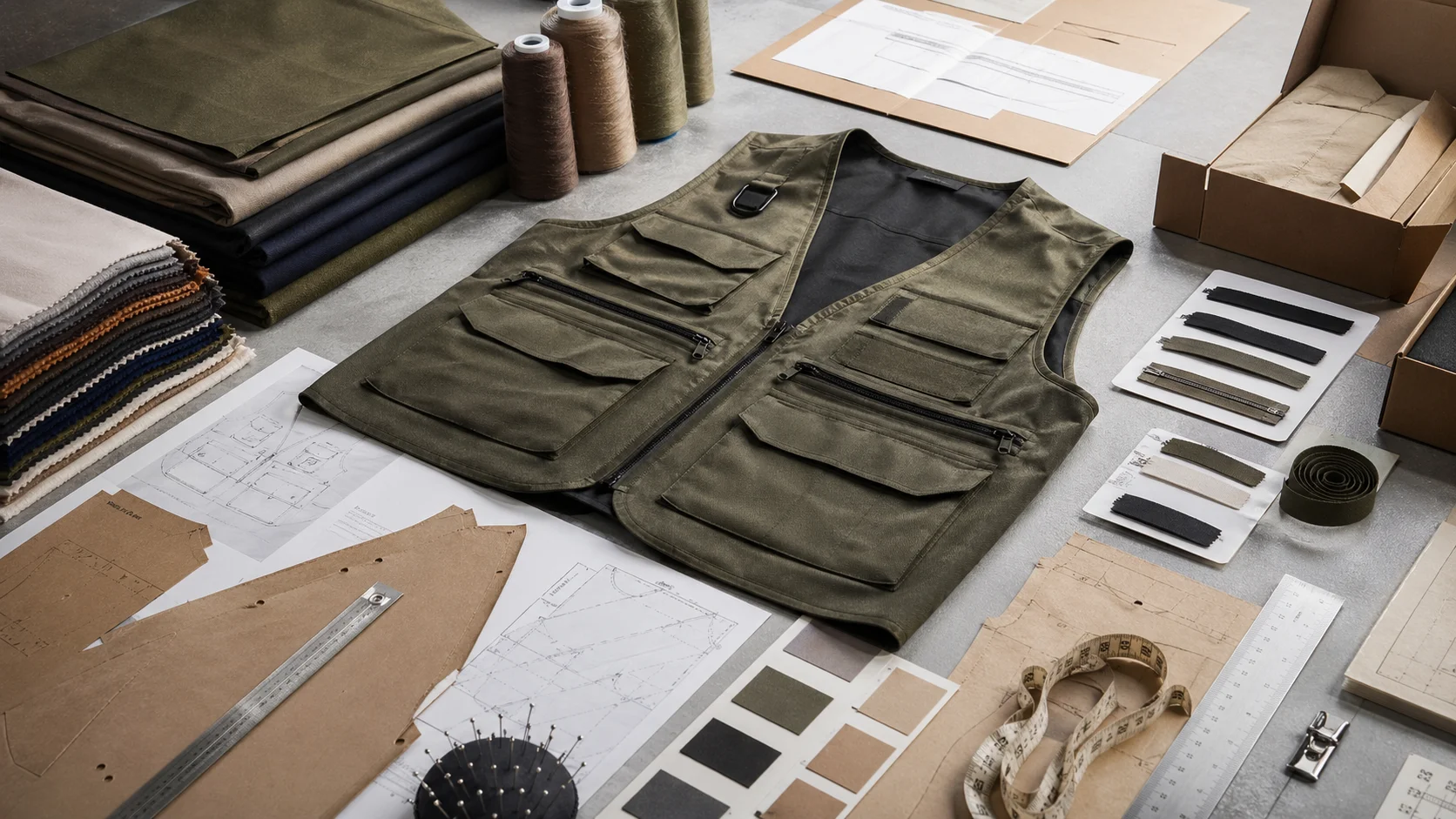
Apparel Box Practical Review with checks for samples, fit, MOQ, QC evidence, pricing terms, and delivery risk.
Fast answer: Apparel Box Practical Review: Board Grade, Inserts, and Damage Control should be judged by production evidence, not by a generic sourcing promise. The buyer needs sample proof, cost breakdowns, QC checkpoints, and delivery buffers in writing.
Ask for recent sample photos, measurement tolerances, fabric or print test assumptions, decoration test notes, packing examples, and a named inspection checkpoint. These details show whether the team can repeat an approved sample at bulk volume.
Separate garment cost, decoration, labels, packaging, sampling, testing, freight, and rush charges. When every cost line is visible, it becomes easier to reduce colorways, adjust size depth, or reserve more time for sampling.
The box has already started selling the garment before the customer touches the fabric. Sixty-one percent of shoppers say presentation affects whether they buy again, and I have watched that truth turn up on factory floors, in return rooms, and in the pause between a courier scan and the first lift of a lid. If you are learning how to design clothing packaging for unboxing, start there.
In the first 10 seconds, a $28 tee can suddenly feel like a $48 tee. Or a $180 blazer can feel cheap. I have watched brands spend $3.50 on a rigid box for a $22 basic and then ship the item inside on a flimsy hanger bag. Backwards. I have also seen a $9 poly mailer with crisp typography outperform a heavy box because the print was clean, the closure felt secure, and the unboxing moved fast.
When I visited a knitwear factory in Portugal, the production manager set out three order types side by side: a mass-market retailer using a $0.22 plain mailer, a mid-market DTC label using a $0.68 printed kraft mailer, and a premium brand using a $2.40 set-up box with tissue and a card. The premium program did look luxurious, but its return rate was 11% higher than the mid-market mailer because customers expected a polished finish and got annoyed when the garment arrived creased. Presentation raises expectations faster than product execution can always keep up.
By contrast, in Vietnam I saw a $14 blouse packed in a heavy branded carton, yet the inner fold plan was sloppy and the sleeves arrived crushed. The brand had put $1.90 per unit into outer packaging and only $0.06 into internal supports. Once the box opens, the customer touches the garment, but the mind has already judged weight, sound, and the order of reveals. Premium is not more layers. It is less friction.
Regional habits shape the package too. In North America, many brands overinvest in box structure and underinvest in print clarity. Across parts of Europe, brands often do the opposite: excellent recycled board, minimal ink, not enough reinforcement for cross-border shipping. In South Asia, factories can be brilliant at efficient folding and insert placement, yet some clients still insist on expensive textured papers that crush in humid transit. The best package survives 3 to 7 days in a courier network, then opens cleanly on a bedroom floor.
For brands working with custom clothing packaging solutions, the packaging brief should be treated like a product spec sheet, not a decoration request. The package sets the promise. The garment has to keep it.
Good packaging carries a brand across a website, a wholesale rack, and a return shipment without losing its voice. Three cues do most of the work: logo placement, typography, and color. Put the mark where the hand lands first. Keep typography legible at 1.5 to 2 meters on a shelf. Use one dominant color and one support tone, not six competing shades. If your brand owns black, ivory, or deep green, the box should say that before the lid comes off.
I’ve seen luxury labels use a 1-color blind emboss on 1200 gsm board and nothing else. I’ve also seen value brands use a single 2-color mailer with a bold sticker seal and build stronger recall than a pricier box. The point is not maximalism. Fit wins. A $35 basic should not arrive in a velvet-feeling package. A $450 coat should not show up in a generic pouch.
For basics, keep it practical: folded tissue, one insert card, one printed mailer or carton, and a return label tucked where it is visible. For occasionwear, include a hanger hook protector, garment bag, and a carton that resists edge crush over 1.2 meters of drop distance. For luxury, the ritual matters. Layering can justify a higher ticket, but only if every layer does something useful. For DTC drops, speed and memorability matter more than ornate finishes, especially when the average order value sits under $75.
Minimal packaging often signals sustainability, but it also signals confidence. Last year I worked with a brand that shifted from glossy wrap to uncoated FSC board, and the result was a 17% reduction in packaging weight and a 9% increase in repeat purchase intent in post-purchase surveys. The opposite can be true too. A premium bridal label I visited in Spain used layered tissue, a ribbon, and a handwritten note to justify a $680 dress. That presentation was not wasteful because the garment itself carried a 42% gross margin and a once-in-a-lifetime purchase cycle.
Consistency matters across channels. Wholesale buyers hate packaging that looks perfect online but arrives dented on the sales floor. Ecommerce teams hate cartons that cannot survive a 60 cm conveyor drop. Retail teams hate boxes that are impossible to stack in a 1.2-meter backroom shelf. If you are also building custom baby clothing manufacturing, packaging cues need to feel softer, safer, and cleaner, with simpler typography and less visual noise. The package should match the buyer, not just the brand deck.
No universal winner exists among mailers, folding cartons, tissue, inserts, and compostable options. The right format depends on garment weight, crease risk, shipping method, and how much handling the item will face before it reaches the customer. A 180 gsm jersey tee can live comfortably in a recycled paper mailer. A 320 GSM French terry hoodie, especially one with a structured hood and chest print, usually needs a folding carton or a reinforced poly mailer with corner protection.
Paper-based formats are strongest where brand perception and recyclability matter. Recycled kraft mailers, FSC folding cartons, and tissue made from 20 to 30 gsm paper give a clean, premium look and are easy to sort in many municipal systems. Plastic-based formats still have a role. A 35 to 60 micron poly mailer can outperform paper in rain, line-haul abrasion, and low-cost shipping lanes. Hybrid solutions, like paper mailers with a thin barrier layer, often promise the best of both and deliver the most confusion if they cannot be separated easily.
Here’s what most people miss: the cheapest-looking material can survive shipping better than the expensive-looking one. I’ve seen matte-coated cartons scuff badly on routes with 2 to 3 transshipments, while a plain kraft sleeve arrived almost pristine. Simple reason. Coating can hide compression damage until the box cracks, while uncoated fiber absorbs minor abuse better. A premium finish is not the same as durable structure.
In one Turkish factory, I watched two sample runs for a woven shirt. The first used a rigid box with foam insert and magnetic flap. Beautiful. It cost $2.85 per unit and added 180 grams to freight weight. The second used a 32 gsm tissue wrap, a scored board insert, and a 1-color sleeve. It cost $0.41 and reduced carton failure in transit by 14% because it fitted the garment better and left less empty space for crushing. Form should follow movement, not vanity.
For brands using private label clothing services, packaging should be specified alongside garment folding dimensions, not after production starts. If the fold height is off by even 1.5 cm, your mailer size changes, your freight cube changes, and your unboxing experience changes with it. For cut-and-sew programs, packaging should be approved with the final sample, since pocket bulk, embroidery, and trims can alter the fit. A loose package is a weak promise.
Packaging spend behaves like any other unit cost. Small changes compound fast. On a startup run of 500 pieces, a one-color printed mailer may cost $0.42 to $0.68 each, while a custom folding box can land at $1.20 to $2.10 depending on board grade and whether you add matte lamination or foil. At 5,000 units, those numbers can fall by 20% to 35%, but freight, plate fees, and warehousing can erase part of the savings.
For a mid-market brand shipping 8,000 to 20,000 orders a month, the sweet spot is often a hybrid package: $0.55 printed mailer for knits and basics, $0.95 to $1.40 carton for structured garments, and a $0.08 to $0.14 insert that handles care instructions and returns. I have seen teams overspend on ribbon at $0.30 a unit and then save pennies on box board. Poor arithmetic. Ribbons feel nice; board keeps product intact.
Premium brands can justify more. A rigid box at $1.80 to $3.90, tissue at $0.06 to $0.11, and an insert set at $0.12 to $0.22 can still work if the average order value is $220 or higher and the margin structure supports it. The question is not whether a package looks good. It is whether the package cost stays under 3% to 5% of net sales, including assembly labor and inbound freight.
Two upgrades usually deliver the best return. First, a better mailer closure, such as a stronger peel strip or tamper seal, which can cut leakage and returns without adding much cost. Second, cleaner print hierarchy, because legible branding makes even a basic package feel deliberate. A brand I audited last year switched from a 4-color finish to 1-color flexo and spent $0.17 less per order. Customer ratings held steady, and damaged-delivery complaints fell by 6% because the new structure folded tighter.
If you source wholesale clothing packaging early in the calendar, your MOQ can work in your favor. A run of 1,000 units may price at $1.40 each, while 10,000 units may fall to $0.74. Yet storage can add $0.03 to $0.09 per month, so ordering 6 months of stock only makes sense if your sell-through is predictable. Size your order to turnover, not optimism. A beautiful package that sits in a warehouse for 8 months is dead cash.
Sustainability claims are easy to print and harder to prove. I’ve visited enough factories to know that a box marked recyclable may still fail in practice if it uses plastic lamination, metallic ink, or a glue line that contaminates the paper stream. According to WRAP, packaging recovery depends on material choice, local sorting capacity, and design for recycling. Same package, different market — different result.
Mixed materials are the silent problem. A paper mailer with a plastic bubble layer, a box with a soft-touch coating, or tissue tied with a synthetic ribbon can all complicate disposal. I have seen brands spend $0.25 extra on a compostable seal and then add foil stamping that makes the whole unit far less recyclable. If you want a claim that holds up, keep the structure simple: mono-material where possible, water-based inks, and adhesives that do not gum up repulping.
Regional reality matters. In the United States, many curbside systems accept clean paperboard but not coated flexibles. In parts of Germany and the Netherlands, sorting systems are stricter and consumer participation is higher. In some Gulf markets, high heat and limited collection infrastructure make reusable packaging more sensible than compostable claims that no one can verify. One-size-fits-all messaging backfires. A package can be genuinely lower impact and still fail a local disposal test.
There are credible ways to cut emissions without dulling the reveal. Replacing a rigid box with a 450 to 600 micron kraft mailer can reduce material weight by 35% to 55%. Switching from foil stamp to 1-color soy-based print reduces chemical complexity and usually shortens lead time by 3 to 5 days. Using certified fibers from bodies such as Textile Exchange or sourcing from mills aligned with OEKO-TEX standards helps support a claim with evidence rather than marketing fog.
For brands in cut and sew manufacturing, the packaging brief should include fiber origin, finish type, and disposal instructions in the same approval round. That is cleaner for compliance and easier for customers. A package that tells the truth costs less reputationally than one that needs a footnote.
A realistic packaging timeline runs 4 to 8 weeks for simple printed mailers and 8 to 14 weeks for rigid boxes, specialty coatings, or custom inserts. If you are adding embossing, foil, or unusual die cuts, expect at least 2 extra weeks. Sample approval for a plain mailer can take 3 to 5 days. A box with multiple decoration methods may need 2 to 3 rounds, especially if the printer and converter are in different provinces or countries.
Start with a structure sample. Then review artwork proof, color proof, and fit sample in that order. Too many brands reverse the sequence and approve a beautiful box before checking whether a folded sweater fits without crushing the sleeves. I’ve seen that mistake delay launch by 10 to 14 days and add 8% to the final bill because the carton had to be resized after print plates were already made.
Testing should be practical, not theatrical. Run a drop test from 60 to 100 cm. Shake the parcel for 30 seconds. Measure crease recovery after 24 hours in the package, especially for satin, crepe, and brushed cotton. Open 10 to 15 samples with people who are not on the project team and ask them one blunt question: did the package make the garment feel more valuable, less valuable, or the same?
Factories make three recurring errors. They undercount glue-set time, so cartons flatten in transit. They ignore humidity, which warps board in monsoon or coastal shipping routes. They approve artwork on screens without checking the 3 mm bleed and 5 mm safe zone, then discover the logo is sliced off the fold line. Not glamorous. Expensive, though.
Start with a one-page packaging brief. Include SKU list, garment weight, folded dimensions, ship method, target unit cost, and the customer promise you want the package to make in 5 seconds. Add the exact finish, such as uncoated kraft, matte laminate, or soft-touch coating, and specify quantity by size. A supplier cannot price what you have not defined.
Before requesting quotes, send dielines, logo files in vector format, Pantone references, closure requirements, and any compliance notes. Ask for pricing at 500, 1,000, 5,000, and 10,000 units so you can see how MOQ shifts the economics. If you are piloting, start with 200 to 300 orders and compare damage rate, return comments, and repeat intent before rolling out to the full line.
For teams launching lingerie, babywear, or premium tailored pieces, align packaging with the category’s handling needs. A delicate camisole does not need the same carton as a structured coat. A children’s set should prioritize safety, easy opening, and clean edges. If your production plan already includes custom baby clothing manufacturing, build the package around gentler visuals and simpler material choices from the start.
Packaging is not decoration. It is a profit decision. I have seen it lower returns, reduce damage, and increase perceived value by more than any ad campaign in the same quarter. Get the spec right, test it under real shipping conditions, and treat every extra cent as a business choice, not a design flourish.
Use a one-color printed mailer, a clean insert card, and tissue only where it protects the garment. For 500 to 1,000 units, that usually lands around $0.50 to $1.10 per order depending on size and freight. Spend on structure and print clarity before adding premium finishes.
Simple mailers often cost $0.25 to $0.80 each at modest volumes, while folding cartons can run $0.90 to $2.10. Rigid boxes, specialty coatings, and inserts can push the total to $2.50 to $4.50. MOQ, ink coverage, and freight usually change the price more than the artwork itself.
Use fewer materials, better fit, and sharper visual hierarchy. A well-sized box or mailer, one strong logo placement, and a consistent color system can feel more premium than layers of ribbon and filler. Customers read order, weight, and finish quality before they read your story.
Plan 4 to 8 weeks for printed mailers and 8 to 14 weeks for custom boxes with coatings, foil, or inserts. If you need multiple sample rounds or cross-border freight, add 1 to 2 weeks. Approval speed depends on whether you are changing structure, print, or both.
Yes. Uncoated FSC board, recycled kraft, water-based inks, and a tight fold can look refined without glossy finishes. The key is precise execution and honest claims. If a package is recyclable in only some regions, say so clearly and avoid overclaiming.