
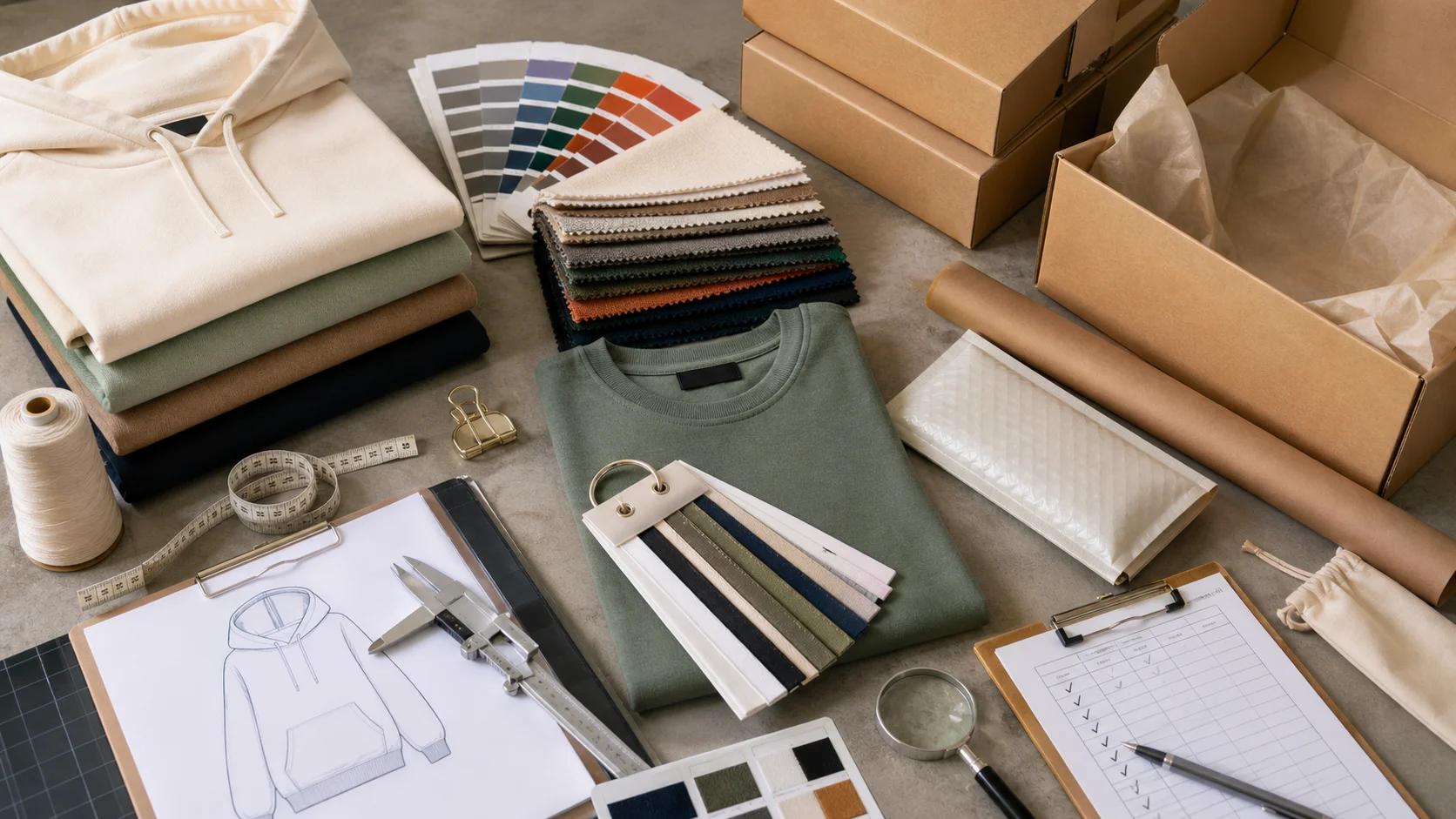
Make Packaging Feel Premium for Clothing Brand compared by sample evidence, fabric or trim specs, MOQ, AQL terms, cost lines, delivery timing, and rework...
Fast answer: Make Packaging Feel Premium for Clothing Brand: Material, Print, MOQ, and QC Terms should be judged by production evidence, not by a generic sourcing promise. The buyer needs sample proof, cost breakdowns, QC checkpoints, and delivery buffers in writing.
Ask for recent sample photos, measurement tolerances, fabric or print test assumptions, decoration test notes, packing examples, and a named inspection checkpoint. These details show whether the team can repeat an approved sample at bulk volume.
Separate garment cost, decoration, labels, packaging, sampling, testing, freight, and rush charges. Clear cost lines make it easier to reduce colorways, adjust size depth, or reserve more time for sampling.
Shoppers decide whether a garment feels worth the price before they ever touch the fabric. I have watched that decision happen in under seven seconds at pop-ups from Milan to Manchester. That is why how to make packaging feel premium clothing brand is not a graphic-design question first. It is a perception question. The box, mailer, or sleeve has to signal value immediately, or the garment starts life discounted in the customer’s mind.
Weight. Sound. Texture. Print precision. Closure. All of it stacks into perceived price. A rigid mailer with a crisp magnetic snap feels nothing like a soft poly bag that rustles like grocery packaging. A 150 gsm printed insert can carry more brand authority than a shiny tag, and a 2 mm board upgrade can do more for memory than a second logo hit.
In Berlin, I once watched shoppers handle two packages side by side: one in a $0.22 poly mailer, one in a $1.05 fold-flat box. Same garment inside, nearly identical cut and finish. The premium package won almost every time. Not because it shouted. Because it felt engineered. Premium does not look decorated. Premium looks controlled.
Factories in Portugal and Vietnam kept circling back to the same point: consistency. Not material cost. A clean fold line, a tolerance held within 1-2 mm, and a dust-free finish often mattered more than a costly specialty board. Outside Ho Chi Minh City, a team rejected 300 sleeves because the corner folds drifted by just 3 mm. Expensive discipline. Customers read it as quality.
Mass-market poly mailers can work for a $28 basic if everything else is dialed in, yet they rarely build brand memory the way a structured package does. For premium perception, the outer pack should behave like a product. Open with intent. Close with certainty. Present the garment as if it belongs in a gallery, not a warehouse. That principle holds across sneakers, knits, and even custom bra manufacturing, where a tight fold and protected cup shape can matter as much as the lace itself.
Premium feels engineered, not merely decorated. If the package is 80% of the first impression, the garment gets only 20% of the credit for a great unboxing. Serious brands know it. Packaging gets treated like production, not like a final flourish.
Oversized packaging looks cheaper. I have measured that effect in showrooms and warehouse audits. A pack that is 20% too large for the product can cut perceived value, even when the print cost is $0.80 higher. The eye reads emptiness as waste. It reads precision as confidence.
For tees and lightweight basics, slim mailers or low-profile cartons work best. Denim wants a heavier folded box with a tighter interior cavity because the weight of the product matches the weight of the pack. Knitwear benefits from drawer-style boxes once the price clears $120. Accessories and gifting formats can move into magnetic closures or rigid lids. Outerwear needs room, but not excess. A garment bag with a structured hanger insert often feels more premium than a giant box that swallows the coat.
Regional norms differ. In Europe, luxury brands tend to favor tighter sizing and heavier board, often in the 1.5-2.5 mm range. Some DTC brands in Asia choose lighter formats, around 1.0-1.5 mm, to protect margin and reduce freight. Neither is automatically better. The right choice depends on category, shipping method, and customer expectation. In Seoul, a sharp, compact pack signals discipline. In Paris, extra board weight can carry more prestige.
Structure must match price point. A $35 basic does not need a drawer box with ribbon pulls. It needs clean folds, protected edges, and a mailer that does not crease in transit. A $250 outerwear piece can justify a magnetic box, reinforced corners, and a branded tissue wrap because the packaging cost becomes part of the product story. I worked with a brand shipping 12,000 tees a month that cut packaging spend by 18% by shrinking the insert size by 15 mm on each side.
Here is the practical rule I use on factory visits. The garment should sit centered, with 5-8 mm of visual breathing room so the customer sees intention, not gap. Tissue should be taut. Inserts should not slide. If the package rattles, the customer hears cheapness before they see it. That is where clothing packaging solutions become a sizing exercise, not just a branding exercise.
The materials most associated with premium perception are thick paperboard, recycled rigid board, cotton paper, and textured uncoated stocks. I have touched hundreds of samples from Italy, Turkey, and China. The finish that wins is often the one that feels calm in the hand. A 350 gsm uncoated board with a clean edge can feel more expensive than a glossy 500 gsm sheet loaded with effects.
Soft-touch lamination still works, but only when used with restraint. It adds a velvety hand-feel that many customers read as luxury, though it can scratch in transit if the coating is too thin. Embossing adds tactile depth. Foil works best as an accent, not a blanket. Spot UV can lift a logo or monogram, but too much of it pushes the pack toward promotional merchandise. The best packs I have seen usually use one primary finish and one supporting detail. Not five.
Print registration is where premium projects are won or lost. I have rejected samples because the logo shifted by 1.5 mm across a fold. That tiny error made the whole box feel rushed. Edge paint matters too. Clean black or deep navy edges can make a rigid box feel bespoke, but uneven paint tells the customer the factory did not care. Glue lines are another hidden fault. Buyers rarely see them in a PDF proof, yet they feel them the moment a flap lifts unevenly.
For brands balancing cost and credibility, recycled content can strengthen the story if the execution is clean. FSC-certified board, cotton paper, and water-based inks can support a higher price because they align with quality and responsibility. Data from Global Organic Textile Standard and OEKO-TEX show how certification language has become a trust signal for apparel buyers, and packaging follows the same logic. Customers do not pay more for “eco” alone. They pay more for proof and polish.
One board grade. One coating. One accent finish. If the sample table starts looking like a beauty counter, the packaging is already losing focus. A premium pack feels edited. It does not feel decorated for decoration’s sake.
Premium brands use fewer words, more white space, and one strong mark. That restraint is not empty minimalism. It keeps attention on the product and stops the pack from reading like an ad. I have seen a $0.60 design beat a $4.00 one because it trusted spacing, not noise.
Typography carries more weight than most founders expect. Serif-led wordmarks can feel heritage-driven, while a disciplined sans serif can look modern without sliding into generic tech branding. Hierarchy is the real test. Brand name first. Support text second. Care information last. If the line spacing is inconsistent by even 2-3 points, the whole design can feel amateurish. Margin discipline matters as much as the font itself.
Color strategy changes by price point. Black and cream often read luxury because they reduce visual noise. Bright saturated palettes can work when the brand sells fashion-forward energy or youth culture, especially in activewear and accessories. Yet the same color travels differently across regions. In Paris, a matte black box with one foil mark can feel elegant. In São Paulo, that same black may read severe unless it is balanced with warmer tones or a livelier insert card. Seoul often rewards crisp contrast and immaculate spacing; overprinting there can kill the premium effect.
A simpler print file often produces better-looking packaging because it reduces alignment errors and waste. On a factory line in Guangdong, I watched a brand trim a six-color layout down to two colors and a blind emboss. Rejects fell from 9% to 2%, and the final packs looked more expensive, not less. Less ink. Fewer problems. Better result.
That principle helps brands moving into private-label formats too. If the garment line already has strong product identity, the pack should not compete with it. A restrained system works especially well for custom baby clothing manufacturing, where softness, cleanliness, and trust matter more than visual noise. Premium design should feel calm enough to support the product, not overwhelm it.
I have built packaging budgets for brands selling at $40, $120, and $350. The economics change fast. The cheapest-looking pack is not always the cheapest to produce, and the most expensive-looking pack is not always the best return. Real work starts with the question of where each dollar changes perception.
Structure, texture, closure, and print precision usually outrank sheer size in perceived value. A smaller box with perfect fit feels sharper than a large format with generous airspace. Freight matters too. A rigid box can cost 3-4 times more to ship per unit than a flat mailer because of cubic volume, especially on international lanes where volumetric weight triggers the bill. I have seen brands save $6,000 per container by shifting from assembled boxes to flat-packed cartons with better engineering.
Supplier geography also matters. Some factory clusters in Guangdong and Zhejiang offer stronger finishing at lower unit cost, while parts of Vietnam and Poland can win on lead time or lower defect rates for simpler builds. Turkey often sits in a useful middle ground for European brands, especially when the order size is 1,000-5,000 units and speed matters more than the absolute lowest cost. The best supplier is not the one with the lowest quote. It is the one who can hold a 1 mm tolerance at scale. If you are comparing a manufacturer, factory, or wholesale supplier in China, ask for production photos, quality checkpoints, and a real sample before approving bulk.
For a $40 product, packaging should probably stay under 3% of retail, or roughly $1.20. At $120, a $2.50-$3.50 pack can be justified if repeat purchase and gifting are part of the model. At $350, the pack can go higher, but only if the customer keeps it, reuses it, or shares it. Premium packaging pays back through retention when it feels like part of the purchase, not an added tax. That logic holds whether you are launching a capsule line or building private label clothing services at scale. For market benchmarking and import considerations, the U.S. International Trade Administration at trade.gov is also a useful reference.
Sustainability should not read as compromise. The best eco-minded packs I have handled did not apologize for being recycled. They looked expensive because they were simple, well-made, and honest about what they were. Recycled board, water-based inks, and mono-material construction can absolutely feel premium if the surfaces are clean and the structure is sound.
Recycled does not mean rough. A well-calendered recycled board with a matte finish can feel warmer and more refined than a glossy virgin stock. Texture matters more than shine. Print clarity matters more than special effects. Structural integrity matters more than marketing claims. If the corners crush easily or the lid bows on opening, the sustainability story starts to feel like a compromise story.
Common sustainable options send different signals. FSC board signals responsible sourcing. Compostable mailers signal lower plastic dependence, though only if the supplier can back the composting claim with certification and conditions. Reusable dust bags, usually in cotton or recycled polyester, signal care and longevity. I have seen the best sustainable packs combine just two or three components: a flat mailer or rigid sleeve, a paper insert, and a reusable fabric bag for higher-ticket items. Less material. Fewer faults. Better presentation.
According to ASTM packaging and material test standards, compression and drop performance matter because transit damage is not a theoretical concern. In factories I have visited, the premium sustainable packs looked more expensive precisely because they were designed with fewer parts and cleaner assembly. No loose ribbons. No double layers nobody needed. Fewer seams. Better edges. Better story.
Final warning: do not overclaim. If the board is 60% recycled, say so. If the weight dropped from 120 gsm to 95 gsm, publish that. If FSC certification applies, show the code. Measurable proof points build trust faster than vague green language ever would.
I use a 30-day packaging rollout plan because speed forces discipline. Week 1 is mood board and structure brief. Week 2 is the first physical sample. Week 3 is print proof, fit check, and drop test. Week 4 is a pilot shipment of 50-200 units so the team can see how the pack behaves in real fulfillment. That is the shortest path I know for figuring out how to make packaging feel premium clothing brand without paying for guesses.
Vendor questions should be direct. What board grade are you using, 300 gsm or 350 gsm, and what is the recycled percentage? Is the coating water-based, soft-touch, or matte lamination? What tolerance can you hold on the fold, 1 mm or 3 mm? What is the lead time in weeks, not days? What is your QC process, and how many units do you inspect per batch? What happens if 5% of the order arrives damaged? I want replacement policy in writing before I sign anything.
Testing premium perception does not require a giant launch. I have run customer surveys with 25-50 shoppers and learned more than from a thousand spreadsheet cells. Show two packaging options, one at $0.90 and one at $2.40, and ask which better matches the product price. Then check whether the answer changes by category. A hoodie buyer may prefer sturdier board, while a lingerie shopper may care more about elegance and discretion.
Make the story consistent across touchpoints. Packaging should match the ecommerce photography, the email confirmation, and the retail shelf if you have one. The bag inside the box should not look richer than the product card. The mailer should not feel cheaper than the return label. The goal is not to spend more. It is to make every visible detail justify the price tag.
How much should clothing packaging cost per order?
For a $40 product, aim for about $0.75-$1.20. For a $120 product, $1.80-$3.50 is realistic, especially if the pack includes tissue, a label seal, or a rigid insert. Above $250, brands often spend $3.00-$6.00 when gifting or retention is part of the business model.
How long does premium packaging take to produce?
Most flat mailers and folding cartons take 2-5 weeks after proof approval. Rigid boxes usually need 5-8 weeks because of assembly, finishing, and QC. Add 1-2 weeks if you are shipping internationally or need a custom insert.
What is the best material for how to make packaging feel premium clothing brand on a budget?
A 300-350 gsm folding board with matte lamination is usually the best value. It gives a clean hand-feel, ships flat, and keeps costs near $1.00-$1.50 in many markets. Add one finish, such as embossing, only if the design is already disciplined.
Can recycled packaging still look premium?
Yes. FSC board, recycled rigid board, and water-based inks can look expensive when the print is sharp and the fit is tight. The key is avoiding weak corners, rough edges, and cluttered graphics that make the pack look improvised.
Where should a brand start if it wants to improve packaging fast?
Start with structure, then sizing, then print. A better-fitting pack usually beats a more expensive finish. If you fix the fold tolerance, right-size the insert, and simplify the design, you can lift perceived value without changing the garment at all.