
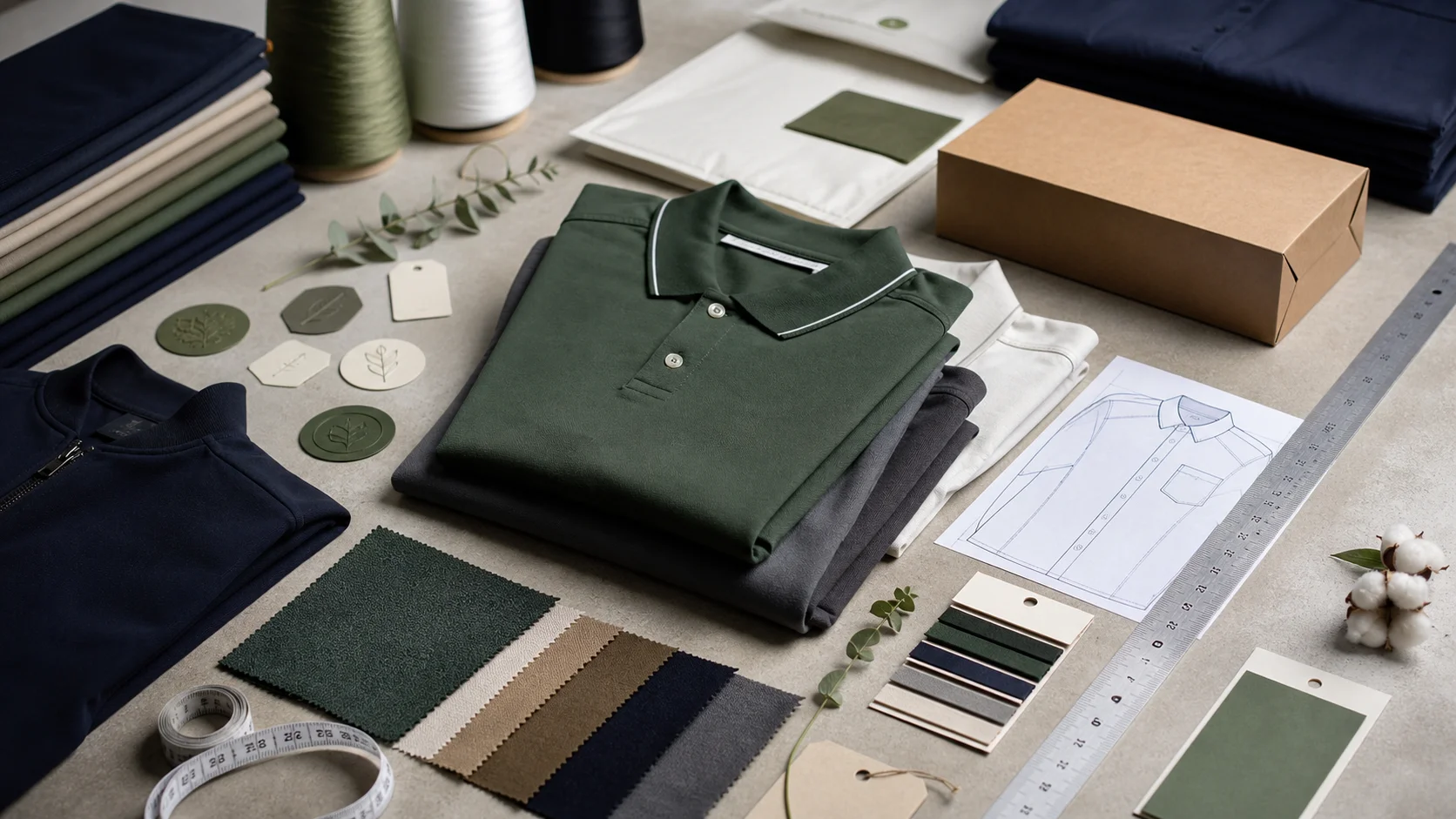
Premium Apparel Packaging Look with checks for samples, fit, MOQ, QC evidence, pricing terms, and delivery risk.
Fast answer: Premium Apparel Packaging Look: Layers, Finish, Inserts, and Cost should be judged by production evidence, not by a generic sourcing promise. The buyer needs sample proof, cost breakdowns, QC checkpoints, and delivery buffers in writing.
Ask for recent sample photos, measurement tolerances, fabric or print test assumptions, decoration test notes, packing examples, and a named inspection checkpoint. These details show whether the team can repeat an approved sample at bulk volume.
Separate garment cost, decoration, labels, packaging, sampling, testing, freight, and rush charges. When every cost line is visible, it becomes easier to reduce colorways, adjust size depth, or reserve more time for sampling.
Sometimes the cheapest box wins the beauty contest. I watched it happen on factory floors in Portugal, Bangladesh, and Vietnam, where a pricier sample arrived with glue squeeze-out, a 1.5 mm lid gap, and scuffed corners after only 200 units. The lower-cost box looked sharper because every fold landed within tolerance, every print panel held density, and every closure sat flush across 1,000 pieces. That is the real answer to how to make apparel packaging look premium.
If you are working with a manufacturer, factory, or supplier, the lesson is the same: premium rarely means lavish. It means control, fewer defects, and steady finishing across large runs. Last year, at a carton supplier outside Ho Chi Minh City, the reject rate on a rushed order sat at 7.8 percent. Then they added a 24-hour cure window and tightened folding tolerances to ±0.5 mm. It dropped to 1.2 percent. Small numbers. Big difference.
Retail shelves and unboxing videos judge packaging in seconds. At shelf, a buyer notices edge alignment, print density, and closure precision before logo size. Online, the camera punishes crushed corners, dull matte laminates, and weak magnetic lids from 30 centimeters away. The unboxing cut lasts maybe 12 seconds, and that is enough to decide whether packaging reads polished or merely expensive.
What brands get wrong shows up fast in the sampling room. They spend on oversized lids, then leave the interior loose. They specify foil, then ignore scuffing on matte laminates. They ask for a brand story on every surface and end up with visual noise. I have seen a £0.42 folding carton outperform a £1.80 rigid box because the first one protected the garment, held shape in transit, and looked disciplined beside a neatly folded tee.
The point is simple. Packaging should signal garment quality, brand discipline, and material credibility before the customer touches the product. If your clothing packaging solutions cannot survive a 1-meter drop, a 3-day courier journey, and 500 handlings in a stockroom, the premium story is already broken.
Structure carries more weight than decoration. Rigid boxes communicate luxury basics and gifting; drawer boxes suggest ceremony and higher margin; mailer boxes suit DTC shipping; folding cartons fit scale and retail speed. I have seen a 280 gsm folding carton sell a £24 T-shirt line more convincingly than a 1.8 mm rigid box used for a lower-priced garment, because the proportions matched the product and the customer never felt padding pretending to be value.
Tees need restraint. Denim needs backbone. Outerwear needs space. A slim tee packed in an oversized box reads like waste, especially when 40 percent of the cavity is filled with tissue or shredded paper. A denim jacket in a box with internal dimensions only 8 to 12 mm wider than the folded garment feels intentional. For coats and puffer jackets, I prefer structural stability first: a 1200 gsm rigid board, clean scoring, and an insert that prevents shoulder compression during a 2- to 4-week transit cycle.
Color is code. In Western Europe, warm neutrals, charcoal, stone, and muted navy read more expensive than loud primaries. In North America, menswear packaging often performs better in deep black or dark green, while youth brands use brighter systems with lower saturation so the print remains stable across 500 to 5,000 units. In South Korea and Japan, softer tones and precise contrast usually beat aggressive artwork because the eye reads control as quality.
I have compared print runs in Turkey, India, and Italy, and saturation management matters more than most buyers admit. High-saturation orange can drift by 8 to 12 percent between first samples and bulk if the press calibration is loose. A restrained palette survives better. Overdesign cheapens the result fast. When artwork competes with structure, the package starts shouting and stops convincing. That is one of the most reliable ways to understand how to make apparel packaging look premium without adding unnecessary cost.
For brands building private label clothing services, the box or mailer should echo the garment price point, not inflate it. A £30 sweatshirt and a £140 wool coat cannot share the same packaging logic. Shape, fill ratio, and color discipline do more than extra ink ever will.
Tactility sells before the eye finishes reading. Soft-touch lamination feels expensive because it reduces glare and adds a low-friction hand feel, but only if the substrate is stable and the coating cures properly. Blind embossing works beautifully on luxury basics. Spot UV can sharpen a logo on matte stock. Uncoated paper telegraphs honesty, which suits heritage denim and minimalist knitwear. Foil is useful, but only in small measures.
Luxury basics usually need restraint: black ink, one finish, one focal point. Sportswear can handle bolder contrast, especially if the brand position is athletic rather than fashion-led. Denim works well with uncoated kraft or textured white stock, where a small debossed mark looks confident. Intimate apparel often benefits from softer palettes, satin-feel laminates, and precise closure systems because the customer associates the package with care, not spectacle.
Here’s what most people miss: finish quality depends as much on moisture and curing time as on the art file. I have seen soft-touch laminate fail after a humid monsoon week in Mumbai because stacks were packed at 68 percent relative humidity, then shipped before adhesive set. In another factory, a 4-hour press calibration cut foil misregistration from 1.4 mm to 0.3 mm. Same artwork. Very different result.
According to ASTM, abrasion and surface durability testing matters because touchpoints fail under real handling, not studio lighting. For more guidance on fiber traceability and sustainability claims, see Textile Exchange and OEKO-TEX. That is why I caution against overusing metallic effects. Too much foil looks discount-driven, especially when registration slips by even 0.5 mm and every edge starts flashing silver. One accent. Maybe two. That is enough.
Heavier board usually signals quality, but only when scoring, folding, and glue lines stay sharp. A 350 gsm SBS carton can look cleaner than a 500 gsm recycled board if the recycled fiber is too fibrous for crisp print. I have opened samples where the corners frayed before the garment did. That is not premium. That is false weight.
FSC paper and recycled board are not interchangeable, and buyers should treat them differently. Virgin fiber often gives cleaner print reproduction for saturated brand colors and small typography, especially below 6 pt. Recycled fiber can create a more authentic sustainability story, particularly for brands selling raw denim, organic cotton, or heritage basics. The trade-off is visible: print can look 10 to 15 percent duller, and fine lines may lose definition if the sheet is too absorbent.
Packaging waste is where premium and restraint meet. A brand can reduce material use by 18 to 27 percent simply by right-sizing cartons, removing unnecessary inserts, and eliminating duplicate tissue layers. I have watched one knitwear label cut board use from 42 grams per unit to 31 grams while keeping the same shelf impact, because they switched from an oversized rigid lid to a snug folding carton with one precision-cut insert.
Fabric wraps can work, but only for higher-ticket collections or controlled gifting. A cotton drawstring bag at $1.20 to $2.50 per unit makes sense if it is reused; otherwise it becomes a soft-cost vanity item. In my experience, fewer components win more often than decorative excess. Better paper. Cleaner glue. Tighter tolerances. That combination reads premium without shouting about it.
For factories that also handle garment production, including cut and sew manufacturing, packaging should be planned alongside the product, not after it. That is how you avoid the common mismatch between a beautifully made tee and a box that feels assembled from leftovers. If you are ordering custom packaging in bulk or wholesale, ask early about production compatibility and MOQ, especially when sourcing from China.
At entry level, a printed mailer or folding carton can land between $0.18 and $0.65 per unit at 3,000 to 10,000 pieces, depending on board grade and print method. That buys you one or two colors, a clean dieline, and a controlled matte finish. Add a soft-touch laminate or a single foil hit, and the price shifts toward the upper end fast. This tier works for tees, socks, and basic private label apparel.
Mid-tier packaging usually runs from $0.75 to $2.10 per unit for 1,000 to 5,000 units. This is where drawer boxes, thicker folding cartons, custom inserts, and spot UV start to make sense. The price drivers are predictable: 1.5 mm to 2 mm board, custom tooling, lamination, foil, and the MOQ. A 2,500-unit run can cost 20 to 35 percent more per piece than a 5,000-unit run, even if the design stays unchanged.
Luxury packaging moves into $2.80 to $8.50 per unit, sometimes higher for complex rigid boxes with magnetic closures, fabric wraps, or multi-component inserts. Freight changes everything. A box made in Europe may carry a higher unit cost but save 2 to 4 weeks on lead time. A Southeast Asian supplier may quote lower labor costs, then add ocean freight, carton packing, and a longer approval cycle that offsets the savings.
The smartest trade-off is a hero detail, not five embellishments. Choose the one feature customers will feel or see first. A crisp deboss. A well-fitted insert. A color-perfect matte lid. I have seen a brand spend $1.90 on foil, windowing, and magnetic closure, only to have the package feel cheaper than a $0.96 box with one perfect emboss and a clean edge. Spend where the hand lands. That principle is central to how to make apparel packaging look premium at different budgets.
If you need a fast quote, get a free quote early and ask for tiered pricing at 1,000, 3,000, and 10,000 units. That exposes the real cost curve before sampling starts.
Asia, Europe, and nearshore production do not behave the same way. In Vietnam and China, finishing capability can be excellent, but sampling often needs tighter written control. In Portugal and Poland, color consistency is frequently strong, while MOQ pressure can push buyers into larger commitments, often 2,000 units or more. Nearshore suppliers in Mexico or Eastern Europe may offer 7- to 14-day shorter transit times, yet they sometimes struggle with specialty foils or complex inserts at low volumes.
Premium packaging fails when timelines are squeezed. Glue cure times get shortened from 24 hours to 6. Print corrections get skipped. Insert fitting is done by eye instead of gauge. The first thing cut in a rush is usually the very thing that creates a premium impression. I have seen a rushed pre-Christmas order from a respected factory lose its edge because the magnetic flap was assembled 1 mm off-center across 800 boxes.
Sample-to-production accuracy separates disciplined factories from merely expensive ones. A strong supplier will hold a color variance within Delta E 2 to 3, keep box squareness under 1 degree of deviation, and preserve lid fit across the first 50, then the next 5,000 units. Weaker factories can look impressive on the sample table and fall apart in bulk. I have seen lower-cost plants outperform premium-name suppliers simply because they track tolerances better and reject bad batches earlier.
According to Trade.gov, transit time, compliance checks, and documentation all affect landed cost and delivery certainty. That matters because a box that arrives late is not premium, no matter how good the foil looks. The machinery of quality is boring. It is also decisive.
A 30-day packaging refresh is realistic if the brief is disciplined. Days 1 to 5: define brand cues, target price point, and one hero finish. Days 6 to 10: confirm board weight, internal dimensions, and a single dieline. Days 11 to 18: sample with color standards locked. Days 19 to 24: test closures, fit, and scuff resistance. Days 25 to 30: approve production only after a 20-unit shipping simulation.
When you brief a supplier, use numbers, not adjectives. Say the scuff resistance must hold through 50 rubs with minimal visible mark. Ask for color variance under Delta E 3. Require glue visibility below 1 mm at the seam. State insert fit tolerance at ±0.5 mm. Brands that write this way get better output because factories can measure the target instead of guessing at “luxury.”
The test sequence should be blunt. Drop tests from 1 meter. Abrasion tests on corners and lid edges. Shipping simulations over 24 to 72 hours. Unboxing checks across 20 to 50 units, not just one perfect sample. If the 37th box looks worse than the first, the design is not production-ready. I would rather approve a restrained package that survives 2,000 units than a theatrical one that drifts after 200.
That is the discipline behind premium apparel packaging. Repeatable, not theatrical. If your packaging can hold its shape, keep its color, and stay aligned through bulk production, the garment inside has a better chance of being judged fairly. Start with the numbers, keep the finish count low, and make every millimeter earn its place.
Entry-level premium packaging typically costs $0.18 to $0.65 per unit for 3,000 to 10,000 pieces. Mid-tier options usually run $0.75 to $2.10, while rigid luxury boxes can reach $2.80 to $8.50 depending on finish, inserts, and MOQ.
Right-size the carton, reduce inserts, and choose one strong tactile detail instead of several decorative effects. A 350 gsm to 500 gsm board with a precise fold often looks better than an oversized box with filler, and it can cut material use by 18 to 27 percent.
Simple printed mailers can take 2 to 3 weeks after artwork approval. Folding cartons and rigid boxes usually need 3 to 5 weeks, while complex finishing or custom tooling can push lead time to 6 to 8 weeks. Add extra time for shipping and sampling.
Rigid boxes and high-quality folding cartons both work, but the best choice depends on price point and channel. For tees and knitwear, a clean folding carton with soft-touch or emboss often looks more premium than a bulky rigid box with weak fit.
Yes, but the unit cost rises. Many factories set low MOQs at 500 to 1,000 pieces for mailers or cartons, while rigid boxes may require 1,000 to 3,000. The safest path is one hero finish, one board grade, and a simple dieline.