
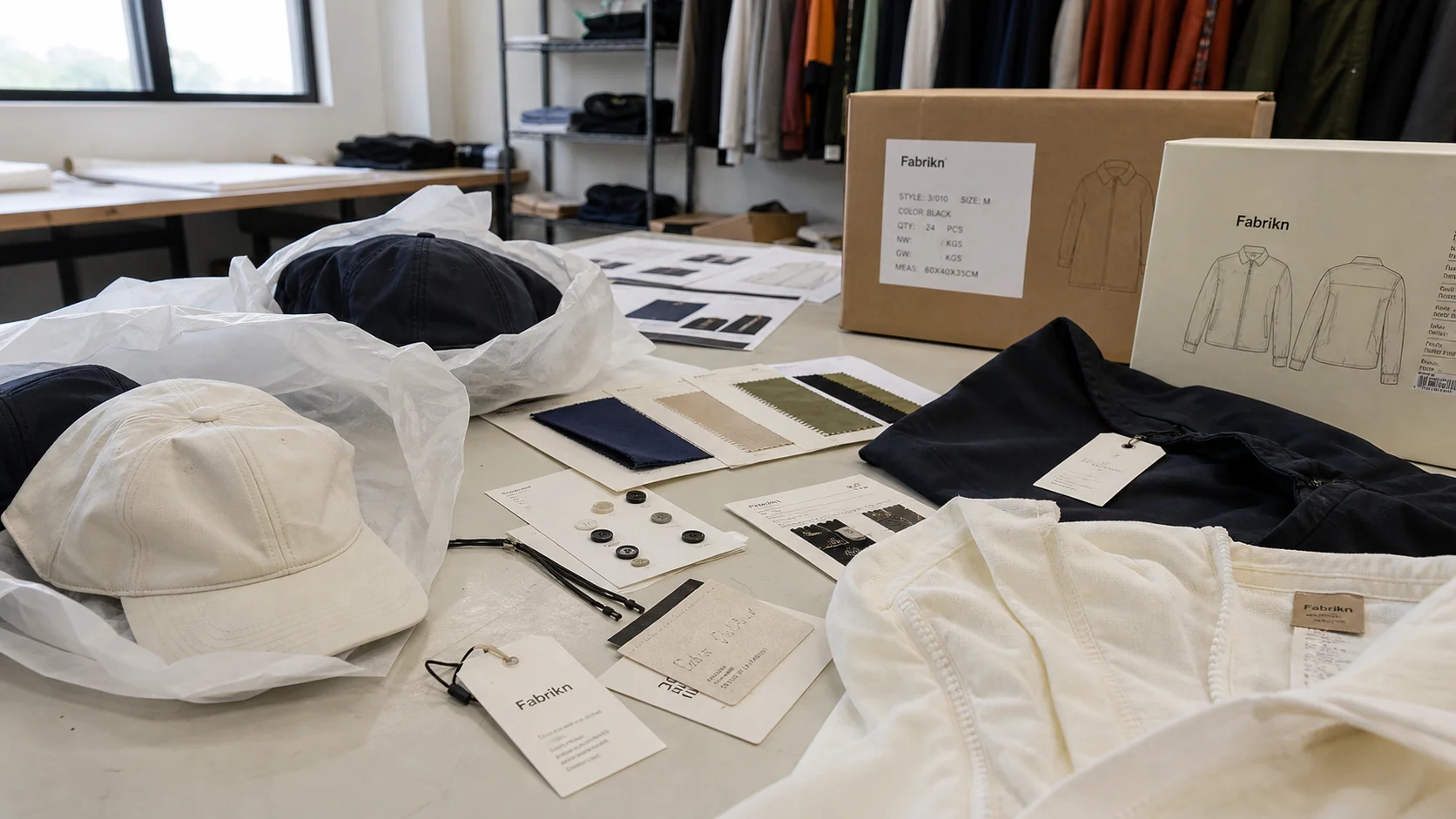
Premium Clothing Packaging Upgrades with checks for samples, fit, MOQ, QC evidence, pricing terms, and delivery risk.
Fast answer: Premium Clothing Packaging Upgrades: Finish, Inserts, Cost, and MOQ should be judged by production evidence, not by a generic sourcing promise. The buyer needs sample proof, cost breakdowns, QC checkpoints, and delivery buffers in writing.
Ask for recent sample photos, measurement tolerances, fabric or print test assumptions, decoration test notes, packing examples, and a named inspection checkpoint. These details show whether the team can repeat an approved sample at bulk volume.
Separate garment cost, decoration, labels, packaging, sampling, testing, freight, and rush charges. When every cost line is visible, it becomes easier to reduce colorways, adjust size depth, or reserve more time for sampling.
Before the garment gets a single glance, the packaging has already started making its case. If you’re thinking about how to make clothing packaging more premium, begin with the moment the parcel lands: the first seven seconds can make a $28 top feel closer to $38. I’ve seen that happen in mock-ups from Shanghai, Ho Chi Minh City, and Porto. The parcel writes the opening line.
Customers judge quality fast after delivery. Rigidity matters. Print accuracy matters. Edge alignment matters. The feel of the closure matters. They do not read your brand story first. A poly mailer with a wrinkled logo and loose adhesive says discount. A 350 gsm folding carton with tight folds says control. Same hoodie, different package, completely different read.
Last year, at a denim factory in Vietnam, a production manager set two shelves in front of me. One held plain mailers. The other held kraft boxes with tissue, a belly band, and a matte label. Buyers picked the boxed orders first, even though both contained jeans priced at $64. Simple reason: the box framed the product as a considered purchase, not a commodity. That framing matters at $18 and at $180.
Factory floors keep repeating the same lesson. Corners matter. Lid fit matters. Creased hangtags matter. A sourcing team once rejected a $0.42 insert card because one corner’s print shifted 1.5 mm. Nobody mentioned the garment spec. Not once.
Commercially, premium packaging earns its keep in three places. Returns fall when the product arrives protected. Gift appeal rises when the box feels worth keeping. Repeat purchase improves because the unboxing memory sticks to the brand. For private label clothing services or a higher-ticket capsule, packaging isn’t decoration. It’s a conversion tool with a freight bill.
The material ladder is blunt. Poly mailers sit at the budget end, then folding cartons, then rigid boxes, then specialty wraps and inserts. A basic poly mailer might cost $0.08 to $0.18 per piece at 5,000 units. A folding carton often lands around $0.35 to $0.95. Rigid boxes run from $1.10 to $3.50, depending on size, wrap paper, and whether you choose magnetic closure, ribbon pull, or a lift-off lid. If you’re asking how to make clothing packaging more premium, start here: structure before decoration.
Paper weight changes perception fast. A 250 gsm carton works for lightweight tees, but a 400 gsm to 600 gsm board gives knitwear, outerwear, and gifting sets a more stable hand feel. Board thickness is visual and mechanical at once. A 1.2 mm rigid board resists crush better than 0.8 mm board and sounds more substantial when the lid comes off. Closure style matters too. A friction fit can feel cleaner than a magnet if the tolerances are tight, while a sloppy magnetic flap can feel cheap at $12 or $120 alike.
Here’s what most people miss: a well-executed kraft finish can look richer than glossy laminate, and often costs less. I’ve seen kraft wrap with a clean blind emboss beat a laminated box that cost 18% more to produce. The tactile cue is quieter. More controlled. Gloss can work for beauty-adjacent fashion, but on apparel it can slide into gift-shop territory if the artwork gets crowded.
Region matters. In China, minimum order quantities for rigid boxes often start at 1,000 to 3,000 units, with better board consistency once you move past 5,000. In Turkey and parts of Eastern Europe, smaller runs at 500 to 1,000 units show up more often, but the per-piece cost rises 15% to 40%. Southeast Asia offers strong folder-gluer capacity, while Italy and Portugal can deliver excellent surface finishing but usually want more lead time and tighter artwork approvals. If you are sourcing through clothing packaging solutions from a manufacturer and supplier, ask about board origin, glue type, production consistency, and collapse resistance, not just the printed mock-up.
For premium packaging, structure is something you feel in the hand, not just something you see on a shelf. A 150 gsm wrap around a cotton shirt may be enough for direct-to-consumer basics. A 2-piece rigid box with a 300 gsm wrap, tissue, and insert board makes sense for outerwear, occasionwear, and gifts. Pick it up once and the difference is obvious. Light packages feel thin. Thin packages feel engineered to vanish. Premium packaging does the opposite.
Some finishes look expensive. Some just shout. Soft-touch lamination, matte varnish, blind emboss, and controlled foil accents usually signal more value than full-surface gloss or noisy metallic coverage. A single foil mark on a 300 gsm folding carton can cost $0.06 to $0.18 extra at 10,000 units. Full-coverage foil can triple that. On camera, the restrained version often wins because light catches the edge for half a second and moves on. That’s enough for an unboxing video.
Color psychology in fashion packaging is less mystical than marketers pretend. Black, bone, charcoal, deep navy, and warm grey read premium because they absorb visual noise. High-saturation pink, lime, and red can work for streetwear, but only when the garment category justifies the energy. I’ve watched premium basics lose authority the moment the box turned into a billboard. Clean typography, 1 or 2 accent colors, and white space usually beat crowded graphics for apparel priced above $40.
Print method should match volume. Digital print works for 300 to 1,500 units and allows quick artwork changes in 5 to 7 days. Offset printing makes more sense for 3,000 units and up, where plate costs are absorbed and color consistency tightens. Flexo is practical for mailers and labels at 10,000 units or more, especially when you want a simple one- or two-color brand mark. If your logo needs ten separate spot colors, you’re paying for complexity that most shoppers won’t notice.
Tactile finishes matter because people film them. Soft-touch film, when applied well, gives a dry velvet feel that shows up in macro shots and short-form video. Embossing creates shadow. Spot UV creates contrast. In factory audits, I saw that a 0.4 mm emboss depth produced cleaner brand visibility than a larger but shallow design. Small detail. Real impact. That’s why premium apparel packaging ideas often work best when the finish is doing less, not more.
Premium print can backfire if the garment is casual or price-sensitive. A $22 jersey tee in a heavily foiled box creates cognitive dissonance. The package promises ceremony the product cannot support. For denim basics, babywear, and promotional sportswear, a restrained matte carton feels more credible. If you are building categories like custom baby clothing manufacturing, a softer palette and clean iconography usually outperform anything that resembles luxury perfume packaging. The buyer wants care, not theater.
Operationally, the gap is bigger than the look. A budget mailer, a mid-tier folding carton, and a premium rigid box differ in setup time, approval loops, and damage rates. In my factory visits, price usually moves faster than turnaround. Finish choices can add 1 to 2 days. Tooling changes can add 7 to 14 days. A structural redesign can stretch a 3-week project to 6 weeks.
Tier Typical format Estimated unit cost MOQ Lead time Budget Poly mailer or basic carton $0.08-$0.45 500-2,000 7-15 days Mid-tier Printed folding carton with insert $0.45-$1.10 1,000-3,000 15-25 days Premium Rigid box with soft-touch, foil, or emboss $1.10-$3.50+ 1,000-5,000 25-45 daysAcross Asia, especially Guangdong and Ho Chi Minh City, I usually see sharper pricing on higher volumes and more tolerance for setup. Europe tends to price higher, often 20% to 45% above Asian equivalents for comparable carton builds, but quality control and shorter shipping lanes can offset some of that. Nearshore production in Mexico, Portugal, or Poland can win on speed, especially if you need replenishment in 10 to 18 days rather than 30 to 45.
What changes fastest is not always what buyers expect. Simple print changes move quickly. A switch from matte to gloss varnish is easy. A magnetic closure, custom insert, or foil stamp takes longer because the factory may need new dies or hand assembly steps. At one Taiwan plant, a foil badge added 4 days to the line. A changed board thickness added 9 days because the die-cut tooling had to be recalibrated.
Trade-offs are unavoidable. Lower MOQs usually mean less room for finish complexity. Higher-end appearance usually means more handling and more rejects. A 2% to 4% spoilage rate is normal on premium runs, especially with delicate wraps and tight color matching. If your product margin is 55% on a $78 jacket, spending an extra $1.20 on packaging can make sense. If you are selling a $19 tank top, that same spend can chew through profit.
Price bands also move with category. A sweatshirt in a rigid box feels indulgent. A basic tee in the same box may feel excessive. For brands using private label clothing services, packaging should match assortment strategy, not ego. The most efficient premium upgrade I have seen was a recycled folding carton, 360 gsm, with one-color matte print and a 0.8 mm insert. It cost $0.62, looked deliberate, and shipped flat at 2,000 units.
Premium doesn’t have to mean over-packaged. Some of the most convincing apparel packs I’ve audited used recycled board, FSC-certified paper, and one well-placed print element rather than three layers of decorative extras. A 100% recycled carton can still feel refined if the board is dense, the ink density is controlled, and the fold lines are crisp. Data from the Forest Stewardship Council supports the market’s shift toward certified paper inputs, and buyers increasingly expect proof, not claims.
Virgin stock can look whiter and brighter, but recycled board has closed the gap. In factory samples, I’ve seen 340 gsm recycled SBS outperform a cheaper virgin stock because the surface calendering was cleaner and the corners held better. The sustainability premium buyers will pay is real when the story is credible. What they will not pay for is greenwashed language. “Eco-friendly,” “natural,” and “planet-positive” mean almost nothing without certification, recycled content percentages, or a measurable reduction in material use.
Minimalism often reads as expensive because it signals confidence. One logo, one color, one structural idea — that can feel more luxurious than a box covered in claims and motifs. I measured a packaging change for a womenswear label that cut material weight by 23% and reduced ink coverage by 31%, while customer satisfaction scores held steady at 4.7 out of 5. They spent less, shipped lighter, and improved brand perception. That’s a rare trio.
For category fit, sustainability should track the product. Athletic basics, premium loungewear, and clean essentials can handle recycled kraft and simple wraps. Occasionwear still benefits from a little ceremony, but not from waste. If your brand also develops technical product through cut and sew manufacturing, align the packaging brief with the same material logic: durable where needed, light where possible, and honest about what is recyclable in your target market.
For broader material standards and traceability expectations, buyers can also review Textile Exchange and OEKO-TEX guidance when building a more credible sourcing story.
Start with an audit. Pull 3 competitor packages from your price tier, 3 from one tier above, and 3 from one tier below. Measure board thickness, print coverage, weight, and cost per unit. Then map how your current pack performs after a 1-meter drop, a 60-second rain simulation, and a 24-hour warehouse stack test. You do not need a six-month strategy. You need a clearer brief.
Brief suppliers on dimensions, fold tolerances, color targets, and finish limits. Give them Pantone references, acceptable deviation ranges, and a sample of your garment fabric so they can judge tone against product. Ask for prototypes in 2 or 3 versions, not 10. More options often mean slower decisions. Confirm insert depth, flap stiffness, and adhesive type. A 0.5 mm tolerance may sound tiny, but it is enough to change whether a lid closes cleanly.
Test before you approve bulk. I want to see shipping damage rates below 2%, corner crush resistance above 12 kg where the format allows, and a packing speed that does not slow fulfillment by more than 10%. Unboxing should be checked under real lighting, on mobile video, and with gloved and ungloved hands. If the tissue tears after one open-close cycle, the finish is too fragile for daily handling.
Then review cost, sustainability, and brand consistency together. Do not approve a beautiful package that pushes landed cost up by 8% if your margin cannot absorb it. Do not approve a green claim without documentation. Lock these decisions before bulk order approval: format, gsm or board thickness, closure style, print method, finish, insert, recycled content target, and MOQ. That’s the practical version of how to make clothing packaging more premium. Everything else is decoration.
If you are comparing factories, ask how the packaging team handles production scheduling, quality checks, and wholesale or bulk packaging runs. The best supplier will be specific about changeover time, defect thresholds, and how they support custom packaging across different garment categories in China and other sourcing hubs.
Premium packaging changes behavior because it changes risk. A well-built box makes the product feel more giftable, which increases sharing and lowers hesitation at checkout. In occasionwear and accessories, I have seen social post rates rise 15% to 25% when the packaging felt photographed rather than merely shipped. For basics, the impact is smaller. For scarves, handbags, and partywear, it can be material to margin.
Packaging also supports premium pricing by reducing the sense that the buyer is gambling. A sturdy carton and clean finish imply quality control, which is half the battle for first-time customers. In categories with higher return rates, even a 1-point reduction can matter more than an extra styling asset. If your package looks cheap, the garment has to work harder to convince people to keep it.
That said, premium packaging is not magic. On commoditized T-shirts, gym socks, and promo basics, a pricey box can waste budget fast. Save the premium move for products where ceremony sells: occasionwear, outerwear, accessories, and curated gifts. Packaging is a sales tool. Treat it that way, and it pays. Treat it like decoration, and it becomes an expense line with very good photography.
Use one stronger structural upgrade, such as a 360 gsm folding carton or recycled rigid wrap, then keep print restrained. In most factories, that approach adds $0.15 to $0.60 per unit instead of $1.50 or more. The biggest savings usually come from reducing ink coverage and avoiding complex finishes.
Basic premium-leaning packaging usually starts around $0.35 to $0.95 per unit for cartons and $1.10 to $3.50 for rigid boxes. At 1,000 to 5,000 units, foil, emboss, and soft-touch finishes raise cost the fastest. Final pricing depends on board thickness, print method, and closure style.
Choose folding cartons, paper wraps, and one-color print before rigid boxes or magnetic closures. Many suppliers can handle 500 to 1,000 units with digital print and modest finishing. Keep artwork simple and use higher board weight, because structure often looks more premium than decoration.
Simple premium packaging can take 7 to 15 days, while rigid boxes with foil or emboss often need 25 to 45 days. Europe and nearshore factories can be faster on shipping, but setup still takes time. Add 4 to 14 days if you need custom tooling or new dies.
Yes, especially for higher-ticket apparel, gifts, and occasionwear. A better unboxing experience reduces perceived risk and increases the chance that customers keep the item. In my audits, premium packaging mattered most for accessories, outerwear, and special-occasion pieces, and least for low-margin basics.