
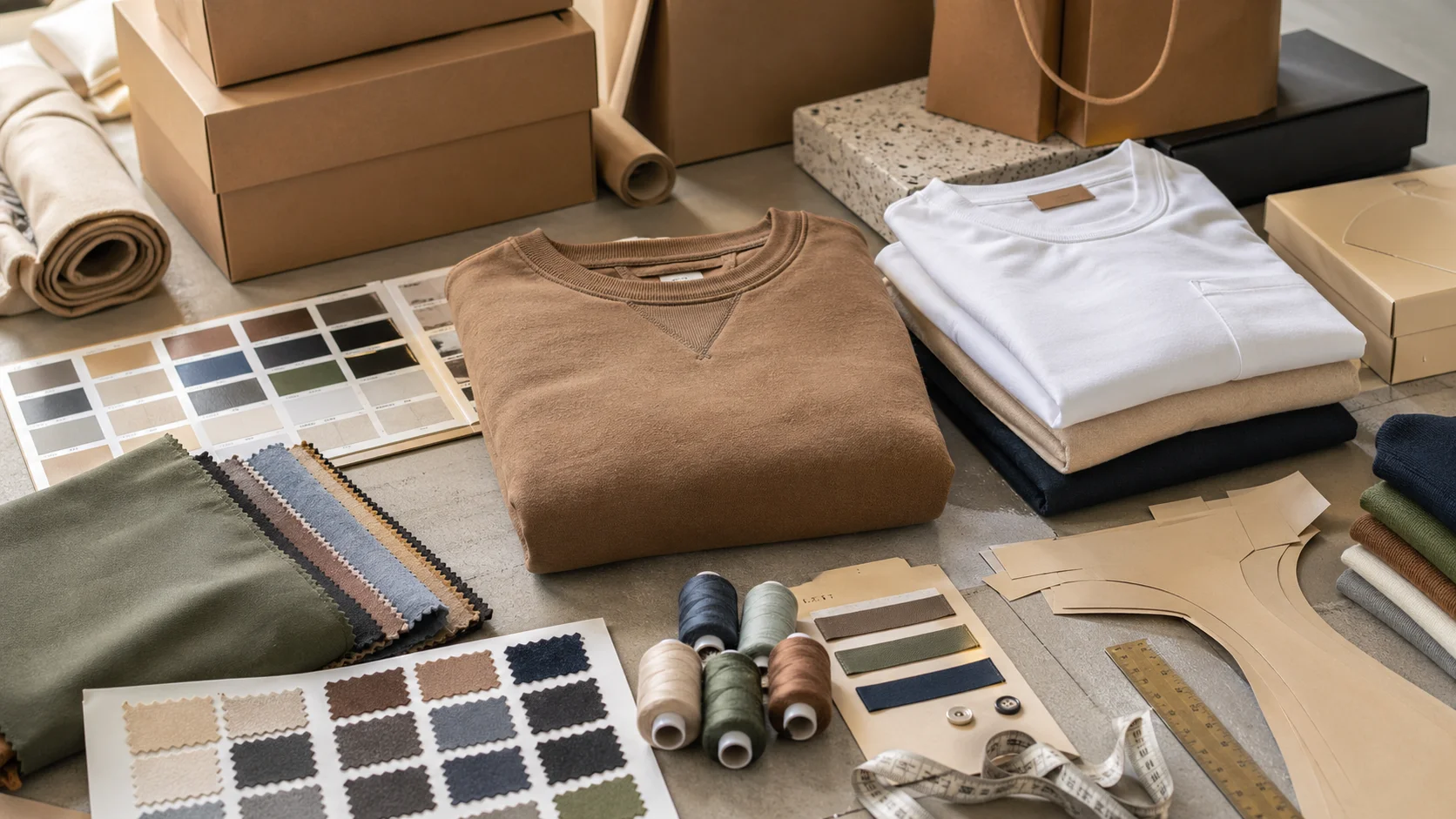
Print Care Labels for Clothing Brand compared by sample evidence, fabric or trim specs, MOQ, AQL terms, cost lines, delivery timing, and rework responsibility.
Fast answer: Print Care Labels for Clothing Brand: Material, Print, MOQ, and QC Terms should be judged by production evidence, not by a generic sourcing promise. The buyer needs sample proof, cost breakdowns, QC checkpoints, and delivery buffers in writing.
Ask for recent sample photos, measurement tolerances, fabric or print test assumptions, decoration test notes, packing examples, and a named inspection checkpoint. These details show whether the team can repeat an approved sample at bulk volume.
Separate garment cost, decoration, labels, packaging, sampling, testing, freight, and rush charges. Clear cost lines make it easier to reduce colorways, adjust size depth, or reserve more time for sampling.
The smallest piece of fabric in a garment is often the one that causes the biggest mess. If you’re figuring out how to print care labels for clothing brand products, start there; labels aren’t paperwork. They are a compliance item, a quality signal, and sometimes the last thing standing between a clean shipment and a costly rework.
A $180 cashmere sweater got held over a 3 mm label error. A $24 fleece hoodie sailed through on a plain printed tag. That contrast explains why teams still treat labels as an afterthought. And in production, tiny mistakes scale fast. On a 2,000-piece order, a $0.08 label error can become a $160 direct loss before freight or labor enters the picture.
On factory floors in Guangzhou, Dhaka, Ho Chi Minh City, and Istanbul, the same pattern keeps showing up. Brands spend 6 to 12 weeks perfecting fit and fabric, then send labels to the supplier with a rushed file. The result is predictable: 500 units reprinted because the fiber order was wrong, 1,200 units delayed because the country of origin was missing, or a premium run rejected because the print bled after a 40°C wash test. And factories there often operate under WRAP, BSCI, and GOTS certifications, yet the lab dip for the label is still treated as optional, not critical.
Mid-tier knitwear factory, north Portugal. A buyer rejected a label because the text sat 1.5 mm too close to the fold. The sweater itself was excellent: 14-gauge merino, brushed finish, flawless seams. The label, printed on soft nylon, failed retail review because the brand name was faint under bright store lighting. That's how credibility leaks away, one tiny print issue at a time. For brands doing private label clothing, the label is part of the product story, not an afterthought.
AATCC testing practices and retailer audit expectations make clear that wash durability and readability matter as much as design. I've seen labels pass on paper and fail after just 5 launderings because the ink fractured or the satin edge curled. Smart teams treat care labels like stitching: with a spec, a test, and a sign-off.
The core format is simple, but brands still get it wrong. A working care label usually needs fiber content, care instructions, country of origin, brand name or RN/registered details where relevant, and size if your line uses size-specific labeling. For children’s programs and items like those in custom baby clothing manufacturing, content clarity matters even more because parent trust is tied to every line of text. And a label with clean content beats a fancy one with missing data.
Markets do not agree on exact wording. The US prioritizes fiber content and origin marking, while the UK and EU expect stronger language discipline around fiber order, care symbols, and consumer-facing readability. Australia follows its own textile labeling conventions, and multilabel export programs need one master file that can be adapted without rebuilding from scratch. I once saw a brand print 8,000 labels for three markets and then discover that one region needed the fiber composition shown in descending order, while another wanted a different origin statement. That mistake cost them 2 extra weeks and roughly $900 in rework and freight.
Format choices are not aesthetic trivia. Woven labels work well for premium knits and tailored pieces. Satin feels softer against skin and is common in lingerie, sleepwear, and lightweight tops. Printed nylon is useful when you need crisp text and lower unit cost. Tear-away labels suit samples, basic tees, and styles where neck comfort matters more than permanence. And for technical programs tied to custom bra manufacturing, I have seen heat transfer labels outperform woven ones because they eliminate bulk at the band line.
Readability is non-negotiable. Use enough contrast so black text stays legible on white, cream, or light grey substrates. Keep symbol files accurate; a misdrawn wash icon is not a style detail. I ask factories to show labels under 500 lux lighting, the same rough brightness many retail floors use. If the text disappears there, it will disappear on a shelf too. And for garments built through cut and sew manufacturing, label placement should be locked before pattern grading starts, not after samples are sewn.
ISO and related textile care symbol references say standardization only works when artwork is clean and file versions are controlled. That's where multi-market brands save time: one approved master label, then local variants for language or legal text. It might sound dull, but it keeps pricey slipups at bay.
The method you choose changes hand feel, durability, and cost more than most founders expect when learning how to print care labels for clothing brand collections. Woven labels are durable and sharp, but they can feel scratchy if yarn density is too high. Printed satin is soft and economical for 1,000 to 5,000 units, though it may fade faster under repeated hot washes. Heat transfer labels create a clean inside finish, which I like for activewear, leggings, and intimate apparel. Printed nylon offers a strong middle ground for workwear, basics, and uniforms.
I have seen budget tees in 180 GSM cotton use printed polyester labels that outlast “premium” satin versions after 20 wash cycles. And that's the counterintuitive part. A cheaper-looking label sometimes performs better because the ink bond is stronger and the substrate is less prone to fray. In a 3-factory comparison I conducted last year, woven damask labels on a soft brushed fleece looked luxurious on day one, but the edges distorted after 12 washes. A plain heat transfer label on the same garment stayed readable at wash 18.
The thing nobody tells you: the softest-feeling label is not always the best performing label. On factory wash tests, I have seen a 1-color heat transfer beat a 3-color woven label by surviving 8 more laundry cycles before edge failure.
Minimum order quantities vary by factory and label type. Woven labels often start around MOQ 1,000 to 3,000 pieces per design, while printed labels can begin at 500. Heat transfer suppliers may ask for 300 to 1,000 units, but setup and plate fees can make tiny runs expensive. And if your collection includes structured shirting, activewear, and tailored knitwear, a hybrid labeling plan is often smarter than forcing one method across all categories.
For brands building from fabric-first decisions, I compare labels the same way I compare seams and trims. A 320 GSM French terry hoodie can tolerate a bulkier woven label at the hem, but a silk-blend blouse cannot. Fiber weight, wash temperature, and contact with skin all matter. The label should suit the garment, not the mood board.
Pricing changes quickly with quantity, method, and finish, especially when working with a manufacturer or factory for custom and wholesale production. For a 500-piece run, printed satin labels might land around $0.12 to $0.28 each, woven labels around $0.20 to $0.45, and heat transfer labels around $0.25 to $0.60 once setup is included. By 2,000 pieces, those ranges often drop 20% to 35%. At 10,000 pieces, a simple woven label can fall to $0.10 to $0.25 apiece, but that only happens once the artwork and finishes are locked in and no one asks for a last-minute font change.
A strong brief makes the supplier's job narrower and the quote more reliable. For print care labels for clothing brand, include the target customer, sales channel, expected order quantity, size range, decoration needs, packaging requirements, and delivery market. Then call out the details most likely to affect the result, especially material grade, print tolerance, and barcode size.
The brief should also explain what cannot change. Some brands care most about hand feel, some about price, some about launch timing, and some about retail compliance. When those priorities are not written down, suppliers tend to optimize for whatever is easiest to quote. Clear priorities help the factory make better tradeoffs before the first sample is cut or printed.
Ask the supplier to respond with assumptions, not just a price. A useful reply states MOQ, sample route, production capacity, inspection plan, packing method, and freight handoff. If the answer is vague, the project may still work, but it needs a tighter pre-production stage before money and calendar pressure build up.
The best time to catch problems is before the pre-production sample is approved. Check measurements, color, placement, material behavior, shrinkage, construction, labels, and packaging in the same review instead of approving each item in isolation. Many bulk issues are not caused by one dramatic mistake; they come from several small unchecked assumptions.
For print care labels for clothing brand, pay special attention to folding method, pack-out sequence, and retail compliance. These details often look minor in an email but become expensive once cutting, printing, sewing, packing, or shipping begins. A simple checklist with owner, due date, and approval status keeps the brand team and factory aligned.
Bulk production should not start until the supplier can explain how the approved sample becomes a repeatable production standard. That means reference sample storage, line instructions, inline checks, final inspection, and defect handling. A factory that can describe this process clearly is usually safer than one that only promises speed.
Price differences are useful only when the quotes cover the same work. Compare sample cost, material source, trims, decoration, packaging, testing, inspection, and freight assumptions. A low unit price can become expensive if it excludes items the brand needs before launch.
Timeline promises deserve the same scrutiny. Ask what happens if the first sample needs revision, whether materials are in stock, when the production slot is reserved, and how export packing is handled. The most reliable supplier is often the one that gives a realistic calendar instead of the fastest optimistic answer.
Before making the final decision, write down the specification, approval owner, delivery expectation, and the one or two risks that would cause the most trouble if missed. For print care labels for clothing brand, this usually means checking material grade, print tolerance, barcode size, and the support process after the order is placed.
This last review does not need to be complicated. It simply makes the decision easier to repeat, easier to explain, and easier to verify when the finished product or jewelry arrives.
One useful way to pressure-test the decision is to ask what would happen if the order had to be repeated in six months. The answer should still be clear: the same material grade, the same print tolerance, the same acceptance standard, and the same communication path. If a second order would depend on memory or guesswork, the first order is not documented well enough yet.
Another useful check is to separate preference from requirement. Preference is the look, wording, or finish the brand likes. Requirement is the measurement, tolerance, certificate, material, or delivery condition that cannot fail. Good buying decisions keep both visible, so the final choice is not pushed around by the last email, the cheapest quote, or the prettiest sample photo.
Finally, ask who owns each approval. A project with one accountable owner for sample review, one owner for final content or artwork, and one owner for delivery sign-off usually moves faster than a project where every decision is shared loosely across a team. Clear ownership reduces delays and makes the finished result easier to judge.