
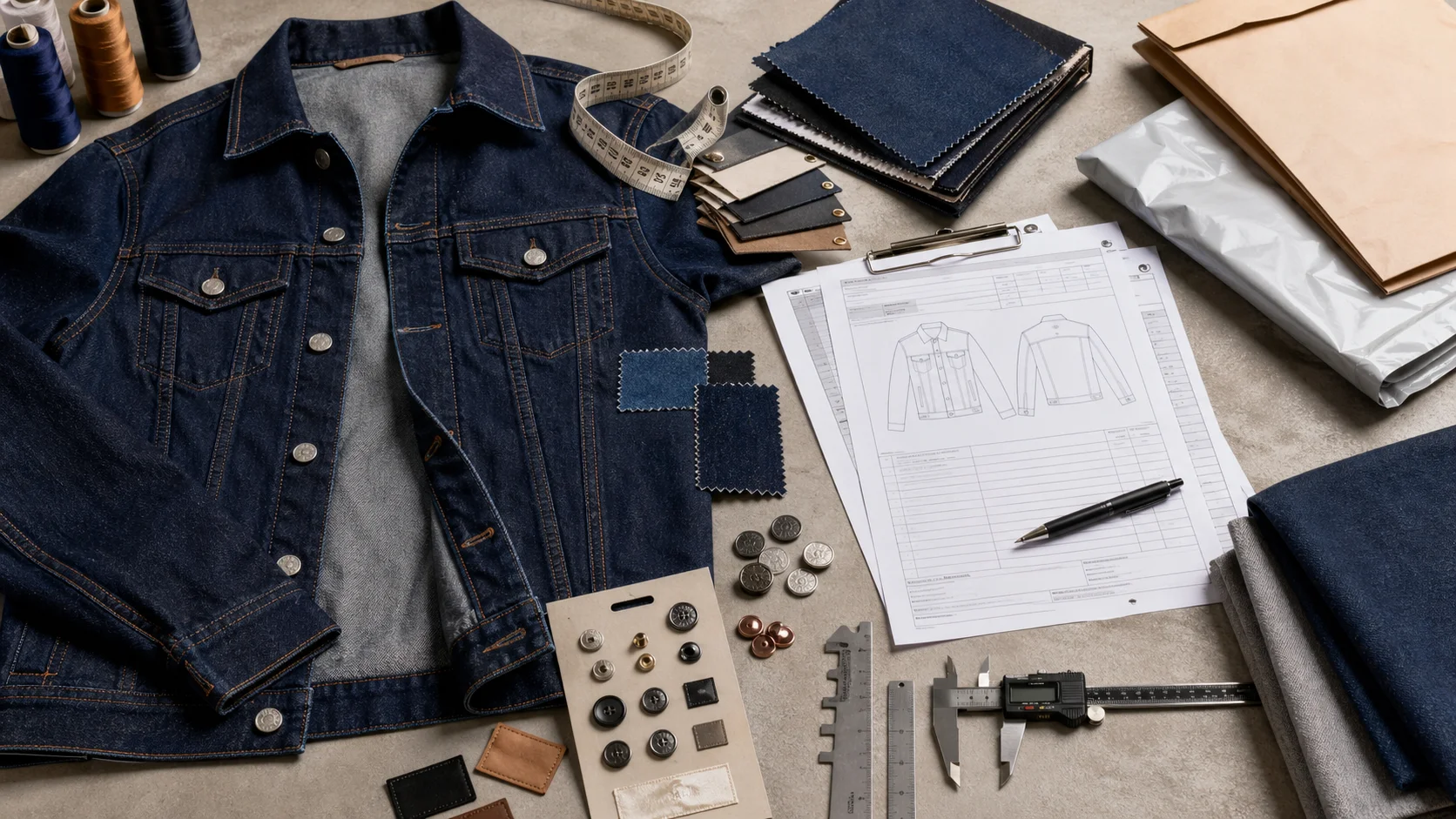
Custom Garment Care Labels Buyer Checklist with checks for samples, fit, MOQ, QC evidence, pricing terms, and delivery risk.
Fast answer: Custom Garment Care Labels Buyer Checklist: Compliance Text, Material, Print, and Timing should be judged by production evidence, not by a generic sourcing promise. The buyer needs sample proof, cost breakdowns, QC checkpoints, and delivery buffers in writing.
Ask for recent sample photos, measurement tolerances, fabric or print test assumptions, decoration test notes, packing examples, and a named inspection checkpoint. These details show whether the team can repeat an approved sample at bulk volume.
Separate garment cost, decoration, labels, packaging, sampling, testing, freight, and rush charges. When every cost line is visible, it becomes easier to reduce colorways, adjust size depth, or reserve more time for sampling.
A shirt can look perfect on the rail and still get stopped dead by four label failures: the fiber content is vague, the country of origin is missing, the wash icon is wrong, and the importer line never made it onto the final version. That sort of mistake can trigger relabeling, a 2% to 5% chargeback, or a shipment hold that adds 7 to 14 days to delivery. What is required on care labels for clothing, in practice, is accuracy, durability, and market-specific clarity — not decoration.
Care labels sit where consumer safety, retailer rules, and border compliance meet. Enforcement is uneven. In the US, inspectors usually care most about permanent labeling and honest fiber disclosure. In the EU, fiber naming and readability get more attention, especially when goods move across borders in batches of 5,000 to 50,000 units. Canada and Australia bring their own language and local-disclosure demands, and they catch brands that thought one master label could cover everything.
At factories in Vietnam, Turkey, and Portugal, the same pattern kept showing up. Higher-priced brands, especially those above $90 retail, were more likely to allow a 10-day pre-production approval cycle and a second artwork round. Budget ranges cut labels late, rushed revisions, and accepted “close enough” from suppliers under pressure to ship 20,000 pieces in 3 weeks. Cheap garments get the toughest scrutiny because they fail more often, not because they are cheap.
The commercial risk goes way beyond a missing line of text. Customers return products when they cannot find washing instructions. Retailers lose patience when the wrong label lands on 1,000 units out of a 12,000-unit order. A label error also signals weaker control elsewhere, and that affects sell-through and reorders. I treat this as a practical guide, not a legal memo, because labels are part law, part operations, part brand reputation.
In Guangzhou, Dhaka, Ho Chi Minh City, and Istanbul, I frequently tour weaving rooms where Rieter carding lines feed into Saurer double-twister spinning mills, and Karl Mayer warp knitting frames produce trim tapes. Those facilities often hold GOTS, OEKO-TEX Standard 100, WRAP, BSCI, and GRS certifications to reassure buyers that both social compliance and sustainable materials are audited. Labels themselves are woven on Staubli jacquard looms or printed on thermal transfer presses, with reactive dye baths and RO-treated rinse water run through licensed DyStar controllers to meet the OEKO-TEX Standard 100 limit values. The same factories run enzyme washes on ring-spun cotton, recycled polyester blends, and Tencel lyocell jerseys on Monforts range and use ultrasonic sealing machines for silicone-free finishes, so the care label needs to reflect every material and process it sees.
The core items stay fairly consistent across major markets: fiber content, care instructions, country of origin, and, where required, the identity of the manufacturer, importer, or responsible business. The details change fast. The US leans hard on truthful fiber disclosure and permanent attachment. The EU puts more weight on fiber naming and clear consumer information. Japan, Canada, the UK, and Australia each add their own wrinkles, from local language expectations to importer identity and format preferences.
In the US, the FTC expects garments to disclose fiber content using generic names such as cotton, polyester, wool, or spandex, usually in descending order. A shirt listed as 60% cotton and 40% polyester cannot just call itself “mostly cotton” on a permanent label. In the EU, Regulation 1007/2011 governs textile fiber names and composition disclosure, and brands selling into multiple member states often prepare labels in 2 or 3 languages to cut customs disputes. For deeper sourcing and production guidance, see the Textile Exchange standards for responsible fiber sourcing and the U.S. Trade Department guidance on market entry and compliance. Data from ISO and market guidance from trade bodies point the same way: standardization helps, but only if the translation is exact.
Here’s the annoying bit. Brands over-label one market and still fail another because a single icon is wrong or a French translation misses a finishing term. A collection can pass in Germany and fail in Quebec. It can clear retailer review in the UK and still get bounced at a border in Australia because the importer line is missing. For multi-market ranges, I insist on a label matrix by SKU, not a one-size-fits-all template.
This matters even more for private label clothing, where the brand name on the neck label becomes the accountability point even if the factory printed the wrong origin detail. In 2024, I reviewed a private-label run of 8,400 units where one label version was fine for the US, but the Canada version needed bilingual content and an extra distributor reference. One template would have failed half the order.
Working with suppliers in Dhaka and Ho Chi Minh City taught me that the same factory is sometimes certified to GOTS, WRAP, and BSCI but still relies on a basic pearl cotton binder for label attachment, which does not survive hydro-extraction in a 450 RPM industrial washer that a Dutch retailer uses for testing. The label has to list that the garment undergoes enzyme wash, pigment dye, or taping with polyurethane adhesives, otherwise border labs read the combination as missing finishing care.
When I check a label for basic compliance, I want four things in front of me. Fiber composition with percentages. Care instructions, either symbols or written words, depending on the market. Country of origin. Responsible-party details, such as the manufacturer, importer, RN number, or registered business name when the market asks for it. That’s the practical floor, not the ceiling.
Percentages have to total 100. They also need to run from highest to lowest, which sounds obvious until a factory mixes up a 52% cotton, 43% modal, 5% elastane rib knit and prints the elastane first because it is the “special ingredient.” Tolerance rules vary by jurisdiction and material type, but sloppy math never looks good. A lab report for a French terry 320 GSM hoodie should match the label, not the sample-room memory of what was bought 6 months ago.
The usual omissions are predictable. “Mixed fibers” is too vague. Missing RN or company identity can turn into a retailer issue even when customs lets the carton through. Trims and linings are another trap. A bonded jacket with a 100% polyester shell, a nylon lining, and a polyurethane coating may need separate disclosure depending on market rules and how the product is marketed. Same story with embellishments that materially change wash behavior, such as foil prints, flocking, or heat-set appliqués.
Blends and finishes change the story. A garment that looks simple on a tech pack can become messy once an enzyme wash, pigment dye, or waterproof coating enters production. I have seen a 92% cotton, 8% elastane legging need a revised care callout after wash testing showed distortion at 40°C, which meant the label had to move from a generic symbol set to a more specific written instruction. That small change added 4 days and $0.18 per piece.
For certified ranges, I cross-reference the label with OEKO-TEX Standard 100 test reports, GRS content sheets, and GOTS mill certificates, so the dye-lot numbers, recycled polyester percentages, and organic cotton bale tags all align. Machines such as the Durkopp Adler bar-tacking seamers and Tajima embroidery heads that sew on identification tags can only work after the label design is finalized, and the pattern cutter needs that precise notation before the GOTS-certified organic cotton quilted fabric is laser-cut. When a supplier in Istanbul quoted $2.50-4.00 per unit at 500 MOQ for woven labels, the price already included the cost of heat-set edges and flame retardant testing for the UK market.
The five core care symbols are wash, bleach, dry, iron, and professional care. They help customers read the garment fast, but they do not replace the full label where written wording is required. In North America, bilingual labels are common in many categories. In parts of Europe, the same garment may need multiple languages if the retailer sells across borders. A symbol can reduce confusion. A symbol alone cannot rescue an incomplete declaration.
Placement matters just as much as wording. A compliant label should be sewn in, durable, easy to find, and readable after repeated washing. It should not hide inside detachable packaging that disappears at checkout. I have tested labels that looked fine on day one and turned unreadable after 5 wash cycles because the ink bled, the woven edge curled, or the neck seam scratched the print off. That failure never shows up in a spreadsheet.
Factories often fail on comfort, not content. A label stitched into a side seam with a coarse needle can pass legal review and still trigger customer complaints within 48 hours. I have also seen oversized satin labels in lightweight knits create enough irritation to lift return rates on a 3,000-piece run by 0.7 percentage points, pushing the delivery window out because the retail partner insisted on swaps. A proper stitch path using a Brother TC-P series machine, the right heat treatment, and the patience to test the label through a 150-cycle abrasion rig cuts those complaints, but it takes deliberate sequencing in the cutting room before the care label is attached.
Cost and lead time are no longer excuses for poor compliance. In Guangzhou and Ho Chi Minh City, a standard woven care label with double-sided printing, thermo-adhesive backing, and stitched-on attachment runs $0.20 to $0.45 per unit for orders of 10,000 pieces, provided the artwork is locked before the dye lot hits the jet dye machine. When special ink (e.g., RFID-embedded fiber) or organic cotton floss is requested, the price can jump to $0.95 per label, and the factory may insist on a 1,000-piece MOQ for the custom run.
For a private-label capsule in Istanbul this spring, a certified WRAP and BSCI supplier quoted a flat $2.50-4.00 per label at a 500-MOQ tier that covered artwork proofs, heat-sets, and GRS-backed recycled polyester. That range includes the cost of machine set-up on an Omet press, the color-matching for Pantone 17-5641 TCX, and the 24-hour proof cycle needed for EU organic cotton blends. The entire process, from design submission to final QA, took 18-22 business days, which matches the industry-average timeline I see for mills balancing multiple certifications.
Turnaround slows if language approvals take longer or if shipping is routed from Dhaka through Chittagong instead of the usual seaport. A compliant label that passes GOTS and OEKO-TEX Standard 100 scrutiny may still sit on hold for 5 extra days if the freight forwarder requests updated documentation, so planning for 25 days total gives a better buffer than promising 12-day express production.
Brands often submit incomplete tech packs, and the factory improvises. Missing wash instructions, shorthand like “cool wash,” or failing to name the blender for a 30% recycled nylon trim can trigger a “non-compliant” flag. Another repeat offender is assuming one language set suffices—especially when a Hong Kong buyer ships to Spain and expects Spanish and Catalan on the same label.
Using the wrong material references is another hazard. A label may list “polyester” when the approved document calls the shell “recycled polyester” to match GRS certification, or it may omit the difference between a tinted acetate lining and a silk-like, OEKO-TEX Standard 100 certified viscose lining. When the certification body audits, they compare the label to the invoice material list and the dye lot results, so any deviation produces a finding.
Finally, brands forget to update the label when the process changes—say, when the factory switches from a conventional wash to a PFC-free water repellent applied via a Montex roller. Once that soluble coating is part of the garment, the label must indicate “Do not tumble dry” and note the professional DWR treatment if required by the destination market’s consumer safety agency.
Start by creating a labeling matrix by SKU that lists every market, every language, and every content requirement. Confirm that the SOR (Source of Record) matches what’s on the label and what the lab test shows. For garments made in Dhaka or Guangzhou, I build a checklist that runs through the fiber content, wash icons, RN or company number, importer identity, and any retailer-specific line — then I cross-check that with the factory’s traceability records from their WRAP and BSCI audits.
Next, lock down the materials and processes before the label is printed. If you are using GOTS organic cotton, ensure the label says “GOTS certified by Control Union 123456,” and include the dye lot number if you’re also listing OEKO-TEX Standard 100. Once the dye house (often in Ho Chi Minh City or Istanbul) confirms the Pantone match, send the final art to the label vendor with coordinates for placement, specify the seam tape width, and approve a physical sample before the bulk run.
Finally, build in a QA gate at the warehouse where a trained merchandiser checks each box of labels for the proper symbols, languages, and attachments before the garments are folded. That gate should include a 5% pull for washing to ensure the ink, adhesive, or woven structure survives 40°C and 60 minutes in a laboratory shaker.
Packaging can ease compliance by keeping care labels visible through the supply chain instead of hiding them inside poly bags that are opened only at the retail store. Clear poly bags with QR codes that link to certifications, recyclable paperboard hangtags that summarize label data, and reusable cloth bags printed with fiber breakdown help retailers verify quickly without damaging the label.
Choosing folded cardboards made from post-consumer recycled pulp also underscores sustainability claims when paired with GRS-certified recycled polyester labels. Brands shipping from Ho Chi Minh City to the EU often include a separate care insert that mirrors the sewn label but in a recyclable format, which satisfies markets that allow supplemental instructions for multilingual compliance.
Finally, collaborate with your packaging supplier to digitize the label specifications in PLM so that label gloss, placement, and material notes appear on the same sheet as the carton barcode, reducing handoffs and mistakes that can lead to non-compliance fines.
Q: Do care labels need to mention the finishing process like enzyme wash or water repellent?
A: Yes, if the finish materially affects care or safety. Markets such as Sweden and Canada expect additional notes when a process changes the garment’s washability or moisture protection.
Q: Can I use a single care label for multiple retail partners?
A: Only when all requested markets share the same language, symbols, and mandatory statements. Otherwise, provide dedicated versions, especially if an importer line or bilingual text differs.
Q: How do I ensure my care labels survive shipping and washing?
A: Test them in-house using your standard wash cycle, check for abrasion resistance, and work with a supplier that can deliver OEKO-TEX Standard 100 or GOTS label material. Confirm the attachment uses a Brother TC-P seamer or similar industrial setup to prevent detachment during the garment’s lifetime.