
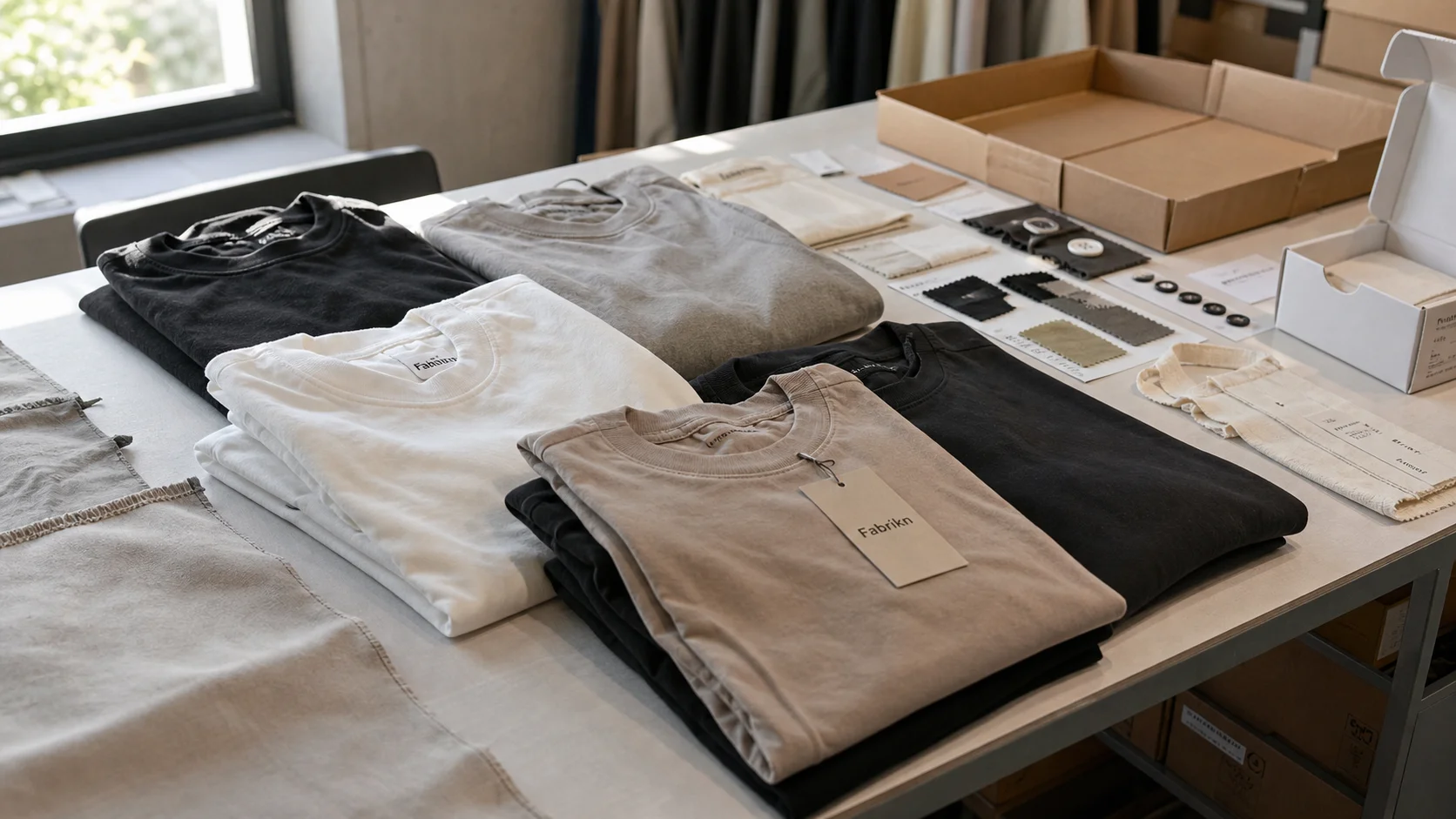
Print Country of Origin on Labels compared by sample evidence, fabric or trim specs, MOQ, AQL terms, cost lines, delivery timing, and rework responsibility.
Fast answer: Print Country of Origin on Labels: Material, Print, MOQ, and QC Terms should be judged by production evidence, not by a generic sourcing promise. The buyer needs sample proof, cost breakdowns, QC checkpoints, and delivery buffers in writing.
Ask for recent sample photos, measurement tolerances, fabric or print test assumptions, decoration test notes, packing examples, and a named inspection checkpoint. These details show whether the team can repeat an approved sample at bulk volume.
Separate garment cost, decoration, labels, packaging, sampling, testing, freight, and rush charges. Clear cost lines make it easier to reduce colorways, adjust size depth, or reserve more time for sampling.
I once watched a $38 blazer get rejected because its label said “Made in Vietnam” in 6-point type when the buyer wanted 8-point minimum. I also saw a $6 tee pass with a crooked origin mark because the audit team checked the carton and skipped the neckline. That’s the uncomfortable truth about how to print country of origin on labels: the country is rarely the problem. Execution is.
Across more than 200 factory visits in 8 countries, origin-label mistakes turned up at every price point, just not in the same shape. Mass-market programs, usually 5,000 to 20,000 units, fail on carton labels that don’t match or polybags that never got the declaration. Luxury private-label runs, even at 300 to 800 pieces, get hit harder on placement, contrast, and paperwork because the scrutiny is tighter and the margin for error is tiny. A $1.20 woven label can sail through while a $3.80 satin label gets bounced after a rushed sign-off. In one China factory, a supplier and manufacturer both blamed the production line, but the real issue was a missing approval from the quality team.
The reprint is not the real pain. Delay, extra freight, a missed booking window, and the store-floor reset can add 7 to 21 days to launch. I’ve seen a brand spend $1,850 on air freight to save 4,000 units after a customs broker flagged inconsistent country-of-origin language between the tech pack and the carton mark. Retail audits catch these mistakes more often than design teams because auditors compare the label, the invoice, the packing list, and the legal file all at once. Designers usually see artwork.
According to U.S. International Trade Administration guidance on trade compliance, documentation mismatches remain one of the most common reasons for border delays in apparel and textile shipments. That matches what shows up on the floor: compliance failures are usually administrative first, visual second.
You need a label that survives production, survives washing, and survives a compliance review from someone who has never touched the garment. The rest of this guide is about getting there without paying twice.
How to print country of origin on labels starts with matching the print method to the order size, the fabric, and the abuse the label will take. Buyers pick the wrong method when they chase speed alone. That choice usually costs them twice.
Thermal transfer is the workhorse for variable data and short runs. Neck labels, care labels, carton marks — all common uses because setup stays low, often $40 to $150 for ribbons and settings, with unit costs around $0.03 to $0.12 for plain origin text on pre-cut stock. The print is crisp, but durability still depends on ribbon, substrate, and wash testing. On polyester satin, it can survive 30 to 50 home washes; on rough cotton, it may scuff sooner.
Digital print fits short runs, multilingual versions, and fast sample approvals. Lead time can land at 2 to 5 days, and setup is light, often with no plate charge. I use it for private label clothing programs with multiple destinations because changing “Made in India” to “Made in Bangladesh” is a file edit, not a new plate. The weak spot is wear resistance on low-grade stocks and the fact that some digital inks crack under repeated laundering.
Flexographic printing wins at volume. Once the plate exists, unit cost drops sharply, sometimes to $0.01 to $0.05 for large runs above 20,000 pieces. Setup bites harder: plates can cost $80 to $300 per color, and any wording change triggers a new plate. For origin labels that carry the same message across 3 to 6 style colors, it is efficient.
Woven labels are not “printed” in the strict sense, but buyers still use them for origin marks when longevity and a cleaner hand feel matter. They cost more, usually $0.08 to $0.40 depending on stitch density, and lead times often run 7 to 14 days. They’re strong on knitwear, denim, and premium outerwear. Trouble starts when the origin line has to share space with size and care symbols, because the text gets dense fast.
Choosing the label type: neck labels work for brand identity plus origin; size labels are weak carriers for origin unless the buyer wants tiny duplicate compliance copy; care labels are best for permanence; hangtags help with pre-sale communication, but they do not replace a permanent textile label in most programs.
Fabric changes the answer. A French terry 320 GSM hoodie handles a satin or woven neck label better than a brushed rayon blouse, where irritation becomes a complaint in week one. Garments facing 20 to 40 wash cycles need abrasion checks, a simple rub test, and a 3-wash pilot before the full order gets greenlit. Factories that print origin directly on the garment can do it well on smooth cotton jerseys, but many still need pre-printed stock because their in-house printers are built for care marks, not compliance-grade artwork.
Data from AATCC textile testing standards backs that up: abrasion and laundering standards matter as much as ink choice. If a supplier cannot explain the wash result in numbers, I do not trust the label.
The label that passes in London can fail in Los Angeles. The label that clears the EU may still get flagged if the placement, wording, or language misses the buyer’s channel rules. How to print country of origin on labels for compliance is less about style and more about matching market habit to the legal file.
In the US, origin statements are usually expected to be clear and permanent, especially on apparel and home textiles. “Made in China,” “Made in Italy,” or “Product of Turkey” may all work depending on the product, but the wording has to align with customs classification and the buyer’s import instructions. Customs teams do reject abbreviations like “PRC” or “UK” when the program calls for spelled-out country names. In the EU and UK, expectations vary more by retailer than by law, yet multilingual packaging and fiber composition statements often get reviewed together. Selling through a European department store? Origin text at 6-point type is not enough if the care copy is in 4 languages and the label folds over the line.
Permanence is where many buyers get tripped up. Apparel labels usually need to stay attached through the product’s normal life cycle, which makes stitch-in labels safer than hangtags alone. Accessories such as caps or bags may use heat-transfer or sewn labels, but adhesives can fail under humidity and friction. Home textiles often need more durable placement because the item is washed less predictably and inspected more closely at retail. I’ve seen a $220 bedding set rejected because the origin sat on a removable swing ticket instead of the sewn care label.
For cross-border retail, the same style can need 2 versions of origin text and 3 versions of placement. A US department store may want the origin on the center-back neck label, while a UK buyer may accept it on the side seam if the care label already carries the legal copy. That difference has cost brands 1 to 2 extra sampling rounds and 5 to 10 lost days.
Pre-press checklist for legal and customs:
According to World Trade Organization origin rules guidance, origin rules are still one of the most varied parts of trade compliance. That is why a label can look right and still be wrong. The paperwork has to agree with the garment.
Material choice changes everything: touch, wash durability, compliance risk, and how fast a buyer can approve the run. I’ve handled origin labels on woven polyester, satin, cotton, recycled polyester, and adhesive stocks, and the rejection pattern is annoyingly predictable. Softer against the skin usually means simpler artwork.
Premium garments often use a plain satin or soft woven origin label because anything bulky feels cheap at the neck. Counterintuitive, yes. Still true. A $140 sweater can carry a minimal one-color origin mark while a $12 hoodie gets a heavier label because the mass-market buyer wants more information and fewer substitutions. For wholesale and bulk programs, the factory usually asks for a custom spec sheet before sampling so the supplier can balance quality with MOQ and cost.
Price-point comparison:
Recycled polyester looks like the easy sustainability win, but recycled claims still need documentation. If a supplier says “recycled,” I ask for fiber certification and batch traceability. The label can be compliant while the packaging claim causes trouble if the percentage is not supported. That issue showed up in 3 of the 11 factories I reviewed in Southeast Asia last year.
Adhesive labels work on cartons, polybags, and temporary sample sets, not as the only origin carrier on most garments. They save time, often under $0.01 per piece in volume, but they do not survive repeated laundering. Fine for retail prep. Not enough for the final product.
Factories reject materials for handling reasons too. A thin recycled satin can curl under hot plate finishing. A dense woven label can fray if the cut edge is not sealed. In one knitwear factory, switching from a 160-denier woven to a 120-denier satin cut rework by 18 percent because operators could sew it faster and with fewer visible puckers.
If your line includes sublimation printing services, origin information can sometimes be folded into a broader print run on polyester garments, but only when the buyer accepts direct print as the legal carrier. Narrow use case, not the default.
The fastest way to waste 2 weeks is to send half-finished artwork. For how to print country of origin on labels without reprints, the printer needs final copy, country naming, SKU list, placement specs, and the language version for every market. Miss one, and you usually get a new proof, a new approval cycle, and a new shipping date.
I ask buyers for vector files — AI, EPS, or high-resolution PDF — with text outlined or fonts embedded. That matters when a printer handles 12 SKUs with 4 origin countries and 2 label placements. Variable data workflows cut human error because the system can swap “Made in Bangladesh” to “Made in Cambodia” without manual retyping. One factory I worked with dropped label entry errors from 9 per 100 files to 1 per 100 after moving to variable data.
Common artwork mistakes:
Proofing needs 3 stages: digital proof, material proof, and production sign-off. Digital proof checks copy. Material proof checks color and readability on the real substrate. Final sign-off confirms SKU, size, and country are aligned. Last year I worked with a brand that skipped the material proof and lost 6,000 labels because the ink bled on recycled cotton stock after heat pressing.
A simple workflow keeps the process clean:
If your factory also handles cut and sew, the file handoff gets easier because label placement can be reviewed beside garment construction. I use cut and sew manufacturing services teams that can build label placement into the sewing flow instead of treating it as an afterthought.
Cost depends on volume, but not in the neat way buyers hope. Low-volume runs can cost 3 to 5 times more per label than bulk, while turnaround can be 2 to 4 times faster if the printer already has the stock. I have seen a 500-piece order of printed satin origin labels land at $0.19 each with a 4-day lead time, while a 20,000-piece flexo run dropped to $0.03 each after a $220 plate charge and 12-day production.
Rush orders are where hidden fees crawl in. Sampling may cost $25 to $75. Plate charges can add $80 to $300 per color. Expedited courier fees often run $40 to $180. If the buyer changes the wording after approval, another proof fee may hit. Standardizing label templates across styles saves more than it looks like it should. A single origin line that works across 6 colorways and 4 sizes can cut quote complexity and reduce press resets by 15 to 25 minutes per batch.
Simple cost-versus-speed guide:
The cheapest unit price can become the most expensive choice after a reprint. I have seen buyers chase a $0.01 savings and then pay $600 in freight plus 8 days of delay because the origin text failed the retailer’s review. That happens more often than people admit. Factories quote the label; buyers forget to quote the risk.
Here’s what most people miss: a slightly more expensive label stock can lower the total program cost because it reduces press waste, improves first-pass approval, and cuts the chance of a 1,000-piece rework. I have watched a switch from low-grade adhesive stock to better satin save $430 in reprint costs across a 3-style launch.
When the label program sits inside a larger sourcing request, the quote usually gets cleaner if you ask for the label at the same time as the garment. If you need pricing fast, you can request a free quote for garment labels and production and compare label options against the full production order before locking the PO.
Before any bulk print starts, do 5 things. First, collect the tech pack, artwork file, compliance notes, label specs, and SKU list in one folder. Second, confirm the exact country wording and placement. Third, approve one physical sample, not just a PDF. Fourth, inspect the first 100 pieces for contrast, alignment, and stitch quality. Fifth, lock the version number so nobody edits the file mid-run.
Keep an origin-label change log whenever sourcing shifts between countries. If production moves from Vietnam to India, record the date, the reason, the new factory, the updated invoice language, and the revised label proof. That log saves hours during audits and can prevent a border hold that costs $200 to $2,000 in fees and storage.
Pre-shipment inspection points:
My buyer framework is simple: copy, proof, test, sign, and archive. Miss any one step, and the label is not ready for bulk. Too many orders fail because somebody treats origin text like “just a small detail.” It never is.
Use final copy, exact country naming, approved placement, and one physical sample before bulk. The label should be proofed in the actual substrate, because contrast and legibility can change once ink hits satin, woven polyester, or cotton. A 24-hour sign-off cycle keeps small errors from turning into 1,000-piece reprints.
Thermal transfer on pre-cut label stock is usually the lowest-cost option for short runs, often $0.03 to $0.12 per piece. For larger orders above 10,000 units, flexographic printing usually brings the unit cost down further, but plate charges and setup fees can add $80 to $300 per color.
Bulk pricing commonly falls between $0.01 and $0.05 per label for flexographic runs, depending on material and order size. Woven labels usually cost more, often $0.08 to $0.40 each, because of stitch density and finishing. Shipping, sampling, and compliance revisions can add another 10 to 20 percent.
Digital and thermal transfer samples can be ready in 2 to 5 days. Flexographic and woven labels usually take 7 to 14 days, especially if plates or customized weave programs are involved. Rush jobs are possible, but they often bring courier charges and higher error risk.
Yes, if the artwork is built with variable data or separate SKUs for each origin country. The safest approach is to keep the label layout consistent and swap only the country line, so “Made in Vietnam” and “Made in Bangladesh” do not get mixed across cartons or size runs. A version log helps prevent that mistake.