
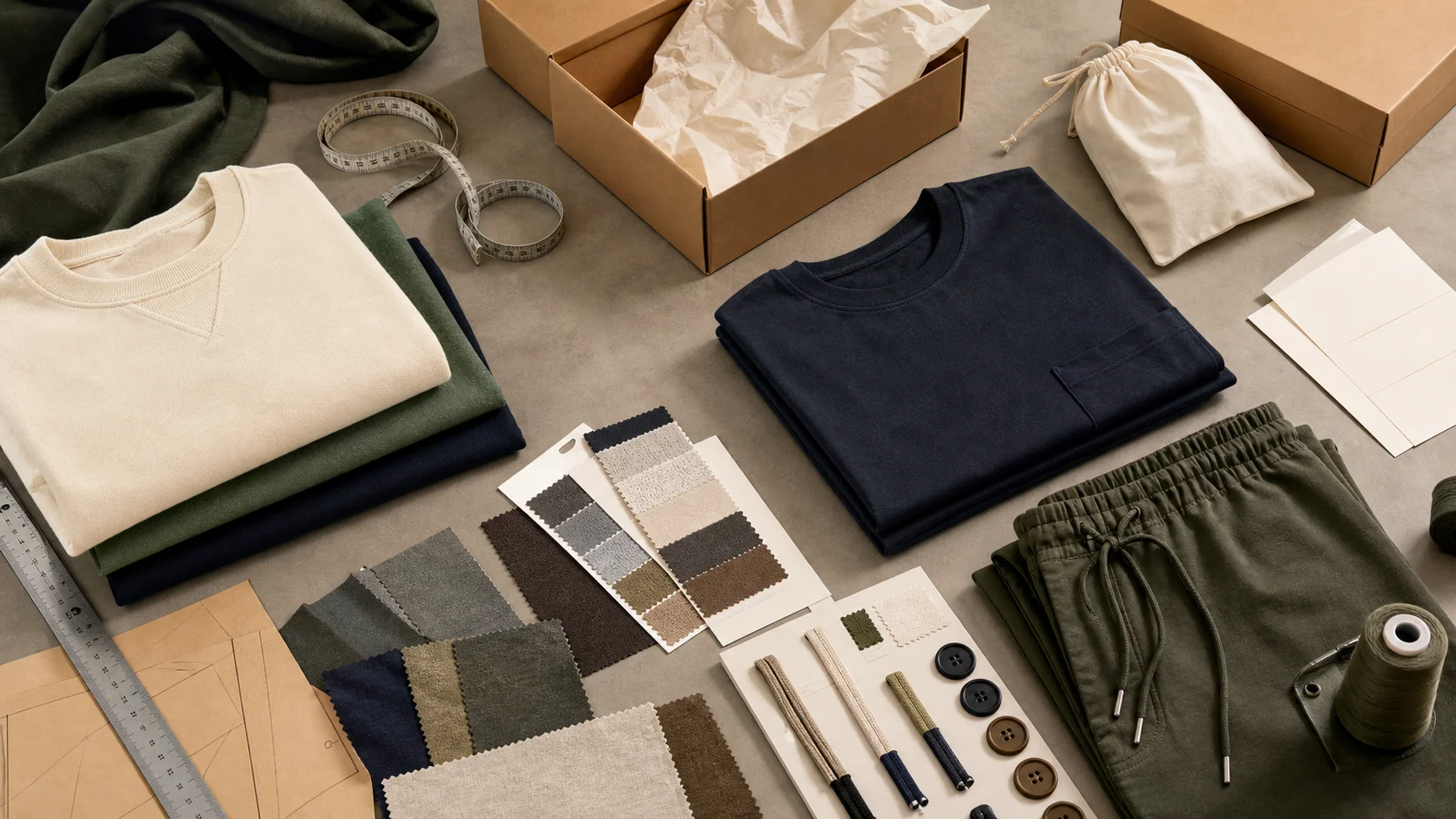
Cut and Sew Manufacturing compared by sample evidence, fabric or trim specs, MOQ, AQL terms, cost lines, delivery timing, and rework responsibility.
Fast answer: Cut and Sew Manufacturing: Tech Pack, Sample Gate, MOQ, and QC Terms should be judged by production evidence, not by a generic sourcing promise. The buyer needs sample proof, cost breakdowns, QC checkpoints, and delivery buffers in writing.
Ask for recent sample photos, measurement tolerances, fabric or print test assumptions, decoration test notes, packing examples, and a named inspection checkpoint. These details show whether the team can repeat an approved sample at bulk volume.
Separate garment cost, decoration, labels, packaging, sampling, testing, freight, and rush charges. Clear cost lines make it easier to reduce colorways, adjust size depth, or reserve more time for sampling.
The first clue is always on the cutting table: fabric rolls, pattern pieces, and a sample that proves the concept or exposes the flaw. That is what what is cut and sew manufacturing actually means. Garments are built from separate fabric panels, then cut, stitched, finished, and packed. If you want more control than blanks can offer, this is the model brands use for fit, handfeel, and margin.
I have walked 200-plus factory floors across 8 countries, and the same truth keeps repeating. Brands that care about fit, handfeel, and margin end up here. Control is the real draw. A 220 GSM jersey tee, a 320 GSM French terry hoodie, and a nylon-spandex active set all need different fabric sourcing, seam logic, and testing. Stock blanks do not bend to that kind of work without compromise.
Smaller runs of 300 to 800 units often create tighter quality control because the line is easier to supervise. Large-volume factories can reject low-MOQ orders or push them onto the weakest line. That is why a specialist manufacturer with the right setup can outperform a bigger supplier better suited to bulk programs.
Backwards on paper, normal on the floor. A factory that runs 50,000 units of one style may still treat a 500-piece order like a nuisance, while a specialist doing 1,200 units a month can spend 12 extra minutes per sample and catch a sleeve imbalance before bulk production. I have seen that difference erase 8 to 12 percent in returns for emerging brands. Fit matters. So does consistency. So does the ability to choose organic cotton, recycled polyester, or a heavier knit that makes the garment feel worth its price.
Identity matters too. A private label line that uses a custom rib, a custom neckline, or a specific enzyme wash feels distinct the second a customer touches it. For founders building private label clothing services, that control often matters more than shaving 40 cents off a unit cost. I have seen brands sell a $48 tee with a 28 percent gross margin because the fit is right, while a cheaper blank-based tee at $18 stalls at 18 percent because returns and discounting eat the gain.
So why pay more upfront if savings might show up later? Better spec. Better fabric. Better factory. Fewer remakes, fewer markdowns, stronger sell-through. Not theory. Production sheets say it after the cartons leave the floor.
It starts before a blade touches fabric. A brand sends a tech pack: measurements, seam notes, artwork placement, fabric targets, trim lists, packing instructions. Then pattern making begins. A pattern maker drafts the garment in base size, and grading expands it into the full size range, often 5 to 8 sizes depending on the category. If the spec is off by 0.5 inch at chest width, the problem multiplies across the grade.
Sampling usually takes more than one round. I have seen a hoodie go through 3 samples before approval because the rib opening was too loose, the kangaroo pocket sat 1.2 inches too low, and the shrinkage after wash was 6 percent instead of the agreed 3 percent. That is why approved samples matter more than mood boards. A sketch sells the idea. A sealed sample locks the reality. Data from ASTM International and OEKO-TEX standards for textile testing point to the same lesson: measurable quality standards beat subjective approval every time.
After sample sign-off comes marker making, which lays out pattern pieces to reduce waste. Then cutting. Then sewing, where machine choice matters. A knit tee may move through overlock, coverstitch, and flatlock machines. A woven shirt needs a different line, often with collar settings, button-sew stations, and precise placket work. Denim adds heavier needles, bartack machines, and wash-room testing. Activewear may require bonded seams, heat presses, and stretch-thread control. Each category asks for a different factory skill set.
Mistakes show up in the same places again and again. Spec errors. Inconsistent shrinkage. Weak stitch standards. Trim mismatches, especially zipper lengths and label colors. I once watched a factory scrap 700 units because a black woven label arrived in a warm charcoal tone that looked invisible under retail lights. The bulk fabric was fine. The branding was not.
Workflow changes with order size and complexity. A 400-piece run of a basic tee may move from cutting to packing in 3 to 4 weeks after sample approval. A 3,000-piece denim order can take 8 to 12 weeks because washing, distressing, and inspection add labor hours. More complexity means more checkpoints. More checkpoints mean less tolerance for sloppy communication.
Three sourcing models, three very different jobs. Blank apparel means buying finished stock garments and decorating them with print or embroidery. Full package production means the factory handles almost everything, from fabric sourcing to trims, development, production, and sometimes freight support. Cut and sew sits in the middle. Each model has a place, but they are not interchangeable.
Blanks are fast. A supplier can ship 100 hoodies in 5 to 10 days if stock is available. But sameness comes bundled with that speed. Fit is locked. Fabric is fixed. Branding is limited to placement and decoration. A brand may save $2.00 to $4.00 per piece at first, then lose far more through weak differentiation and higher discounting. I have seen a retailer move 2,000 blank tees at full price, then spend the next season explaining why customers could find the same body from five other labels.
Cut and sew takes longer because development comes first. Sampling can take 2 to 6 weeks, bulk another 3 to 12 weeks, and freight adds its own clock. The payoff is control over silhouette, fabric, trim, and finishing. If your product story depends on a custom 260 GSM cotton jersey, enzyme wash, or a cropped fit that cannot be bought off the shelf, what is cut and sew manufacturing becomes the rational choice. It also supports better retail margins when design identity is part of the value proposition.
Full package production fits a brand that wants fewer touchpoints and can trust the factory to source materials. It works well for founders with a clear concept but limited sourcing staff. The trade-off is visibility. You may save time, but you lose some control over the mill, the dye lot, and the trim vendors. If you want a partner that handles that end-to-end model, cut and sew manufacturing is often the better fit than chasing individual vendors.
My rule is blunt. Choose cut and sew for design control, fit accuracy, and brand identity. Choose blanks for speed, simplicity, and a very narrow product plan. If the garment needs a story, a handfeel, or a precise fit spec, blanks are usually too blunt an instrument.
Pricing shifts hard with order size, fabric, construction, and country of origin. A 500-unit run can cost 30 to 60 percent more per piece than a 5,000-unit run, even if the silhouette is identical. Development overhead is spread across fewer units, cutting waste is higher, and the line still needs setup time. A basic cotton tee might land at $4.20 to $6.50 in a 500-piece order, while the same shirt can drop to $2.40 to $3.60 at 5,000 units.
Startup brands usually live in the lowest MOQ bracket. That may mean $300 to $1,000 in sample fees, plus fabric and trims for 100 to 500 pieces. Mid-market programs often sit in the 1,000 to 3,000 unit range and can afford better fabric sourcing, tighter inspection, and more predictable reorders. Premium and luxury runs are a different animal. A heavyweight terry hoodie with custom drawcord tips, pre-shrunk fabric, and stricter wash testing may cost $12 to $28 at production level before freight, because the labor content is higher and the tolerances are tighter.
Regional differences matter. South Asia often prices labor-intensive categories lower, especially when factories are set up for knit basics or woven shirting. Nearshore factories in Mexico, Central America, Portugal, or Eastern Europe can cost more per piece, yet faster replenishment and lower freight can narrow the gap. I have seen a $7.80 unit price in a nearshore factory beat a $6.10 offshore quote once duty, air freight, and 4-week delays were counted. Cheap is not always cheaper.
Premium brands pay for more than fabric. They pay for finer stitching, better grading, less puckering, stronger inspection, and wash tests that catch torque, shrinkage, and color loss. Even zipper choice matters. A YKK zip can add $0.35 to $0.90, depending on length and finish. On 1,500 units, that adds up fast. But so does a bad zipper that triggers 6 percent returns.
For brands scaling beyond basic tees, the real cost question is landed margin, not FOB. You need the factory price, yes, but also duty, packaging, freight, and remake allowance. That is where many first orders go wrong.
Factory location changes more than the invoice. It changes speed, visibility, compliance risk, and the odds that a mistake gets caught before it becomes a container of inventory. Asia often wins on labor cost and scale. Nearshore options win on speed and communication. Domestic production wins on sampling access and shorter transport. The trick is understanding the full math, not just the unit quote.
Lower labor cost does not always mean lower total cost. A factory with a $2.20 labor cost but 7 percent defect rate may end up more expensive than a factory charging $3.10 with 2 percent defects. I have seen this in both knitwear and denim. The second factory costs more on paper, then saves money through fewer remakes, fewer late shipments, and fewer chargebacks from retailers who punish missed delivery windows.
Time zone overlap matters more than brands admit. A factory 12 hours ahead may add 24 hours to every approval loop. A factory 2 hours away can answer pattern questions, adjust a marker, and approve a strike-off in the same working day. That saves a week fast. Audit access matters too. If your team cannot visit, ask who is there on the floor, how often line audits happen, and what defect data is shared weekly. According to U.S. International Trade Administration trade guidance and logistics reporting, delays compound quickly once cross-border movement and customs touch the timeline.
Sustainability varies sharply by region and factory maturity. Two factories in the same country can differ on wastewater treatment, boiler fuel, chemical management, and traceability. A mature facility may run on better energy mix, track fabric lots to the roll, and document water discharge. A weaker one may outsource dyeing, hide subcontracting, and treat waste like someone else’s problem. That is why I ask for evidence, not slogans.
The thing nobody tells you: a slightly higher hourly wage can produce lower total landed cost if the line is cleaner, the communication is faster, and the compliance system is real. I have seen brands save 9 percent overall by paying more per hour and less per mistake.
Start with a brutal checklist. Ask for minimums, category experience, machine list, lead times, compliance records, and QA systems. A factory that handles 20,000 woven shirts a month may still be a poor fit for a 480-piece fleece drop. A factory that says yes to everything is often more dangerous than one that refuses the wrong product category. Specialization usually beats enthusiasm.
I want defect data, not adjectives. Ask for the last 3 inspection reports. Ask for acceptable quality level targets. Ask how they handle shrinkage, shade variation, and seam slippage. If they cannot show pilot samples from a similar brand, I assume the learning curve will be paid by the buyer. I also ask whether they own the cutting, sewing, washing, and packing stages or outsource key steps. Outsourcing can add 1 to 3 weeks and make quality harder to trace.
Communication reveals more than a polished deck. Do they answer within 24 hours? Do they flag a problem before you do? Can they explain why a 3.5 cm collar width matters on a size medium? If they cannot translate production language into buyer language, the relationship will be expensive. That is especially true for product families like denim, technical knits, and any item that needs wash testing or bonding.
Do not accept sustainability claims without evidence. Ask for wastewater treatment logs, chemical management policies, wage transparency, and audit recency. Certifications help, but they are not enough by themselves. I look for recent audits, preferably within 12 months, plus proof that the factory can trace yarn, fabric, dye lot, and trims. For adjacent categories like headwear, the same due diligence applies, which is why brands often cross-check a custom hat manufacturing partner against the same standards.
If you need a fast next step, ask for one pilot style, one reference from a similar category, and one landed-cost sheet. Then verify every line item. That is the only way to know whether a factory can deliver or simply quote well.
Start with one product, not five. Define the style, fit, fabric, trims, target cost, and launch quantity before you contact factories. A tech pack should include measurements, seam types, artwork placement, wash standards, packaging notes, and tolerances. The cleaner the package, the fewer sample rounds you will need. I have seen brands cut sampling churn from 4 rounds to 2 by specifying shrinkage, fabric GSM, and label placement before development began.
Set a realistic MOQ and margin target. If your landed cost is $9.80 and your wholesale is $24, your margin may look acceptable until you add duty, freight, returns, and markdown exposure. Build a simple sheet with at least 5 lines: FOB, duty, packaging, freight, and expected return rate. Then test the product before you scale. A 300-piece pilot teaches more than a thousand opinions.
Use the first run to measure defect rate, sell-through, and reorder speed. If sell-through is under 55 percent in the first 30 days, the product needs revision, not volume. If defects are under 2 percent and reorder requests are arriving within 21 days, you have something worth expanding. That is where brands should spend their budget, not on invisible upgrades customers will never notice.
My operating rule is simple. Pay for quality where customers can feel it. Spend on fabric handfeel, fit, seam strength, and wash stability. Do not overspend on details that do not move sell-through. A clean spec, disciplined sourcing, and honest factory selection do more for margin than a flashy trim package ever will.
It is the process of making garments from separate fabric panels that are cut to pattern, sewn together, finished, and packed. Unlike blanks, it allows custom fit, fabric choice, trims, and construction details. That is why brands use it for tees, hoodies, woven shirts, denim, and activewear.
Basic styles can start around $2.40 to $6.50 per piece at higher volumes, while premium or complex items can reach $12 to $28 or more before freight. A 500-unit run usually costs much more per piece than a 5,000-unit run because development and setup are spread over fewer units. Fabric, trims, country of origin, and wash work all change the number.
Most programs need 2 to 6 weeks for sampling and 3 to 12 weeks for bulk production after approval. Simple knits can move faster, while denim, outerwear, and technical garments take longer because of wash tests, hardware, and added QC steps. Freight can add 1 to 5 weeks depending on origin and mode.
Yes. Many factories accept low MOQs in the 100 to 500 unit range, though pricing will be higher than large runs. Small brands often benefit because they can test fit, color, and sell-through before committing to bigger volumes. The key is to build a precise tech pack and accept that the first run is usually a learning order.
Ask about minimum order quantities, category experience, machine capability, lead times, defect rates, and compliance records. Request pilot samples, recent inspection reports, and proof of wastewater, chemical, and wage practices if sustainability matters to your brand. Also confirm whether the factory owns all production stages or outsources cutting, washing, or packing.