
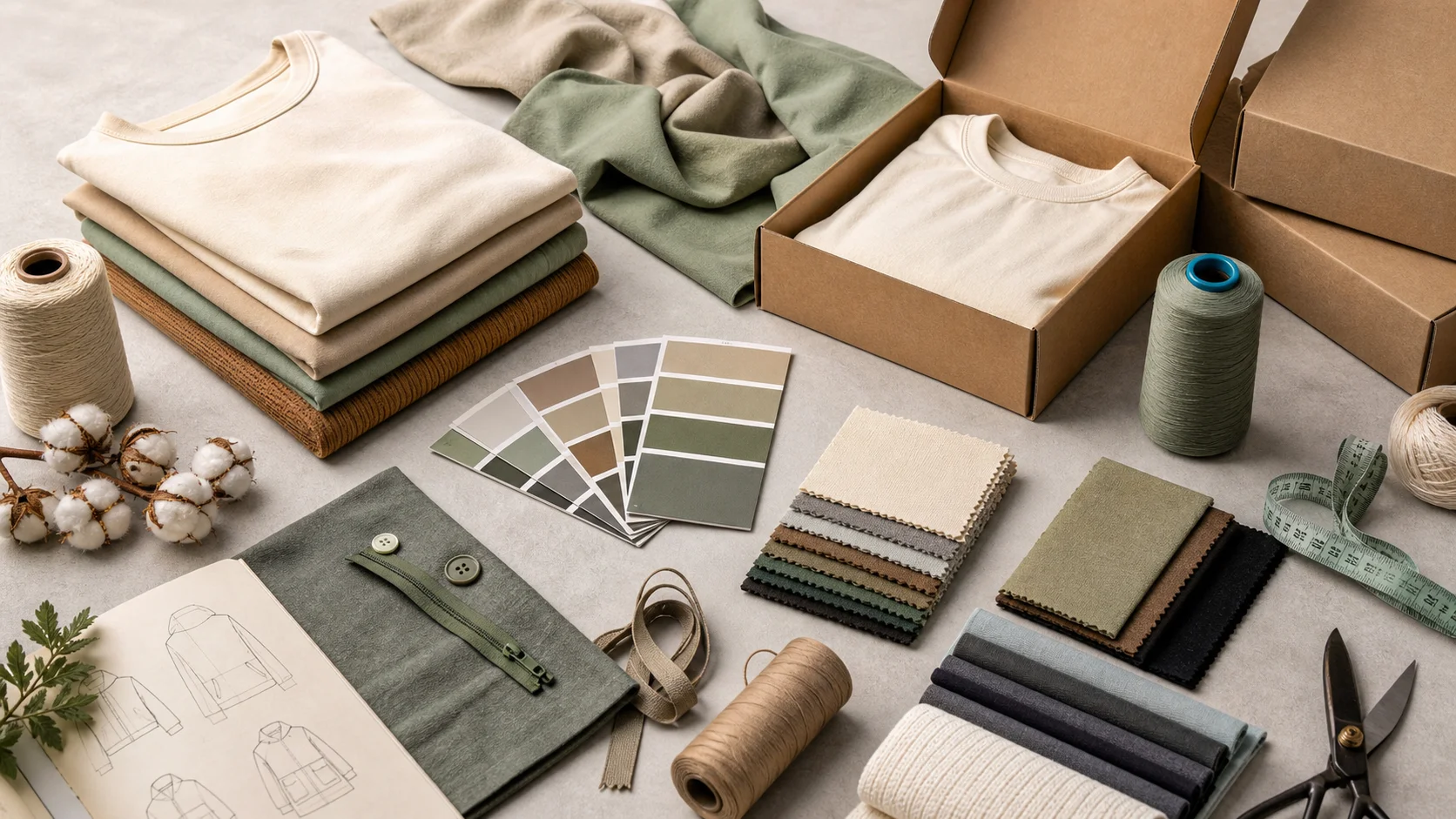
Print Logo on Clothing Mailer Bags compared by sample evidence, fabric or trim specs, MOQ, AQL terms, cost lines, delivery timing, and rework responsibility.
Fast answer: Print Logo on Clothing Mailer Bags: Material, Print, MOQ, and QC Terms should be judged by production evidence, not by a generic sourcing promise. The buyer needs sample proof, cost breakdowns, QC checkpoints, and delivery buffers in writing.
Ask for recent sample photos, measurement tolerances, fabric or print test assumptions, decoration test notes, packing examples, and a named inspection checkpoint. These details show whether the team can repeat an approved sample at bulk volume.
Separate garment cost, decoration, labels, packaging, sampling, testing, freight, and rush charges. Clear cost lines make it easier to reduce colorways, adjust size depth, or reserve more time for sampling.
I’ve watched a $4.80 T-shirt land like a $48 gift because the mailer carried the brand mark cleanly across a matte black panel. Then I’ve seen the reverse: wrinkled, unbranded packaging making a $120 knit set feel like clearance stock. Before the first order ships, how to print logo on clothing mailer bags decides the price expectation. The package speaks first.
Buyers spot packaging in the first 10 seconds, not the first 10 minutes. That tiny window shapes perceived quality, social sharing, and the odds of a repeat order. In boutique wholesale, a logoed mailer can also signal consistency to store staff handling 20 to 200 units at once. During a factory visit in Vietnam, I saw two nearly identical women’s tops arrive in different mailers; the branded one stayed on the counter, while the plain bag disappeared into the back room.
A printed mailer can replace several smaller spend lines. A brand that once paid $0.08 for a sticker, $0.05 for tissue branding, and $0.12 for a thank-you card can fold part of that into one printed bag. On a 5,000-unit order, that is not decoration. It is a $1,250 to $2,000 decision before freight. For a small label, that money buys better fabric or a healthier margin.
I’ve also seen printed mailers lift retention more than founders expect. A brand I advised in Los Angeles shifted from plain poly bags to two-color printed mailers on 3,000 monthly orders. Repeat purchase rate moved from 18.4% to 21.1% over two quarters, and customer photo shares doubled from 6 to 12 posts per 1,000 orders. Was packaging the only reason? No. But packaging made the brand feel remembered.
The mistakes are common, and costly. Overdesign comes first. A logo with five colors and a tiny slogan may look sharp on a 300 DPI screen, then fall apart on a moving conveyor. Printing too small comes next; anything below 18 mm on a scuffed surface turns into guesswork. Weak films crack under transit rubbing, especially on 60 to 80 micron polyethylene, and ignored scuffing turns “premium” into greyed-out ink before the parcel leaves the sorting center.
The first decision in how to print logo on clothing mailer bags is method, because the method sets your cost, your color limits, and your quality ceiling. I’ve stood beside presses that ran 20,000 mailers an hour and others that handled 500-piece test runs with all the drama of a laboratory. The answer depends less on fashion and more on volume, artwork, and substrate.
Flexo is the workhorse for poly mailers, especially at 5,000 to 100,000 pieces. Plates are required, usually one per color, and setup can run $120 to $350 per design depending on the factory and size. It handles simple logos, bold text, and spot colors well, but fine gradients get muddy fast. For a two-color brand mark on a 100-micron mailer, flexo is often the lowest-cost professional option.
Rotogravure uses engraved cylinders and is built for scale. It makes sense at 50,000 pieces and above, where the per-unit cost can drop sharply after the tooling is absorbed. Print quality is strong, even on rich blacks and dense solids, and color consistency holds better across long runs. The drawback is upfront investment. Cylinder prep can cost $400 to $1,500 per color, so this method rewards brands with stable artwork and repeat orders.
Digital printing is the flexible option for 300 to 5,000 bags, and it is the friendliest route for artwork changes. No plate fee. No cylinder fee. Faster approval. A small label brand can test a 1,000-piece run with three logo variations, then reorder the winner. It suits compostable mailers and paper mailers when the factory uses compatible inks, though the unit price often stays higher than flexo. I see it most often at $0.18 to $0.55 per bag before freight.
Stickers and labels work for very small runs, sample packs, or seasonal drops with 100 to 500 units. They also help when the mailer itself is pre-stocked and printing is not worth the delay. But they peel, crease, and split the branding into two steps. If the adhesive fails in cold weather or on textured kraft, the whole presentation looks improvised. For brands already using custom baby clothing manufacturing, I’ve seen this approach used only as a bridge, not a long-term system.
My practical rule is simple. Match the method to order volume, artwork complexity, and finish quality. Under 2,000 units, digital or labels usually win. Between 2,000 and 20,000, flexo becomes the sensible default if your logo uses one to three colors. Above 20,000, rotogravure earns a place if the design stays stable for at least 2 seasons. If the logo needs metallic ink, tiny type, or a photographic effect, rethink the bag or simplify the artwork before you price it.
For buyers comparing a manufacturer, a factory, or a supplier in China, ask which process they run in-house and which is outsourced. That affects production speed, quality control, and whether your custom artwork can be handled in bulk or only on a small MOQ. In wholesale programs, those details often matter more than the lowest unit quote.
Material decides how much of your logo survives contact with reality. Poly mailers take ink differently from kraft mailers, and recycled content can shift print consistency in measurable ways. Virgin polyethylene film gives the crispest registration, with fewer pinholes and steadier color, while a 30% recycled film can show more variation in gloss and opacity. Paper-based mailers, including kraft, support a more natural look, but they absorb ink faster and can soften fine edges.
On one factory floor in India, I compared the same black logo on 80-micron virgin poly, 75-micron recycled poly, and 120 gsm kraft. The virgin sample had the sharpest edge, the recycled version showed slight banding, and the kraft sample looked warmer but less exact. None was wrong. Each suited a different story. If your brand sells technical basics or premium athleisure, the sharper film reads cleaner. If you sell natural fibers or a lower-impact collection, kraft often matches the product promise better.
Finish changes perception too. Matte surfaces hide minor scuffs and fingerprints, which matters in transit when parcels rub for 3 to 8 hours across sorting belts and tote bins. Gloss makes color look deeper, especially on dark mailers, but it exposes every crease. Soft-touch finishes feel expensive, yet they add cost and can complicate recycling. For a brand using sublimation printing services for garment decoration, I usually recommend echoing that same visual logic in packaging: keep the package finish aligned with the product finish.
Thickness and structure matter just as much. A 60-micron bag can save freight, but it tears easier around the seal if overfilled. An 80 to 100-micron bag gives better scuff resistance and holds its shape while the print sits on a flatter surface. Gussets help capacity, though a wide gusset can distort a logo if the design crosses a fold. If the artwork is meant to sit front and center, ask for a flat panel of at least 140 mm by 180 mm before approving placement. I have seen beautiful logos ruined by a 12 mm seam shift.
When you source a custom mailer in bulk, material choice also affects shipping weight, sealing behavior, and quality at the carton level. A reliable supplier will explain how recycled blends change ink adhesion and whether the manufacturer can keep the same print result across multiple production lots. If the factory in China cannot show consistent samples, the lower price is rarely worth it.
Artwork prep decides whether the factory prints your brand or a blurry interpretation of it. For how to print logo on clothing mailer bags correctly, I ask buyers to send vector files first: AI, EPS, or PDF with outlined fonts. Raster files can work for simple art, but they fall apart fast when enlarged beyond 150% or compressed by email software. A 72 DPI logo may look fine on a laptop and still print with soft edges, jagged type, and uneven fills.
The safest spec is a vector logo, Pantone references, and a layout file with exact measurements. If the logo includes a box, tagline, or QR code, supply the minimum size in millimeters, not “as large as possible.” For mailers, the line between legible and muddy is thin. I recommend a type floor of 5.5 pt on light bags and 7 pt on dark bags. Thin rules under 0.25 mm often vanish once ink spreads into film texture or paper grain.
Pantone matching is better when brand color is non-negotiable. CMYK can be fine for digital printing, but it may shift by Delta E 3 to 6 on different substrates. That sounds technical because it is. In plain terms, a deep teal can turn greener on kraft, duller on recycled film, or flatter on matte stock. Proofing on the actual bag material is the only honest test. If your supplier refuses a strike-off, I treat that as a warning sign.
White ink is essential on dark bags, but it is not magic. It can take two passes to reach opacity, and the extra coverage raises cost and lead time. Here’s the part nobody tells you: on very dark recycled mailers, a slightly larger white underbase often beats a perfectly registered but thin white print, because it hides tiny substrate variation better. I learned that after a 2,000-piece run for a brand that also used private label clothing services; the narrower underbase looked elegant on screen, then patchy in the hand.
Design elements most likely to fail are predictable. Thin lines. Reversed type. Gradients. Fine textures. Metallic simulation. If the artwork depends on all five, simplify before you quote. Strong packaging is not a poster. It is a moving surface, folded and scraped for 1,000 kilometers before anyone opens it.
For sustainable programs, it helps to compare claims with trusted standards from OEKO-TEX, Textile Exchange, and the U.S. International Trade Administration. These references are useful when a custom packaging supplier says a material is compliant but the paperwork is incomplete.
Pricing changes fast once you move from plain stock to branded production. For a small run of 500 to 1,000 bags, digital printing or labels often costs $0.18 to $0.60 per unit, plus shipping and sample approval. At 3,000 to 10,000 units, flexo usually lands in the $0.08 to $0.22 range depending on size, ink count, and thickness. Past 25,000 units, rotogravure can reduce the unit cost again, though the upfront tooling pushes cash out earlier.
I’ve compared printed mailers with plain mailers plus labels or branded tape for brands shipping 1,000 to 8,000 orders a month. Plain stock may look cheaper by 20% to 35% on the first quote, but labels add labor and waste, and tape rarely creates the same shelf impression. A branded mailer often wins once you include handling time. If a packer spends 6 extra seconds applying stickers to 5,000 orders, that is roughly 8.3 labor hours a month.
Setup fees are where many buyers get surprised. Plates for flexo might cost $120 to $350 per color. Digital may charge no plate fee but carry a higher unit price. Sampling can run $60 to $180 for shipping and production, especially if you want three substrates and two color versions. Reprint risk also has a price tag. If the first run is off by 10% because of shade drift or seal failure, you are paying freight twice. That hurts more than the artwork fee.
Lead time depends on the method and the queue. A plain mailer can be ready in 7 to 10 days. A printed digital run usually takes 10 to 18 days. Flexo often needs 15 to 25 days, while rotogravure can stretch to 25 to 40 days once cylinders, proofing, and final production are included. If the factory is also managing cut and sew manufacturing, book earlier than you think. Apparel production and packaging often compete for the same QC team.
Hidden costs show up at the border and in the warehouse. Color changes between SKUs can trigger extra plate charges. QC rejects at 2% to 5% are normal on larger runs, but anything above that should be investigated. Freight delays can make a 14-day production quote arrive in 31 days if the container misses booking. If you need accurate budgeting, build a 10% to 15% contingency into the packaging line.
In many wholesale programs, the best economics come from ordering in bulk after artwork is locked, not from chasing the cheapest MOQ. A good manufacturer or factory will help you balance cost, lead time, and quality instead of only pushing the lowest quote.
The first supplier call should be specific. Ask for MOQ, supported bag materials, maximum print area, accepted file formats, and whether they can match Pantone or only approximate it. I also ask for the standard defect rate, because a factory that says “zero defects” is usually hiding its data. For most runs, 2% to 4% rejection is realistic if you want honest quality control. Ask whether seals are tested at 1.5 kg or 2.0 kg pull force, and whether the bags are printed before or after sealing.
Sample approval is where expensive mistakes die early. Request at least one color strike-off on the actual substrate, one full bag sample, and one packed sample if the logo sits near a fold or gusset. Compare shade under daylight and warm indoor light. Check for weak seals after loading 300 to 500 grams above target weight. If the logo smudges when rubbed 10 times with a dry cloth, the ink system is wrong for the material.
Run quality checks on alignment, scuffing, barcode interference, and cut accuracy. On a production lot, I inspect 20 random pieces from every carton and check whether the print drifts more than 2 mm left or right. If the bag carries a barcode, make sure the artwork does not reduce scan speed. A black logo over a barcode zone can trigger false reads in sorting systems.
Sustainability claims need proof too. Ask for recycled content certificates, ink safety information, and disposal guidance that matches the bag material. If the supplier says “eco” but cannot show a standard, I push back. Packaging that looks green and behaves poorly is still waste. Brands already serious about product integrity in custom baby clothing manufacturing know the rule: claims need paper trails, not adjectives.
Before you confirm production, make sure the supplier shares a clear QC report and the manufacturer agrees to hold a sealed reference sample from the approved custom run. That simple step reduces avoidable errors in bulk and improves overall quality.
The sample that fails in week one saves you from the shipment that fails in week four.
Start with a packaging brief that a factory can actually price. Include logo files, Pantone numbers, bag size, order volume, target ship date, print method preference, and whether the bag must be recyclable, compostable, or just low-cost. I also include one reference image and one prohibited example. That cuts revision loops from 4 rounds to 2 in many cases. For brands already managing private label clothing services, this brief should sit beside your garment spec pack, not in a separate inbox thread.
Approve one test round before mass production. Even if the artwork looks perfect on screen, the first bag proves whether the colors hold, the seal survives, and the logo sits where the packer expects it. Keep a signed sample in your QC file, along with print dimensions and photos taken under natural light. Store the final artwork as vector, plus one locked PDF and one editable source file. That archive saves time when a reorder lands 6 months later.
Set reorder thresholds early. If your monthly sales hit 70% of the next packaging batch, trigger the next order before you hit the last pallet. Packaging consistency costs less than fixing brand drift later. A bag that changes shade from one run to the next looks careless even when the product inside is excellent.
For brands that need repeatable decoration systems across garments and packaging, the same discipline used in sublimation printing services and cut and sew manufacturing applies here too: lock the spec, save the proof, then print only what you can repeat. That is the quiet difference between a package that sells and a package that just ships.
If you are still comparing options, revisit how to print logo on clothing mailer bags only after the manufacturer confirms the MOQ, quality standard, and production timeline. In China especially, those three points determine whether the job is profitable in wholesale or painful in bulk.
For 500 to 1,000 bags, expect roughly $0.18 to $0.60 per unit with digital printing or labels. At 3,000 to 10,000 units, flexo often drops to $0.08 to $0.22 per bag, before freight and sampling. Plate fees, color count, and bag thickness can change that quickly.
Start with a one- or two-color vector logo, then request a digital sample on the actual substrate. For runs under 2,000 units, digital printing or high-quality labels usually gives the best balance of cost and flexibility. Keep the artwork simple and avoid gradients or thin reversed text.
Plain stock can be ready in 7 to 10 days. Digital printed mailers usually take 10 to 18 days, while flexo often needs 15 to 25 days and rotogravure 25 to 40 days. Add time if the factory needs revised artwork, plate changes, or color approval.
Send vector files such as AI, EPS, or PDF with outlined fonts. Include Pantone references, exact logo dimensions in millimeters, and a note on placement. Raster files are risky because print edges can soften or pixelate when the design is enlarged.
Yes, but you need the right ink and print process for the material. Recycled films can show more variation in color, while compostable and paper-based mailers may need specific inks or adhesion testing. Always ask for proof of material claims and a sample on the final substrate.