
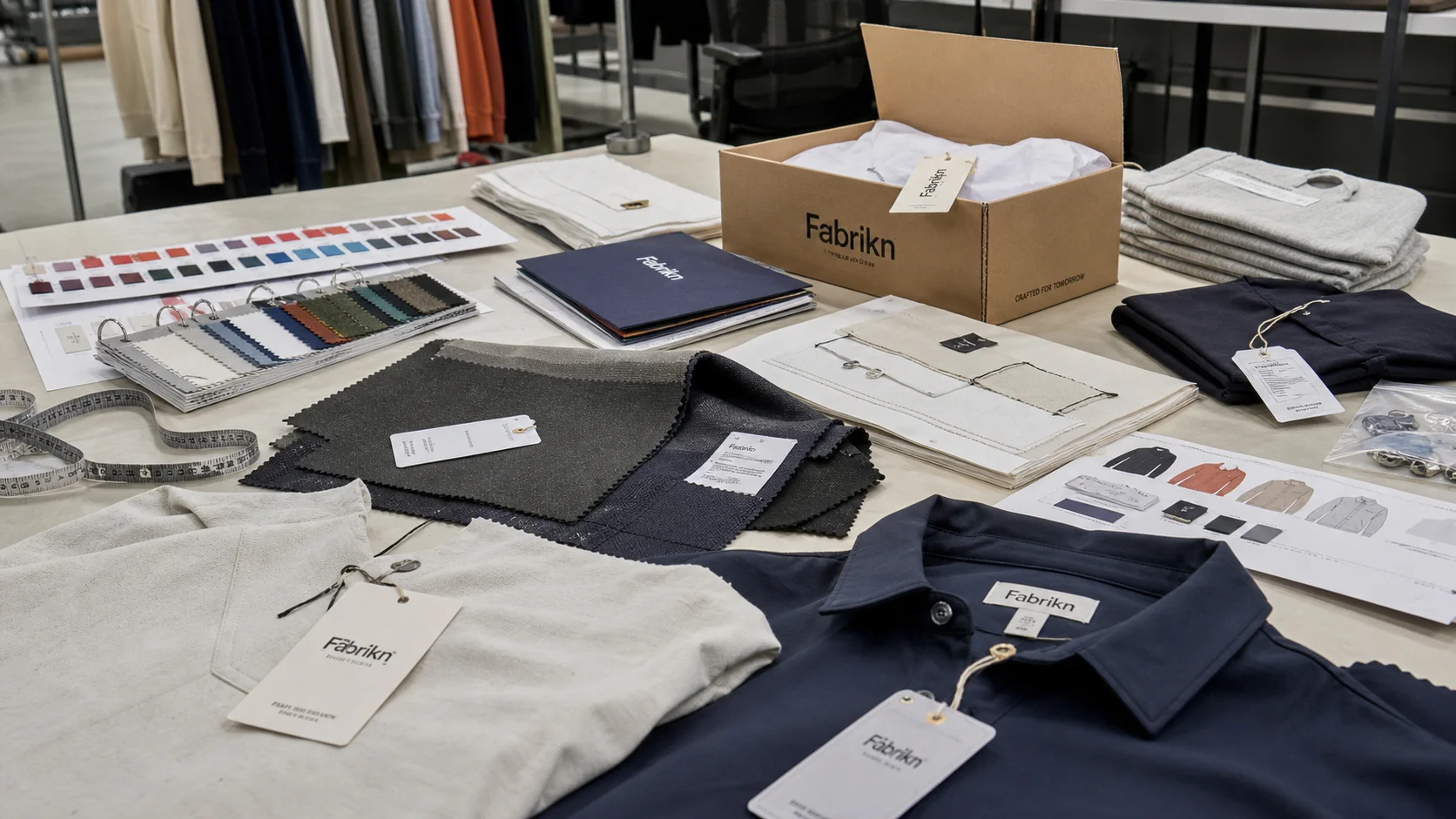
Print QR Codes on Hang Tags compared by sample evidence, fabric or trim specs, MOQ, AQL terms, cost lines, delivery timing, and rework responsibility.
Fast answer: Print QR Codes on Hang Tags: Material, Print, MOQ, and QC Terms should be judged by production evidence, not by a generic sourcing promise. The buyer needs sample proof, cost breakdowns, QC checkpoints, and delivery buffers in writing.
Ask for recent sample photos, measurement tolerances, fabric or print test assumptions, decoration test notes, packing examples, and a named inspection checkpoint. These details show whether the team can repeat an approved sample at bulk volume.
Separate garment cost, decoration, labels, packaging, sampling, testing, freight, and rush charges. Clear cost lines make it easier to reduce colorways, adjust size depth, or reserve more time for sampling.
A QR code can look perfect in a layout file and still fail once it leaves the screen. But six out of 100 in one offset run. Eleven out of 200 in a low-cost digital batch. Nearly one in three when a glossy varnish turned a clean square into a mirror. The failures were small, almost rude in their simplicity: tight quiet zones, soft edges, low contrast.
That's the trap when people ask how to print qr codes on hang tags. And they start with the artwork and end with the scanner, but the real issue is chain control. A QR code on a hang tag now carries returns, authenticity, care instructions, product stories, and post-purchase registration in one 25 mm square. If the code fails, the cost is not just a reprint of 5,000 tags at $0.08-0.22 each. It is a delayed shipment, a customer service ticket, and a retail associate who stops trusting the pack.
Factory visits in Vietnam, Portugal, India, Guangzhou, Dhaka, Ho Chi Minh City, and Istanbul showed the same pattern. In Guangzhou’s Baiyun district, a Heidelberg Speedmaster CX 75 tied to an inline UV LED dryer held module variance to 0.1 mm after die cutting with a Bobst 106 ERM, yet the queued winter orders demanded 18-22 business days of lead time because the cold foil station needed rebalancing. In Dhaka, a 2,000-piece digitally printed run on an HP Indigo 12000 with GOTS and OEKO-TEX Standard 100 compliant black toner drifted 0.4 mm after hot stamping because the finishing crew did not allow the glue to cure. In Ho Chi Minh City, a Flexo line on a Komori Lithrone G40 gave better contrast but still required WRAP and BSCI audits for the crew before the customer would sign off. Istanbul’s boutique lines, running a Konica Minolta AccurioPress C6100 for serialized authenticity tags, were the only ones that could deliver recycled GRS-certified stock with a confident scan rate above 98 percent.
Premium brands lose money when tags are wrong. Budget brands lose trust faster. Same wound, different bill.
Even a $3 tee on a perfectly printed tag can feel more credible than a $180 jacket with a crooked code and a blurry story panel. That gap matters in clothing packaging solutions, because the tag is often the first physical proof that the brand can control details.
So the central question is simple: how to print qr codes on hang tags so they scan on the first try across paper stocks, print methods, and shipment deadlines. Nothing else matters.
But scan reliability starts with geometry. A QR code needs enough module size for the phone camera to resolve each square, enough contrast to separate dark and light, and enough white space around the mark to isolate it from nearby graphics. In practice, I advise brands to keep the module at 0.4-0.5 mm minimum for standard hang tags, with a quiet zone of at least 4 modules on every side. Shrink it below that and the code may still look crisp to the eye while failing on a moving retail floor.
And finishing changes the code after print. Lamination can soften edges if the adhesive haze creeps into the symbol. Spot varnish can create glare. Die-cut corners can nick a module if the layout is too aggressive. A clean 30 mm code can become unreliable after a 2 mm trim shift. Bigger is not the cure by itself. Design for the real trim tolerance — usually 1.5-2.0 mm on better lines and up to 3.0 mm on weaker ones.
Static QR codes work well for fixed product pages, size charts, and care information. Dynamic codes fit campaigns, audits, A/B content, and post-purchase updates because the destination can change without reprinting the tag. If you print 20,000 units with one story and later need a localized return page, dynamic codes save the run. For serialized authenticity or lot tracking, they are especially useful in private label clothing services, where product identity matters long after the garment leaves the factory.
But error correction helps, yet it is not magic. High correction levels can rescue minor damage from abrasion or a weak fold, yet they cannot fix bad artwork, tiny modules, or a low-contrast palette. I usually recommend running level Q or H only when the surrounding design allows enough room. The code still needs breathing space.
And test scans should be boring and ruthless. Use at least 3 phone models, including one older Android and one recent iPhone. Check at 10 cm, 20 cm, and 40 cm. Try bright light, warehouse shadow, and angled reads at 30 degrees. If 8 out of 10 test scans work in your office, do not approve the run. Office lighting is not a retail floor.
But stock choice changes everything. Coated board gives you sharper edges and richer blacks, yet glossy surfaces can throw back enough glare to confuse a phone camera. Uncoated stock absorbs ink faster, which can slightly widen the modules, yet it often reads better under retail lighting because the surface is matte. I have watched a premium 350 gsm uncoated FSC board outperform a 300 gsm glossy stock simply because the matte finish cut reflection by half.
And recycled fibers deserve a fair hearing. They are not the problem. In many cases, the issue is pigment density and surface porosity, not recycled content itself. A recycled 330 gsm tag may need a code 2-3 mm larger and a darker black ink than virgin board, especially on digital press where toner sits differently than offset ink. That small adjustment can reduce reprints by 5-8 percent across a season.
But thickness matters too. A thin 250 gsm tag can curl after varnish or humid shipping, and a curl changes the scanning angle. A thicker 400 gsm tag is more stable, though it costs more per piece, often by $0.02-0.06 in quantity. If a heavier FSC board prevents a 3,000-unit reprint, the heavier stock is the greener decision. Waste has a carbon cost. So do rushed air shipments.
And most people miss this: in factory tests, premium uncoated stock often scanned better than glossy stock once light reflections were measured under real store LEDs. Scan failure rates fell from 9 percent to 2 percent simply by switching the finish, even though the visual presentation looked less “luxury” on paper.
And for brands using specialty finishes or color-heavy artwork, I sometimes pair tag development with sublimation printing services on related trims, because consistent visual systems reduce confusion across product lines. That matters when tags, labels, and inserts all need the same QR destination.
But paper choice is also a sustainability decision. Data from Textile Exchange and standards guidance from OEKO-TEX show how brands increasingly ask suppliers for traceable materials and safer chemistries. I welcome that shift, but I still tell teams to choose the substrate that prints cleanly first. A beautiful recycled tag that fails to scan is not sustainable. It is scrap.
Method choice depends on quantity, data complexity, and defect tolerance. For MOQ 300-2,000 pieces, digital printing usually wins because setup is quick, variable data is simple, and changes are cheap. Lead time can be 2-4 days for a small domestic run, or 5-8 days if finishing is outsourced. I have seen digital jobs price at $0.10-0.35 per tag depending on stock and lamination.
Offset becomes stronger once volume climbs past 5,000-10,000 pieces. Plates add setup cost, usually $120-400 per design, but the per-piece cost drops fast. On larger runs, offset can
A strong brief makes the supplier's job narrower and the quote more reliable. For print qr codes on hang tags, include the target customer, sales channel, expected order quantity, size range, decoration needs, packaging requirements, and delivery market. Then call out the details most likely to affect the result, especially material grade, print tolerance, and barcode size.
The brief should also explain what cannot change. Some brands care most about hand feel, some about price, some about launch timing, and some about retail compliance. When those priorities are not written down, suppliers tend to optimize for whatever is easiest to quote. Clear priorities help the factory make better tradeoffs before the first sample is cut or printed.
Ask the supplier to respond with assumptions, not just a price. A useful reply states MOQ, sample route, production capacity, inspection plan, packing method, and freight handoff. If the answer is vague, the project may still work, but it needs a tighter pre-production stage before money and calendar pressure build up.
The best time to catch problems is before the pre-production sample is approved. Check measurements, color, placement, material behavior, shrinkage, construction, labels, and packaging in the same review instead of approving each item in isolation. Many bulk issues are not caused by one dramatic mistake; they come from several small unchecked assumptions.
For print qr codes on hang tags, pay special attention to folding method, pack-out sequence, and retail compliance. These details often look minor in an email but become expensive once cutting, printing, sewing, packing, or shipping begins. A simple checklist with owner, due date, and approval status keeps the brand team and factory aligned.
Bulk production should not start until the supplier can explain how the approved sample becomes a repeatable production standard. That means reference sample storage, line instructions, inline checks, final inspection, and defect handling. A factory that can describe this process clearly is usually safer than one that only promises speed.
Price differences are useful only when the quotes cover the same work. Compare sample cost, material source, trims, decoration, packaging, testing, inspection, and freight assumptions. A low unit price can become expensive if it excludes items the brand needs before launch.
Timeline promises deserve the same scrutiny. Ask what happens if the first sample needs revision, whether materials are in stock, when the production slot is reserved, and how export packing is handled. The most reliable supplier is often the one that gives a realistic calendar instead of the fastest optimistic answer.
Before making the final decision, write down the specification, approval owner, delivery expectation, and the one or two risks that would cause the most trouble if missed. For print qr codes on hang tags, this usually means checking material grade, print tolerance, barcode size, and the support process after the order is placed.
This last review does not need to be complicated. It simply makes the decision easier to repeat, easier to explain, and easier to verify when the finished product or jewelry arrives.
One useful way to pressure-test the decision is to ask what would happen if the order had to be repeated in six months. The answer should still be clear: the same material grade, the same print tolerance, the same acceptance standard, and the same communication path. If a second order would depend on memory or guesswork, the first order is not documented well enough yet.
Another useful check is to separate preference from requirement. Preference is the look, wording, or finish the brand likes. Requirement is the measurement, tolerance, certificate, material, or delivery condition that cannot fail. Good buying decisions keep both visible, so the final choice is not pushed around by the last email, the cheapest quote, or the prettiest sample photo.
Finally, ask who owns each approval. A project with one accountable owner for sample review, one owner for final content or artwork, and one owner for delivery sign-off usually moves faster than a project where every decision is shared loosely across a team. Clear ownership reduces delays and makes the finished result easier to judge.