
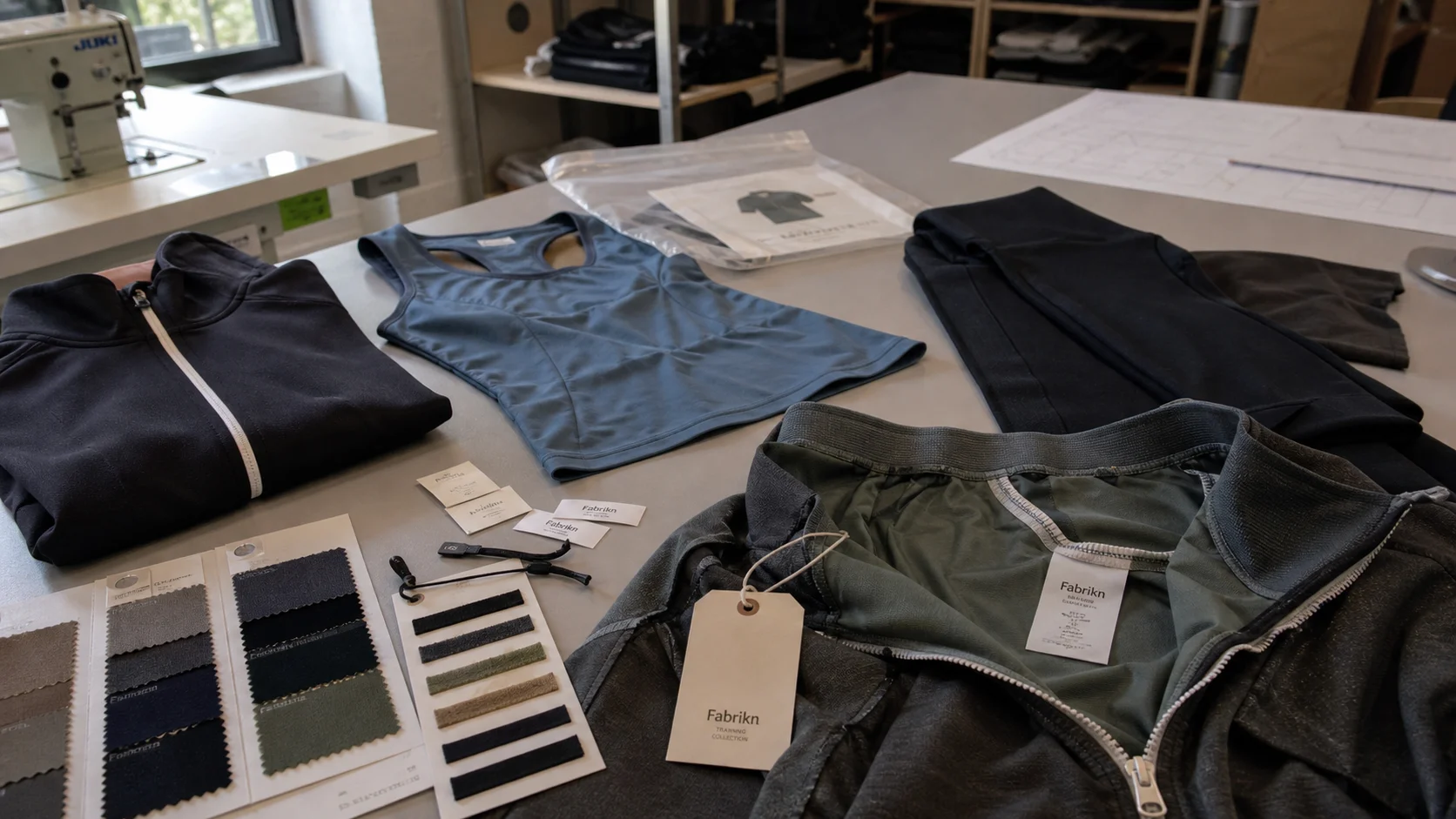
Should Go on A Hang Tag compared by sample evidence, fabric or trim specs, MOQ, AQL terms, cost lines, delivery timing, and rework responsibility.
Fast answer: Should Go on A Hang Tag: Material, Print, MOQ, and QC Terms should be judged by production evidence, not by a generic sourcing promise. The buyer needs sample proof, cost breakdowns, QC checkpoints, and delivery buffers in writing.
Ask for recent sample photos, measurement tolerances, fabric or print test assumptions, decoration test notes, packing examples, and a named inspection checkpoint. These details show whether the team can repeat an approved sample at bulk volume.
Separate garment cost, decoration, labels, packaging, sampling, testing, freight, and rush charges. Clear cost lines make it easier to reduce colorways, adjust size depth, or reserve more time for sampling.
Before the fitting room, before the sales pitch, the tag has to earn its keep. If you are asking what should go on a hang tag, start with the first glance.
In many stores, the hang tag gets handled before the garment is tried on, and that changes everything. I have watched shoppers flip a tag, read two lines, and decide within three seconds whether a piece feels worth $18 or $180. Tiny rectangle, big job: grab attention fast, justify the price, then cut hesitation.
From factory floors in Bangladesh to boutique suppliers in Portugal, the same pattern keeps showing up. The winning brand is not the one with the longest caption; it is the one that gives shoppers the fastest answer to three questions: what is it, why does it cost this much, and why should I trust it?
So what should go on a hang tag at the front? Brand name, product name, size, price, and one concise value statement. A $18 T-shirt can survive with a line like “320 GSM cotton jersey, garment washed.” A $180 jacket needs more proof because the shopper is paying for structure, function, and fit, not just fabric.
I have seen lower-priced tags win conversion with eight to 12 words. I have also seen premium tags fail after 60 words of self-congratulation. The tag is not a mini-brochure. It is a sales tool with legal limits, and every extra sentence competes with the product itself.
That first scan should also orient the shopper to the garment category. Is it a relaxed French terry hoodie, a stretch poplin shirt, or a 14 oz denim overshirt? Specificity sells. Vague claims do not. When a buyer can understand the piece in one glance, they move faster to the fitting room and spend less time second-guessing.
For brands building private label clothing services, the hang tag often does the heavy lifting that the garment cannot. It replaces a salesperson for the first few seconds. That is why what should go on a hang tag at the front should carry only high-value information. Anything that does not help identification, price justification, or trust belongs on the back, or not at all.
Compliance is not optional. On apparel tags, the legal basics are usually fiber content, country of origin, and the business identity required in that market. Care instructions may sit on the hang tag if space allows, though many brands move them to a sewn-in label or QR-linked care page. In the US, the FTC rules are straightforward. In the EU and UK, language, placement, and consumer information expectations can differ enough to force separate versions.
According to Trade.gov apparel market access guidance, apparel market access depends on clear product origin data and accurate labeling across regions, which is why one tag layout rarely works everywhere. A tag designed for New York shelf displays can fail in London if the legal text is too small or the claims are not supported in the local format. I have seen brands spend $6,000 on a reprint because they tried to force one global tag into three markets.
Traceability is where premium brands can build trust without crowding the face of the tag. A factory code, batch number, QR code, or certification mark can help buyers and retail partners verify the product path. For sustainability claims, specificity matters more than volume. “Contains 60% recycled cotton, certified to a documented chain of custody” is better than “eco-friendly.” The first can be audited. The second is marketing fog.
Data from Textile Exchange material sourcing standards shows how material claims are increasingly scrutinized, especially where recycled content and fiber sourcing are involved. If a brand says organic, recycled, or responsibly sourced, I want documentation in the file and consistency on the tag. No documentation, no claim. That rule has saved more brands from trouble than any glossy sustainability statement ever could.
Here is the part many factories quietly confirm: the most compliant brands often print less, not more. They separate legal data from marketing copy, which keeps the hang tag readable and reduces the chance of a market-specific error. That is especially useful for cut and sew manufacturing runs where different fiber blends, washing effects, or trim packages can change by SKU and size set. A manufacturer, factory, or supplier that handles production at scale will usually ask for this structure early because it protects quality and reduces MOQ-related mistakes.
Trust is built through precision. If the product is 97% cotton and 3% elastane, say that. If the jacket shell is 410 GSM wool blend, say that. Buyers read numbers as proof. They read vagueness as risk.
Brand story works when it feels earned, not when it sounds like a speech.
The strongest brand stories on hang tags do not sound like brand speeches. They sound like evidence. I have visited factories where a 24-hour enzyme wash, a 320 GSM French terry, or a reinforced double-needle shoulder seam did more to justify price than any line about heritage. Function, craftsmanship, and material choice are persuasive because they can be checked.
If a shirt costs $28, the tag should explain why it is not a $12 shirt. Maybe the fabric is combed cotton with tighter yarn counts. Maybe the MOQ was 500 pieces and the brand invested in a better fit block. Maybe the print is discharge rather than plastisol. Those details are concrete. They make the buyer feel the difference before the fitting room mirror does.
For a $180 jacket, the narrative can go deeper, but it still needs discipline. Lead with one headline claim, one proof point, one emotional cue, and one call to action if relevant. For example: “Built with 410 GSM recycled wool blend. Tested for 20,000 abrasion cycles. Made to hold shape for years.” That sequence tells the shopper what the product is, why it costs more, and what kind of life it is built for.
Affordable tags need restraint. Luxury tags can support a fuller story because the buyer expects more context, more detail, and often more craftsmanship. The trick is not to write more simply because the price is higher. The trick is to match the language to the evidence. A brand with a $65 hoodie and a brand with a $650 coat both need clarity, but they do not need the same amount of copy.
I have seen tags sink conversion when they try to sound emotional without offering facts. “Made for dreamers” says almost nothing. “Oversized French terry hoodie, enzyme washed for softness, stitched in a 400-piece run” says enough to create interest and credibility. That is the difference between brand theater and useful selling.
For brands using clothing packaging solutions, the hang tag should match the rest of the package system. If the box, tissue, and insert all speak in careful numbers and clean language, the tag can be slightly warmer. If the rest of the presentation is loud, the tag needs to be the calmest thing in the package. For wholesale and bulk programs, that consistency also helps a supplier keep the line efficient across custom colorways and repeated production runs.
The thing nobody tells you: on the factory visits that produced the strongest sales tags, the copy was often written after the sample fit session, not before. Once the team saw the drape, weight, and handfeel in person, the words became shorter and more believable.
That is not a creative trick. It is a selling discipline. It is also one of the clearest answers to what should go on a hang tag when the goal is conversion rather than decoration.
The tag itself sends a message before a single word is read. Recycled paper, FSC-certified stock, cotton twine, and plastic alternatives all signal different priorities, and each one has a cost implication. I have seen 350 gsm uncoated recycled stock outperform glossy laminated card on perceived honesty, especially for brands selling denim, knitwear, or outdoor basics. Shoppers often read texture as truth.
Finishes matter, but only if they support the price point. Embossing can suggest craft. Foil can suggest luxury. Matte coatings can make a mass-market tag feel more edited. Yet too much finishing can backfire. Mixed materials, heavy varnish, plastic cords, and laminated layers can make recycling harder and create a sustainability claim that collapses under scrutiny. If the hang tag says low-impact, the physical object should not behave like waste.
Typography carries more weight than most brands admit. A clean hierarchy usually wins: top line for the product name, mid-level line for one proof point, bottom line for legal data, and a QR code placed where it can be scanned without turning the tag over five times. The best tags are readable at 40 cm in hand and still understandable from 1.5 meters on a rack.
I like a visual stack that feels disciplined. One headline. One descriptor. One factual line. One compliance zone. Any more than that, and the tag starts competing with the garment. Any less, and the shopper has to guess.
Here is where factory reality gets interesting. Some of the lowest-waste tags I have seen were also the most premium-looking. They relied on dense typographic spacing, one color of ink, and a well-chosen FSC stock rather than foil, debossing, or shaped dies. For brands chasing sustainable fashion branding, that is the sweet spot: less material, better design, clearer message.
There is also a category difference. A ribbed tank top or cotton tee can use a simple rectangular tag. A technical shell or tailored blazer may need a fold-out format to carry fit details, waterproof ratings, or fabric performance data. But even then, the rule stays the same. The tag should explain, not decorate. If you are planning what should go on a hang tag for custom apparel, material choice and hierarchy should lead the design.
Hang tag cost moves with order size, print method, finish, and complexity. In economy runs, a simple one-color tag on standard stock can sit around $0.06 to $0.15 per piece at 5,000 to 10,000 units. Add variable data, a QR code, or a second print color, and that cost often rises by 10% to 30%. A premium tag with special stock, foil, or a custom die-cut may land between $0.25 and $0.90 per piece depending on quantity. Luxury pieces can go higher, especially if the tag is multi-layered or paired with specialty strings and seals.
Entry-level products should not carry expensive tag systems that never return value. A $24 fleece does not need a $0.70 tag unless that tag is doing real work, such as carrying legal translations for multiple markets or encoding SKU-level traceability. Mid-range brands often sit in the best cost-to-benefit zone. They can support tighter copy, better stock, and a QR code without blowing out unit economics.
Premium tags are justified when they support conversion or reduce rework. A reprint caused by a wrong fiber claim can erase the savings from choosing the cheapest printer. I have seen a brand save $1,200 on initial tag production and lose $8,500 correcting a market-specific origin statement. That is false economy.
If you are comparing segments, think in content density as much as dollars. Economy products need fewer words and simpler compliance. Premium goods can carry a better story, but not clutter. Luxury items can support a richer narrative, yet the paper, emboss, and finish need to feel intentional rather than ornamental. The tag must match the retail promise.
For brands scaling across categories, from hats to outerwear, the most efficient path is often a shared tag architecture with adapted content blocks. That is where custom hat manufacturing and apparel programs can borrow from each other: one layout family, different legal fields, consistent brand voice. It reduces setup costs and keeps the shelf look coherent.
If you want to think like a buyer, compare cost against risk. A 12-cent tag that underperforms on clarity can be more expensive than a 30-cent tag that sells faster. Cheap is not the same as cost-effective. I have watched the cheaper option trigger more returns, more questions at the register, and more late-night file fixes than any premium finish ever did. In China or any other major sourcing market, production teams will usually recommend the simplest tag that still protects quality and compliance.
Before you ask for a quote, define the audience, sales channel, market, SKU count, and required claims. A wholesale tag for department stores is not the same as a DTC tag for a product page unboxing. If you launch in the US, EU, and UK, split universal content from market-specific legal text before design starts. That one move saves time.
A strong brief should include dimensions, stock, finish, print method, copy, barcodes, translations, attachment method, and approved artwork. I also want unit quantity, target cost, carton pack counts, and lead time. If a supplier knows you need 8,000 pieces in three weeks with variable data and two language versions, the quote will be real instead of aspirational.
Build one master content matrix. Put product name, fiber composition, origin, claims, size, barcode, and market notes in one file. Product, legal, design, and sourcing teams can all pull from the same source, which avoids the classic factory problem: three versions of the same sentence, none of them final.
Most reprints happen for boring reasons. A barcode spec is missing. A claim changes after sample approval. A translation gets updated but the printer works from an old PDF. I have seen a 20,000-unit job held for five days because the barcode was 2 mm too small for the retailer’s scanner standard. That is preventable.
If your collection uses different trim packages or garment constructions, a shared brief becomes even more valuable. Brands working with private label clothing services or managing a mix of woven and knit styles should keep version control tight. The tag file should tell the truth about each SKU, not just the mood of the season. The same applies whether you are buying from a local manufacturer or a China-based factory handling bulk production for a wholesale supplier.
Proofread at arm’s length, then from a shopper’s distance. If the tag cannot be read in 10 seconds, it is too crowded. Check spelling, legal claims, barcode scan quality, color accuracy, and the strength of the string or fastener. Then attach one sample to the real garment, because a tag that looks balanced on a flat proof can hang oddly on a jacket or knit.
I also run a simple store-floor test with three questions. Can shoppers identify the item? Can they understand the value? Can staff answer questions using the tag alone? If the answer to any of those is no, the tag needs editing. The goal is not to impress designers. The goal is to move a product.
One more practical step: confirm that the tag still works after transportation, folding, and hanging. Paper weight, string length, and fold position can change once the piece reaches the rack. What looked crisp in the studio can look sleepy in-store.
The best tags are edited, not crowded. They answer the right questions fast, and they do it with enough restraint to make the garment look stronger, not noisier.
For a basic T-shirt, use the brand name, product name, size, price, fiber content, country of origin, and one short proof point such as “220 GSM cotton jersey.” Keep the front clean and move longer legal text to the back or a QR code. Most good basic tags stay under 25 words of marketing copy.
Premium apparel can support more detail, but it still needs hierarchy. Add fabric weight, construction detail, performance claim, and a traceability cue such as batch code or QR link. I usually recommend two proof points, one brand line, and legal data that is easy to audit.
Simple tags often cost $0.06 to $0.15 each at 5,000 to 10,000 units. Mid-range tags with better stock or a QR code can run $0.15 to $0.35, while premium or luxury tags may reach $0.25 to $0.90 or more. Finish, print colors, and order size drive the final number.
Most hang tag orders take two to four weeks after artwork approval, though complex finishes or multi-market versions can stretch to five to six weeks. If you need variable data, multiple languages, or special die-cuts, build in extra time for proofing and sample approval.
You need fiber composition, origin, business identity where required, and accurate claims for each market. The US, EU, and UK do not always share the same formatting expectations, so one tag rarely works everywhere. Split universal branding from market-specific legal text before printing.