
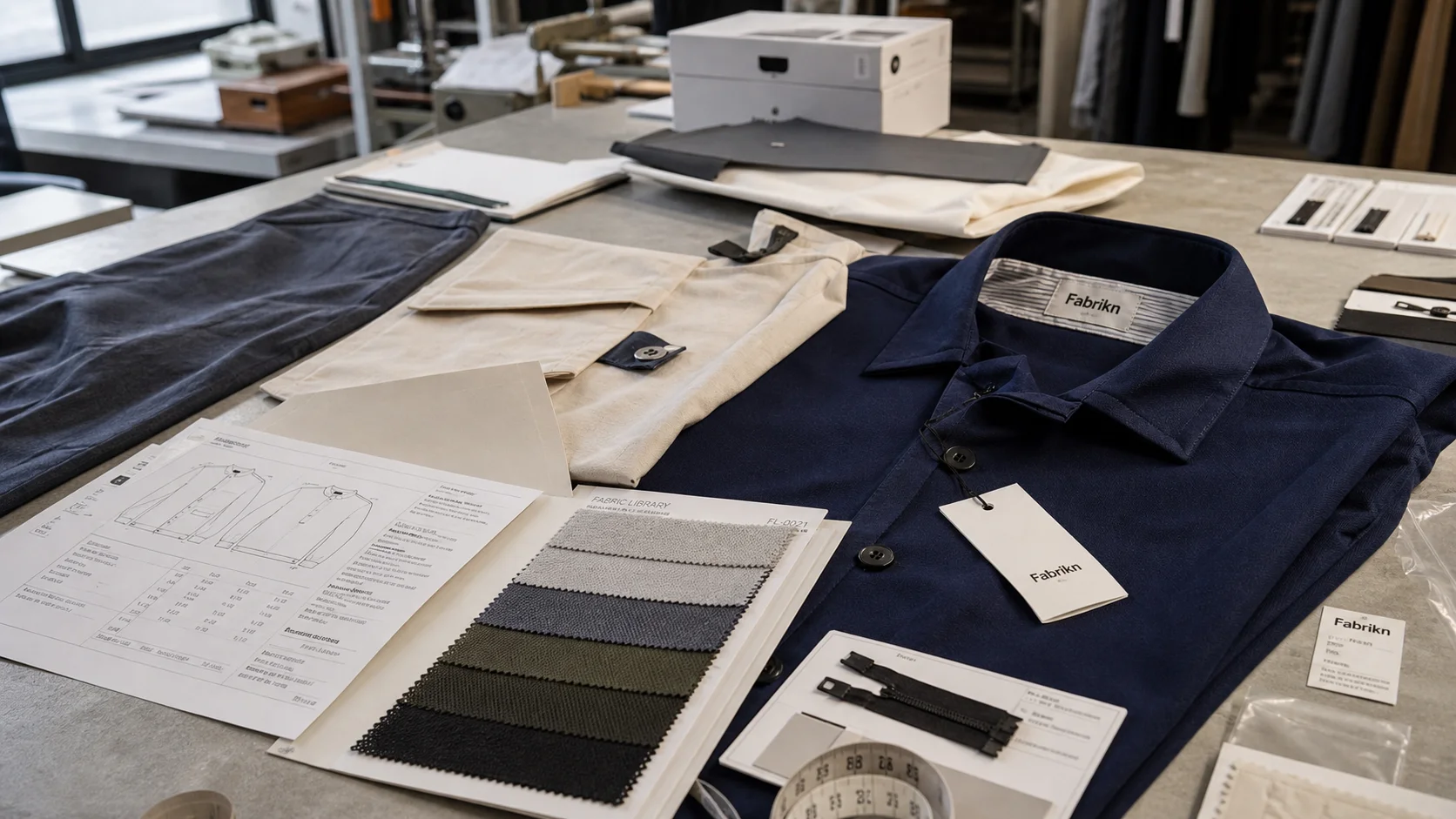
Does A Clothing Manufacturer Do compared by sample evidence, fabric or trim specs, MOQ, AQL terms, cost lines, delivery timing, and rework responsibility.
Fast answer: Does A Clothing Manufacturer Do: Sample Evidence, MOQ, Capacity, and Rework Terms should be judged by production evidence, not by a generic sourcing promise. The buyer needs sample proof, cost breakdowns, QC checkpoints, and delivery buffers in writing.
Ask for recent sample photos, measurement tolerances, fabric or print test assumptions, decoration test notes, packing examples, and a named inspection checkpoint. These details show whether the team can repeat an approved sample at bulk volume.
Separate garment cost, decoration, labels, packaging, sampling, testing, freight, and rush charges. Clear cost lines make it easier to reduce colorways, adjust size depth, or reserve more time for sampling.
A sketch and a hopeful grin can disappear fast once the quote lands 38% higher than expected. I’ve watched it happen more than once. That gap is exactly what does a clothing manufacturer do before a single bulk order starts: they turn an idea into something a line can actually sew, measure, inspect, and ship.
Not a polite introduction. A stress test. The strongest factories tear through the tech pack line by line, compare the spec sheet to the sketch, and flag construction issues in minutes. Dropped shoulder? Easy. Bias-cut panel with bonded seams and contrast topstitching? Not easy. In Portugal and Vietnam, I’ve seen teams catch a collar stand problem before the brand even opened its laptop.
Most of the weight sits in the tech pack. BOM, stitch type, measurement points, packaging notes, artwork placement, compliance needs — all of it. Thin pack, soft quote. When the pack names French terry 320 GSM, enzyme wash, YKK zips, and nickel-free snaps, the factory can price with real precision. Fabric availability changes fast too; a material swap can swing cost by $1.20 to $3.50 per meter, and trims can add another $0.15 to $0.80 per garment.
And the part many new brands miss: sample development often takes 1 to 4 weeks before the first revision. Complex styles usually need 2 or 3 rounds, especially when the silhouette depends on exact drape, shrinkage behavior, or placement prints. A responsible manufacturer brings up MOQ early, because a design that looks clean at 500 pieces can turn into a headache at 100. Those first 48 hours can save 3 weeks later when a weak idea gets corrected before fabric is cut.
Walked factories in Turkey, India, and Mexico, and the best teams behaved like editors. No flattery. Just sharper construction, better sequencing, fewer surprises. That is the manufacturer’s real value in the opening meeting: cutting risk before the brand spends money on mistakes. If the quote changes fast, that is not always bad news. Sometimes it is the first honest news you have received.
Development is where a garment becomes repeatable. Brilliant concepts fail when sampling is treated like decoration. A manufacturer’s job is to translate a design into a product that can be sewn 300 times with the same tension, the same armhole balance, and the same shrinkage behavior after wash.
Pattern making, grading, proto samples, fit samples, pre-production samples — that’s the usual path. Pattern making sets the base shape. Grading scales that shape from XS to XXL or from baby 0-3 months to 24 months, which is why custom baby clothing manufacturing often needs tighter tolerances than adult basics. A 1 cm error on a tiny romper matters more than on a relaxed sweatshirt. In many factories, the sample room sits beside production planning, so the same team can judge whether a design is practical at 500 pieces or only at 50.
Fit approval is where the back-and-forth gets real. The brand comments on rise depth, sleeve pitch, neckline width, and hem finish. The factory adjusts the pattern, re-sews the sample, and may test again for recovery, pilling, and shrinkage. A tee at $12 retail and a tee at $120 can look nearly identical on a hanger, yet the production logic differs sharply. The cheaper version may use a lower GSM jersey, looser tolerance, and minimal wash testing. The premium version might require 26 stitches per inch, tighter color fastness standards, and a 3% shrinkage ceiling after laundering.
Higher-end factories reject weak designs earlier. That can save money. I watched a factory in Italy refuse a poorly balanced blazer after the proto sample because the shoulder line would have created recurring returns. The brand lost 2 days, not 2 months. Harsh? Maybe. Damage control? Absolutely.
Sample rounds change details, not intent. Once the brand signs off on the direction, the silhouette should stay fixed. Construction notes shift, trim choices shift, seam allowances shift, pocket depth shifts, label placement shifts, and sometimes fabric weight shifts too. One sportswear client I advised moved from 280 GSM fleece to 320 GSM French terry and cut returns by 14% after the first wash test. The garment felt more expensive, and the factory also reduced puckering complaints while avoiding a costly rework cycle.
Proto. Fit. PPS. Miss one, and the bulk order inherits the mistake.
Here’s where ambition meets machines. Once fabric arrives, the manufacturer coordinates inspection, spreading, cutting, sewing, pressing, finishing, tagging, and packing. Each step sounds simple until a single print panel, blind hem, or bonded seam slows the entire line. On a good day, basic knitwear can move in days. Tailored garments need more workstations, more operator skill, more line balancing.
Cutting starts with fabric inspection. Then the rolls are relaxed, spread in lays, and cut using straight knife, band knife, or automated cutters depending on volume. Sewing becomes choreography: operators, line leaders, mechanics, quality teams, warehouse staff. If the style includes embroidery, appliqué, or complex pocket construction, the factory has to place the right machine at the right minute. I’ve seen a 4,000-piece hoodie order delayed because rib cuffs arrived 5 days late, which forced resequencing across 12 operators.
Factory scale changes everything. A small local plant may run 30 to 60 workers and handle 200 to 800 pieces per week. A mid-sized regional factory might staff 120 to 250 workers and move 2,000 to 5,000 pieces weekly. An export-oriented mass producer can exceed 10,000 pieces a day, but only if the style is simple and the fabric supply is locked. The labor structure follows that volume. More output usually means tighter specialization, less flexibility, stricter scheduling.
Machine allocation and bottlenecks sit in the manufacturer’s lap too. A style with patch pockets, coverstitch hems, and heavy embroidery can choke a line if each station isn’t timed properly. That’s why a cut and sew factory is not just about cutting fabric and sewing it back together. Sequence. Capacity. Discipline to stop work when defects appear. In Bangladesh, I watched a factory hold 600 pieces for 2 hours because one needle size created skipped stitches. That pause saved a shipment.
Production output depends on garment type. Basic jersey T-shirts, leggings, and polos move faster than lined trousers, denim jackets, or structured dresses. The manufacturer’s job is to keep the line moving without flooding it with work it cannot absorb. Fast is useful. Controlled is better.
Quality control is where a factory earns trust or destroys it. The manufacturer tests color fastness, shrinkage, seam strength, needle detection, and measurement tolerances before the boxes leave the building. A garment that is 2 cm off at the chest may seem minor until 700 units are packed and the retailer starts charging back every defect.
Inspection happens in layers. In-line inspection catches faults while sewing is still underway. End-of-line inspection checks garments after completion. Final random inspection samples finished goods using AQL methods, which many buyers reference alongside standards from bodies such as ISO. I’ve seen factories that relied only on final checks, and the reject pile was twice as high as at plants that corrected issues during sewing. You do not want 400 flawed units sitting in cartons.
Compliance reaches far beyond stitching. Manufacturers may need to manage labor audits, restricted substances lists, labeling rules, country-of-origin requirements, and import documents. Some buyers also ask for chemical testing aligned with OEKO-TEX or social compliance documentation from WRAP. Export factories serving major retailers usually keep cleaner records, tighter training logs, and better traceability than smaller domestic plants. That difference showed up clearly in three factories I visited in Eastern Europe, where one plant could trace a dye lot in 10 minutes and another needed 2 days.
Many returns and chargebacks are preventable. Loose bartack, mislabeled fiber content, zipper that fails after 3 wash cycles — all of it should have been caught before shipment. The best factories know compliance is not paperwork theater. It is risk control. Skip it, save $0.20 per piece, lose $20,000 in returns later.
Pricing is a stack, not a number. A manufacturer builds cost from fabric, labor, trims, wash or dye process, packaging, freight, duties, and margin. Change any one of those, and the quote moves. A 180 GSM cotton jersey tee with screen print is not priced like a 420 GSM French terry hoodie with enzyme wash and woven labels. The first may be $3.20 to $5.10 ex-factory at 1,000 pieces. The second can easily land at $11 to $18 before freight.
Minimum order quantities vary because the factory has to buy materials, schedule machines, and absorb setup time. A woven shirt with yarn-dyed fabric might require MOQ 500 pieces per color. A digitally printed style could be lower, sometimes 100 to 300 units, while a reactive dye batch may push the threshold higher. Scale matters too. A small workshop may accept 150 pieces but quote a higher unit price because the setup cost is spread over fewer garments. Not greed. Arithmetic.
Time line shifts at every stage. Sampling may take 1 to 4 weeks. Fabric sourcing can take 7 to 21 days if the mill has stock, or 4 to 8 weeks if it does not. Bulk production may run 15 to 45 days depending on style complexity, and shipping can add 3 to 40 days depending on route and mode. Repeat orders often move 30% to 50% faster because the pattern, fit, and fabric approvals are already on file.
To make the math easier, I use a table-style breakdown in my head:
Low quotes often get expensive later. A factory promising 10 days on a complex style is either overconfident or hiding tradeoffs. Brands usually get better results by asking what is driving the price up or down, then deciding which changes matter. Shorter stitching? Lower MOQ? Fewer colorways? Each one changes the quote by a different amount.
Choosing a factory is a product decision, not a romance. Brands pick a manufacturer because the sales deck looks polished, then spend 6 months untangling quality problems. The right choice depends on category, order size, price target, and how much control you want over the process.
Domestic factories usually win on speed, communication, and smaller MOQs. Nearshore options can cut transit time by 7 to 15 days and keep meetings in the same time zone. Offshore factories often offer lower unit costs, especially on orders above 1,000 pieces, but they can demand more structure from the buyer. Sustainability varies too. A nearby mill may use less freight emissions, while an overseas facility may have better water recycling or energy efficiency. Geography is not destiny. Process is.
Ask direct questions before signing anything. Do you hold certifications? What is your sample policy? What is your defect rate? Do you manage sourcing or only CMT? Can you handle private label clothing services, or do you expect the brand to supply all components? I also ask whether they have worked on product families like denim, activewear, or custom hat manufacturing, because specialization matters more than broad claims.
The cheapest quote often hides higher rejection rates, slower approvals, or fabric control that looks weak on the floor. I’ve visited factories that quoted 12% below market and still lost money because they reworked 8% of production. That cost gets passed to the brand somehow. If a factory cannot explain its construction standards in plain language, keep looking.
Fit matters too. A great swimwear factory may be a poor denim partner. A strong basics plant may struggle with tailored jackets. A factory that excels at private label clothing services may still be weak on development for technical outerwear. Specialization is the filter. Gloss is not.
Before you ask for a quote, give the factory something useful. Tech pack, size chart, bill of materials, target price, target margin, artwork files, compliance needs — one clean package. If you already know the fabric, add composition, GSM, and finish. Sketch only? Expect a guess. Complete file? A usable price can land within 48 hours.
Approvals must be staged. Sign off on prototype, fit sample, pre-production sample, and bulk reference sample. If the hem changes after approval, document it. If a buyer wants a different zipper pull or a lower GSM fleece, the factory should issue a revised cost sheet. I insist on written change logs because one missing note can turn a $6.80 sweatshirt into an $8.10 one after production is already scheduled.
Payment terms usually involve a deposit of 30% to 50%, with the balance due before shipment or against documents. Inspection planning should happen before bulk starts, not after cartons are stacked. A realistic production calendar needs a buffer of 7 to 14 days for fabric delay and at least 1 extra sample round. I’ve seen brands lose launches because they planned for perfect conditions. Factories do not run on perfect conditions.
Build a master file for each style. Keep every approval in one folder. Assign one person to own comments from start to finish. Launching a silhouette-heavy collection? A pattern-sensitive cut and sew manufacturing partner may be the right fit. Scaling basics? Lock the repeat order process early. That alone can save 2 to 5 weeks on the next run.
Sustainability changes the factory’s job from sourcing to shipping. Dye selection, water use, energy load, packaging, traceability — all of it shifts. Some factories treat it as a checklist. Others use it to cut waste, reduce defects, and improve line efficiency. I’ve seen both in Vietnam, Spain, and Pakistan. The gap was not country. It was management.
Organic cotton, recycled polyester, and low-impact dyes can raise unit cost by 5% to 20%, yet better process control can lower rejects, shrinkage, and deadstock. A factory that tracks fabric roll IDs, water consumption, and trim waste can often spot savings within 1 season. That’s the part buyers miss. Sustainability is not only a moral cost. It is production discipline.
For buyers who want deeper context on fiber sourcing and responsible production, it helps to review industry references like Textile Exchange and trade guidance from Trade.gov. Those resources make it easier to compare claims, verify certifications, and ask sharper questions before production begins.
A clothing manufacturer turns your concept into a producible garment. That includes reviewing the tech pack, advising on fabric and trims, making samples, setting MOQ, and managing bulk production. For a first order, sampling often takes 1 to 4 weeks and bulk production another 15 to 45 days.
Pricing depends on fabric, labor, trims, wash, packaging, and order size. A basic tee at 1,000 pieces might cost $3.20 to $5.10 ex-factory, while a heavier hoodie or tailored item can run far higher. Small orders of 150 pieces usually have a much higher unit cost because setup is spread over fewer garments.
During sampling, the factory creates proto samples, fit samples, and pre-production samples. They adjust pattern shape, measurements, seam construction, and fabric choice until the garment can be made consistently. Most styles need at least 2 sample rounds before approval, and complex products may need 3.
Lead time depends on style complexity and material availability. Sampling can take 1 to 4 weeks, fabric sourcing 7 to 21 days, and bulk production 15 to 45 days. Repeat orders are often 30% to 50% faster because the factory already has approved patterns and references.
Match the factory to the product category, order size, and quality target. Ask about certifications, defect rates, sample policy, social audits, and whether they handle CMT or full sourcing. A factory that is excellent at knit basics may not be the right fit for denim, babywear, or technical outerwear.
Strong brands do not chase the lowest quote. They choose the factory that can explain cost, timing, and quality with evidence, then manage the process with discipline from sample one to shipment. That is how you protect margin, reduce waste, and make what does a clothing manufacturer do work in your favor on the next order.