
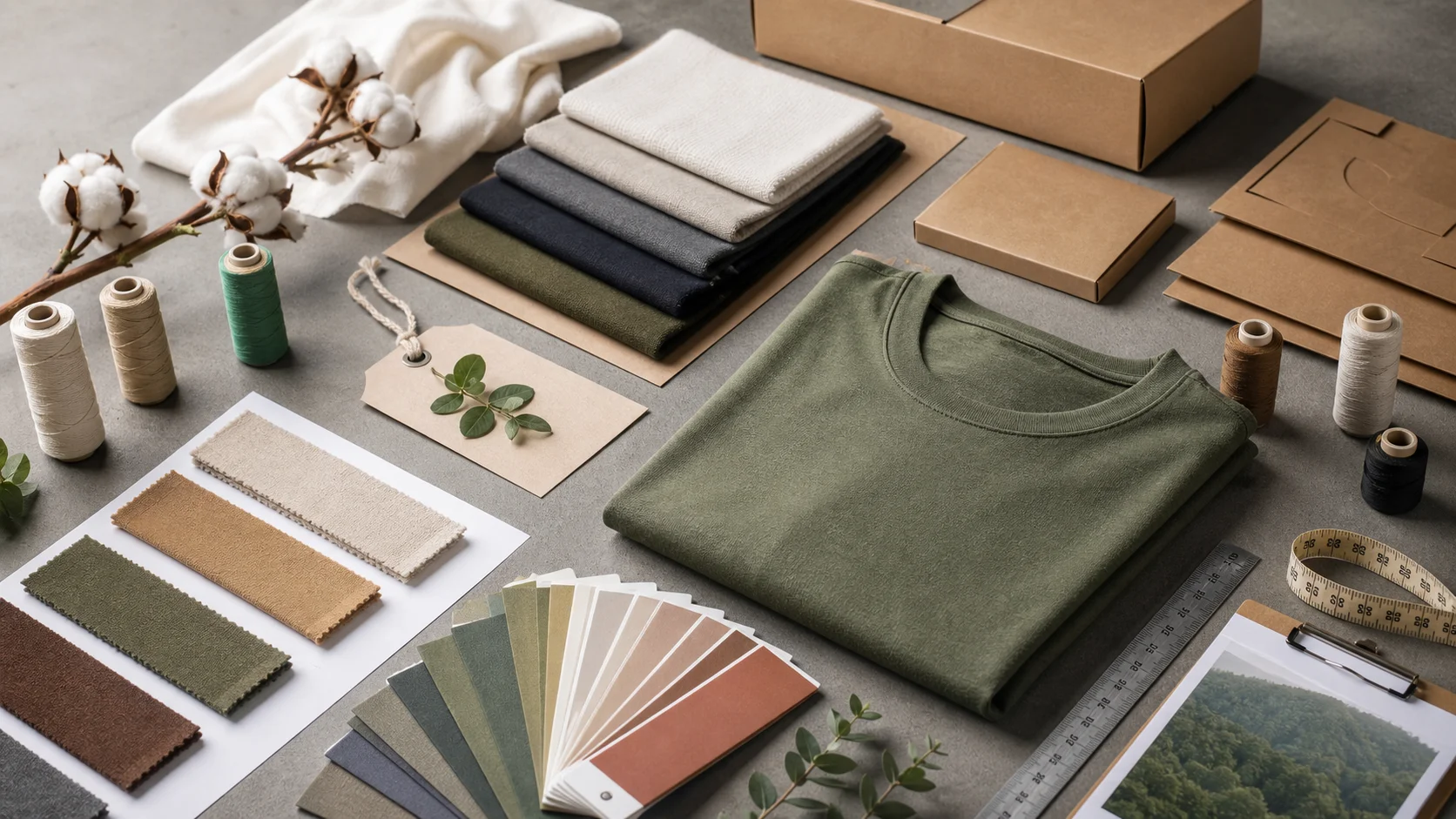
Vet A Clothing Production Vendor in China compared by sample evidence, fabric or trim specs, MOQ, AQL terms, cost lines, delivery timing, and rework...
Fast answer: Vet A Clothing Production Vendor in China: Sample Evidence, MOQ, Capacity, and Rework Terms should be judged by production evidence, not by a generic sourcing promise. The buyer needs sample proof, cost breakdowns, QC checkpoints, and delivery buffers in writing.
Ask for recent sample photos, measurement tolerances, fabric or print test assumptions, decoration test notes, packing examples, and a named inspection checkpoint. These details show whether the team can repeat an approved sample at bulk volume.
Separate garment cost, decoration, labels, packaging, sampling, testing, freight, and rush charges. Clear cost lines make it easier to reduce colorways, adjust size depth, or reserve more time for sampling.
I’ve walked into factories in Guangzhou, Fujian, and Zhejiang where the Alibaba profile promised a “premium apparel partner,” yet the first aisle held warped rolls of jersey, three half-finished work orders, and a sales manager who couldn’t find the sample log. That gap is the real reason how to vet a clothing factory in china matters: polished listings hide more than they reveal.
In the first 100 words, how to vet a clothing factory in china should already be on your mind, because the first call, the first visit, and the first document request tell you far more than a brochure. One conversation, one deposit, done. That’s how plenty of buyers get burned. On-site, I read the business before I read the price.
A factory gate with clear truck access, labeled receiving bays, and posted visitor rules usually tells me more than a glossy brochure. A trader posing as a factory often has a tiny office, sparse production noise, and no fabric inventory beyond a few presentation swatches. The sample room is a truth machine. If samples are sorted by season, fabric type, and buyer, and if every piece has a card with style number, date, and revision history, I trust the operation more.
If samples are piled in plastic tubs with no order, I start asking harder questions. Document readiness matters too. Can they show recent production records, cutting tickets, and QA forms in 10 minutes, or do they scramble for 30?
In my experience, real producers sound different. You hear cutting tables, steaming, and packing in parallel. You also see worker density that makes sense: 35 to 80 people in a medium plant, not 8 workers stretched across a supposed 500,000-piece capacity.
That first walk-through also exposes whether the company is a small workshop, a trader, or a true manufacturer with lines, machines, and a consistent production rhythm. A factory that can make 1,000 French terry hoodies at $4.20 a piece in 21 days is useful only if it can repeat the result, pass inspection, and keep a paper trail when a claim comes back six months later.
That is the standard I use, whether I’m seeing a babywear specialist or a general knitwear supplier such as custom baby clothing manufacturing.
The first question is not “How much?” It is “What kind of supplier am I standing in front of?” Manufacturers own some or all of the production process. Traders source from outside workshops and manage communication. Hybrids do both, which can help flexibility but blur accountability. If you’re buying at $2.80 per T-shirt or $14.50 for a fleece sweatshirt, that structure changes your margin, your control, and your risk.
I ask for five documents before I trust a quote: business license, export license if they handle exports directly, tax registration, factory address, and ownership structure. A real factory can usually show the address matching the production site, not just a sales office in a business tower. I also ask who owns the sewing lines, the cutting room, and the washing or embroidery subcontractors. If they cannot answer in one sentence, I assume work is being pushed out.
Small workshops often accept MOQs of 100 to 300 pieces, but they can need 4 to 6 weeks for sampling and 30 to 45 days for bulk. Medium factories may want 500 to 1,500 pieces and deliver in 20 to 30 days. Large plants can quote lower unit costs on 5,000-piece runs, yet they may be rigid on fabric minimums, trimming specs, and payment terms. Speed and flexibility rarely live in the same building as scale.
Here’s what most people miss: the cheapest quote often comes from a trader layering a margin on top of an unknown workshop. I have seen a “factory” quote $3.10 for a polo, then quietly outsource it to a plant that charges $2.40, leaving no room for rework, testing, or accountability. That is how defects slip through and lead times blow out.
Price should be broken down line by line: fabric at $1.20 to $4.80, trims at $0.25 to $1.10, sewing labor at $0.70 to $3.00, testing at $0.10 to $0.45, packaging at $0.15 to $0.60. If a supplier gives only one number, I press for the breakdown. A serious partner can explain the difference between ring-spun cotton, 320 GSM French terry, and a cheaper knit blend, and knows when a style needs private label clothing services rather than a basic production quote.
Certificates are useful, but only as proof of a process that happened once. I care about audit type, date, scope, and verifier. Social compliance audits, quality management audits, technical capability reviews, and product-specific testing all answer different questions. A WRAP or ISO certificate may help, but if the audit is 18 months old and no corrective actions are visible, I treat it as a photograph, not a guarantee. For textile chemistry and safety claims, I also cross-check standards with OEKO-TEX and production benchmarks with ISO.
Labor evidence tells you what the certificate cannot. I look for overtime records that stay within legal limits, timecards that match actual shift patterns, dormitory conditions that are clean but not staged, and safety signage near boilers, cutting machines, and dyeing zones. Missing fire extinguishers, blocked exits, or one shared locker for 40 workers are not small issues. They are signs that discipline stops at the reception desk.
Compliance expectations change by market. A factory selling only domestic stock may run on looser documentation. EU buyers usually need stronger chemical testing, traceability, and social audit records. US retailers often ask for stricter chain-of-custody proof and stronger defect documentation. Premium brands may require all of that plus fiber-content verification, shrinkage standards, and third-party inspection. Data from the U.S. Department of Commerce trade guidance shows how export buyers increasingly ask for documented proof, not promises, especially as apparel sourcing shifts toward more audited suppliers.
The counterintuitive part shows up on factory visits. A spotless office can hide weak floor-level discipline, while a modest plant with worn paint may still run tight logs, signed attendance sheets, and clear corrective-action records. I’ve trusted factories with basic chairs and plastic clipboards more than showrooms filled with branded coffee cups. The floor tells the truth. The lobby does not.
For buyers building technical product lines, especially knit or newborn ranges, the safest partners are often the ones that can show recent test reports, not just a wall of framed certificates. If you need complex sewing or specialty construction, ask whether they handle cut and sew manufacturing in-house or only coordinate it. That answer changes who is accountable when a seam opens or a collar twists after wash.
Quality begins before the first stitch. I start at incoming fabric inspection, where rolls should be checked for shade variation, holes, slubs, and width tolerance. Then I move to cutting, sewing, finishing, and packing. Each stage should have records. If fabric is accepted at a 4-point system and cut with no lay map, the factory is trusting luck. Luck is not a quality system.
Ask to see QC logs, AQL standards, defect photos, and rework procedures. A good factory can show how many pieces failed inline checks, what the defects were, and how they were fixed. I want to see defect codes for broken stitches, wrong measurements, skipped topstitching, oily marks, and label placement errors. If the factory says “we inspect everything,” I ask for evidence. Zero defects is a slogan, not a statistic.
Garment-specific checks matter. Measurement tolerance on a T-shirt might be plus or minus 1 cm on body length and 0.5 cm on neckline width. Stitch density should stay consistent across batches, especially on heavier fabrics like 320 GSM French terry. Shrinkage must be tested after wash and dry cycles. Colorfastness matters on dark cotton and pigment-dyed pieces. Trim accuracy matters on zippers, drawcord tips, and woven labels. One missed trim can sink a line of 10,000 units.
Premium factories usually run lower volume, tighter tolerances, and more in-line inspection. Mass-market factories often rely on process control because volumes are high and margins are thin. Neither model is automatically bad. What matters is whether the controls match the promise. A factory willing to show reject rates, corrective actions, and the last three inspection reports is usually safer than one that keeps saying every batch is perfect.
I once reviewed a 6,000-piece knit order where the factory separated fabric lots by shade and wash result, then reran 420 units because the after-wash measurement drifted 1.8 cm. That kind of discipline costs money in the short run. It saves money when returns arrive. A plant with documented control is worth more than a cheaper quote with no trail.
Two factories can quote the same $5.60 hoodie and deliver completely different landed costs. One may include fabric sourcing, garment wash, label application, polybagging, and carton testing. The other may exclude testing, charge extra for embroidery, and bill freight separately. I compare labor, fabric, trims, testing, packaging, and freight as separate lines, because that is where margin gets lost.
China is not one pricing zone. Coastal hubs like Guangdong and Zhejiang usually move faster and cost more because supply chains are dense and skilled labor is easier to access. Inland provinces can offer lower labor rates, sometimes by 10 to 18 percent, but transit to ports can add 2 to 5 days and complicate follow-up. Large factories often have better machine uptime. Smaller workshops may give you more attention but less stability. Geography changes both speed and risk.
Sampling timelines are another trap. A simple tee sample may take 7 to 10 days. A hoodie with wash effects, embroidery, and custom trims can take 14 to 21 days. PP approval often adds 3 to 7 days. Bulk production for 1,000 to 3,000 pieces usually sits in the 18 to 35 day range, while repeat orders can move faster if fabric is in stock. Shipping still needs 7 to 25 days depending on mode and lane.
Buyers should check hidden fees before signing anything. Sample charges, plate fees, rush fees, inspection fees, overage allowances, and lab testing costs can add 3 to 12 percent to the order. Some suppliers quote low and recover margin through extras. Others quote higher but include more in the base price. I prefer transparency over cleverness. The number on the pro forma invoice is rarely the number that matters.
For brands scaling private collections, this is where a clean, repeatable model pays off. A structured quote for 1,500 units, with clear fabric specs and color standards, is far safer than a vague commitment to “make it like the sample.” If the product needs precise fit, speak in pattern terms, not adjectives. That is how I protect budgets and timelines while building get a free quote conversations around facts instead of guesswork.
Fast replies are nice. Clear replies are better. I judge communication by speed, specificity, and whether the answer survives written follow-up. A factory that responds in 2 hours with vague promises is less useful than one that replies in 24 hours with measurements, fabric options, and a corrected spec sheet. Written clarity matters because manufacturing disputes are rarely solved by memory.
Sampling is a test of discipline. When I visited factories in Dongguan and Ningbo, the strongest teams treated each sample like a mini production run. They logged fabric lots, recorded the pattern version, and documented every revision. Weak teams sent back a prettier sample with new mistakes. If they cannot keep track of a size spec from sample 1 to sample 3, they will not control bulk variance across 3,000 pieces.
I test problem-solving with one small change request and one measurement question. I ask them to move a pocket 1.5 cm higher and explain how that affects sewing order. Then I ask what tolerance they guarantee on chest width after wash. A good factory answers directly and often with a counterproposal. A weak one gives a yes, then misses the detail later.
Sales staff can be excellent communicators, but they are not always the people who know the machine settings, shrinkage behavior, or seam allowances. The better factories put merchandisers and technicians on calls. That matters when you are ordering a 280 GSM sweatshirt, a denim overshirt, or a complex product with specialty stitching. The people who cut and sew should be part of the decision, not hidden behind the quotation.
The thing nobody tells you: the factory that says no to impossible deadlines can be safer than the one that agrees to everything. I have seen factories promise 12 days for a 2,000-piece run, then quietly subcontract half the order and lose control of labels and finishing. A disciplined “no” protects your brand more than a reckless “yes.”
Turn this into a repeatable process. Start with a screening call, then document review, then audit or video walk-through, then sampling, quote comparison, and finally a pilot order. I use a weighted scorecard with compliance at 25 percent, QC at 25 percent, communication at 15 percent, capacity at 15 percent, pricing at 10 percent, and transparency at 10 percent. The numbers force discipline.
Before any deposit, lock the basics in writing: signed specs, wash and test standards, payment terms, penalty clauses, inspection rights, and approval of labels and packaging. For smaller buys, I like a pilot run of 300 to 1,000 units or a low-risk style with simple trims. That reveals fabric behavior, finishing quality, and communication gaps without putting the whole season at risk.
Strong vetting protects both brand reputation and gross margin. A missed seam on 500 units can cost more than the savings from a $0.18 lower unit price. A two-week delay can wipe out a launch window. I’ve seen brands survive because they built checks early, and I’ve seen others burn through cash because they trusted the first tidy quote. If the supplier can pass the process, the price becomes meaningful. If not, the price is just decoration.
Start with documents, a factory visit or live video walk-through, and at least one sample round. Check the business license, production address, QC records, and whether the company actually owns sewing lines. A first-order pilot of 300 to 1,000 units is a practical way to test consistency.
Basic remote vetting can cost little beyond your time, but third-party audits often run from $300 to $1,500 depending on scope and location. Factory visits, samples, and lab tests can add another $200 to $800. For bulk apparel, that spend is small compared with the cost of one failed shipment.
Request the business license, export license if applicable, tax registration, factory address, ownership structure, recent audit reports, and sample QC logs. If the factory cannot share recent dates or gives documents with mismatched addresses, treat that as a warning. Real producers usually provide these within 24 to 48 hours.
Simple samples often take 7 to 10 days, while complex styles can take 14 to 21 days. Bulk production usually runs 18 to 35 days for 1,000 to 3,000 pieces, and repeat orders can move faster if fabric is already in stock. Shipping adds 7 to 25 days depending on transport mode.
Yes, but only partially. Remote vetting works best when you combine video calls, document review, sample testing, and reference checks from other buyers. It can catch obvious trader setups and missing records, but it cannot fully replace a floor walk-through, especially for quality systems and labor conditions.