
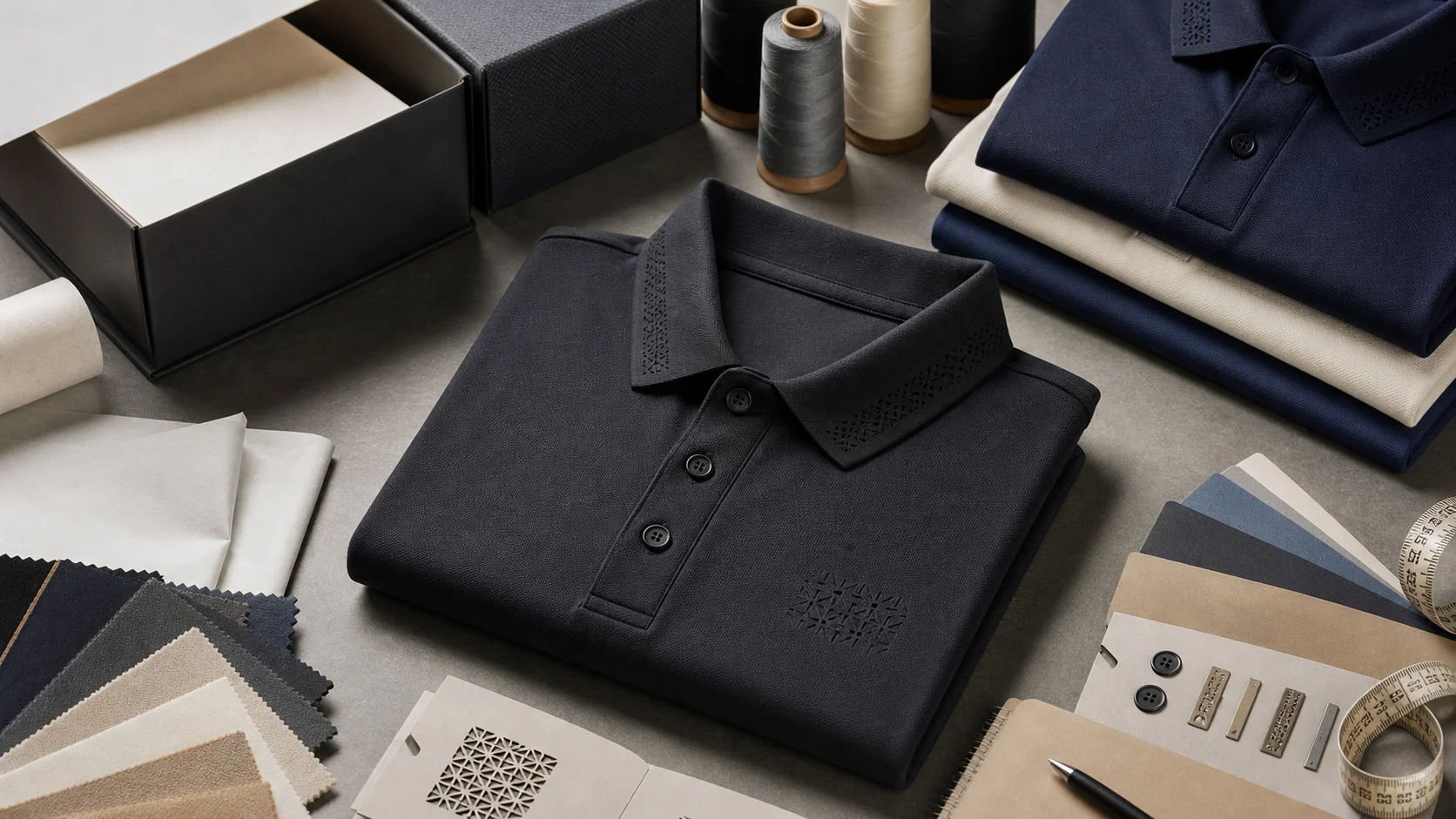
Source Clothing Production Vendor in China compared by sample evidence, fabric or trim specs, MOQ, AQL terms, cost lines, delivery timing, and rework...
Fast answer: Source Clothing Production Vendor in China: Sample Evidence, MOQ, Capacity, and Rework Terms should be judged by production evidence, not by a generic sourcing promise. The buyer needs sample proof, cost breakdowns, QC checkpoints, and delivery buffers in writing.
Ask for recent sample photos, measurement tolerances, fabric or print test assumptions, decoration test notes, packing examples, and a named inspection checkpoint. These details show whether the team can repeat an approved sample at bulk volume.
Separate garment cost, decoration, labels, packaging, sampling, testing, freight, and rush charges. Clear cost lines make it easier to reduce colorways, adjust size depth, or reserve more time for sampling.
The first factory visit in China can drain the romance out of sourcing in under ten minutes. If you are learning how to source clothing factory in China, that moment matters, because the $1.80 quote is often not from a factory at all and the sample room can be a polished lie.
I have stood in places where the hang tags looked perfect, the sales floor smelled like fresh ink, and the bulk line sat 400 meters away with a different team, different machines, and a very different level of discipline.
Usually, the first clue is the sample room. Samples can be sewn by a senior technician using better thread, tighter tolerances, and total attention. Bulk lines do not get that treatment. On a run of 3,000 T-shirts, I have seen sample measurements land within 0.5 cm while bulk drifted 1.5 to 2 cm, enough to create returns in denim and knitwear. A factory offering MOQ 300 pieces and a 10-14 day sample lead time may still be safe, but only if the bulk line can repeat the sample without improvisation. For basics, a defect rate under 2.5% is respectable. Above 5%, your margin starts bleeding through rework, replacements, and freight.
Chasing the cheapest quote is not a philosophical mistake. It is arithmetic. A quote that is 10%-15% higher can still be cheaper if reject rates drop from 8% to 2%, because every bad garment adds inspection time, repackaging, and customer service costs. Last year I worked with a brand that chose a Shenzhen supplier at $4.20 per cut-and-sew hoodie instead of an inland quote at $3.65. Their final landed cost was lower by $0.18 per unit after fewer size errors, fewer late cartons, and one less air freight emergency. The cheaper factory looked cheaper only on paper.
Regional differences sharpen the picture. In Guangdong, labor and factory overhead can push unit prices up by 8%-12% versus less developed inland areas, but export paperwork, trims sourcing, and port access are faster. In Fujian, I have seen strong knitwear and sportswear execution at MOQ 500 pieces, while Zhejiang often delivers cleaner finishing on woven shirts and fashion basics. The point is not that one province wins. The point is that your product type decides where value hides.
Three supplier models sit behind most quotes: manufacturer, trading company, and agent. A manufacturer owns the machines, the production team, and usually the quality control process. A trading company handles sourcing, coordination, and often resells capacity from multiple factories. An agent sits between you and the supply base, collecting a fee or commission for finding and managing production. Each can work, but they control different things, and confusion here costs brands weeks.
When I screen a new supplier, I ask for the business license, export rights, factory address, and a recent social compliance audit. Then I compare the address on the license with the address on the shipping documents and map it against the phone area code. That sounds tedious. It is. It also catches fake factories fast. If a supplier claims 20 product categories, from baby rompers to wool coats to backpacks, I get cautious. Real factories usually have 2-4 core categories, not 15. Recycled photos from Alibaba, vague answers about machinery, and shifting lead times from 20 days to 45 days are all warning signs.
Here’s what most people miss: a trading company is not automatically worse. For a small brand placing 300-800 pieces across 3 SKUs, a good trader can be faster than a direct factory because they aggregate accessory sourcing, testing, and sample follow-up. For a scale-up ordering 5,000-20,000 pieces monthly, direct factory relationships usually cut friction and protect margin. I have seen traders add 6%-9% to unit cost, but I have also seen them save a first-time buyer from a bad fabric swap that would have cost far more in returns. If your line includes technical items like a hoodie with flatlock seams or custom baby clothing manufacturing, ask who owns needle changeovers, fabric inspection, and needle-detection logs before you share a tech pack.
Before you send any design files, ask five questions. Who buys fabric, and from which mill? Who approves trims? Which factory line will run the order? What is the exact MOQ per color and per size ratio? Can they show a recent inspection report from 30-60 days ago? If the answers are slow, defensive, or too polished, keep moving. A good supplier answers in numbers, not slogans.
China is not one sourcing bucket. Guangdong, Zhejiang, Jiangsu, and Fujian each price, move, and fail differently. Guangdong, especially the Pearl River Delta, is strong for speed, trims access, and fashion basics. Zhejiang, near Ningbo and Hangzhou, is efficient for woven shirts, knit polos, and private label programs that need organized supply chains. Jiangsu often performs well on higher-end finishing and heavier apparel. Fujian leans into sportswear, casual knits, and activewear. I have seen the same French terry 320 GSM hoodie quoted at $4.10 in Fujian, $4.45 in Guangdong, and $3.78 inland, but the inland option needed two extra freight moves and a second inspection.
Sample pricing also shifts by region and by product. A knit T-shirt sample may cost $35-$80 in Guangdong, $25-$60 in Zhejiang, and $20-$50 inland. Denim samples often run $60-$150 because of wash testing, rivet work, and fit revisions. Outerwear costs more again because of lining, zippers, seam sealing, and fill handling. MOQ follows the same logic: cut-and-sew basics can start at 300-500 pieces, structured shirts at 500-800 pieces, denim at 800-1,500 pieces, and outerwear at 1,000 pieces or higher. Fabric choice changes everything. A stock 100% cotton jersey is easy. A recycled polyester-spandex blend with custom dye lots is not.
Coastal provinces cost more on paper, but they often reduce logistics friction by 2-5 days per order cycle. That time matters when you are balancing photo shoots, ecommerce launches, and retail deliveries. I have watched brands save $0.30 a unit by moving production inland, then spend $0.55 a unit on rework, extra cartons, and domestic freight because the factory had to truck trims from another province. Cheap quotes can become expensive when the line cannot hold specs or when the factory subcontracts the wash process.
Denim shows this clearly. A 12 oz denim jean with enzyme wash and contrast topstitching may be $13.50 in Zhejiang, $12.80 in Fujian, and $11.90 in an inland site. Then you add sample rounds, shrinkage testing, and freight to port. The inland producer may still win, but only if the wash house can control shade bands across 2,000 pairs. For premium casualwear and private label clothing services, I usually favor the region that gives me stable communication over the region that gives me the lowest quote. Stability saves margin.
For sourcing teams, trade data from WTO and broader market reporting from trade.gov show why this regional specialization persists: export infrastructure, supplier clustering, and component density affect both speed and defect recovery. A factory 90 minutes from a button supplier and a dye house can solve problems in 48 hours. A factory 900 kilometers away may need a week. That is not a small difference. That is the gap between launching on time and eating markdowns.
The pre-production sample is not a souvenir. It is your contract written in fabric. When you learn how to source clothing factory in China properly, quality checks before bulk production become non-negotiable. I inspect stitch density, seam allowance, measurement tolerance, shrinkage after wash, trim consistency, and color fastness before a bulk order gets signed.
On knits, I want to see whether the side seams twist after laundering. On denim, I want to know if the inseam shrinks more than 3% after a 30°C wash. On woven garments, I check collar points, placket alignment, and button spacing down to 1 mm.
Wash the sample twice. Measure before and after. Tug seams. Check whether rib cuffs recover, whether labels distort, and whether the zipper waves after pressing. If a factory sends a sample back with notes, photos, and a revised measurement sheet within 24-48 hours, that is a good sign. If they simply say “no problem” and resend the same piece, I worry. Communication speed matters because it signals how they treat escalation during production.
Factory capability checks should include the machinery list, inline QC steps, final inspection process, and whether they control fabric sourcing or buy through brokers. A maker with 18 lockstitch machines, 6 overlocks, 2 flatlock machines, and a needle detector on the packing line has a different quality profile than a showroom with glossy samples and no operational proof. According to AATCC test standards, colorfastness and dimensional stability should be measured with repeatable methods, not guesses. For sustainable sourcing benchmarks, you can also review Textile Exchange guidance and OEKO-TEX certification criteria.
Set your defect benchmark before production starts. For basics, an AQL of 2.5 is common. For more complex garments, 1.5 may be better if the margin can carry it. I have worked with factories that run only 4-6 clients and still outperform larger sites because the operators know one construction method deeply, rather than juggling twenty. Detail-heavy garments punish distraction. A smaller team with disciplined QC often beats a larger, busier floor with more moving parts.
Unit price is only one line in the spreadsheet. Total landed cost includes sampling, molds, labels, packaging, inspection, freight, duties, and payment fees. A basic T-shirt may cost $3.20 to make, but add $60 for samples, $120 for lab dips, $0.18 for woven labels, $0.22 for polybags, $150 for third-party inspection, and $900-$1,800 for sea freight depending on volume. If you pay by wire with bank fees of $25-$45 per transfer, those charges stack too. I have seen founders ignore these items and lose 6%-10% of margin before inventory even hits the warehouse.
MOQ rises with complexity. A cotton jersey tee might start at 300 pieces per color. A sweatshirt in 400 GSM fleece might need 500-800 pieces. A lined blazer or padded jacket can jump to 800-1,200 pieces because the factory must buy more fabric and trim in one run. Fabric choice changes thresholds. Stock fabric lowers risk and can shorten sampling by 1-2 weeks. Custom dyed fabric adds lab dips, strike-offs, and minimum dye batch commitments. If the factory says 14 days from approval to ship, ask what happens if the fabric is delayed by 5 days. The answer usually reveals the real schedule.
The timeline from tech pack to shipment usually runs 6-12 weeks for basics and 10-16 weeks for more complex garments. Sampling can take 7-21 days. Fit comments and revisions may take another 7-14 days. Production itself might take 15-35 days, then inspection, packing, and booking add 3-10 days. Air freight can deliver in 3-7 days, but it may cost $4-$8 per kilogram, which crushes margins on heavy fleece or denim. Sea freight is slower at 20-35 days port to port, yet it is far cheaper for bulk orders over 500 kilograms.
A unit price of $3.10 can lose to $3.45 if the cheaper factory needs air freight on half the order or if inventory sits idle for three extra weeks. Cash tied up in slow stock hurts more than many founders admit. If you are building a repeat program, cut and sew manufacturing often gives better control over the real cost stack because construction, fit, and trim planning happen earlier, not after the first carton is already booked.
Trade data from trade.gov shows how freight timing and landed cost shape sourcing decisions. The factory quote is the starting point, not the verdict.
Your first order should be a controlled experiment, not a leap. Start with a search list of 20-30 suppliers, narrow to 8-10 after the first call, then compare 3-5 factories seriously. I use a scorecard with six columns: price, MOQ, responsiveness, compliance, sample quality, and capacity. Give each factor a score out of 10, then weight quality and capacity higher than the cheapest quote. I would rather pay $0.40 more per unit than discover that a factory can only finish 600 of 1,000 units on time.
Once you have the shortlist, send the same tech pack to all finalists. Include flat sketches, bill of materials, grade rules, labeled measurements, construction notes, Pantone references, packaging details, and a target delivery date. If the garment is a hoodie, specify fabric weight like 420 GSM brushed fleece, stitch type, rib composition, and wash process. If it is a shirt, name collar interlining, button count, and seam tolerance. The more precise the pack, the faster you separate serious operators from guessers.
Negotiate more than unit price. Payment terms matter. A 30/70 split is common, but 20/80 or 50/50 may be possible depending on order size and trust. Ask for defect handling terms, packaging approvals, allowable tolerance ranges, late-delivery penalties, and what happens if the bulk shade varies from the approved strike-off. On one order, a supplier agreed to replace any carton with more than 3% defects without charge, which saved the brand nearly $2,400 on a 4,000-piece run.
For small brands, I prefer a pilot order of 300-800 pieces across 1-2 styles before scaling. That volume is large enough to expose process issues and small enough to absorb mistakes. Use the pilot to test fit, wash, packaging, and carton labeling. If you are building a niche line or premium basics, get a free quote only after you have clarified your construction standards and delivery window. A vague inquiry gets a vague price.
My workflow is simple. Shortlist, sample, test, inspect, then scale only after the first shipment proves that the factory can repeat the approved sample within the same 1-2 cm tolerance. Process discipline beats optimism every time.
The first shipment tells you whether the supplier is a partner or a problem. I review defect rates, return rates, customer comments, and gross margin by SKU. If a 2,000-piece order comes back with 4% measurable defects and 1.5% returns, I do not shrug. I calculate what those issues cost in markdowns, replacements, and paid support. A “cheap” factory can drain 12%-18% of gross margin if the downstream problems keep stacking.
Then I decide whether to reorder, renegotiate, or switch. If the garment sold through in 3 weeks with low returns, I look for scale. If defects were concentrated in one construction point, such as neckline stretching or zipper puckering, I ask for corrective action and a revised sample before any new order. If communication breaks down after shipment, I treat that as a structural risk, not a temporary hiccup. Production memory matters. So does honesty.
Long-term factory relationships improve pricing more than many buyers expect. A supplier who can forecast your next 2 seasons, book fabric early, and see payment land on time often gives better pricing than a one-off customer who shops every order like a bidding war. I have seen steady buyers save 4%-7% after 3 consistent orders, not because they begged, but because the factory trusted the volume. That trust also buys better attention when a rush order appears.
There is a practical rhythm to it. Share a 6-month forecast. Confirm colorway plans 30-45 days early. Pay invoices on time. Review shipment data after every season. If the supplier keeps hitting a 2.5 AQL target, ships on schedule, and documents issues clearly, stay. If not, move. Cheap sourcing without process is just expensive chaos in a prettier spreadsheet.
Start with 20-30 suppliers, verify licenses, then compare 3-5 factories on price, MOQ, sample quality, and response time. For a small brand, a direct factory or a strong trading partner can both work if the MOQ is 300-800 pieces and the tech pack is precise. If you are still figuring out how to source clothing factory in China, do not skip the sample round.
For a basic T-shirt, factory pricing often starts around $3.00-$5.00 per piece, depending on fabric, color, and finish. Add sampling, labels, packaging, inspection, freight, and duties, and landed cost can rise by 15%-30% above ex-factory price.
Most basics take 15-35 days in production after approval, while more complex garments can take 10-16 weeks from tech pack to shipment. Sampling usually adds 7-21 days, and freight can add 3-35 days depending on air or sea.
Check the business license, factory address, export rights, and recent audit documents. A real manufacturer should be able to show machinery lists, production photos from the same address, and detailed answers about line capacity, while a trading company often coordinates multiple sites.
Yes. Private label works well if you provide clear specs for fabric, trim, fit, packaging, and labeling. For many programs, MOQ starts at 300-500 pieces for basics and 800-1,200 pieces for structured garments, with lead times of 6-12 weeks. If you want a cleaner result, treat how to source clothing factory in China as a process, not a shortcut.