
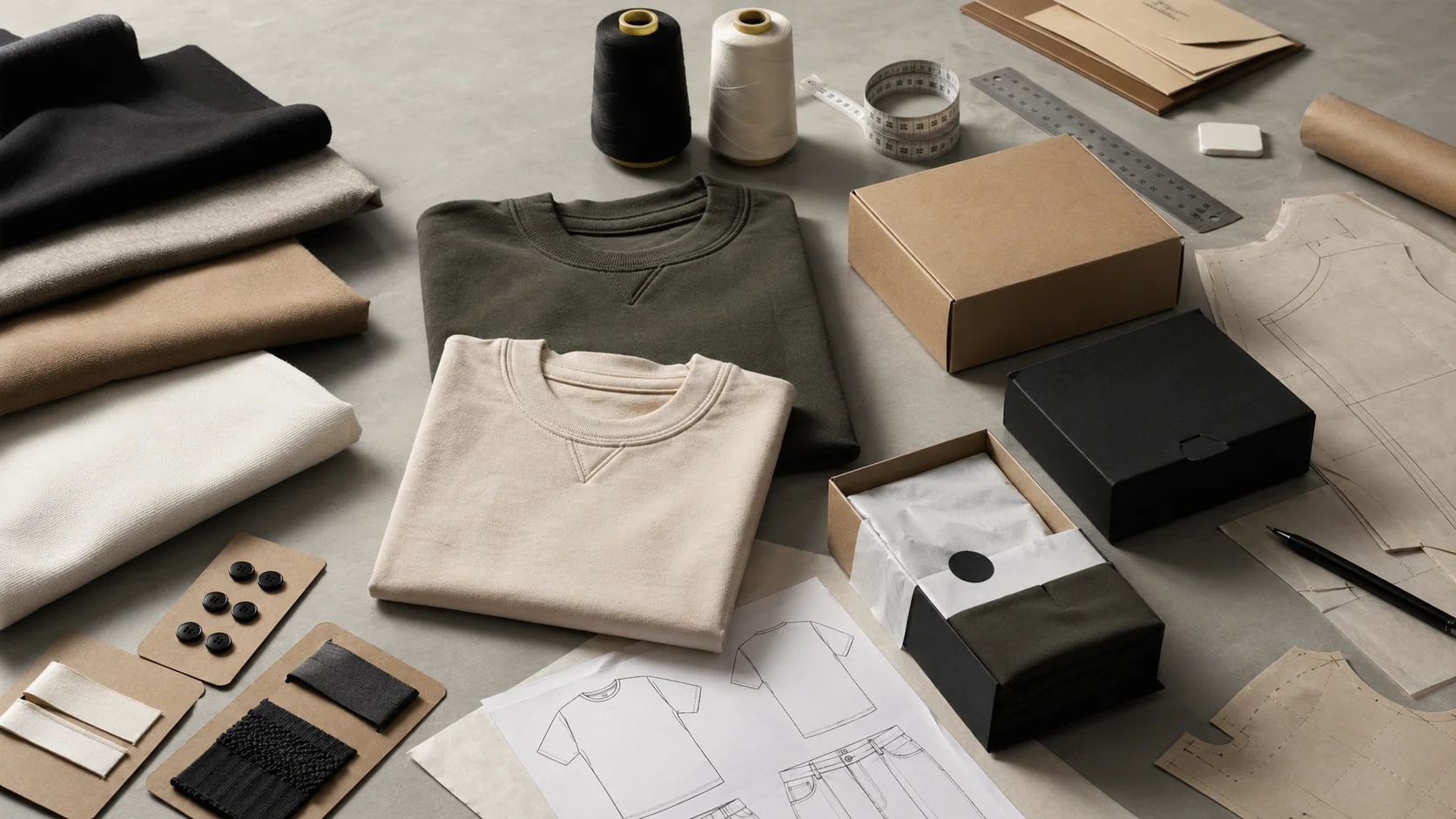
Vetting Garment Vendors Online with checks for samples, fit, MOQ, QC evidence, pricing terms, and delivery risk.
Fast answer: Vetting Garment Vendors Online: Proof, References, and Sample Evidence should be judged by production evidence, not by a generic sourcing promise. The buyer needs sample proof, cost breakdowns, QC checkpoints, and delivery buffers in writing.
Ask for recent sample photos, measurement tolerances, fabric or print test assumptions, decoration test notes, packing examples, and a named inspection checkpoint. These details show whether the team can repeat an approved sample at bulk volume.
Separate garment cost, decoration, labels, packaging, sampling, testing, freight, and rush charges. When every cost line is visible, it becomes easier to reduce colorways, adjust size depth, or reserve more time for sampling.
Finding the right apparel supplier can make or break your clothing business. Whether you are launching a new brand, expanding a private label line, or sourcing a dependable manufacturing partner for wholesale production, the supplier you choose affects product quality, pricing, lead times, customer satisfaction, and ultimately your reputation. In an increasingly digital sourcing environment, most businesses begin the process online. That makes it essential to know how to vet apparel suppliers online before you commit to samples, deposits, or long-term production contracts.
This guide explains a practical, business-focused approach to evaluating clothing manufacturers and sourcing partners online. You will learn what to look for on supplier websites, how to verify credibility, what questions to ask, and how to spot red flags early. If you are comparing potential partners, you may also want to learn more about Fabrikn’s apparel manufacturing services, explore our about us page, or reach out through our contact page to discuss your project.
Apparel sourcing is not just about finding the lowest price. The right supplier should support your brand’s quality standards, delivery schedule, product range, and growth plans. Vetting suppliers online helps you reduce the risk of working with companies that overpromise, underdeliver, or disappear after taking payment.
For fashion brands and B2B buyers, poor supplier selection can lead to a chain of costly problems: inconsistent sizing, fabric defects, delayed launches, inventory issues, and damaged customer trust. Online vetting is your first defense against these risks. It also helps you identify suppliers that are aligned with your niche, whether you need activewear, uniforms, private label basics, streetwear, or premium collections.
A legitimate supplier should present itself professionally online. Start by reviewing the company website, social media profiles, and business listings. A polished online presence does not guarantee quality, but it does indicate that the company has invested in credibility and transparency.
Pay attention to the details. If the website is full of generic stock images, vague claims, or broken pages, that may indicate a lack of operational maturity. A serious supplier should be able to explain its process clearly and provide content that reflects real production capability.
Look at whether the company uses a professional domain-based email address. A supplier using only free email accounts may still be legitimate, but it is worth asking why. Also compare the business name across the website, email signature, social profiles, and business directories to ensure consistency.
Once the online presentation looks credible, investigate the company’s legal and operational background. You want to confirm that the business actually exists, operates in the location it claims, and has a track record you can verify.
Some manufacturers list factory locations, offices, or showrooms online. If these details are provided, search them independently through map services, business registries, or trade directories. A supplier with traceable public information is generally lower risk than one that hides behind a vague online profile.
Reputable apparel suppliers often explain whether they are a factory, trading company, sourcing agent, or hybrid operation. This distinction matters because it affects pricing, lead times, communication flow, and production control. For example, a direct manufacturer may offer more control over quality and customization, while a sourcing company may coordinate multiple production partners.
One of the biggest mistakes buyers make is choosing a supplier that is too broad or too generic. A clothing manufacturer that claims to make everything from luxury suits to technical outerwear may not be the best fit if your brand needs specialized knitwear or performance leggings.
Ask yourself whether the supplier has experience with your specific category. Review their product gallery, service pages, and case studies to see if they have handled similar materials, construction methods, or end-use requirements.
If your brand requires custom trims, embroidery, screen printing, washing, dyeing, or technical performance fabrics, confirm that the supplier can manage those processes in-house or through reliable partners.
Beyond product categories, evaluate whether the supplier can support your business at different stages of growth. Can they handle sampling, low minimum order quantities, bulk production, packaging, labeling, and fulfillment? A supplier that only performs one stage of the process may slow your launch or create coordination issues later.
Quality control is one of the most important factors when vetting apparel suppliers online. A supplier may look strong on paper, but without a clear quality process, your finished garments may not meet expectations.
Ask whether the supplier performs in-line inspections, final inspections, or third-party quality checks. If they mention certifications, request clarification on what those certifications cover and whether they are current. Certifications can support trust, but they should never replace detailed due diligence.
If you plan to sell in regulated markets or to major retail buyers, compliance is not optional. Depending on your region and product type, you may need to consider labeling requirements, fiber content accuracy, country of origin rules, chemical restrictions, labor standards, and safety regulations.
Online vetting should include a review of whether the supplier understands relevant compliance requirements. Suppliers who are familiar with export markets and retail standards are generally better prepared to support growth-minded apparel brands.
Fast and clear communication is a strong sign of professionalism. During the vetting stage, pay close attention to how the supplier responds to your questions. Are they concise, informative, and transparent? Or are they evasive, slow, or inconsistent?
Responsiveness matters because it often reflects how the supplier will behave once you are in production. If they are hard to reach before they have your order, they may be even harder to reach once a deadline approaches.
Send a detailed inquiry with product specifications, target quantities, material preferences, and timeline expectations. A good supplier should respond with relevant questions rather than a generic quote. This demonstrates real interest and technical understanding.
Price matters, but it should never be the only factor. When vetting apparel suppliers online, compare pricing in the context of quality, service, and reliability. An unusually low quote can be a warning sign if it comes with vague details or unrealistic promises.
Request pricing that is broken down clearly. Ask what is included and what is not. For example, does the quote include fabric sourcing, trims, labeling, packaging, and export documentation? Transparent pricing makes supplier comparisons much easier and reduces the chance of surprise costs later.
Minimum order quantities vary widely in apparel manufacturing. Smaller brands may need lower MOQs, while larger businesses may prioritize cost efficiency at scale. Make sure the supplier’s MOQ matches your budget and inventory strategy. Likewise, evaluate lead times carefully. A supplier who promises extremely fast delivery may be cutting corners or overcommitting.
Any supplier can claim experience. The key is verifying it. Look for proof of work that shows real production outcomes, not just attractive marketing language.
When reviewing images, look for consistency and authenticity. Photos that show different garment types, production stages, and finishing details are generally more believable than generic staged images. If a supplier lists recognizable clients, confirm those partnerships where possible.
Third-party reviews can be helpful, but they should be interpreted cautiously. Look for patterns rather than one-off complaints or praise. A few negative reviews are not necessarily a deal breaker, but repeated comments about missed deadlines, poor communication, or quality issues should be taken seriously.
Online vetting should always lead to tangible proof. Samples are one of the best ways to assess whether a supplier can deliver what they promise. Even before placing a production order, a sample can reveal a lot about craftsmanship, fabric quality, sizing accuracy, and communication efficiency.
Also evaluate how the supplier manages the sampling process. Do they provide a clear timeline? Are they willing to make revisions? Do they explain what needs to be corrected? The sample stage often reveals whether the supplier is collaborative and process-driven or disorganized and difficult to work with.
Before you place a production order, make sure the supplier offers clear terms. Online vetting is not complete until you understand the commercial and legal structure of the partnership.
Never rely on verbal assurances alone. A reliable supplier should be comfortable putting important details in writing. If you are creating original designs, protect your brand by confirming ownership of artwork, patterns, and custom developments.
Some warning signs are easy to miss if you are focused only on price or speed. Watch for these common red flags:
If several of these issues appear at once, move on. The cost of a bad supplier relationship is usually much higher than the cost of continuing your search.
Use this simple checklist to compare suppliers online more efficiently:
The best apparel suppliers do more than take orders. They act as manufacturing partners that help you reduce risk, improve product quality, and scale with confidence. If you are evaluating a potential long-term partner, consider exploring Fabrikn’s services or contacting our team directly through the contact page.
Learning how to vet apparel suppliers online is a crucial skill for any business that depends on reliable garment production. A supplier may look credible at first glance, but true reliability comes from evidence: verified business details, product specialization, quality processes, clear communication, and sample performance. By using a structured vetting approach, you can reduce risk, save time, and choose partners who support your growth.
In the apparel industry, the right supplier is not just a vendor. They are part of your brand’s foundation. Take the time to investigate carefully, compare options thoughtfully, and ask the right questions before you commit.
Get a free quote from Fabrikn — your trusted B2B clothing manufacturer with 10+ years of experience. MOQ as low as 200 pieces.
Get a Free Quote →The best approach is to combine website review, business verification, product capability assessment, sample testing, and contract review. Do not rely on a single factor like price or online appearance alone.
Check for a real company name, physical address, professional email, consistent branding, proof of past work, and clear contact details. Independent verification through directories or registries also helps.
Yes. Samples help you evaluate quality, fit, construction, and communication. They are one of the most effective ways to confirm whether the supplier can meet your standards.
Major red flags include vague business details, unrealistic pricing, poor communication, pressure to pay immediately, and refusal to provide samples or references.
It is wise to compare at least three to five suppliers so you can evaluate pricing, capability, communication, and reliability side by side.
Yes. A polished website is only one part of the vetting process. Always verify company information, request samples, and assess how the supplier handles communication and documentation.
Ask about their specialization, MOQ, pricing, lead times, quality control process, sample development, compliance standards, and payment terms. These questions reveal a lot about their professionalism and fit.