
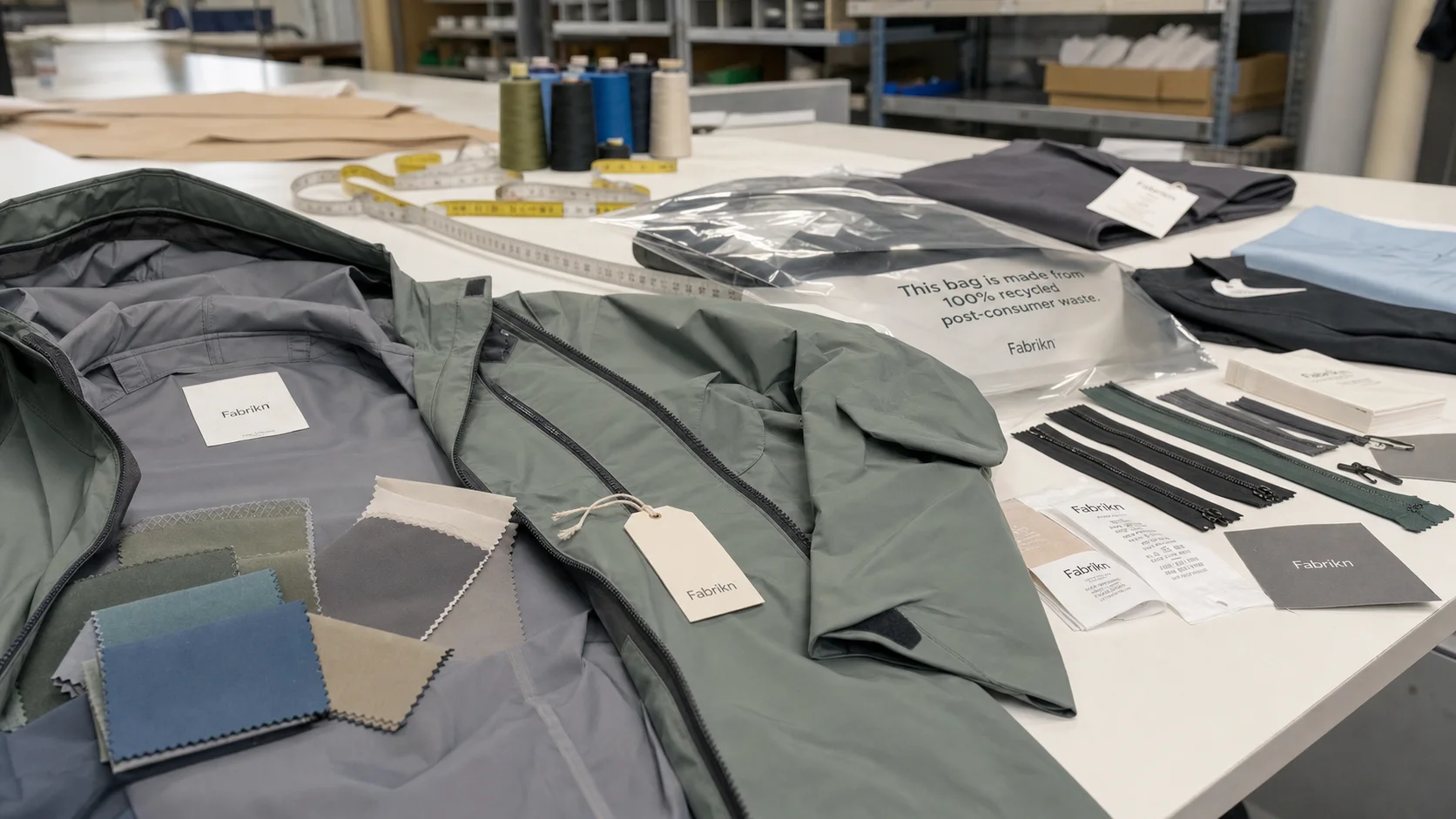
Low MOQ Activewear Manufacturer China compared by sample evidence, fabric or trim specs, MOQ, AQL terms, cost lines, delivery timing, and rework responsibility.
Fast answer: Low MOQ Activewear Manufacturer China: Sample Fit, Trim, AQL, and Delivery Risk should be judged by production evidence, not by a generic sourcing promise. The buyer needs sample proof, cost breakdowns, QC checkpoints, and delivery buffers in writing.
Ask for recent sample photos, measurement tolerances, fabric or print test assumptions, decoration test notes, packing examples, and a named inspection checkpoint. These details show whether the team can repeat an approved sample at bulk volume.
Separate garment cost, decoration, labels, packaging, sampling, testing, freight, and rush charges. Clear cost lines make it easier to reduce colorways, adjust size depth, or reserve more time for sampling.
The smartest activewear launches are starting small, fast, and a little less politely than they used to. A low MOQ activewear manufacturer china now gives founders room to test demand without gambling the whole season on one colorway and a hopeful spreadsheet.
Across factories in Guangdong, Fujian, and Zhejiang, the math is blunt. A 200-piece test order can tie up $2,500 to $8,000 in fabric and cut-and-sew cost, while a 1,000-piece run may push the buy to $12,000 to $40,000 depending on trims, bonding, and print work. Smaller orders usually cost more per piece, often by 18% to 45%, but they cut dead stock and let brands learn faster. That matters when 60% of first-time activewear launches never reorder the original colorway.
China handles small runs differently from many bulk-only suppliers I’ve seen in Vietnam, Turkey, and India. Some factories there are excellent at volume, but they often want 500 to 1,500 pieces per style before pricing gets sharp. A low MOQ activewear manufacturer china can sometimes quote 100 to 300 pieces with usable patterns, active development support, and access to mill stock rooms larger export houses would never open for such a small order.
The trade-off is plain. You pay more per unit, but you avoid sitting on 700 unsold leggings in a size run that missed the market. I’ve seen brands recover their launch math after selling only 42% of the first batch because the next production decision came from actual demand, not a hopeful forecast.
When I visited a 38-machine factory outside Dongguan, the sample room was more organized than the bulk floor. That surprised me. The sampling team could turn a nylon-spandex legging proto in 3 days, while a bigger export house down the road needed 7 to 10 days and a minimum of 500 pieces to justify special trim sourcing. Smaller Chinese factories often move faster because the owner still answers fabric questions and the pattern maker sits two tables away.
That speed matters for custom sportswear manufacturing, especially if your first launch includes 2 colorways, 3 sizes, and a compression waistband that needs one more fitting round. I’ve seen a 14-day sample cycle turn into 8 days simply because the factory had stock yarn and a dye house 40 minutes away. The lesson is not that China is always cheap. It is that China can be fast, and fast is profitable when your MOQ is low.
Here’s what most people miss: a small Chinese factory often gives better fabric access than a larger one, because it is more willing to buy from local stock lots in 20 to 50 meter cuts. That can save a launch that only needs 150 pieces of French terry 320 GSM or recycled polyester-spandex in one color. A factory that can source from multiple mills gives you options when you are not ready for full custom development.
A serious low MOQ activewear manufacturer china can usually produce leggings, sports bras, racerback tanks, running shorts, bike shorts, and lightweight outer layers. The realistic minimum changes with complexity. Basic leggings may start at 100 to 200 pieces per color when fabric is in stock, while a sports bra with molded cups and bonded edges often starts at 300 to 500 pieces. Tanks and shorts with simple seams can sometimes begin at 80 to 150 pieces.
Simple cuts are friendlier to small orders. A straight-leg legging in 240 GSM nylon-spandex, a crop top with coverstitch hems, or a training short with a 5 cm elastic waistband is much easier to approve than a seamless piece with engineered zones. Seamless construction usually wants 500 to 1,000 pieces because machine time and yarn setup are expensive. Compression panels, laser-cut ventilation, and bonded seams also push minimums upward, even when the garment looks minimal on the hanger.
The easiest materials to source in small lots are nylon-spandex, polyester-spandex, recycled blends, and brushed fabrics. Stock fabric programs are your friend. If a mill already has 200 to 800 meters available, a low MOQ activewear manufacturer china can often reserve enough for a 100- to 300-piece run without special dyeing. I’ve also seen brushed polyester-spandex work well in pilot launches because it hides minor fitting issues better than shiny compression knit.
Trim choices are where many buyers get surprised. Custom elastic in 3 cm or 4 cm widths can add a 200 to 500 meter minimum, even if the garment MOQ is only 150 pieces. Screen prints are friendlier than all-over sublimation for tiny orders, but each color can add setup cost. Specialty zippers, molded logo pulls, and custom brand tapes can push the factory to quote a 300-piece minimum even on a plain tank. If you want to protect margin, start with the garment and keep the trim story restrained.
For private-label launches, I often recommend a tighter first collection and then expansion through private label clothing services. That keeps the first buy focused on fit, handfeel, and repeatability. I’ve seen a 4-style collection outperform a 9-style launch because each piece was better financed, better measured, and easier to reorder within 21 to 30 days.
Paperwork matters, but it does not tell the whole story. I always ask for the business license, export history, fabric test reports, and quality-control records from the last 3 to 6 orders. If a factory claims it serves overseas brands, it should be able to show shipment dates, product categories, and at least a few anonymized packing photos. Certifications help, especially OEKO-TEX or GRS, but they do not guarantee good sewing or honest communication. According to Global Standard, certified systems still require proper chain-of-custody controls, and I have seen factories with impressive certificates fail basic measurement discipline.
On-site, I look at the sample room before I look at the sales office. A tidy pattern table, labeled size sets, and organized fabric swatches tell me more than a polished presentation deck. If the factory can explain shrinkage control, stitch balance, and fabric source options in plain language, that is a positive sign. If they cannot tell me whether a 240 GSM knit has 18% or 22% spandex, I walk.
My red flags are specific. Inconsistent stitching across the same seam. No record of colorfastness or shrinkage testing. Sample rooms where 6 styles are piled on one table with no size tags. Vague answers about whether the fabric comes from a mill or a trader. I also pay attention to response time. A factory that takes 4 days to answer a simple quote request will be slower when a fit problem appears during bulk.
There is a practical buyer checklist I use on every visit. Ask for a quotation within 48 hours. Ask to see a pattern-maker’s correction notes. Ask how the factory handles a 3 mm seam allowance change. Ask whether they can quote 100, 200, and 500 pieces without rewriting the entire email thread. If they can, that is a good sign. If they keep pushing you toward a higher quantity without explaining cost drivers, the order will probably become a headache later.
If the product is technical, I prefer factories that already do cut and sew manufacturing for activewear rather than general knitwear shops moonlighting in leggings. A factory that understands stretch recovery, flatlock spacing, and gusset design will save you two or three development rounds. That is worth real money when sample courier fees run $35 to $90 per parcel.
For a basic legging in nylon-spandex, I usually see these factory quotes in China: 100 pieces at $7.50 to $11.50 per piece, 300 pieces at $6.20 to $9.00, and 1,000 pieces at $4.20 to $6.40. A sports bra with removable pads often lands at $6.80 to $10.50 for 100 pieces, $5.50 to $8.20 for 300, and $3.90 to $5.80 for 1,000. A technical top with bonded seams or multiple panels can run 20% to 35% higher at every quantity.
Those numbers shift fast once you add the hidden buckets buyers miss. Molds for logo hardware can cost $120 to $400. Grading across 5 sizes may be $40 to $150 per style. Lab dips can add 7 to 10 days and $60 to $200 per color. Courier fees for samples can run $45 to $120 round trip. Rework is the cost nobody budgets for, and I have seen it eat 8% to 12% of a small launch budget.
Vietnam often gives strong sewing quality, but small activewear runs can be harder to place because many factories prefer larger orders or a narrower fabric list. Bangladesh can be cost-competitive on labor, yet smaller orders often struggle when mills and trim suppliers want volume. Turkey is excellent for speed into Europe and can handle fashion-forward knits, but the fabric price can be 10% to 25% higher than comparable Chinese stock lots. China sits in the middle: better fabric access than many competitors, faster sample movement than most, and a wider range of factories willing to quote 100 to 300 pieces.
Data from WTO and trade sources shows that apparel sourcing is splitting between agility and cost, not just low labor rates. I have seen a slightly higher Chinese quote still win because the sample arrived 6 days sooner, the defect rate was lower, and the brand could launch before a seasonal buying window closed. That 2-week timing advantage can be worth more than a $0.60 unit saving.
Fabric access also changes landed cost. China’s domestic mill network makes it easier to source 150 to 300 meters of a ready nylon-spandex blend without paying a full custom dye minimum. That matters if you are testing 2 colors at 150 pieces each. If your supplier insists on a $2,000 dye lot and 1,000-meter MOQ, your cheap unit price is fiction. A quote only makes sense when you factor fabric, trims, freight, duties, and the 2 to 4% rework risk that small launches usually carry.
For a clean first order, I plan 4 to 8 weeks for simple styles and 8 to 14 weeks for technical pieces. A straightforward legging in stock fabric can move from tech pack to first shipment in about 30 to 45 days if the factory has open capacity. Add bonded seams, custom fabric development, or print matching, and the calendar stretches quickly. The sample stage alone can take 7 to 14 days for the first proto, then 5 to 10 days for fit corrections.
Fast-track orders work best when the factory already has the fabric and trim on hand. If you need custom knit development, the mill may require 15 to 30 days just to approve yarn and color. Bulk cut-and-sew is usually the easiest part once the fabric is in warehouse stock. QC, packing, and carton labeling add another 3 to 6 days, depending on order size and whether the buyer requires carton-level barcode checks.
Low MOQ orders get delayed by the same forces that hit large ones, only harder. Fabric mill minimums. Trim delays. Fit revisions that reset the sewing line. And holiday shutdowns. Chinese New Year can pause production for 10 to 20 days, but the real impact starts earlier because workers leave gradually and freight bookings tighten. I have seen a 12-day delay become a 32-day delay because a 200-piece order waited behind a larger export run for the same dye house.
One useful planning rule: if your launch depends on a fixed marketing date, work backward by at least 2 months for simple pieces and 3 months for technical ones. That gives you room for one sample revision, one fabric delay, and one courier mistake. If a low MOQ activewear manufacturer china promises 10 days for a custom bonded bra, I would want proof, photos, and recent order references before I believe it.
Activewear quality starts with performance, not polish. I want seam strength, stretch recovery, opacity, pilling resistance, and wash performance measured before bulk approval. For leggings, the critical checks are squat proofing, waistband recovery, and seam popping at the inner leg gusset. For sports bras, I focus on band recovery, cup positioning, and elastic stability after 5 to 10 wash cycles. For tops, I care about neckline distortion and pilling after abrasion.
A factory should be able to discuss tests in measurable terms. A 300 GSM brushed legging should not shrink beyond 3% to 5% after washing, and recovery should stay within a tight tolerance after repeated stretch. According to AATCC methods used across the industry, colorfastness and dimensional stability are not optional for commercial apparel. I also ask for color consistency across dye lots, because one bad shade can ruin a 2-color launch. For broader materials and responsible sourcing context, Textile Exchange is also a useful reference point for buyers evaluating recycled fibers and preferred materials.
Packaging is part of quality. A mislabeled size sticker or wrong barcode can block a retail delivery more effectively than a weak seam. I check hangtag spelling, country of origin, fiber content, care label language, carton marks, and master carton counts. If the factory can do carton-level barcoding, it usually has better warehouse discipline. If it cannot, I budget another 1 to 2 days for my own QC team to fix the shipment before dispatch.
For sustainability claims, I also request supporting certification documents and testing files from recognized sources such as OEKO-TEX. That does not replace a fit test or wash test. It simply reduces the chance that a small-order launch gets blindsided by a compliance issue after labels are printed and cartons are sealed.
Start with 5 to 8 factories, not 20. Define your target MOQ, product type, and price ceiling before you email anyone. If your first run is 150 leggings and 100 bras, say so clearly. Then ask for factories that have made the same category within the last 6 months. I would rather speak with 6 focused suppliers than 18 random ones who all say yes but cannot quote the same construction.
Your shortlist should include at least one factory that specializes in technical activewear, one that does simpler cut-and-sew knits, and one that can supply stock fabrics quickly. If you need a white-label path with quicker branding setup, I often suggest pairing the search with request a factory quote for custom activewear so you can compare responses on the same day. Speed in the first email often predicts speed in production.
Send a tight request: measurements in centimeters, fabric composition, target retail price, color count, order quantity, size ratio, required certifications, and desired delivery window. Include 3 to 5 reference images and state what you do not want. If you want a 240 GSM matte legging with a 9 cm waistband and no front seam, say that. If you want 85% recycled polyester and 15% elastane, say that too. The clearer the brief, the less likely the factory will quote the wrong construction.
Compare quotes on landed cost, not unit price alone. That means sample fees, courier costs, duty assumptions, packaging, and the likelihood of rework. I often score suppliers on 4 factors: communication speed, pattern accuracy, fabric access, and willingness to quote 100, 300, and 1,000 pieces without forcing a larger MOQ. If a factory cannot explain a cost difference between stock fabric and custom dye within 2 emails, it is not ready for your launch.
For brands building from scratch, the best path is usually 1 pilot order, 1 revision order, and then a scale order. After the second run, you can renegotiate on fabric reserve, trims, and payment terms. That is also when a supplier becomes a real manufacturing partner instead of a quote in your inbox.
For simple activewear styles, 100 to 300 pieces per style is common, especially if fabric is in stock. Technical garments with bonded seams, molded cups, or seamless construction often start at 300 to 1,000 pieces. The exact MOQ depends on fabric availability, trim complexity, and whether the factory is set up for sampling.
A basic legging in China often costs about $7.50 to $11.50 at 100 pieces, $6.20 to $9.00 at 300 pieces, and $4.20 to $6.40 at 1,000 pieces. Add more for custom elastic, prints, or compression panels. Sample fees, courier costs, and rework should be budgeted separately.
Simple styles usually take 4 to 8 weeks from tech pack to shipment if fabric is in stock. Technical pieces commonly take 8 to 14 weeks because of sampling, fabric development, and trim delays. Chinese New Year and fabric mill minimums can add another 1 to 3 weeks.
Choose a factory with clear export history, recent activewear orders, and fast, specific communication. Ask for business registration, fabric test reports, and QC records, then compare sample quality in person or with detailed photos. A good first-run factory can quote 100, 300, and 500 pieces without changing the story every time.
Yes, but only if the mill has stock yarn or pre-dyed fabric available. Custom dyeing, custom elastics, and specialty trims can raise the real minimum far above the garment MOQ. For a small launch, I usually recommend stock fabric first, then custom development on the repeat order.