
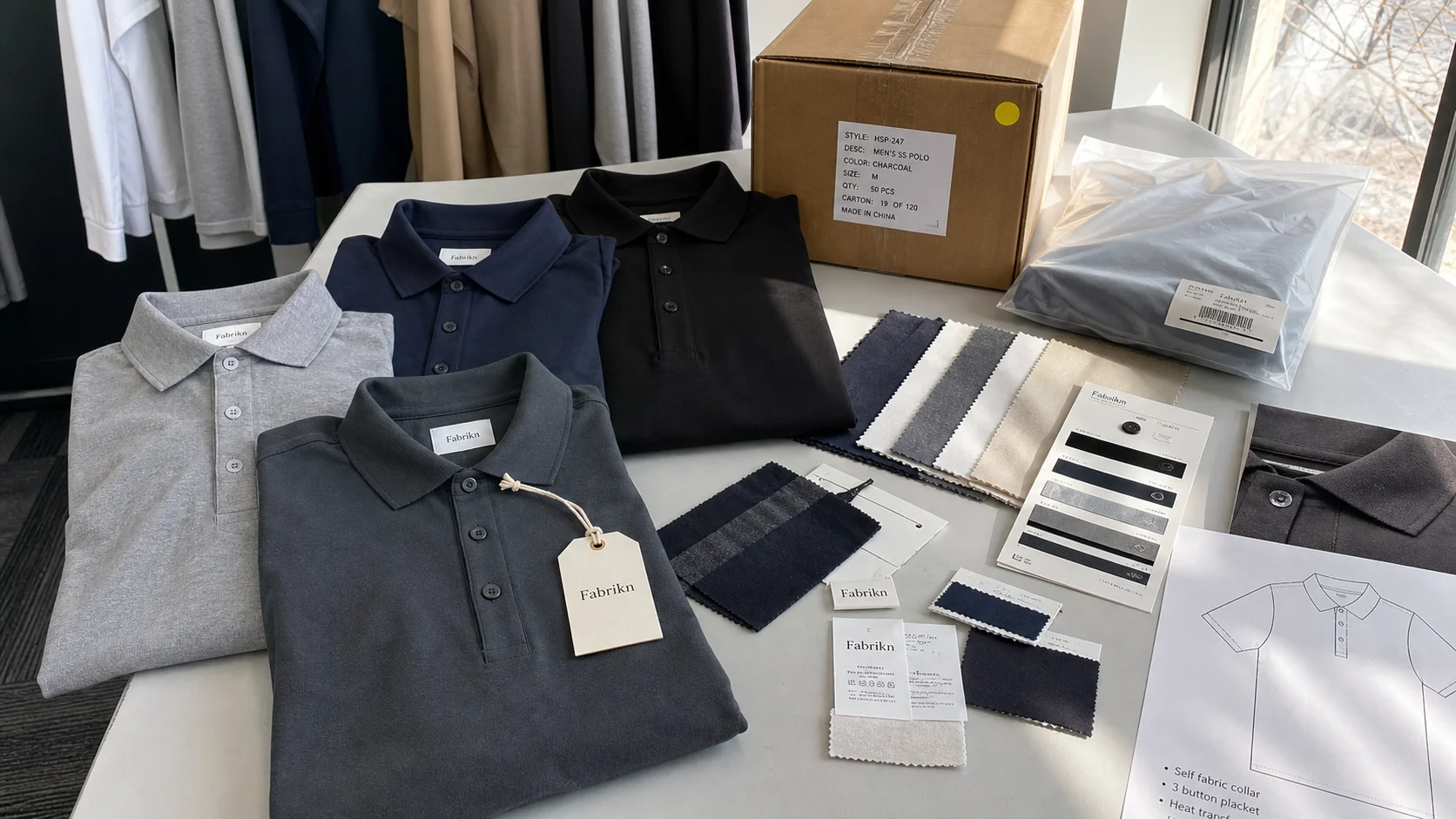
Luxury Clothing Unboxing Experience with checks for samples, fit, MOQ, QC evidence, pricing terms, and delivery risk.
Fast answer: Luxury Clothing Unboxing Experience: Box, Tissue, Insert, and Packing Flow should be judged by production evidence, not by a generic sourcing promise. The buyer needs sample proof, cost breakdowns, QC checkpoints, and delivery buffers in writing.
Ask for recent sample photos, measurement tolerances, fabric or print test assumptions, decoration test notes, packing examples, and a named inspection checkpoint. These details show whether the team can repeat an approved sample at bulk volume.
Separate garment cost, decoration, labels, packaging, sampling, testing, freight, and rush charges. When every cost line is visible, it becomes easier to reduce colorways, adjust size depth, or reserve more time for sampling.
The garment may be the star, but the opening scene gets the first review. Sixty-seven percent of premium shoppers say packaging changes how valuable a garment feels, and a 10% upgrade in packaging can lift repeat purchase intent by 6 to 8 points. Luxury clothing unboxing experience ideas matter because the customer judges quality before the fabric is even touched.
Across 8 countries and 200-plus factories, I’ve watched luxury clothing unboxing experience ideas do something fabric alone cannot: deliver the first physical proof of quality before a sleeve, seam, or stitch is touched.
Seven seconds. That’s the window. A rigid lid that closes cleanly, tissue that opens without tearing, and a box that lands squarely on a table all send one message: this brand controls details. Online shoppers feel that immediately because they can’t touch the cloth until after payment clears. Gifting benefits too, along with the kind of social sharing that quietly moves premium apparel without discounts.
Factory-floor reality is messier than brand decks suggest. I’ve watched brands spend $12.40 on a box set and still look cheaper than competitors spending $4.80, because the high-cost version had crooked foil, loose inserts, and wrinkled tissue. The expensive-looking packs were not always the highest-cost. Discipline beat volume. In Vietnam, a well-run pack line with 2 tolerances and 1 clear print standard often outperformed a more elaborate setup that needed 5 components and constant hand correction.
Regional taste shifts the brief. European buyers often prefer restrained minimalism, black text on white board, 1 belly band, no excess ribbon. In parts of the Middle East and across several Asian markets, tactile finish and presentation layers matter more: heavier board, soft-touch coating, drawer reveals, and gift-ready structure. Those preferences are not abstract. They influence return rates, gifting conversion, and even how often the package is kept for storage.
For brands working on private label clothing services, packaging is often the most visible brand cue on day one. White T-shirt at $48? Wool coat at $980? Same pressure. The box has to carry trust before the fit is tested.
Luxury feels expensive when every touchpoint is controlled, not overloaded. That is the lens I use when I walk a factory floor. Not how many layers exist. How exact they are.
Magnetic rigid boxes, drawer-style cartons, belly bands, dust bags, branded seals, acid-free tissue — all of them can signal value if the spec is tight. A rigid set-up box can cost 3 to 5 times more than a premium folding carton, yet it often supports a higher average order value because it reads as a keeper, not a disposable mailer.
Texture carries half the message. Soft-touch lamination feels quiet in hand. Debossing on a logo panel creates a shadow, not a shout. Foil works best in restrained areas, usually under 8% of the visible surface, because over-foiling starts to look promotional rather than luxurious. Low-noise closures matter too. A strong magnetic snap or a clean drawer pull gives the opening sequence a rhythm the camera can catch.
Garment protection has to look elegant while doing hard work. Acid-free tissue prevents discoloration on silk, cupro, and pale wool. Corrugated inserts can hide inside paper wraps, especially for knitwear and tailored shirts, so the shape holds during 3 to 5 weeks of transit. Fold engineering matters more than most founders expect. A French terry 320 GSM hoodie packed with a poor shoulder fold will arrive tired, no matter how beautiful the box is.
When I visited factories in Portugal and Sri Lanka, I kept seeing the same pattern. The best luxury packs used fewer components, but each piece had tighter tolerances. A 1.5 mm misalignment on a logo panel reads as cheap. So does tissue that is cut 4 mm off-center. The customer may not measure it, but the eye does.
Here’s what most people miss: in some of the strongest packs, luxury came from subtraction. One box, one insert, one card, one dust bag. The discipline was the selling point. For brands built on cut and sew manufacturing, this restraint often aligns better with production reality than a complicated multi-part reveal that slows packing lines and increases damage.
Too many layers create friction. They also raise waste, invite transit scuffing, and frustrate shoppers who want a camera-ready reveal in 20 to 30 seconds, not a puzzle.
Luxury clothing unboxing experience ideas should scale with the garment, not with ego. Under $250, the brief is control and cleanliness: premium folding carton, quality tissue, and one branded insert can be enough. Between $250 and $800, the customer expects more ceremony. Above $800, the packaging has to feel giftable and archival, because the buyer is paying for the story as much as the cloth.
I usually map spend as a share of product value. Entry luxury: 1% to 2%. Mid-luxury: 2% to 4%. High luxury: 4% to 7% if gifting is central and the box is expected to stay in the home. A $1,200 coat with a $42 packaging set sits at 3.5%, which is reasonable if it cuts returns by even 1 to 2 points and improves gifting conversion.
Channel matters. DTC luxury brands can justify more elaborate packs because the unboxing is part of the media plan. Wholesale is different. Retail partners want easy handling, efficient cube size, and low breakage. A wholesale order moving through 2 or 3 intermediaries does not need the same theatrical build as a direct shipment to a customer’s apartment.
Regional cues shift again. North American buyers tend to favor a clean, camera-friendly reveal with quick access to the garment. Japanese luxury often rewards precision and restraint, sometimes down to 0.5 mm print accuracy and exact fold symmetry. GCC markets often respond to gift readiness and a sense of abundance, which can mean a more layered presentation without crossing into wasteful excess.
I’ve seen brands chase the highest tier and fail because the construction never matched the ambition. The cheapest-looking packs were often the ones trying to mimic the most expensive segment without the board weight, the corner integrity, or the print discipline to support it. That mismatch is brutal. Customers feel it instantly.
For brands using custom baby clothing manufacturing, the same logic applies at smaller scale. A $28 romper does not need a luxury box, but it does need a clean reveal if it is sold as a premium gift set.
Sustainability earns trust when it looks disciplined. FSC board, recycled paper, mono-material builds, water-based inks, and reusable dust bags can all read as premium if the finish is precise and the color density holds. The mistake is to make sustainability look like compromise. Thin board, washed-out print, and flimsy closures say budget, not responsibility.
There is a tradeoff. Removing plastic windows and high-gloss laminates can improve recyclability, but only if the design team protects surface quality elsewhere. I’ve seen brands lose perceived value because they cut a laminate and never replaced the visual depth. A matte board with rich ink coverage, crisp typography, and tight folds often performs better than a shiny pack with awkward green messaging stamped across it.
Factory data backs this up. Brands that reduced component count by 20% to 30% often improved waste metrics and line efficiency at the same time, because there were fewer hand steps and fewer opportunities for damage. In one supplier review, a foldable mailer plus dust bag replaced a 5-piece set and cut packing time by 18 seconds per unit. Small on paper. Real money across 10,000 units.
Buyers will pay more for packaging that is reusable or recyclable, but they still reject anything that feels flimsy. That is the tension. Premium shoppers are not asking for sermons. They want proof. Recycled content percentages. Component counts. Estimated CO2 savings. Certification references. According to Textile Exchange, material choices and traceability have become central purchase signals for sustainability-minded consumers, and packaging follows the same logic.
For textile safety and chemical compliance, OEKO-TEX provides widely recognized standards that many premium suppliers use when specifying materials and trims. That matters if your manufacturer or supplier sources inserts, tissue, or dust bags across multiple production runs in China or elsewhere.
My view is blunt. Sustainability in luxury packaging should feel expensive, calm, and measured. Never preachy. Never apologetic. If the pack looks like it was designed by a compliance team alone, it will fail on the shelf and in the postroom.
Last year I worked with a brand that moved from a 6-component set to 4 components, used 82% recycled board, and published the pack breakdown on the insert. The result was better than expected. Returns stayed flat, and repeat purchase intent moved up 4 points.
The sequence should answer 3 questions in order: protection, identity, delight. Simple on paper. Messy in practice. The outer mailer protects. The first interior layer identifies the brand. The final reveal delivers the emotional lift. If any one of those jobs is done twice, the whole experience starts to feel cluttered.
For shirts and knitwear, I prefer a compact reveal. Outer carton, tissue, product card, garment. For tailoring and gowns, staging helps. A drawer pull, then tissue, then a ribbon lift, then the garment laid flat. The opening pace should match the price. A $160 shirt does not need a 4-step ceremony. A $2,400 dress usually does.
Hierarchy rules matter. Logo placement should stay consistent across SKUs. Insert order should never change without a reason. Tissue fold direction should be standardized so the customer always opens from the same corner. Thank-you cards belong on top of the final fold or inside the dust bag, not floating loose. Those small decisions create a visual grammar shoppers learn quickly.
Short copy works best. One line about craft. One line about care. Maybe 12 to 18 words. Not a manifesto. The sensory details do the heavy lifting: controlled friction, crisp fold lines, and the faint sound of a well-cut closure. Brands that manufacture through get a free quote requests often ask for more inserts than they need. I usually push them to reduce, test, and simplify first.
My workflow checklist is unforgiving because production is unforgiving:
The common mistake I see in factory audits is painfully predictable. Brands perfect the outer box and neglect the inner presentation, which is what the customer films. Consistency is the real luxury, not excess decoration. This is where cut and sew manufacturing teams that understand fold logic often outperform packaging-only vendors.
Packaging cost is built from 5 variables: board grade, finishing, insert complexity, minimum order quantity, and assembly labor. I’ve seen the same design quote at $0.95 in one region and $3.80 in another, purely because hand assembly added 22 seconds per unit and a magnetic closure required more calibration. A 15% to 30% cost swing between pilot runs and larger runs is normal.
Lead times are equally varied. Standard printed cartons usually take 3 to 5 weeks. Rigid boxes often take 6 to 10 weeks. Fully customized multi-component sets can run 8 to 14 weeks, especially if tooling needs a second round. Seasonal congestion pushes all of that wider. Wait until 2 weeks before launch to approve art, and you are already late.
Local vendors have one major advantage: speed of revision. When a dieline needs changing by 2 mm or a logo needs re-centering, local teams can often turn that around in 24 to 72 hours. Overseas factories may win on unit cost at scale, especially above MOQ 5,000, but they require better forecasting and more patience on samples. Cash flow also matters. Storage on 20,000 boxed units can erase part of the unit savings if sell-through slows.
For startup luxury brands, I recommend a lean modular setup: premium folding carton, 1 insert, 1 dust bag, 1 card. For established seasonal collections, a rigid box may justify itself because repeat buying is already proven. For gifting-heavy capsules, invest in a better opening sequence and stronger exterior finishes, because presentation becomes the product. According to Trade.gov, cross-border trade conditions can affect sourcing lead times, customs timing, and packaging replenishment, which is another reason to keep supplier plans flexible.
Manufacturer selection also matters. Ask each factory, supplier, or production partner for board specs, finishing samples, quality checks, and a clear MOQ before you compare quotes. If you are buying wholesale or bulk from China, make sure the packaging line can hold tolerances at scale, not just on the sample table.
My factory lesson is blunt. Rushing print approval costs more than the upgrade itself. Rework, air freight, and delayed launch can wipe out the savings from a cheaper carton. If a packaging quote looks too good, check the tolerance sheet before you check the price.
Start with 1 hero SKU. Build 3 packaging options. Test them with 10 to 15 target customers before you scale. Not friends, founders, or family. Real buyers who know the category, can compare prices, and will tell you if the pack feels like $80 or $800. That test is cheaper than one bad production run.
Film each unboxing in natural light. Measure watchability, share rate, damage rate, and return reasons. If the customer pauses at the same spot in the sequence, that is useful. If the tissue tears 3 times in 10 opens, that is a design flaw. If the box travels 1,500 miles and arrives with a crushed corner, the structure is wrong.
The KPIs are straightforward. Packaging cost as a share of AOV. Transit damage below 1% to 2%. Repeat purchase lift after launch. Social share rate by order size. You can also track gift order share during peak periods, because premium packs often outperform normal packs by 8 to 12 points around holiday windows. If a collection drop includes a collaboration, the box should be ready to film by day 1.
I recommend a 30-day rollout. Week 1: sample from 2 suppliers and verify board weight, finish, and print. Week 2: lock artwork and test transit. Week 3: pack 50 units and review returns plus customer comments. Week 4: refine the insert, confirm storage, and launch a controlled batch. Brands that use private label clothing services can fold this into a broader brand system without rebuilding every season.
My editorial view is simple. The best unboxing experience does not shout luxury. It earns it, one controlled detail at a time. If you want proof that the brief is working, ask whether the package would still feel expensive with the logo removed. If the answer is yes, you have a system. If the answer is no, keep refining. These luxury clothing unboxing experience ideas work best when the manufacturer, factory, and supplier all follow the same quality standard.
The best performers combine structure, texture, and timing. A rigid box, acid-free tissue, and a clean reveal sequence can lift repeat purchase intent by 6 to 8 points, while also improving gifting appeal and shareability. The pack should feel intentional in 7 seconds or less.
A common benchmark is 1% to 2% of retail for entry luxury, 2% to 4% for mid-luxury, and 4% to 7% for higher-end gifting-focused ranges. A $1,200 coat with a $42 pack lands at 3.5%, which is often defensible if it reduces returns and supports presentation.
Standard printed cartons usually take 3 to 5 weeks, rigid boxes 6 to 10 weeks, and customized multi-component sets 8 to 14 weeks. Add time for sampling, transit testing, and artwork revisions. If approval slips by 1 week, launch dates can move by 2 or 3 weeks.
Yes. FSC board, recycled paper, water-based inks, and mono-material builds can look premium if the print is sharp and the structure is precise. The key is to keep the pack disciplined. Buyers reject flimsy packaging, even when they like the sustainability message.
Start with 1 hero SKU and 3 prototype pack options. Test them with 10 to 15 target customers, then review damage, share rate, and repeat intent. If the garment sells under $250, a premium carton and strong tissue system is usually enough to begin.