
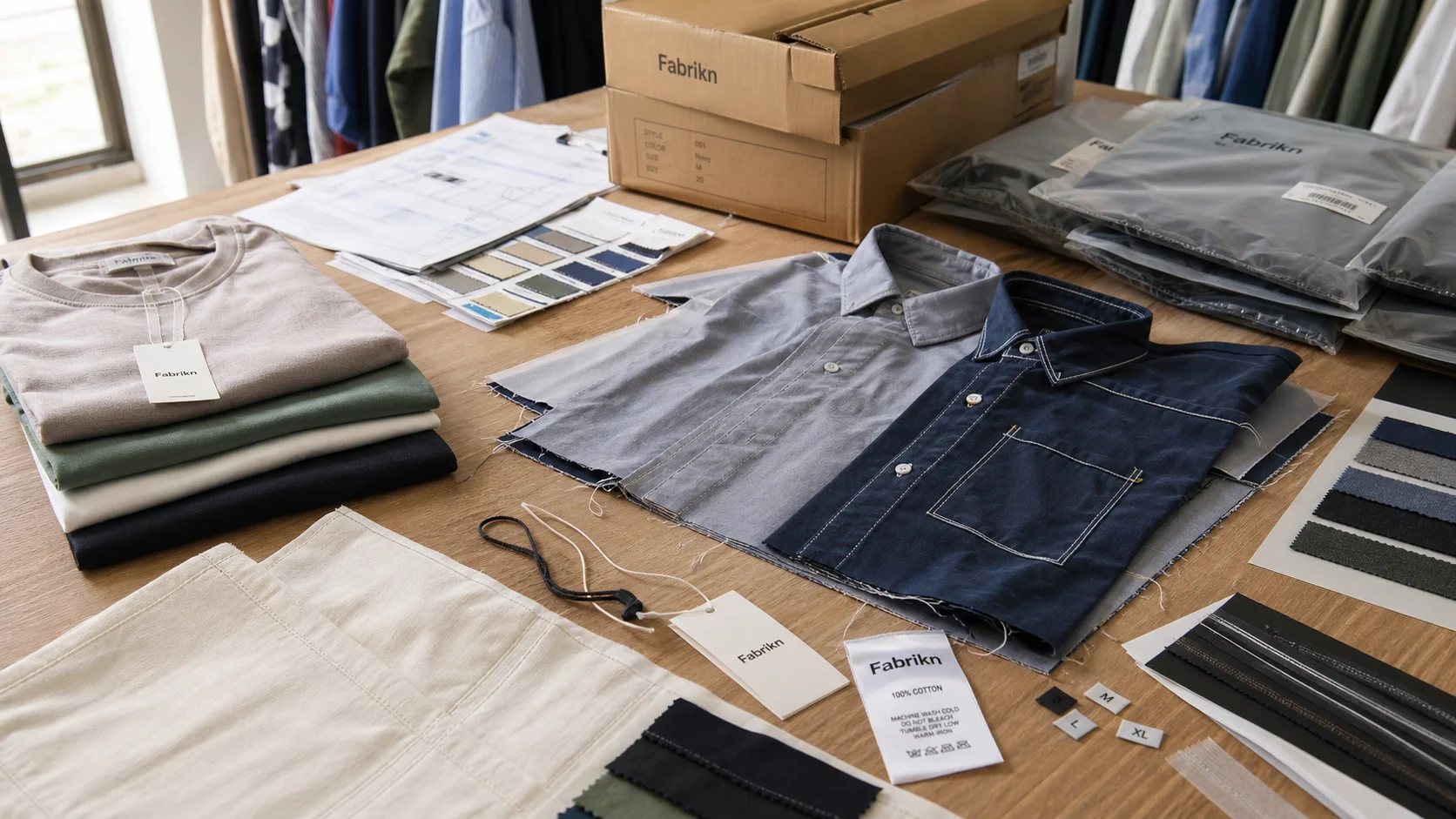
Small-batch Hoodie Supplier MOQ for Emerging Brand Launches compared by sample evidence, fabric or trim specs, MOQ, AQL terms, cost lines, delivery timing,...
Fast answer: Small-batch Hoodie Supplier MOQ for Emerging Brand Launches: Sample Fit, Trim, AQL, and Delivery Risk should be judged by production evidence, not by a generic sourcing promise. The buyer needs sample proof, cost breakdowns, QC checkpoints, and delivery buffers in writing.
Ask for recent sample photos, measurement tolerances, fabric or print test assumptions, decoration test notes, packing examples, and a named inspection checkpoint. These details show whether the team can repeat an approved sample at bulk volume.
Separate garment cost, decoration, labels, packaging, sampling, testing, freight, and rush charges. Clear cost lines make it easier to reduce colorways, adjust size depth, or reserve more time for sampling.
How Emerging Brands Choose a MOQ Clothing Supplier - Clothing Manufacturer manufacturing guide
Use this page when a new brand is sourcing hoodies in small batches and needs MOQ, sampling, and decoration decisions before launch.
Decision pointWhat to confirm before productionProduct specFabric weight, fit block, size range, trims, and decoration method.Order economicsMOQ, sample cost, unit tiers, packaging, freight, and repeat-order terms.Quality controlPre-production sample, color approval, measurements, labeling, AQL, and carton marks.Emerging brands usually do not win by ordering the biggest volume. They win by choosing a MOQ clothing supplier that can support small launches, reduce inventory risk, and still deliver the construction quality needed to earn repeat customers. In apparel sourcing, MOQ, or minimum order quantity, is not just a pricing number. It affects cash flow, color options, fabric selection, size curves, packaging, and how quickly a brand can validate demand with a first drop.
For a new label, the right supplier is rarely the one quoting the lowest unit price on paper. The better choice is the factory or production partner that offers a workable minimum, clear sampling discipline, realistic lead times, and consistent communication when approvals need to move quickly. A common small-run benchmark for basic cut-and-sew styles is about $2.50-4.00 per unit at 500 MOQ for a simple tee in 180-220 gsm combed cotton jersey, while hoodies in 320-350 gsm brushed fleece often land closer to $7.00-14.00 per unit depending on print, trim, and finishing. A supplier that understands low-volume production can be the difference between a controlled first run and a warehouse full of unsold stock.
For brands comparing a MOQ clothing supplier for emerging brand orders, the sourcing question is practical: can this partner help you launch with controlled risk, while still meeting the standards buyers expect from a credible apparel line? Common proof points include recent bulk orders at 100-300 pcs per style, sample turnaround in 5-10 business days, and compliance documents such as GOTS, OEKO-TEX Standard 100, WRAP, or BSCI where relevant to the product category.
MOQ stands for minimum order quantity. In apparel, it is the smallest order a supplier will accept for a style, color, fabric, or size run. The figure can apply to one design or to each component in that design. A supplier may quote 100 units per style, 200 units per color, or 300 units per fabric type. In practice, the real MOQ is often the sum of several separate rules, such as 300 meters per custom-dyed fabric, 500 pieces per printed colorway, or 1,000 woven neck labels per artwork file.
That distinction matters. A brand might hear “low MOQ” and assume the order is flexible, only to discover the supplier still requires specific fabric yardage, color minimums, and trim purchase commitments. A proper sourcing conversation should clarify every layer of the order before anyone confirms a PO. Typical questions include whether the minimum is per fabric lot, whether one color can be split across sizes, and whether custom trims such as embossed PU patches or metal snap buttons have separate vendor minimums.
MOQs exist because factories need to cover setup time, cutting waste, pattern development, machine changeovers, fabric procurement, and labor planning. On a cut-and-sew line, that setup can include CAD pattern grading, automatic fabric spreading, marker making, laser or manual cutting, overlock stitching, single-needle topstitching, coverstitch hemming, and final pressing. For emerging brands, the goal is not to eliminate MOQ. The goal is to find a supplier whose MOQ is aligned with the brand’s stage, margin structure, and sales forecast.
New brands usually operate with limited cash and limited market proof. A large production commitment can lock up working capital long before customer response is known. MOQ affects more than unit cost. It influences how much size depth can be carried, whether multiple colorways are possible, and how much risk sits in the first launch. For example, a 300-piece run split into 5 sizes at 12/24/30/24/12 may create very different sell-through risk than a 100-piece capsule with only two colors and fewer size breaks.
Small brands also need flexibility. One fit may work better than expected, one color may underperform, and one style may need a quick reorder. High MOQs can prevent that kind of learning. A supplier with a reasonable minimum creates room for iteration, especially when the factory can hold approved patterns and graded specs for repeat orders without redoing development from scratch.
There is a tradeoff. Lower MOQ often means higher unit cost, less room for aggressive customization, and tighter control over material options. A common sourcing reality is that stock fabric programs and standard trims can support 50-200 piece runs, while custom-dyed knits, special washes, or custom jacquard labels often push the effective minimum higher. Some brands accept that premium in exchange for reduced inventory exposure. Others scale MOQs strategically by starting with fewer styles, then increasing volume once the best sellers are clear.
A lower MOQ can protect a launch. A realistic MOQ can protect the margin. The best supplier helps a brand balance both, using actual fabric yield, labor minutes, and trim costs instead of guesswork.
MOQs vary widely depending on garment type, construction complexity, fabric sourcing, and factory specialization. Still, emerging brands can use the following as a practical starting point when speaking with suppliers. These ranges are common rather than fixed, and they usually assume standard construction, stock trims, and no unusually heavy embellishment.
Product Type Common MOQ Range Why MOQ Tends to Land There T-shirts 100 to 300 pcs per style/color Simple construction, 180-220 gsm combed cotton jersey, standard neck rib, single-needle and overlock operations Hoodies and sweatshirts 100 to 250 pcs per style/color Heavier 320-350 gsm brushed fleece, rib cuffs and hem, kangaroo pocket attachment, more sewing operations Leggings and activewear 150 to 500 pcs per style/color Technical polyester-spandex or nylon-spandex knits, 4-way stretch testing, coverstitch and flatlock seams, fit sensitivity Woven shirts 100 to 300 pcs per style/color Pattern precision, placket construction, collar stand accuracy, and size grading increase setup effort Jackets and outerwear 200 to 500 pcs per style/color Shell, lining, interlining, zipper, snap, and binding components add sourcing complexity and assembly stages Private label basics 50 to 200 pcs per style Pre-developed blanks, stock colors, and limited decoration can reduce minimums and shorten development timeThese ranges are only reference points. A supplier may quote lower minimums for stock fabrics and standard trims, then require more quantity for custom dyeing, special washes, embroidery, puff print, discharge print, or proprietary hardware. When a brand requests multiple colors and full size runs, the effective MOQ often rises quickly. A common example is a 150-piece style becoming a 450-piece fabric commitment if each colorway requires its own dye lot.
The best supplier for an emerging brand is not simply the one with the smallest number on the quote. A useful MOQ clothing supplier should combine flexibility with manufacturing discipline. Four qualities matter most.
Some suppliers quote only garment quantity. Others count fabric, trims, labels, or packaging separately. A dependable partner explains whether MOQ is per style, per color, per fabric, per size set, or per print placement. That clarity prevents expensive surprises. Typical sourcing detail: ask for a written breakdown showing fabric consumption per unit, trim minimums, and any one-time charges for pattern development, sampling, or screen setup.
Emerging brands need a supplier who can make prototype samples, fit samples, salesman samples, and pre-production samples without forcing the full order too early. The more structured the sampling process, the lower the risk of a bad first run. In common production setups, sample approval may move through 2-4 rounds, with a first prototype in 5-7 business days for simple cut-and-sew items and 10-15 business days for more technical garments.
Low MOQ only helps if the supplier can actually source the right materials. If fabric availability is inconsistent, a small launch can still be delayed by dye lot issues, trim shortages, or mill minimums. Good suppliers know which materials suit lower-volume runs and which ones do not. Common examples include stock 1x1 rib for collars and cuffs, ready-made woven labels, YKK zippers, nickel-free snaps, and OEKO-TEX Standard 100 certified jersey when chemical compliance is important.
Not every detail is worth custom development at launch. A practical supplier will guide brands toward the changes that matter most, such as fit, fabric handfeel, and core branding, while cautioning against expensive low-volume customizations that damage margin without improving sell-through. For example, a custom jacquard waistband or all-over sublimation print can raise the minimum well above a basic solid-color style, while embroidery on a left chest can often stay manageable if stitch count and thread colors are kept simple.
If you are evaluating production support, the pages at Fabrikn services, about us, and contact us can be useful starting points for understanding how a manufacturing partner presents capability, process, and inquiry flow. A useful sourcing signal is whether the supplier publishes a spec sheet template, sample request form, and file requirements for artwork, grading, and labeling.
Sampling is where many emerging brands either gain control or lose it. A clear approval sequence reduces mistakes before bulk production begins. In a typical apparel workflow, the factory may use CAD pattern software, a sample cutting table, and single-needle or overlock machines for the first build, then confirm finish details on a pre-production sample before the bulk line starts.
A practical sample path usually includes the following steps:
Skipping steps may save time in theory, but it often increases rejection risk later. A brand that wants to work with a true low-MOQ supplier should still expect discipline in sampling. Fast sampling is useful only when it is also controlled. A common best practice is to require a signed approval sheet for fit, color, trim, and packaging before bulk cutting starts.
One common mistake is approving a sample based only on appearance. Fit, seam strength, stitch density, shrinkage, and color consistency deserve equal attention. Small brands often feel pressure to move quickly, but production errors at bulk scale are usually more expensive than a careful sample round. For woven and knit garments alike, inspection should include needle damage, skipped stitches, seam slippage, and whether the fabric reacts properly after steam pressing or wash testing.
Lead time is the total time from approval to shipment, and for small brands it is one of the most important sourcing variables. A common end-to-end timeline for a simple tee or hoodie is 18-22 business days after all materials are on hand and the pre-production sample is approved. More technical styles, custom-dyed fabrics, or embellished garments often need 30-45 business days, especially when fabric must be milled or dyed to order.
Lead times usually depend on four things: fabric availability, trim availability, sample approvals, and factory capacity. If a garment uses stock jersey, standard rib, and ready-made labels, production can move faster. If it depends on custom knit development, special wash effects, or imported components like zippers and heat-transfer films, the schedule expands. A common delay point is lab-dip or strike-off approval, which can add 5-10 business days if the color is not accepted on the first pass.
Other common delay drivers include late size chart revisions, missing artwork files, re-grading after fit changes, or an unexpected change in carton specifications. For brands sourcing on a tight launch calendar, the safest approach is to lock the tech pack, approve the reference sample, and confirm all trims before bulk cutting starts. Sourcing detail to request: ask the supplier to state whether lead time starts from deposit receipt, approved sample sign-off, or confirmed material arrival, because those start points vary widely.
Useful sourcing conversations also cover whether the factory keeps stock blanks, whether it cuts in-house or outsources cutting, and whether it uses in-line inspection during sewing or only final inspection. In-line checks with a 4-point fabric review, bundle ticket tracking, and hourly line audits usually reduce rework compared with end-of-line-only QC.
Fabric and trim decisions have a direct effect on MOQ, lead time, and consistency. If the brand wants lower risk, the safest route is usually stock-supported materials and proven trims. For T-shirts, common choices include 100 percent combed cotton jersey, 100 percent organic cotton jersey, or cotton-spandex jersey for a little stretch. For fleece items, 320-350 gsm brushed fleece or French terry is common. For activewear, polyester-spandex or nylon-spandex blends with moisture management finish are typical.
Material testing should not be vague. A useful supplier will confirm GSM, knit structure, shrinkage range, colorfastness, pilling resistance, and recovery where relevant. For example, a good low-MOQ spec sheet might call for 180-200 gsm jersey with less than 5 percent shrinkage after wash, 95/5 cotton-spandex rib at 2x2 knit for cuffs, and a two-needle coverstitch hem on body and sleeve openings. If the brand needs a more premium handfeel, compact yarn, enzyme wash, silicone softener, or peached finish can be discussed early instead of after sample approval.
Trims matter just as much. Neck labels may be woven or heat-transfer. Hangtags may use coated paper or recycled stock. Hardware may be YKK coil zippers, metal zipper pulls, or snap fasteners that need corrosion resistance testing. For low-MOQ work, the factory often prefers stock trims because custom dies, custom molds, and custom print plates increase cost and minimum order commitments. Certifications can also matter at this stage: GOTS is relevant for organic fiber chain-of-custody, OEKO-TEX Standard 100 is commonly requested for chemical safety, and WRAP or BSCI are often used as social compliance indicators.
Ask the supplier to confirm which trims are already in-house, which are sourced from regular vendors, and which require new tooling. That distinction helps the brand understand whether a quote is based on real production readiness or just a preliminary estimate. Common sourcing detail: request fabric swatches, trim cards, and a BOM with supplier part numbers before approval.
Small brands can be hurt by quality issues that are easy to miss in a sample but obvious in bulk. The biggest risks are inconsistent stitching, poor grading, fabric shade variation, and trim failure. On a tee, that may show up as twisted side seams, neck rib distortion, or neckline puckering after wash. On a hoodie, it can be uneven pocket placement, zipper ripple, or mismatched rib recovery.
Good factories use concrete inspection checkpoints. Typical bulk QC includes incoming fabric inspection, in-line sewing checks, pre-final measurement audit, final AQL inspection, and carton count verification. Many sourcing teams work to AQL 2.5 for major defects and 4.0 for minor defects, though the exact standard should be stated in the purchase agreement. If the garment includes print or embroidery, the inspection should also cover placement tolerance, ink coverage, stitch density, thread breakage, and whether the decoration survives washing.
Brands should also pay attention to construction details that are hard to correct later. These include seam allowance consistency, bartack reinforcement at stress points, overlock thread tension, coverstitch width, and whether the pattern was adjusted for fabric stretch or shrinkage. A supplier that can explain how it checks these details is usually more reliable than one that only talks about unit price.
Another sourcing detail worth asking for is whether the factory performs needle detection, metal detection, or carton moisture checks where applicable. For certain categories, especially children's wear and outerwear with metal hardware, those controls can reduce defect and compliance risk. If the supplier claims certification, ask for the current scope certificate rather than a generic logo; for example, GOTS and OEKO-TEX claims should match the actual fabric program being used.
Negotiating MOQ is not about pushing the factory to accept unrealistic terms. It is about shaping the order so the economics still make sense for both sides. The most effective strategy is to simplify the first run. Fewer colorways, fewer trims, fewer embellishments, and a tighter size curve often reduce the effective minimum more successfully than arguing over the base unit number.
A brand may also ask for a trial approach: 100-150 pcs on the first style, then a reorder clause at the same pattern and fabric spec if sell-through hits a target. This works best when the supplier knows it may receive repeat business. Another common tactic is to use stock fabrics for launch and reserve custom fabric development for the second order, which can reduce the first commitment by several hundred units.
It is also reasonable to ask whether one MOQ can be spread across multiple colors or size runs. Some suppliers allow total style MOQ of 300 pieces split into three colors at 100 each, while others require 300 per color. That difference can dramatically affect cash flow. To keep the order healthy, brands should also understand the tradeoffs: lower MOQ may mean a slightly higher landed cost, fewer customization options, or a longer wait for the best price break.
Useful sourcing detail: when negotiating, request a price ladder at 100, 300, and 500 units, plus separate pricing for sample, development, and bulk. That gives the brand a realistic view of how much the unit cost changes when volume increases.
A fair comparison between suppliers should focus on more than quote price. Emerging brands need to evaluate fit, communication, compliance, and production readiness together. The best comparison is usually a side-by-side scorecard built from actual documents, not verbal promises.
Checkpoint What Good Looks Like Useful Sourcing Detail MOQ clarity Style, color, fabric, and trim minimums are all stated clearly Ask for MOQ in writing with a note on whether it applies per color or per size set Sampling process Prototype, fit, pre-production, and gold sample steps are defined Request estimated sample lead time in business days for each round Material sourcing Supplier can source stock and custom materials without major delays Confirm whether fabrics are stock-supported or mill-developed Quality control Incoming, in-line, and final inspection are documented Ask what AQL standard, measurement tolerances, and test methods are used Compliance Relevant certifications are current and match the program Check for GOTS, OEKO-TEX Standard 100, WRAP, or BSCI where applicable Communication Response times are fast and questions are specific Track how quickly the supplier answers BOM, fit, and lead-time questionsFor emerging brands, the strongest supplier is often the one that can show process discipline in documents and samples. If the supplier provides a spec sheet, a pre-production checklist, and a packing standard, that is usually more valuable than a low quote without context. Common sourcing detail: ask for references from brands at a similar order volume, such as 100-500 pcs per style rather than only large enterprise programs.
Once a brand has narrowed the supplier list, the next step is to send a complete tech pack and ask for a first-round estimate that includes unit cost, sampling cost, MOQ by component, lead time, and any known dependencies. A solid first inquiry should include flat sketches, measurements, fabric composition, label artwork, print or embroidery placement, size range, target ship date, and preferred certifications such as GOTS or OEKO-TEX Standard 100 if the fabric program requires them.
Brands should also ask how the supplier handles approval delays. If material approvals slip by a week, does the production window shift by one week or two? If a color is rejected after lab dip, is there a standard turnaround for a new strike-off? These questions matter because small orders often rely on a tight launch calendar and one late approval can affect e-commerce photography, warehouse scheduling, and marketing spend.
The goal is to build a sourcing relationship that can scale. A good MOQ clothing supplier should be able to support a first 100-300 piece run, then repeat the same style with cleaner efficiency on the second order. That usually happens when the supplier keeps graded patterns, approved trims, and construction notes organized for repeat production.
If you are comparing partners, use a checklist that includes price at 100, 300, and 500 units; sample lead time; bulk lead time; fabric source type; QC method; and current compliance documents. That makes the decision easier than trying to compare quotes line by line without the same assumptions.
Get a free quote from Fabrikn — your trusted B2B clothing manufacturer with 10+ years of experience. MOQ as low as 200 pieces.
Get a Free Quote →What is a good MOQ for a first clothing launch? For many emerging brands, 100-300 pcs per style is a practical starting range, especially for T-shirts, fleece basics, and simple woven styles. Lower can work for blanks or stock-supported items, while technical garments often need higher commitments.
How long should small-batch production take? A common timeline is 18-22 business days after all materials are approved and on hand for simple garments, with 30-45 business days more typical for custom fabric, complex trims, or embellished styles.
Which certifications matter most? GOTS is commonly used for organic fiber programs, OEKO-TEX Standard 100 is often requested for chemical safety, and WRAP or BSCI are widely used for social compliance screening. The right certification depends on the fabric and the buyer’s sourcing requirements.
What should be checked before bulk starts? Confirm the pre-production sample, fabric GSM, shrinkage, trim quality, size chart, color approval, construction details, and final packing method. A typical approval pack also includes measurement tolerances and the final BOM.
Can a supplier lower MOQ without lowering quality? Yes, if the order is simplified with stock fabrics, standard trims, fewer colors, and a clean size curve. The tradeoff is usually a slightly higher per-unit cost or fewer customization options.