
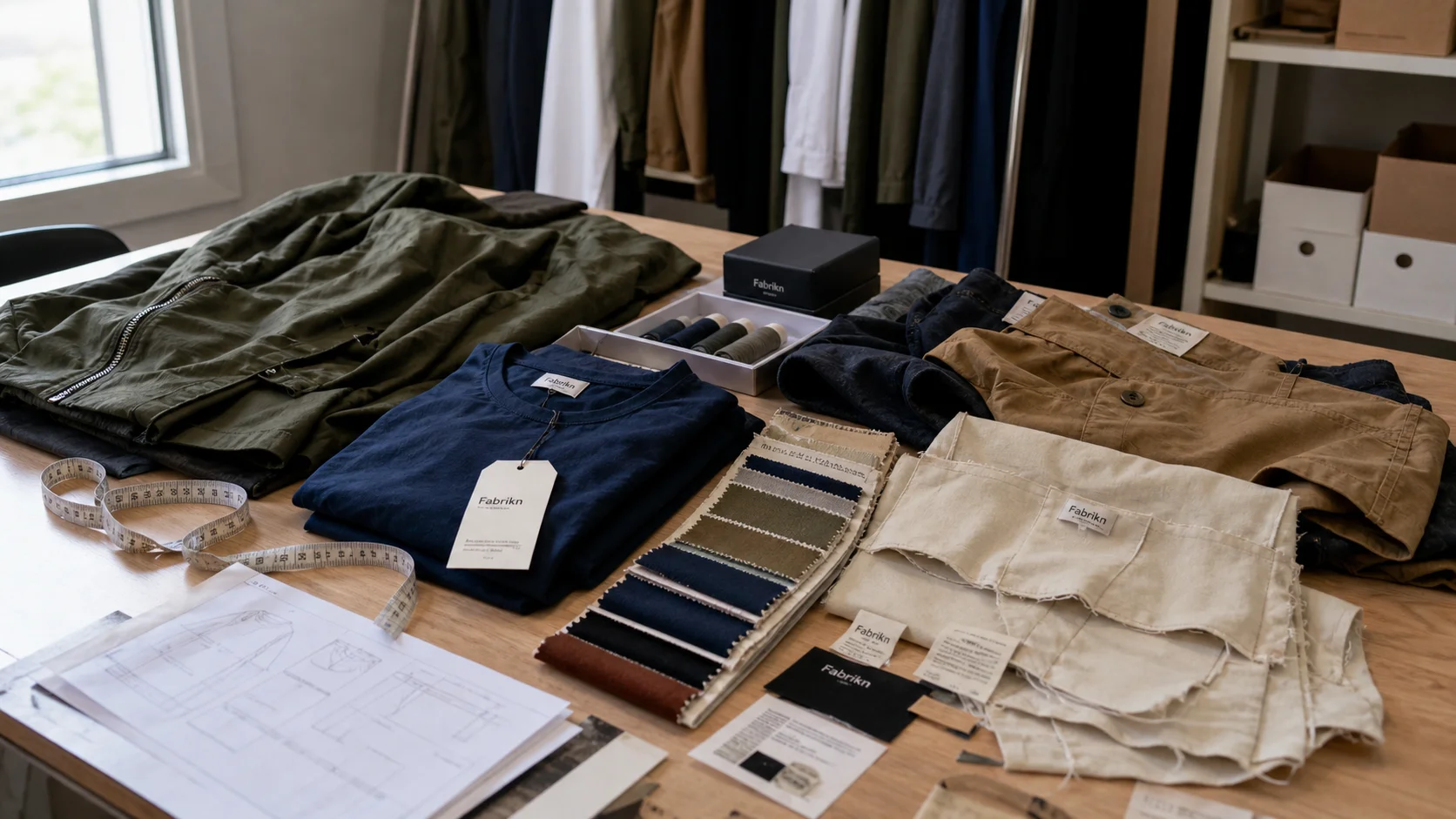
OEM Apparel Manufacturer for Private Label Brands compared by sample evidence, fabric or trim specs, MOQ, AQL terms, cost lines, delivery timing, and...
Fast answer: OEM Apparel Manufacturer for Private Label Brands: Material, Print, MOQ, and QC Terms should be judged by production evidence, not by a generic sourcing promise. The buyer needs sample proof, cost breakdowns, QC checkpoints, and delivery buffers in writing.
Ask for recent sample photos, measurement tolerances, fabric or print test assumptions, decoration test notes, packing examples, and a named inspection checkpoint. These details show whether the team can repeat an approved sample at bulk volume.
Separate garment cost, decoration, labels, packaging, sampling, testing, freight, and rush charges. Clear cost lines make it easier to reduce colorways, adjust size depth, or reserve more time for sampling.
Private label brands do not fail because of bad ideas; they fail because they mistake a sample for a system. After 200-plus factory visits across eight countries, I’ve seen the same costly error repeat: a brand falls in love with the prototype, then expects production to behave like the sample room. It won’t. An OEM apparel manufacturer for private label brands has to turn a sketch, a tech pack, and a target price into 500, 2,000, or 10,000 saleable units without drifting on fit, fabric, or finish.
OEM means original equipment manufacturing. Plainly: the manufacturer makes to your spec, and you own the label, the design direction, and the commercial strategy. That matters because private label brands are not just buying garments. They’re buying consistency, margin control, and a cleaner path to reorder. A strong OEM apparel manufacturer for private label brands can repeat a winner faster and with fewer surprises than a scattered supplier base ever will.
What buyers often miss is that a factory is not just labor with fluorescent lights. It sources fabric, advises on construction, cuts, stitches, washes, presses, packs, and, in better operations, spots problems before they turn into chargebacks. When I visited knitwear facilities in Bangladesh and outerwear plants in Turkey, the best teams weren’t the cheapest. They were the ones that forced fit standards and trim approvals before bulk.
Built around strengths, the advantage gets obvious fast. A plant that runs 30,000 T-shirts a month will usually price basics tighter than a boutique workshop in Portugal. A workshop in Portugal, though, may handle structured jackets, bonded seams, or 120-piece runs with far less chaos. The cheapest quote often becomes the most expensive once rejects, rework, air freight, and missed season windows are counted. I’ve watched a $2.70 unit price turn into $4.20 landed after 11 percent defects and a second freight move.
That is why the buyer’s lens has to stay sharp. I look at five things first: quality, compliance, cost, lead time, and communication. If one of those is weak, the rest usually follows. Brands that scale well treat their OEM apparel manufacturer for private label brands as a production system, not a vendor lottery. For private label clothing, that mindset is the difference between a clean launch and a warehouse full of awkward lessons.
OEM, ODM, and contract manufacturing sound interchangeable until a brand owns the wrong thing. OEM is custom production to your specifications. ODM means the factory already owns or controls the product concept, pattern, or base style, and you usually select from its existing range. Contract manufacturing is broader still: the factory makes what you specify, but ownership of development inputs can be shared or limited by the contract structure.
In OEM, you control the pattern, fabric, trims, branding, and product direction. In ODM, the factory often controls the base block, construction, and sometimes even the size spec. In contract manufacturing, the legal framework can be customized, but the operational reality often resembles one of the other two models. I’ve seen suppliers call themselves OEM while offering only near-stock customization: color changes, logo swaps, and a slightly different hem.
That distinction hits margin hard. A DTC brand that starts from a stock style may get a lower sample bill and a faster first order, sometimes 2 to 3 weeks faster, but it gives up differentiation and can get trapped in price competition. A founder with a design team usually does better in OEM because the brand can control fit, trims, and packaging, then use those assets across seasons. Retailers with house brands also prefer OEM when they need size consistency across 50 stores or more.
Last year I worked with a brand that moved from ODM hoodies to custom cut-and-sew fleece. The sticker price rose by 18 percent, but return rates dropped by 9 points because the shoulder slope and rib recovery were finally tuned to its customer. That’s a trade worth making. For more technical silhouettes, including support garments, an experienced custom bra manufacturing partner can make the difference between a product that fits and one that comes back.
An OEM apparel manufacturer for private label brands can cover far more than T-shirts, but specialization is everything. Basics such as jersey tees, hoodies, and leggings are usually the fastest to source because the patterns are standardized and the fabric markets are deep. Structured garments like blazers, denim, and tailored trousers take more engineering. Performance wear, outerwear, and intimate apparel demand tighter tolerances, more testing, and better material control.
Across the factories I’ve visited, scale and specialization cluster by region. China still offers unmatched breadth for mixed-category programs, especially when a brand needs 1,000 to 20,000 units across several SKUs. Bangladesh remains strong for knitwear and basics, where volumes of 3,000 to 50,000 pieces can bring real unit-cost advantage. Portugal and Turkey shine at premium small runs, often 100 to 800 units, with sharper quality control and faster reaction times. Nearshore hubs can cut transit by 10 to 25 days, which matters more than people admit.
Price point follows complexity, not just logo placement. A cotton tee in 180 GSM jersey might land at $2.20 to $4.50 FOB depending on volume, fabric origin, and print method. A French terry hoodie at 320 GSM can sit between $8 and $16. A tailored denim jacket with enzyme wash, metal trims, and branded jacron can climb to $14 to $28. Performance leggings with bonded seams and moisture-wicking fabric often sit in the $6 to $12 range, while premium wool outerwear can run far higher.
Here’s what most people miss: premium factories often reduce landed cost. They may quote $1.20 to $2.00 more per piece, but if they cut defect rates from 8 percent to 2 percent and reduce return rates by 3 to 5 points, the math improves. I saw that pattern repeatedly in Portugal and Turkey, where cleaner sewing and tighter measurement control offset higher labor rates. The right OEM apparel manufacturer for private label brands is the one whose strengths match your product, not the one with the lowest quote on paper.
Pricing starts long before bulk production. A proper quote should separate sampling, pattern making, grading, fabric, trims, labor, packaging, testing, freight, duties, and markup. Sample costs alone can range from $30 to $150 per style, and more if the factory must source a custom fabric or knit a lab dip first. Patterns and grading may add another $40 to $200 depending on complexity and size range. Some factories absorb part of this if you place a bulk order above 1,000 pieces; many do not.
Bulk price falls as MOQ rises. A 300-piece run of a basic jersey tee may price at $4.80 to $6.20 FOB, while a 3,000-piece order may drop to $2.20 to $3.10. The same logic applies to hoodies, woven shirts, and activewear, though fabric type changes the curve. Custom-dyed fabric, heavy washes, and specialty trims can keep unit cost high even when volume rises. A 500-piece order of a pigment-dyed sweatshirt is rarely priced like a 5,000-piece order of a stock-color tee.
The hidden costs are what ruin comparisons. Revision rounds can add $20 to $80 per sample. Third-party testing may cost $120 to $400 per style depending on the number of tests and the market you are selling into. Rush fees are common when a brand compresses a 6-week sample cycle into 2. Packaging changes, such as switching from polybags to recycled mailers or adding hangtags and size stickers, can add $0.10 to $0.60 per unit.
To compare factories properly, I ask each one the same questions: Is the quote FOB, EXW, or DDP? What is the exact fabric composition and GSM? Are labels, wash care tags, and cartons included? How many sample rounds are included? What is the MOQ per color and per size? What testing is already covered? If one factory quotes $3.60 and another quotes $4.10, I want to know whether the lower quote excludes shrinkage testing, carton labels, or a second sample fit pass.
That discipline protects margin. It also forces the factory to tell the truth about what the price includes, instead of hiding labor in vague packaging language. When a quote arrives with no line items, I treat it as a draft, not a deal.
Quality control should begin at the fabric stage, not after cartons are sealed. I expect inline inspection, midline checks, and a final inspection using AQL standards. For most apparel, the common checkpoints are colorfastness, shrinkage, seam strength, stitch density, measurement tolerance, labeling accuracy, and carton packing. If a tee shrinks 7 percent instead of the acceptable 3 percent to 5 percent, or if the neck rib twists after one wash, that is a production failure, not a styling detail.
Compliance matters because it affects returns, customs clearance, and whether a retailer will even accept your shipment. Data from Trade.gov and trade authorities shows how tightly apparel supply chains are tied to standards, tariffs, and shipment timing. In the EU and UK, fiber content and care labeling are not optional. In the US, flammability rules and country-of-origin marking can stop goods at the border. That’s before a retailer’s own vendor manual adds lab testing, packaging specs, and social audit requirements.
Audit priorities shift by region. In South Asia, I look hard at traceability, overtime records, and subcontracting control. In Turkey and Portugal, documentation and measurement discipline tend to be stronger, but buyers still need to verify chemical testing and fabric lot consistency. For sustainability claims, I want evidence. If a mill says recycled content, I ask for certification from recognized systems such as Textile Exchange or corresponding transaction documents. For OEKO-TEX certified materials, see OEKO-TEX. Green language is cheap; paperwork costs money.
Great samples do not guarantee production consistency. I’ve seen a sample room deliver a flawless sweatshirt while bulk production missed chest width by 1.5 cm on every size because the factory never locked the measurement sheet. That is why the pre-production sample, golden seal, and written tolerance sheet matter. Without those, the line will drift.
Lead time starts with the tech pack, not the first sample. For a basic knit tee, I usually see 10 to 14 days for sampling, 7 to 10 days for pre-production approvals, 3 to 5 weeks for bulk, and 1 to 4 weeks for shipping depending on the lane. A woven shirt can stretch to 6 to 8 weeks in bulk. Complex outerwear, especially with taped seams or custom hardware, often needs 8 to 12 weeks before it is ready to ship.
MOQ shifts with fabric choice, color matching, and trim sourcing. A stock cotton jersey in one color may support a 300-piece MOQ. A custom-dyed fabric can push MOQ to 1,000 meters or more, which changes the unit economics fast. Metal trims, custom zippers, and branded elastic often have their own minimums, sometimes 500 to 3,000 units per component. If you want four colors and six sizes, the ordering puzzle gets harder.
Holiday shutdowns create the biggest planning errors I see. Chinese New Year can add 2 to 4 weeks of slippage. Ramadan, Eid, and local festival periods affect output in Bangladesh, Pakistan, and Turkey. Fabric mills also create invisible delays, especially when lab dips or strike-offs are waiting for approval. The brands that win align inventory with launch calendars and reorder windows, not with hope.
If you are building your first range, plan around one initial pilot plus a reorder buffer of 20 to 30 percent. That gives you time to test sell-through before you commit to a larger run. It also reduces the risk of getting stuck with 900 units of a color that looked better on a screen than it did under store lighting.
My selection process is simple and hard to fake. Shortlist three to five factories. Send the same RFQ to each. Request samples. Audit the strongest two. Then place a pilot order, usually 300 to 1,000 units, before committing to scale. That sequence exposes who can actually produce and who only sells confidence.
The strongest signals are boring in the best way. Clear communication within 24 to 48 hours. Transparent capacity data, such as lines per day or monthly output. Documented QA procedures. Written tolerance sheets. A factory that can explain why a French terry 320 GSM hoodie costs $1.80 more than a lighter fleece version is usually safer than one that just says “quality is high.”
Red flags show up early. Vague lead times. No measurement sheet. Answers that change depending on who you ask. Quotes that are far below everyone else’s without a clear reason. Inconsistent statements about materials, especially when the factory cannot say whether it sources cotton yarn locally or imports it. I also watch for a supplier that refuses video calls to show the cutting room or sample floor.
Build a scorecard with five categories: specialization, MOQ flexibility, compliance, communication speed, and pricing clarity. Score each from 1 to 5. I give extra weight to specialization and compliance because those two areas usually determine whether a supplier can support private label growth. If two factories tie, I choose the one that sends fewer surprises, not the one that talks the most.
Before you contact factories, assemble a clean brief. You need a tech pack, target cost, size range, fabric references, compliance needs, order forecast, and packaging specs. If possible, include a benchmark garment with measurements and photos. A factory can quote a hoodie faster when it knows whether you want brushed fleece, French terry, or loopback, and whether the target is $7.00 FOB or $12.00 FOB.
Your first email or RFQ should be direct. State product type, quantity, target market, required certifications, preferred Incoterm, and launch date. Ask for sample cost, bulk MOQ, estimated lead time, and payment terms. If you want to speed the conversation, say whether you are seeking a cut-and-sew build, a near-stock modification, or a full custom development path.
Two revision rounds are realistic for most styles. One for silhouette, one for finishing. More than that usually means the brief was incomplete, not that the factory is difficult. After samples are approved, place a pilot order and inspect it like a retailer would: measurements, wash performance, labeling, packing, and carton marks. That is the cleanest way to test a new vendor before you scale.
The brands that win do not trust showroom promises. They use numbers, measurements, and sample evidence. When the OEM apparel manufacturer for private label brands is the right fit, margins improve and returns fall. If you want a sharper starting point, request a free quote for private label apparel manufacturing and compare the answer against your own cost model before you say yes.
An OEM partner produces garments to your specifications, usually from your tech pack and size chart. The factory handles sourcing, cutting, sewing, finishing, and packing, while you own the brand, label, and product direction. That setup is common for private label programs that need repeatable quality and controlled margins.
Costs vary by garment, fabric, and order size. A basic tee can fall around $2.20 to $6.20 FOB, while hoodies, denim, and outerwear are usually higher because of fabric weight, washes, trims, and labor. Sampling often adds $30 to $150 per style before bulk pricing begins.
For a basic knit style, expect roughly 4 to 8 weeks from approved sample to bulk completion, plus shipping time. Woven garments and outerwear often need 6 to 12 weeks. Fabric approvals, holidays, and trim sourcing can add 1 to 4 weeks if the brief is not locked early.
Send a tech pack, target quantity, size range, fabric reference, target price, packaging requirements, and compliance needs. Include a launch date and the market you will sell into. The more complete the brief, the more accurate the quote, especially on MOQ, testing, and sampling costs.
Yes, but capacity depends on the factory’s equipment, fabric sourcing, and product mix. Small runs of 100 to 500 units are common in premium or nearshore plants, while larger factories may prefer 1,000 to 10,000 units per style. Always confirm MOQ by color, size, and fabric before you commit.