
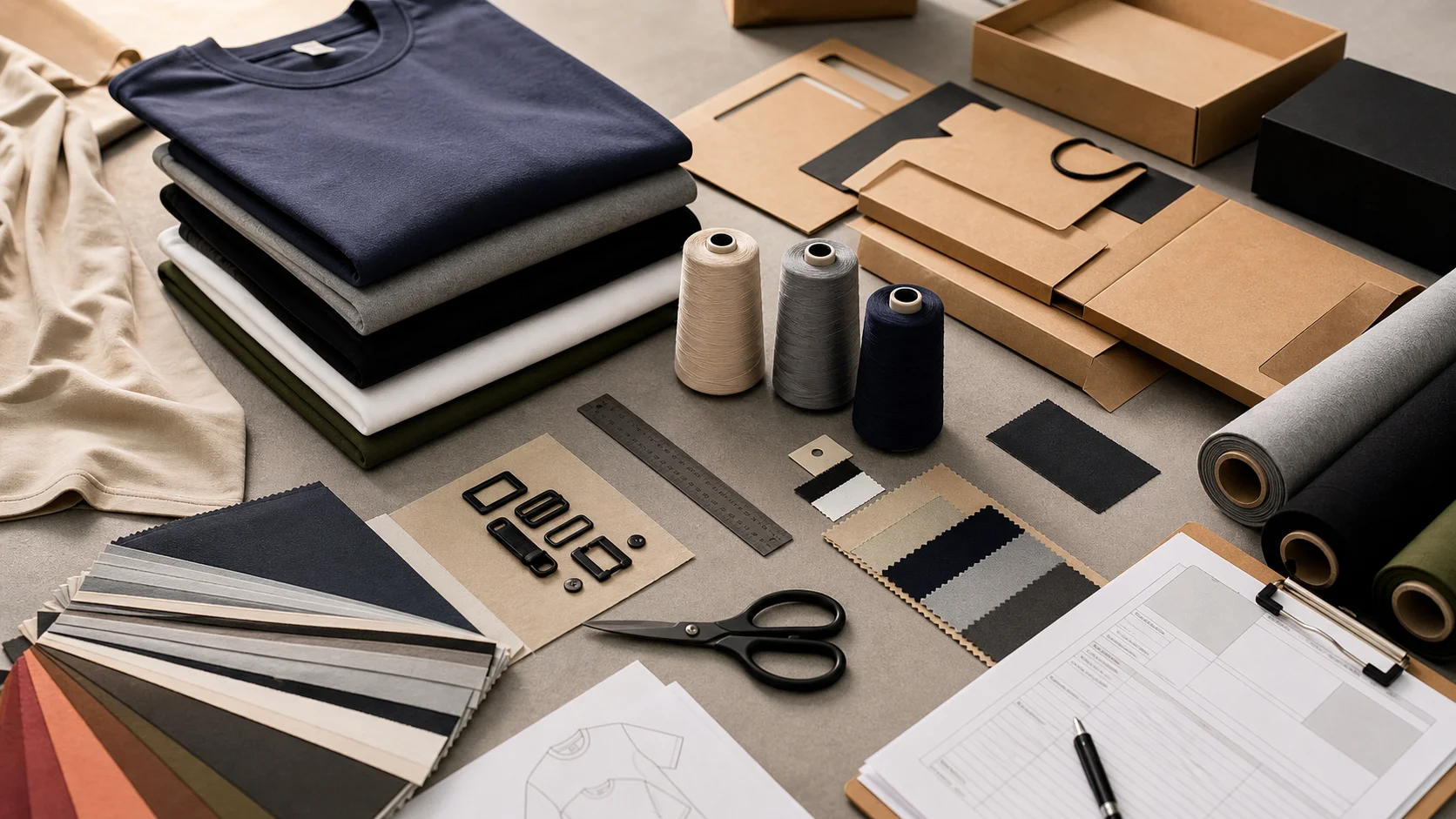
Bulk Garment Production for Private Labels with checks for samples, fit, MOQ, QC evidence, pricing terms, and delivery risk.
Fast answer: Bulk Garment Production for Private Labels: Capacity, QC, Payments, and Freight should be judged by production evidence, not by a generic sourcing promise. The buyer needs sample proof, cost breakdowns, QC checkpoints, and delivery buffers in writing.
Ask for recent sample photos, measurement tolerances, fabric or print test assumptions, decoration test notes, packing examples, and a named inspection checkpoint. These details show whether the team can repeat an approved sample at bulk volume.
Separate garment cost, decoration, labels, packaging, sampling, testing, freight, and rush charges. When every cost line is visible, it becomes easier to reduce colorways, adjust size depth, or reserve more time for sampling.
In Ho Chi Minh City, a sales manager once walked me through a spotless showroom and quoted a 21-day bulk lead time with a 2% defect target. Two minutes later, the sample room told a different story: unfinished tops, re-cut collars, erased measurements on the pattern table. That room said more about bulk garment production for private label brands than the brochure ever did.
For a brand comparing a manufacturer, factory, or supplier, the real test is repeatability. Factory fronts can be deceiving, and polished floors do not prove strong production discipline. Then you step behind the curtain and find missing notches, loose grading charts, handwritten amendments on a style with 12 size points. Pretty packaging. Weak engine.
Repeatability starts in the sample room. If a factory cannot make the same French terry 320 GSM hoodie twice without shifting the hood opening by 1.5 cm, bulk size will only magnify the problem. Tech packs, pattern discipline, and approval habits set the tone long before the first bundle reaches sewing. In plants with tight sample control, bulk work often needs 20% fewer corrections, even when labor costs run $0.40 to $0.80 higher per hour than the cheapest competitors.
Low-cost plants chasing wholesale volume show the gap fastest. A quote for 5,000 tees at $2.10 a piece still means very little if the pattern team is stretched thin and pre-production checks are rushed. Mid-tier factories usually charge a bit more, then save time later by reducing rework. That matters when a brand is trying to launch 3 colors and 6 sizes in one drop.
Here’s the part buyers keep relearning. Design intent must become repeatable output at scale. A rib neckline needs the same quality recovery on the first shirt and the 4,000th. Print placement has to stay inside the same 2 cm window. Packaging should land with the right size stickers in the right carton count. Last year, at a Bangladesh knitwear plant, the production manager showed me a 14-step sample approval log. That kind of discipline protects margin better than salesmanship ever will.
The flow is simple on paper and temperamental in practice: tech pack, fabric sourcing, trim booking, pattern development, sample approval, grading, bulk cutting, sewing, finishing, inspection, packing, carton shipment. It gets messy fast when a brand sends “premium handfeel” instead of stitch count, seam allowance, or GSM target.
In bulk garment production for private label brands, delays usually begin before cutting starts. Missing measurement charts force pattern revisions. Missing trim specs trigger long email loops. A neckline bind with no width, fold direction, or thread color can add 3 to 5 days to every approval cycle. I watched a 7-day sample round stretch to 24 days because a buyer changed the label artwork three times and never froze the care label copy.
Pattern approval and grading decide whether sizes stay consistent. Approve size M without checking the jump from S to XL, and the line may still ship a 3% to 8% error rate in chest width or sleeve length. Small on paper. Big when a retailer flags 400 units from a 5,000-piece order. Sign off in three places: pre-production sample, size set, first output from the line. After that, changes should be rare and documented.
Some steps repeat once per style. Others repeat per color. Dyes, prints, and wash recipes can shift handfeel and shrinkage, so an enzyme wash on one black lot will not always behave like a stone wash on the same pattern in blue. Trim sourcing repeats by SKU, and sometimes by size run if packaging changes. For cut and sew manufacturing, that distinction matters because the control system has to track style-level and color-level variation without losing the thread, literally and financially.
For private label brands, the best-run programs treat the tech pack like a legal document. If the spec calls for a 1x1 rib collar, a double-needle hem, and a 320 GSM French terry body, the custom factory should quote, sample, and repeat against those exact terms. Data from WTO trade reporting shows how fast apparel supply chains can move across borders, but speed only matters when the spec is frozen and the process is disciplined.
Most buyers stare at sewing cost because it is visible. Easy to compare. Wrong place to stop. The real stack includes fabric, trims, labor, sampling, packaging, freight, duties, compliance testing, and quality control. On a basic tee, fabric can be 35% to 55% of landed cost, labor 12% to 22%, packaging 2% to 6%. Freight and duties on top, and the cheap quote stops looking cheap.
MOQ changes everything. A 300-unit run may carry a unit cost 20% to 40% higher than a 3,000-piece order because fabric waste, setup time, and bookkeeping get spread over fewer garments. Yet high MOQs also raise inventory risk. I have seen brands order 8,000 hoodies at $7.40 ex-factory, then markdown 2,100 units because the color leaned too cool under retail lighting. Not a sewing issue. A merchandising miss manufacturing could not fix.
Region matters, but not in the tidy way sourcing decks like to pretend. South Asia often brings lower labor rates, sometimes $0.35 to $0.75 per minute equivalent in certain knit categories. Southeast Asia can cost a bit more and still move faster on communication and fabric coordination. Turkey usually prices 15% to 30% above comparable basic knit programs in Bangladesh or Pakistan, yet it can win on turnaround for smaller repeat runs. Nearshore factories in Mexico or Central America can be 10% to 25% more expensive on labor, though lower freight and duty exposure can offset that on replenishment orders.
Decoration methods swing unit economics fast. A basic screen print may add $0.18 to $0.45 per piece. Puff print, embroidery, or heat-transfer applications can add $0.60 to $2.50 depending on stitch count or artwork size. I have watched a brand save $0.30 on sewing and lose $1.20 on a complicated chest embroidery that needed re-hooping and rework. Cheap labor sometimes comes with higher rejection rates, slower throughput, or weaker finishing. The quote looks lower because the hidden scrap never appears in the first email.
There is one small place where brands overspend again and again: packaging. A standard polybag, size sticker, and carton marking might run $0.12 to $0.28 per unit, while custom inserts, printed tissue, and rigid mailers can push that far higher. If you need clothing packaging solutions, price them early. Otherwise the factory quotes only the garment, and your margin disappears into cartons, barcodes, and compliance labels.
Trade data from trade.gov shows how freight and tariff exposure can alter landed cost by region, especially on replenishment programs that ship several times a year. Model at least three scenarios: lean MOQ, standard MOQ, growth MOQ. If a supplier cannot show the difference between 500, 2,000, and 5,000 pieces, the quote is not ready for decision-making.
Sampling is rarely the bottleneck buyers think it is. A clean sample cycle can take 7 to 14 days for simple tees, 14 to 21 days for knitwear, and 21 to 35 days for outerwear, depending on fabrics, trims, and fit changes. Bulk adds another layer: cutting, sewing, finishing, inspection, freight. A shirt that looks “easy” on a line sheet can still need 6 to 10 weeks from approval to shipment if fabric booking slips.
For basic jersey tees, fast programs can ship in 25 to 35 days from bulk approval in Turkey or Southern Europe, 35 to 50 days in Southeast Asia, and 40 to 60 days in South Asia when mills are busy. Knitwear stretches longer because yarn sourcing and linking take time, often 45 to 70 days in normal conditions. Outerwear can run 60 to 120 days, especially with seam sealing, zippers, or specialty fills.
Fabric availability beats labor cost more often than brands admit. A 30-day sewing window can turn into 60 days if greige goods are not secured. I saw that in India: a factory had people and machines ready, then waited 19 days for dyed fabric from an upstream mill. The line sat. The buyer blamed the factory. The factory blamed the mill. The real issue was poor booking discipline upstream.
Rush orders work only when the style is simple, the fabric is in stock, and approvals are frozen. A 2,000-piece tee with standard rib and a one-color print can sometimes move quickly. A 4,000-piece sweater with yarn-dyed stripes and custom labels cannot. Rush premium usually adds 10% to 25% to factory price, and it still does not erase the risk of missed shade approval or late carton labeling.
The longest delays often come from decision drift, not sewing. One delayed print approval can cost more time than the actual stitching. Brands that lock fit, artwork, labels, and packaging before bulk release often save 1 to 3 weeks. That is the gap between a seasonal drop landing in store and one clearing customs after the promotion window closes.
Do not audit the office. Audit the line. A bright reception area tells you almost nothing about whether a factory can sustain bulk garment production for private label brands across repeat orders, new colors, and mid-season replenishment. I look first at machine layout, then inline checks, then WIP inventory, then the skill mix on the floor. If the sewing line is crowded with half-finished garments and the QC station is empty, that is a signal.
Machine density matters. So does balance. A factory with 60 machines and only 2 experienced operators on critical seams may struggle more than a 45-machine floor with stronger team training. I ask how often needle breaks are logged, whether operators rotate between styles, and how defects are classified. Factories that track those numbers weekly usually have a better shot at holding bulk quality inside a 2% to 4% defect band.
Certifications help, but they do not guarantee consistency. ISO or social compliance certificates can be real and still sit beside weak process control. Verify production records. Ask for first-pass yield, rework rate, and on-time shipment percentages for the past 6 to 12 months. If the factory cannot produce those numbers, it is hiding behind paperwork. For a brand building private label clothing, that gap gets expensive after the first reorder.
Red flags are usually verbal. Evasive MOQ answers. Vague capacity claims like “many pieces per month.” Sample-to-bulk mismatch on stitch density or shade depth. Slow replies on trim questions. A factory that quotes 1,000 pieces today and 10,000 next week without showing line allocation is likely overpromising. I have walked out of plants where every answer was “no problem.” Problem.
A practical buyer checklist starts with four numbers: monthly output by category, average defect rate, average lead time, percentage of repeat orders. If a factory can prove all four, it has a better chance of scaling. If it can also show how it handles 2 colorways, 5 trims, and 8 size points without chaos, you may have found a partner worth developing.
QC is a chain, not a single inspection. Inline inspection catches problems while production is still moving. Pre-final checks spot drift before the lot is packed. Final random inspection tests finished cartons before shipment. Shipment checks verify quantities, labeling, and carton condition. A strong program uses all four. A weak one waits until the container is sealed and hopes for the best.
Buyers should know the defect thresholds too. AQL standards use sampling tables to decide whether a lot passes or fails, and the numbers change by defect type. A missing label is not the same as a loose thread. Compliance issues can include restricted substances, incorrect fiber-content claims, and care labeling errors. Data from OEKO-TEX and Textile Exchange show how seriously the industry treats chemical and fiber transparency, but the factory still has to turn those standards into daily practice. For import rules and sourcing guidance, trade.gov apparel resources are also useful.
Sustainability can save money when it cuts waste. Better marker planning can reduce fabric loss by 3% to 7%. Cleaner wash recipes can lower water and chemical use. Tighter carton sizing can save freight cubic volume. Traceability adds overhead, too. Tracking farm, gin, spinner, dyer, and mill across multiple tiers takes time, data discipline, and audit fees. Real cost.
During factory visits, the best sustainability programs are usually boring in the best way. They log water use per batch, measure reject rates, and keep chemical approvals organized by supplier. The marketing version sounds grander than the operational one. If a plant claims 100% sustainable production but cannot show fabric lot records or testing certificates, I treat the claim as unverified until the paperwork matches the shelves.
The fastest way to lose money is to send a deposit before the spec is frozen. I have seen brands pay 30% upfront on a 2,500-piece order, then discover they never confirmed label placement, packaging count, or wash treatment. That mistake can add 5% to 12% to the final cost through rework, delayed freight, or inventory write-offs. A disciplined first order should look almost dull. Good.
Start with a tech pack audit. Check measurements, seam types, stitch density, artwork placement, fabric weight, color standards, packaging details. Then compare at least 2 quotes line by line. A factory quote at $4.80 and another at $5.35 may differ because one includes carton inserts, testing, and inline QC while the other leaves them out. Do not compare totals until the inclusions match.
Here’s what most people miss: the first bulk order is not only a production test. It is a communication test too. If a supplier cannot turn comments into a corrected sample within 3 to 5 days, that delay will multiply once 4,000 units are already on the floor. For a brand that sells apparel and custom bra manufacturing, the lesson stays the same. Fit, support, grading—signed off before quantity becomes the problem.
Before you approve bulk, request these documents:
Give first-time orders a 30-day action plan. Days 1 to 5: audit the tech pack and cost sheet. Days 6 to 10: approve sample corrections and lock packaging. Days 11 to 15: confirm fabric booking, trims, and size set. Days 16 to 25: monitor cutting and sewing, then review pre-final QC photos. Days 26 to 30: arrange third-party inspection and shipment release. If the factory cannot keep pace with that calendar, it is not ready for repeat business.
One more practical step: put every approval in writing. Keep color approvals, fit comments, inspection results, and revised artwork in one folder, then carry that record into the next reorder. The second run should be cheaper, faster, and calmer because the paper trail is clean and the factory can read it.
It is the process of making a branded clothing style at scale, usually after samples and approvals are locked. Orders commonly start at 300 to 500 pieces and can run into the thousands, depending on category and factory capacity.
Basic tees can land around $2.10 to $5.50 ex-factory, while hoodies and knitwear often sit between $6.50 and $14.00, depending on fabric, decoration, and MOQ. Freight, duties, testing, and packaging can add another 15% to 35% to landed cost.
Simple tees may take 25 to 50 days from bulk approval to shipment, while knitwear often needs 45 to 70 days and outerwear 60 to 120 days. Fabric availability can add 1 to 3 weeks if mill booking slips.
Yes, but unit cost usually rises when MOQ drops below 500 to 1,000 pieces. Small orders also limit fabric efficiency, increase setup time per unit, and can make decoration costs look disproportionately high.
Use at least three checkpoints: inline inspection during sewing, pre-final inspection before packing, and final random inspection before shipment. For critical launches, add a shipment check on carton count, labels, and packing list accuracy.