
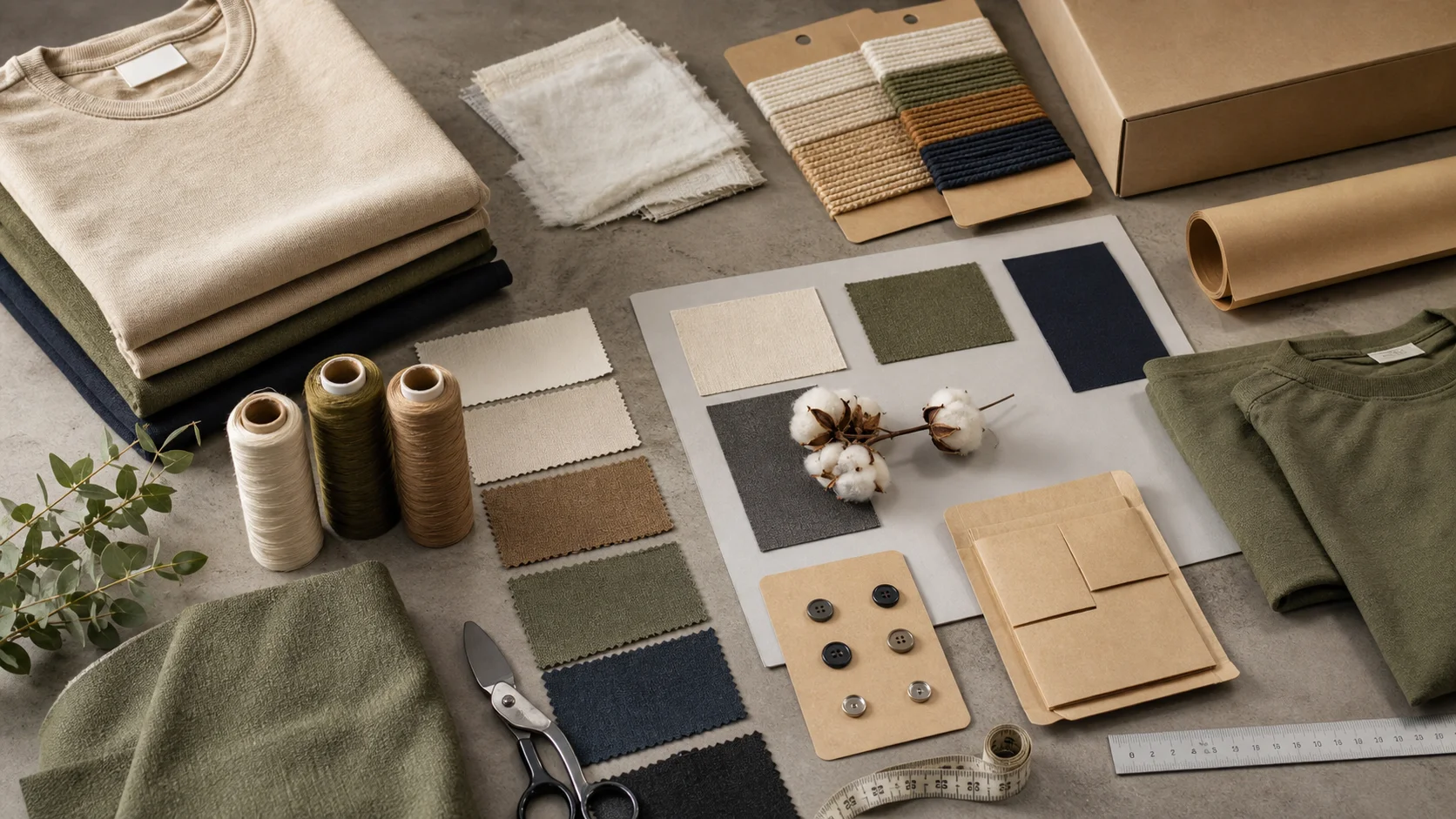
OEM Clothing Manufacturer with checks for samples, fit, MOQ, QC evidence, pricing terms, and delivery risk.
Fast answer: OEM Clothing Manufacturer: Samples, Cost, and Lead Time should be judged by production evidence, not by a generic sourcing promise. The buyer needs sample proof, cost breakdowns, QC checkpoints, and delivery buffers in writing.
Ask for recent sample photos, measurement tolerances, fabric or print test assumptions, decoration test notes, packing examples, and a named inspection checkpoint. These details show whether the team can repeat an approved sample at bulk volume.
Separate garment cost, decoration, labels, packaging, sampling, testing, freight, and rush charges. When every cost line is visible, it becomes easier to reduce colorways, adjust size depth, or reserve more time for sampling.
The first sell-through is flattering right up until the spreadsheet starts talking back. I’ve watched brands clear 80 percent of stock in 21 days, then discover the margin has evaporated under sampling losses, air freight, and returns. That is usually the moment founders start looking for an oem clothing manufacturer for fashion brands, because growth exposes the gap between a pretty sample and a profitable bulk order.
In my visits to 200+ factories across 8 countries, the pattern stays the same. Founders begin with small batches, often 100 to 300 pieces per style, then hit the wall when demand jumps to 1,000 or 5,000 units. OEM matters because the brand keeps ownership of the design, fit, spec sheet, and commercial direction while the factory handles production. That split protects brand identity and lets you scale without building a manufacturing team from scratch.
Regional differences are real. China still offers the broadest trim sourcing and the shortest development cycles for complex products, with MOQs often starting at 300 to 500 pieces on simpler styles. Vietnam tends to be strong on knitwear and disciplined quality control, though sampling may take 2 to 4 weeks if yarn needs to be imported. Turkey is fast for Europe-facing brands, especially on replenishment runs of 200 to 1,000 units, and Portugal often wins on premium finishing and lower order complexity, even when labor costs run higher. I’ve seen basic tees in Portugal priced 15 to 25 percent above Southeast Asia, yet delivered with fewer fit corrections.
Here’s what most people miss: a higher-cost factory can reduce total cost if it cuts defect rates from 6 percent to 1.5 percent and removes the need for a second production run. A $4.80 unit that ships cleanly is cheaper than a $3.90 unit that creates 300 flawed pieces, two air-freight reorders, and a week of customer complaints. That is why serious brands stop shopping by unit price alone.
An oem clothing manufacturer for fashion brands makes garments to your design, your measurements, and your construction rules. You supply the tech pack, the factory turns it into samples, and then bulk production begins. The pattern may come from your sketch or an existing block, but the finished product is still yours in branding and commercial control. That is the core of OEM: production is outsourced, design authority stays with the brand.
The difference between OEM, ODM, and CMT is not academic. ODM means the factory already has a style and may simply rebrand or modify it, which can be faster but gives you less control over fit and differentiation. CMT, or cut, make, trim, means you provide fabric and trims, and the manufacturer assembles the garment. For a brand building private label clothing, ODM can be useful at launch; for a brand with a distinct silhouette or performance spec, an oem clothing manufacturer for fashion brands is the cleaner route. If your product depends on precision, such as a bra with molded cups or boning, a specialist partner in custom bra manufacturing is a different conversation from standard knits.
The workflow is familiar, but the handoffs matter. It starts with a tech pack, then sampling, fit comments, grading across size runs, fabric booking, bulk cutting, stitching, labeling, packing, and final shipment. A 12-point tech pack is often enough for a simple tee, yet outerwear may need 25 or more pages once seam allowance, zippers, wash standards, and measurement tolerances are included. Brands still need in-house control over fit approval, color standards, product safety, and merchandising. I’ve watched founders outsource too much and lose control over the one thing buyers notice first: how the garment wears.
For more technical programs, cut and sew manufacturing is where the best OEM partners prove their discipline. They can translate a sketch into a repeatable production method, not just a single sample that looks good under studio lights.
I never trust a sales deck until I’ve seen floor reality. A credible factory can show audit reports, export records, client references, machine lists, and the actual names of its sample-room technicians. Ask how many sewing lines are active, how many QA staff are on site, and whether the factory owns embroidery, printing, or washing equipment. If they rely on outsiders for every special process, your lead time will stretch by 7 to 14 days the moment the style becomes complicated.
Your due diligence checklist should cover certifications such as OEKO-TEX Standard 100, social compliance reports, export history by market, and whether the factory has handled your category before. A babywear plant needs a different level of chemical control than a streetwear hoodie line, which is why I pay close attention to specialization. Brands working on custom baby clothing manufacturing should demand stricter testing and traceability than they would for a cotton jersey tee.
Ask direct questions. What is the MOQ by color and by size? Is sampling charged separately, and if so, is that fee credited against bulk? How long is a PP sample, a size set, and a production slot? Can they source fabric, or do they require you to nominate mills? What are payment terms, 30/70 or 50/50, and do they ask for deposits on trims? A factory that answers in numbers is usually safer than one that answers in adjectives.
Red flags show up early. Vague capacity claims like “we can do anything” usually mean subcontracting. Inconsistent sample measurements, no lot traceability, and a refusal to explain where printing or washing happens all point to hidden risk. I’m opinionated here: the cheapest quote often masks defects, late shipment, or fabric substitution. That $2.10 tee can become a $4.70 headache once you count rework and customer returns. Ask for the lowest and highest recent order value, not just the prettiest sample.
Unit price is the headline; landed cost is the truth. I break it down into fabric, trims, labor, sampling, testing, freight, duties, QC, and a buffer for errors. A tee priced at $3.20 ex-factory can land at $5.10 or more after freight and duty, while a jacket that looks expensive at $18 may cross $29 once zippers, lining, and inspection are added. If your factory quote excludes testing, you are not getting a full quote.
Fabric choice is the biggest swing factor. A basic 180 GSM cotton jersey might run $2.50 to $4.00 per meter, while a premium French terry 320 GSM can be $5.50 to $8.50 depending on yarn quality and dye method. Specialty finishes add more. Enzyme wash is usually cleaner and more controlled than stone wash, but it can add $0.25 to $0.60 per piece; heavy abrasion may cost even more and increase rejection rates. On knitwear and denim, that difference can double raw material cost before labor is even counted.
MOQ changes the math fast. Small runs of 100 to 300 pieces often increase per-unit cost by 20 to 50 percent because the factory spreads setup time, marker making, and fabric waste across fewer units. I’ve seen a 500-piece order priced at $6.40 per hoodie, while a 2,000-piece run of the same spec dropped to $4.90. That is not factory greed. It is arithmetic. Better machinery does not erase the setup burden.
Regional labor costs matter, but not in a simple cheap-versus-expensive way. Southeast Asia often offers lower sewing labor, especially on basics, while nearshore production in Turkey, Portugal, or parts of Eastern Europe can win on speed and reorder flexibility. For styles with low complexity and stable demand, overseas production can save 12 to 18 percent on unit cost. For items that sell out and need replenishment in 3 weeks, a closer factory may save the margin you would have spent on air freight. I have watched a “cheap” factory become the most expensive one after two delays, one color mismatch, and a last-minute trim substitution.
There is also the hidden cost of decision-making. An oem clothing manufacturer for fashion brands that asks for approval on every yarn shade, zipper pull, and carton spec may slow you down, but that caution protects you from expensive mistakes. According to ISO quality systems guidance, process control is what keeps variation manageable. In practice, a clean workflow can save 2 to 4 percent of total order value by reducing defects, not by shaving labor minutes.
A realistic production timeline begins long before cutting fabric. Development usually takes 1 to 3 weeks, sampling another 2 to 5 weeks, approvals 3 to 10 days, material booking 1 to 4 weeks depending on whether fabric is stock or custom, bulk production 3 to 8 weeks, inspection 2 to 5 days, and shipping anywhere from 5 days by air to 35 days by sea. If a brand needs 1,500 pieces across 4 colors, those weeks disappear quickly.
Category changes the clock. Basics such as tees, tanks, and sweats can move in 30 to 45 days if fabric is ready. Denim often needs 45 to 60 days because wash development adds another layer. Knitwear can take 6 to 8 weeks if yarn dyeing is involved. Outerwear and embellished products may need 8 to 12 weeks, especially if they require seam sealing, coatings, or hand-applied trims. A simple style is not always simple once the factory starts grading sizes or aligning prints at the seam.
Fabric booking and color approval are frequent bottlenecks, and they are rarely glamorous ones. Mills often require minimum dye lots of 300 to 500 meters, so a single color mistake can stall a whole production run. I’ve seen brands lose two weeks because they approved a pantone swatch under warm light instead of daylight. That sounds trivial until the season calendar is already unforgiving. Bulk commitments before lab dips are signed off are a fast way to create dead stock.
Overseas production usually means slower first runs but better economics on larger orders. Nearshore production can cut lead time by 10 to 20 days and make reorders far faster, especially if a style is already pattern-approved. If a top seller moves from 800 pieces to 3,000, a nearby factory with available capacity may restock in 2 to 3 weeks, while an offshore partner may need 5 to 7 weeks. For high-volume winners, that speed can be worth more than a slightly lower unit price.
When a brand treats the timeline as fixed, delays become expensive. When it treats the timeline as a chain of decisions, it can move faster without sacrificing control.
Quality control starts before bulk, not after. I want first article approval, inline inspection, final AQL checks, and carton verification documented in writing. A good factory will measure against tolerances of plus or minus 0.5 cm on key points for fitted tops and slightly wider ranges for loose silhouettes. If they do not have a measurement sheet, they do not have a process. Final packing should also be checked for barcode accuracy, carton count, and polybag labeling, because shipping 2 wrong cartons can erase a month of margin.
Compliance is not paperwork theater. Restricted substances, labor standards, country-of-origin rules, and product safety testing all matter. Data from Global Organic Textile Standard shows how documentation and chain-of-custody standards are used to verify claims, while Textile Exchange reports continue to show rising demand for preferred fibers. I want lab reports for dyes and finishes, not just verbal reassurance. For children’s garments and swimwear, testing expectations are stricter, and failure rates are expensive.
Sustainability claims fall apart without evidence. Ask about energy use per kilogram of fabric processed, water intensity in washing, chemical management, and whether the factory tracks recycled content by lot. Packaging reduction is one of the easiest wins: dropping hangtags from 3 cards to 1, or replacing excess tissue with a single recyclable insert, can cut waste without affecting the product. I also watch whether a factory reuses cutting scraps or sends them to landfill.
If you are sourcing from a China-based supplier or any large factory network, ask for proof of traceability rather than general promises. An oem clothing manufacturer for fashion brands should be able to show batch records, inspection logs, and corrective action notes when something goes wrong. The thing nobody tells you is that a smaller, well-run manufacturer can outperform a larger one on waste, rework, and documentation. I’ve stood in 40-line facilities that lost labels by the pallet, and in 8-line plants that tracked every roll of fabric by barcode and every defect by operator. Size alone does not create discipline. Systems do.
Before you contact factories, prepare a tight package: tech pack, target price, size range, fabric direction, forecast volume, shipping market, and compliance requirements. If you want 600 pieces in 2 colors, say so. If your ceiling is $7.25 landed, say that too. A brand that understands its numbers gets better answers faster, and a brand that hides volume usually gets generic quotes.
Your first conversation should be short and specific. Ask about MOQ, sample turnaround, production slots, test capability, fabric sourcing, export markets, and whether they have handled your product category before. If they export to the US, EU, or UK, ask for that proof. If they promise a 2-week sample, ask what happens when fabric must be milled. If they cannot answer in numbers, move on.
Score your shortlist on pricing, communication speed, quality, ethical standards, and capacity transparency. I like a simple 1-to-5 matrix, with hard evidence attached to each score. That means test reports, sample photos, response times, and client references, not flattering talk. Then request samples, verify references, place a pilot order of 100 to 300 pieces, and scale only after the results are measured in defect rate, on-time delivery, and margin. A pilot protects you better than optimism ever will.
An OEM manufacturer produces garments to your design, tech pack, and material specifications. The brand keeps control of fit, branding, and product direction while the factory handles sampling, bulk production, labeling, and packing. In many cases, the factory also manages grading and some fabric sourcing.
Basic tees can land around $3.50 to $6.00 per piece, depending on fabric, MOQ, and region. Hoodies often range from $7.00 to $14.00, while outerwear can move from $18 to $35 or more. Freight, testing, and duty can add 15 to 40 percent to the ex-factory price.
Simple basics often take 30 to 45 days from approved sample to shipment. Knitwear, denim, and outerwear usually take 45 to 90 days, especially if fabric must be dyed or washed to order. Air freight can shorten delivery, but it raises landed cost sharply.
Check certifications, audit reports, export history, machinery, staff depth, and client references. Then compare sample accuracy, communication speed, MOQ, lead times, and payment terms. The best factory for you is the one that can repeat the same quality across 3 to 5 production runs, not just one sample.
Yes, but expect higher per-unit costs. Small MOQs of 100 to 300 pieces often increase pricing by 20 to 50 percent because setup, fabric waste, and labor are spread across fewer units. If your demand is uncertain, a pilot order is safer than committing to a large run.