
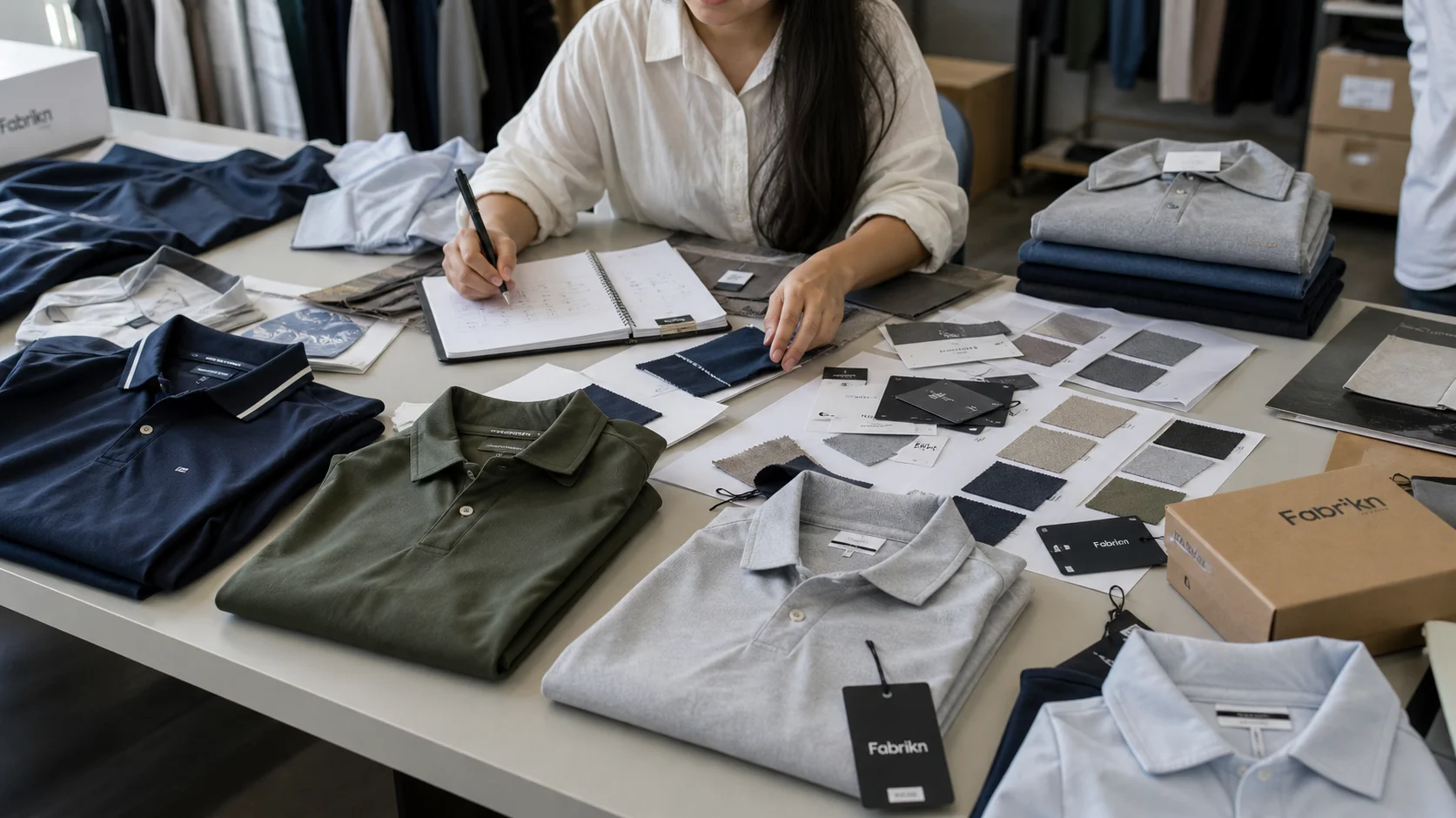
Clothing Factory Sampling Process with checks for samples, fit, MOQ, QC evidence, pricing terms, and delivery risk.
Fast answer: Clothing Factory Sampling Process: Samples, Fit, Timing, and Revisions should be judged by production evidence, not by a generic sourcing promise. The buyer needs sample proof, cost breakdowns, QC checkpoints, and delivery buffers in writing.
Ask for recent sample photos, measurement tolerances, fabric or print test assumptions, decoration test notes, packing examples, and a named inspection checkpoint. These details show whether the team can repeat an approved sample at bulk volume.
Separate garment cost, decoration, labels, packaging, sampling, testing, freight, and rush charges. When every cost line is visible, it becomes easier to reduce colorways, adjust size depth, or reserve more time for sampling.
Startup fashion brands don’t usually blow up because the product was bad. They blow up because the factory looked cheap, then turned expensive in all the ways that matter.
Roughly 20% to 40% of a fashion startup’s launch capital can disappear before the first sell-through report ever arrives. If you’re learning how to find reliable clothing manufacturer for startups, the first trap is assuming the lowest quote is the safest choice. Sample churn, delayed MOQ commitments, weak QC — that’s where the money goes. The quote looks clean. The invoice after the quote does not.
Overseas sourcing can look 18% cheaper on paper, then swell by another 15% to 30% through freight surprises, rework, and slow back-and-forth on trims, labels, and fit. In my experience, a factory in Bangladesh might quote $3.40 for a tee while a supplier in Portugal comes in at $4.10, yet the second option can be cheaper overall if it saves two sample rounds and ships cleaner production files. Founders miss that part all the time.
Across factories in Vietnam, Turkey, and Los Angeles, one pattern kept repeating in person and in email threads. Low-price suppliers answered fast, then missed delivery by 10 to 14 days and left measurement disputes hanging. Others charged 8% to 12% more, sent tight spec sheets, tracked revisions, and flagged fabric risks before cutting. Cash survives with the second group. It burns with the first.
A smaller factory with 25 to 60 workers can outperform a 300-person site if the sample room is disciplined and line balancing is tight. I’ve watched a compact knitwear unit complete 120-piece pilot runs with fewer defects than a much larger plant making 2,000 units a day. Size does not equal reliability. Systems do.
The core promise here is simple: how to find reliable clothing manufacturer for startups comes down to consistency across samples, timelines, and documentation. That is the real filter. Boring, yes. Cheap to ignore? Not even close.
A knit tee, a structured blazer, and technical outerwear do not belong on the same factory shortlist. A tee in 180 GSM combed cotton needs different machinery, different shrinkage control, and different QA checks than a blazer with horsehair canvas or a shell jacket with taped seams and waterproof zippers. Send the same inquiry to all three categories and you’ll get polite confusion plus inflated pricing.
Before outreach, define your order profile in numbers. How many SKUs are in the first drop — three styles or 12? How many units per style — 100 or 800? What is the target retail price? A $28 tee and a $220 blazer live in different factory ecosystems. What size curve are you using, and what launch window do you need? A 6-week launch and a 16-week launch are not the same business.
Low MOQ factories often handle 50 to 200 pieces per style well, especially for simple jersey or fleece. Many premium factories start paying serious attention at 300 to 500 pieces per style because anything below that interrupts line efficiency. Not unfriendly. Just math.
Finalize the technical specs before outreach and you save time and cash. Incomplete tech packs often trigger 2 to 3 extra sampling rounds, which can add 3 to 5 weeks and $150 to $600 in avoidable charges per style. I’ve seen brands send only a sketch, then act surprised when the factory cannot quote accurately. The factory is not a mind reader.
Private-label basics are easier, but they still demand precision. For founders working on private label clothing services, the winning brief includes construction details, trim callouts, measurement points, and approved fabric references, not vague adjectives like “premium” or “heavyweight.” A 5% higher unit price can be cheaper overall if it cuts sample revisions from four rounds to two and keeps freight from slipping by a week. That is especially true where communication lag, not labor cost, is the real tax.
I use one rule: if a factory cannot quote the same style from a clear tech pack within 48 to 72 hours, it is not ready for startup pace. Good factories ask for fabric composition, target shrinkage, logo placement, and packaging size. Weak ones ask for a mood board and a miracle.
Paper first, photos later. Verify business registration, export licenses, and whether you’re dealing with a real factory, an agent, or a trading company. I’ve met plenty of polished sales reps who sounded like plant managers and knew less than the cut room supervisor 200 meters away. Ask who owns the machinery. Ask who controls production scheduling. Ask where bulk fabric is stored and who signs off on defects.
Dig deeper than unit price. Ask about fabric sourcing, pattern making, grading, embellishment, washing, and finishing. A factory that handles cut and sew manufacturing for a French terry hoodie at 320 GSM should explain marker efficiency, seam allowances, and shrinkage control without hesitation. If they make children’s products, ask whether they understand stricter labeling and chemical rules; a serious supplier of custom baby clothing manufacturing will already have compliance habits built into the workflow.
Request photos or a live video walk-through of the sample room, cutting table, stitching lines, QC station, and packing area. I care less about a glossy reception desk than about the state of the sampling tables and whether a measurement board is actually used. On the factories I trust, work-in-progress tags are visible, sample cards are dated, and cutting, sewing, finishing, and final inspection each have their own lane.
Factory size is a weak predictor. Rate consistency, line output, and in-house QC instead. A 40-worker plant making 15,000 units a month can be more disciplined than a 400-worker operation chasing 100,000 units with chaotic floor management. Capacity without control just means bigger mistakes.
Red flags are easy to spot once you know what to hear: vague answers about lead times, refusal to show the production floor, no written process for defects, and previous order photos with inconsistent labeling, misaligned neck prints, or missing size stickers. Those aren’t minor issues. They’re signals that your first bulk order may be treated as training material.
Data from ISO standards and testing bodies like AATCC matter here because measurement tolerances, colorfastness, and wash performance need objective benchmarks. A supplier that understands standards can explain why a cotton jersey shrinks 4% after enzyme wash, while a weaker supplier only says, “No problem.”
For sustainability and chemical safety checks, it also helps to review Textile Exchange guidance on preferred fibers and OEKO-TEX product safety standards. Those references won’t replace factory audits, but they do help you ask better questions about quality, compliance, and materials.
The real cost of a garment is never just the quoted unit price. I build a framework with sample fees, development fees, MOQ, unit price, mold or print charges, packaging, freight, duties, and rework allowances. If a factory quotes $2.80 for a tee and another quotes $3.25, the cheaper one can still cost more once you add $180 in sampling, $120 in label changes, and $400 in expedited air freight because the bulk missed its sailing window.
I’ve seen budget factories in South Asia and mid-price factories in Eastern Europe deliver very different outcomes at nearly the same landed cost. The lower-price supplier sometimes needs four sample rounds and 15 extra days of communication. The mid-price supplier might be 10% higher on paper, but if it cuts revision cycles in half, the final cost per saleable unit drops. Price tags lie without context.
Startup-friendly manufacturing often falls into three rough tiers. Budget basics: $1.80 to $4.50 per unit for simple tees, tanks, and sweatshirts at MOQs of 300 to 1,000 pieces. Mid-market DTC: $5.00 to $14.00 per unit for better fabric, better finishing, and stronger QC at 200 to 800 pieces. Premium small-batch production: $15.00 to $40.00 per unit for structured tailoring, specialty washes, or technical details at 100 to 300 pieces. These are not absolutes. They are reality checks.
Some factories waive sample charges for serious buyers, then recover margin through higher production pricing on the first two orders. That is common. The sample looks free, but the factory has simply moved the cost elsewhere. If you do not model the first two orders together, you misread the deal by 8% to 15%.
The hidden expense of poor fit approval is brutal. One rejected bulk run can erase the savings from a 10% cheaper quote. I once watched a brand save $0.70 per hoodie on production, then spend $6,800 on rework because sleeve length and shrinkage were not locked before cutting. Cheap becomes expensive fast when the size chart is fantasy.
Trade data from trade.gov can help founders compare sourcing regions by export sophistication, lead time, and tariff exposure. It will not pick the factory for you. It will, however, keep you from assuming that the lowest FOB price automatically produces the best margin.
Sampling to shipment rarely happens in a straight line. A realistic calendar starts with 2 to 4 weeks for sourcing and quoting, 2 to 6 weeks for sampling, 4 to 10 weeks for bulk production, and then transit time on top. If you’re shipping by sea from Asia to the US West Coast, add roughly 18 to 28 days. Air freight is faster, but it can add $1.50 to $6.00 per unit depending on weight and season.
Domestic factories shorten freight, customs, and port uncertainty, but they do not erase development time. A local factory may still need 3 sample revisions and 10 days of fabric procurement. Nearshore suppliers in Mexico, Portugal, or Turkey can reduce transit to 2 to 8 days, yet the calendar still depends on approvals and capacity bookings. Geography changes shipping. It does not fix indecision.
Most delays happen in boring places: missing fabric approvals, late trim confirmations, fit revisions that arrive after the factory has booked the line, and unpaid sample invoices that stop work for 5 days. Weak brands blame logistics. Strong brands notice how often their own response times cause the bottleneck.
Reliable factories protect timelines by reserving materials, booking line space, and insisting on pre-production approvals. I like to see a dated production schedule with checkpoints: fabric arrival, cutting date, inline QC, final QC, packing, and ex-factory date. One promised delivery day is not a schedule. It is wishful thinking with a spreadsheet.
When a supplier can tell you that a satin skirt needs 12 business days for sampling, 18 days for bulk, and 4 days for final inspection, you’re talking to a factory that understands sequencing. When they say “two weeks maybe,” the clock is already ticking against you. In my experience, the most honest factories are also the ones that deliver more consistently.
According to WTO trade reporting, cross-border movement remains sensitive to port congestion, customs delays, and route volatility. That means a launch plan with only one shipping assumption is fragile. Build 2 timeline scenarios at minimum, one standard and one delayed.
The sample chain tells you everything. Prototype, fit sample, sales sample, pre-production sample, and production approval. Skip a step and I get suspicious. Each sample has a job. The prototype proves concept. The fit sample proves dimensions. The sales sample proves market appeal. The pre-production sample proves bulk readiness. Production approval locks the final version.
Contracts should protect the small brand, not just the supplier. I look for payment terms, defect tolerance, late delivery penalties, ownership of patterns, and approval authority over trims and fabrics. A clean contract often includes 30% deposit and 70% before shipment, but terms vary by region and order size. If a factory wants 100% upfront on a first order of 250 pieces, I ask why.
Use measurable QC standards. AQL levels for inspection, measurement tolerances in millimeters, color standards using approved lab dips, and packing checks for barcode accuracy. For a tee, I might allow +/- 1 cm at chest and sleeve openings. For a blazer, the tolerance may need to be tighter. For washed fleece, ask for shrinkage limits after 3 washes, not just one.
Remote startups should request inline inspections and final inspection photos. Better still, insist on defect photos with measurements and correction notes. That creates accountability. I’ve seen stronger factories welcome detailed checklists because they already know their process can survive scrutiny. Weaker factories rush approval, discourage questions, and ask you to “trust the experience.” Experience is not a quality control system.
When I visited one knitwear plant in Ho Chi Minh City, the floor manager handed me a 17-point QC checklist before I asked for it. In another plant in Delhi, a sales manager tried to move the conversation away from sampling and toward “long-term friendship.” The first factory sold me confidence. The second sold me a story.
If your line includes size-sensitive basics, fit consistency matters even more. Good fit control is one reason some founders use specialized development partners before bulk, especially for category-specific programs like private label clothing services that require stable trims and repeatable measurements. The factory should make the review process easier, not harder.
Here is the process I give founders when they need a manufacturer fast and cannot afford a bad first order. Keep it tight. Keep it factual. Keep it measurable.
My scoring rubric is simple: capability, responsiveness, sample quality, price transparency, timeline reliability, and contract clarity. Give each category 1 to 5 points. A factory scoring 24 out of 30 is promising. A factory scoring 18 is a risk. Numbers strip the romance out of sourcing, which is exactly what a startup needs.
After the first order, the relationship matters. Consistent feedback, faster approvals, and payment discipline earn priority on the factory floor. Answer within 24 hours instead of 4 days, and your order moves. Keep decisions stable after sample approval, and the team trusts your brand more. That trust shows up in fewer mistakes and faster reorders.
If you need a quote after mapping your specs, you can always get a free quote for startup clothing manufacturing once the tech pack is ready. That call becomes useful only when your numbers are real.
The right manufacturer should reduce risk, not create more work for a small team. I’ve seen brands win with a 35-person factory in Portugal and lose with a 500-person plant in China. Glamour had nothing to do with it. Consistency did.
Start with a clear tech pack, then shortlist 10 to 15 factories and ask each one for the same style, fabric, and MOQ assumptions. If a supplier cannot quote within 48 to 72 hours or needs multiple clarification rounds for basic details, that is usually a warning sign.
Simple basics can run from $1.80 to $4.50 per unit at 300 to 1,000 pieces, while mid-market DTC production often sits around $5.00 to $14.00 per unit. Add sampling, freight, duties, packaging, and rework allowances, because those can lift your real cost by 15% to 30%.
A realistic first order usually takes 8 to 20 weeks before shipping, depending on complexity and region. I usually budget 2 to 4 weeks for sourcing and quoting, 2 to 6 weeks for sampling, and 4 to 10 weeks for bulk production, then transit time on top.
You can, but only if the factory has proven capability across knitwear, tailoring, and technical construction. A tee in 180 GSM jersey and a taped-seam jacket require very different machinery, skills, and QA processes, so most startups do better with category-specific suppliers.
Focus on factories that openly work with low MOQ programs and ask about their minimums by category. Many serious suppliers begin paying close attention at 300 to 500 pieces per style, but smaller factories with disciplined sample rooms can still handle 100 to 300 units well if the product is simple.