
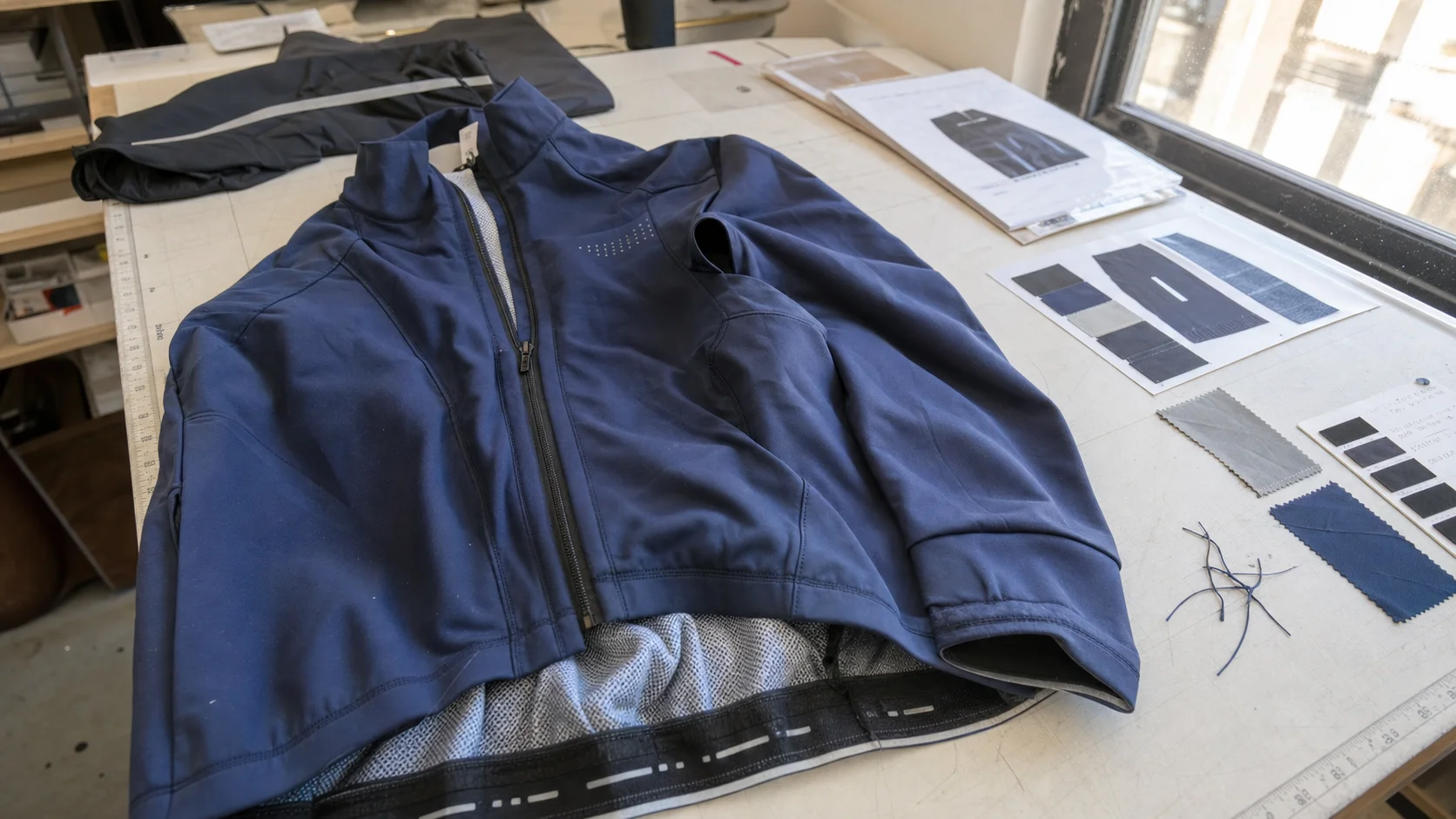
A focused outline for cleaning service apparel buyers evaluating OEM uniform jackets with colorfastness testing, covering wash durability, stain-chemical exposure, fabric and trim performance, lab standards, sampling, and production sign-off factors specific to outerwear programs.
OEM Uniform Jackets with Colorfastness Testing - Fabrikn production reference
Cleaning service teams put outerwear through a rougher wash-and-wear cycle than many buyers expect. Jackets are exposed to repeated laundering, stain removers, disinfectant residue, friction from equipment, and regular contact with plastic bins, car interiors, and upholstered surfaces. In that environment, color loss is not a cosmetic detail. It becomes a uniform replacement cost, a brand consistency problem, and sometimes a customer complaint issue.
For buyers sourcing OEM uniform jackets, colorfastness testing should sit near the top of the technical brief. A jacket that looks acceptable in a showroom sample can still fail after ten or twenty industrial or domestic wash cycles. Dark navy, black, red, royal blue, and contrast panel designs are especially exposed. If the fabric bleeds, fades, crocks, or stains lighter trims, the whole garment program becomes harder to manage.
Cleaning service apparel buyers often need jackets that maintain a professional look across distributed teams. That means a new production run must visually match older delivered stock as closely as possible. When color variation appears between batches, branch managers end up mixing shades in the field. That weakens brand presentation and raises reordering friction.
There is also a practical wear-life issue. Jackets used by cleaning crews may be washed more frequently than standard corporate uniforms because they pick up chemical odors, splash marks, dust, and visible grime. A supplier that understands this usage profile should not only offer fabric options and logo customization, but also specify which colorfastness tests are relevant for the garment category and target care method.
From a purchasing standpoint, colorfastness testing is one of the clearest places to separate a basic cut-and-sew vendor from a capable OEM partner. A factory can produce a jacket to the right silhouette and price, yet still miss the real operating conditions the buyer cares about. Testing helps close that gap.
OEM in the uniform sector usually means the buyer controls the brand, product requirements, and commercial positioning while the manufacturer develops and produces the garment to those specifications. For cleaning service jacket programs, that often includes custom fabric weight, pocket layout, logo application, color matching, size grading, trim selection, and packaging details.
The value of OEM sourcing is not only customization. It is the ability to define measurable standards before production starts. Buyers can lock in shell fabric composition, lining needs, zipper gauge, stitching density, reflective trim placement if needed, and colorfastness performance thresholds. That gives procurement teams a more stable framework than buying off-the-shelf outerwear and adding decoration later.
A typical OEM uniform jacket brief for cleaning service use may include:
Buyers should be careful not to overcomplicate the first development round. Every custom element affects MOQ, sample timing, and approval risk. A smarter approach is to rank requirements into non-negotiable items and secondary options. If colorfastness is business-critical, it should be treated as a release condition rather than a nice extra.
Suppliers that support structured product development often explain this process more clearly through their production workflow and communication channels. Buyers reviewing new manufacturing partners can usually start with core capability pages such as services and then move into project discussion through contact-us.
Not every colorfastness test matters equally for cleaning service outerwear. The right test list depends on how the jacket will be washed, what chemicals it contacts, and which fabric and trim combination is used. Buyers do not need to request every possible textile lab test. They do need to request the ones that reflect actual end use.
This is usually the first checkpoint. It evaluates how well dyed or printed fabric retains color during laundering and whether it stains adjacent fabrics. For cleaning service jackets, this matters because frequent wash cycles are part of normal use. A buyer should confirm whether the test standard aligns with domestic wash or industrial wash expectations, since the results can differ significantly.
A practical sourcing question is not just “Was it tested?” but “At what wash condition, on which fabric, and with what rating result?” Ratings are commonly reported on a gray scale or staining scale. Many buyers aim for commercially acceptable passing levels, but exact thresholds should match market level and garment use.
Crocking tests measure color transfer when fabric is rubbed, in dry and wet conditions. This is highly relevant for jackets with dark shades, brushed surfaces, or heavy logo areas. A jacket that rubs off onto lighter polo shirts, vehicle seats, or customer-facing interiors creates avoidable complaints. Wet crocking deserves special attention because cleaning crews often work in damp conditions or wear garments soon after exposure to moisture.
Even in a commercial cleaning context, sweat exposure matters. Outerwear is often layered over base uniforms and worn during active movement. If underarm or back panel shades shift or bleed, the garment will age unevenly. This test is more important for close-contact zones and darker garments.
Buyers operating teams across outdoor routes or mixed indoor-outdoor assignments should ask about light fastness. Jackets stored in vehicles or worn in sunlight can fade unevenly over time. This is especially relevant for bright corporate colors and budget-dyed synthetics. A fabric that performs well in washing can still disappoint under UV exposure.
This test helps assess dye stability after water contact. It is useful for cleaning crews because jackets may face splash exposure from water-based solutions, misting, or rain during transport between sites. If the garment uses contrast panels or pale trims, water staining risk should be reviewed carefully.
Many failures do not start with the main shell fabric. They start with embroidery thread, reflective tape, printed transfers, piping, collar contrast, or lining bleed. Buyers should ask for testing or at least wash validation on complete garment components, not only on greige fabric lab dips or base fabric swatches.
Purchasing judgment: a supplier showing only base-fabric test data is giving incomplete risk visibility. For uniform jackets, the full garment often fails where the trims meet the shell, not where the shell stands alone.
Colorfastness is partly a dyeing and finishing issue, but it is also shaped by material selection. Cleaning service apparel buyers should review the jacket as a system rather than treating test reports as separate paperwork.
Polyester is common in uniform outerwear because it offers durability, wrinkle resistance, and decent color retention when processed well. Polyester-rich jackets are often a practical choice for cleaning service teams that need repeat washing and moderate weather protection. Polyester-cotton blends can improve comfort and hand feel, but blend behavior depends on dye class, finishing, and wash conditions.
If buyers want richer color depth, they should also ask how that shade behaves after repeated care cycles. Deep black and navy can look strong in approval samples yet still show surface change later. This is where wash testing and rubbing tests become more meaningful than appearance alone.
Some cleaning teams want jackets with light water resistance for transit between locations. PU coating, DWR finishing, or laminated structures can help, but they add development complexity. Coatings may alter shade appearance, hand feel, or seam performance. They can also affect how logos adhere if heat transfer branding is used.
Buyers should weigh whether light splash resistance is truly necessary. In many service programs, a simple tightly woven polyester shell is enough. Adding performance finishes without a real use case can increase cost and raise rejection risk during bulk production.
Low-cost lining materials sometimes become the hidden colorfastness issue. A lining that bleeds onto the inside of a collar or pocket bag can damage the perceived quality of the jacket even if the shell fabric passes its test. Mesh ventilation panels should also be checked for snagging and shade migration, especially where white or light gray is used against dark shells.
Trims do not usually drive colorfastness ratings directly, but they do influence wash survival and garment appearance. Painted zipper teeth, poor-quality pullers, or low-grade contrast tape can create premature wear signals that buyers mistake for fabric failure. If the objective is long service life, it is usually better to simplify decorative trim usage and spend the cost on stronger materials or better testing coverage.
Side seams, cuffs, elbow zones, and pocket entries take repeated abrasion. Fabrics that pass lab tests can still show visible whitening or surface change at these points. This is common in dark jackets with certain weave structures or finishing techniques. Buyers should ask for wear-risk comments on stress areas during sample review, not only generic quality approval.
A disciplined OEM process reduces colorfastness surprises. The best results usually come from staged approvals rather than rushing from tech pack to production deposit.
Start with end use. Cleaning service buyers should define climate range, expected wash frequency, whether laundering is domestic or outsourced, logo method, target lifespan, and whether jackets are for supervisors, drivers, or front-line crews. These distinctions affect fabric choice and testing priorities.
The manufacturer should propose one or more material packages at different price levels. This is where smart buyers compare tradeoffs instead of chasing the cheapest quote. A lower-priced fabric may hit the target look but underperform in wash durability. A slightly more stable fabric can reduce replacement rates enough to justify the cost difference.
Before bulk fabric production, buyers often review lab dips or color swatches. This step is critical when brand color consistency matters. Approval should consider shade under relevant lighting and include a note that final bulk appearance may vary slightly by lot. Lab dip approval alone does not confirm colorfastness, so it should not be treated as the last color checkpoint.
The prototype checks design, fit, and construction direction. At this stage, trims may be temporary substitutes. Buyers should focus on silhouette, usability, and obvious risk points such as tight cuffs, shallow pockets, or awkward zipper length.
Uniform jackets serve a broad wearer range, so grading matters. A size set helps catch proportion problems across sizes rather than approving only one sample size. Cleaning crews need movement through shoulders and back panels without excessive bulk.
This is the key gate for material confirmation. The pre-production sample should use intended bulk fabric, trims, branding method, care label, and packaging details where possible. If colorfastness testing is required, this is a sensible stage to align submitted materials and expected test methods.
Once bulk starts, buyers should confirm whether shade control is monitored lot by lot, whether trim colors are checked against the approved standard, and whether inline inspections look for panel mismatch. Dark garments assembled from separate cut bundles can show visible variation if dye lots are mixed carelessly.
For buyers unfamiliar with a supplier’s background, it helps to review broader company information and production positioning before locking a long-term program. A page such as about-us can help frame that early due diligence, but direct technical discussion is still necessary.
MOQ and lead time are often where buyer expectations need recalibration. OEM jacket programs are more complex than basic T-shirt sourcing, and colorfastness requirements can lengthen approval cycles.
MOQ varies by fabric sourcing route, trim customization, and number of colors or sizes. As a general market reference, buyers may see:
These are not fixed rules. Some factories will quote lower entry MOQs but recover cost through higher unit pricing or reduced customization. Buyers should evaluate total program efficiency, not MOQ in isolation.
Proto samples often take around 7 to 21 days depending on material availability and complexity. Fit revisions add time. Pre-production samples can take longer if bulk fabric must be dyed first or if testing is scheduled before approval. A rushed sample calendar is one of the easiest ways to weaken quality control, because unresolved fabric and trim questions get pushed into production.
Typical production lead time for OEM uniform jackets may fall around 30 to 75 days after final approvals and deposit, but this depends on fabric readiness, order volume, trim procurement, and testing requirements. If the buyer needs third-party lab testing, color approval sign-off, custom packaging, or multi-size carton planning, the schedule should reflect that from the start.
Buyers should treat testing as part of the production calendar, not an afterthought. If a vendor promises very fast turnaround on a technically customized jacket with no room for approvals, the risk is usually shifting downstream to the buyer.
OEM jackets for cleaning service use face a few predictable failure points. These are worth addressing in the purchase order, tech pack, and inspection checklist.
This can happen when cut panels from different dye lots are mixed during sewing. It becomes more visible in navy, black, charcoal, and corporate red. Buyers should request lot control and final inspection under suitable lighting.
White piping, light mesh, or pale zipper tape paired with dark shells can pick up staining during washing. This is a classic problem in sample-to-bulk transition. The safest route is either to test the exact trim combination or reduce high-risk contrast usage.
Heat transfers may crack, peel, or discolor if the application parameters are not well matched to the shell fabric. Embroidery thread can also bleed on lighter grounds. Branding method should be chosen based on wash requirement, not only appearance.
Jackets used in vehicles or around carts and tools often show elbow, cuff, and hip abrasion early. Lab colorfastness results do not fully cover this. Buyers should ask suppliers whether the chosen fabric has a known tendency toward surface whitening or brushing marks.
A common operational problem appears when the care label gives one washing recommendation but the actual user environment is harsher. If cleaning contractors launder at higher temperatures or with stronger chemistry than planned, even a technically acceptable jacket can fail in service. The garment spec and the real care method need to match.
Risk Area What Buyers Should Check Practical Control Fabric shade consistency Lot control and panel matching Approve bulk standard and inspect under proper light Wash fading Wash test method and rating result Align test to actual laundering conditions Color transfer Dry and wet rubbing performance Review dark colors and trims more strictly Trim bleed Contrast component compatibility Validate full garment, not shell only Logo durability Decoration wash resistance Test chosen branding method on final fabricFor cleaning service apparel buyers, the strongest purchasing position comes from being specific without becoming overly complicated. A clear spec package usually performs better than a vague request for “high quality” jackets.
Start by defining the actual use profile. Is the jacket for indoor janitorial teams moving between buildings, mobile cleaning crews traveling in vehicles, or supervisors who need a sharper branded look? A softshell-style outer layer may be justified in one case and unnecessary in another.
Next, state the non-negotiables. These often include color standard, acceptable wash appearance, branding method, pocket function, size range, and minimum colorfastness expectations. If the garment must survive frequent laundering with limited appearance change, say so directly. Do not assume the factory will infer the wash intensity from the industry category alone.
Then review the quote with a tradeoff mindset:
A sensible RFQ package for OEM cleaning service jackets should include the target quantity, size breakdown, color references, intended wash method, logo placement artwork, preferred fabric composition, and any required tests. Buyers who provide this early usually get more accurate quotations and fewer revisions.
It is also worth deciding in advance whether third-party testing is required or whether in-house or mill test reports are acceptable for the order size and market level. For larger programs or compliance-sensitive tenders, outside lab confirmation often gives better control. For smaller repeat orders, buyers sometimes rely on established approved materials if performance history is already known.
The main purchasing lesson is simple: colorfastness should be treated as a commercial requirement tied to wear life, not just a technical line on a report. In cleaning service apparel, a jacket that keeps its color and avoids staining other garments will usually deliver better value than one that wins only on first-cost pricing.
Get a free quote from Fabrikn — your trusted B2B clothing manufacturer with 10+ years of experience. MOQ as low as 200 pieces.
Get a Free Quote →There is no single best option for every program. Polyester or polyester-rich blends are common because they balance durability, appearance retention, and cost. The right choice depends on climate, wash frequency, comfort needs, and branding method.
Cleaning service jackets are washed often and exposed to moisture, friction, and chemical residue. Without colorfastness testing, buyers risk fading, bleeding, crocking, and inconsistent brand appearance across teams.
Washing and rubbing tests are usually the first priority. Perspiration, water, and light fastness can also matter depending on how the jackets are worn and laundered. Trim and logo durability should be reviewed alongside shell fabric performance.
Many programs start around 100 to 300 pieces for simpler jackets and move into 300 to 800 pieces per color for more customized production. Exact MOQ depends on fabric source, trim customization, and the level of OEM development required.
Sampling can take a few weeks, and bulk production often takes roughly 30 to 75 days after approvals. Lead time changes based on fabric availability, dyeing, trim sourcing, testing, and order volume.
Full garment validation is safer when possible. Many real failures come from logo applications, lining bleed, contrast trims, or mixed-material interactions rather than from the shell fabric alone.
Use a clear tech pack, approve bulk-representative samples, align tests with actual laundering conditions, limit risky contrast trims, and confirm decoration durability before production starts.