
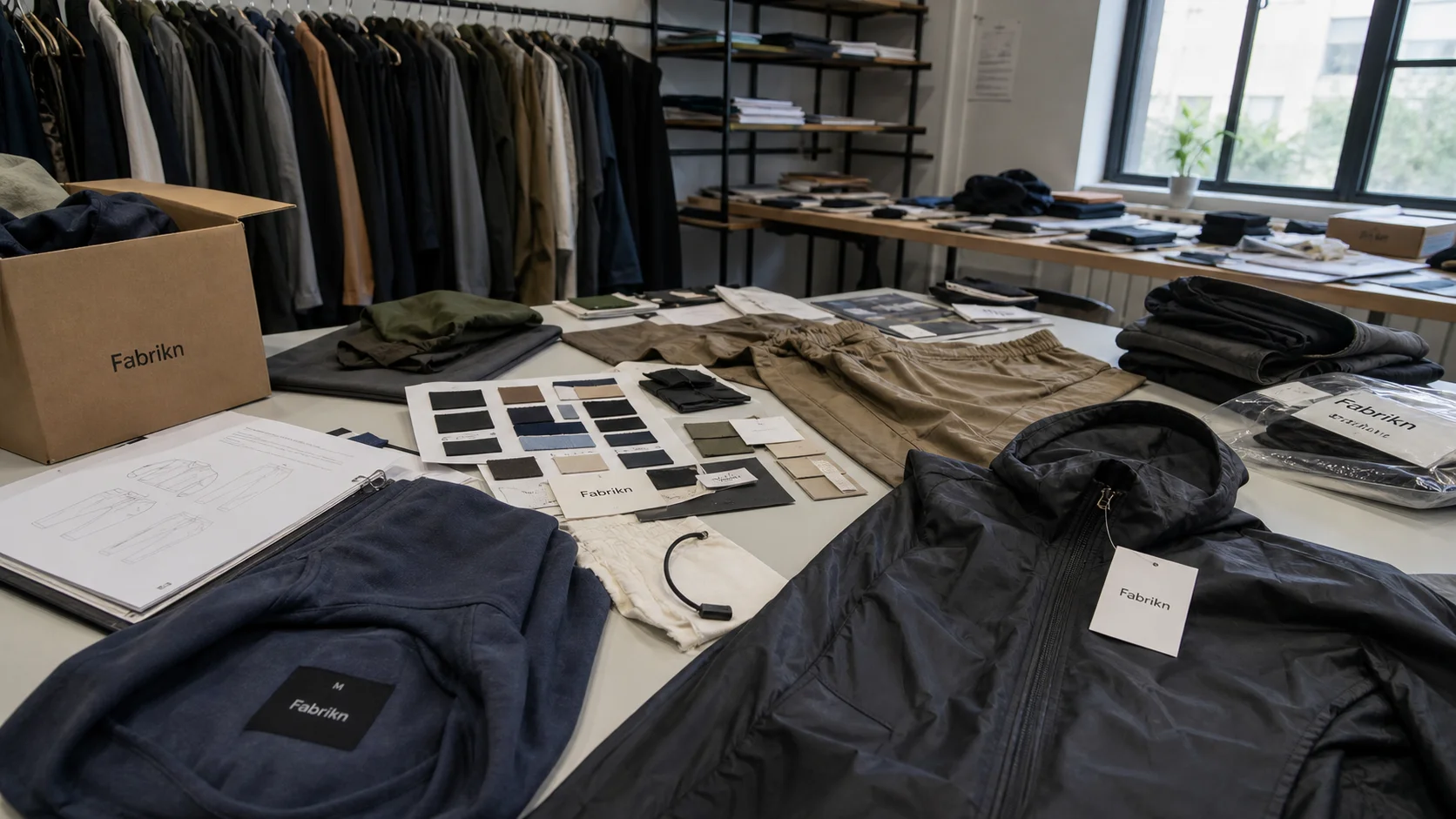
Polo Shirt Manufacturer with Low MOQ compared by sample evidence, fabric or trim specs, MOQ, AQL terms, cost lines, delivery timing, and rework responsibility.
Fast answer: Polo Shirt Manufacturer with Low MOQ: Sample Fit, Trim, AQL, and Delivery Risk should be judged by production evidence, not by a generic sourcing promise. The buyer needs sample proof, cost breakdowns, QC checkpoints, and delivery buffers in writing.
Ask for recent sample photos, measurement tolerances, fabric or print test assumptions, decoration test notes, packing examples, and a named inspection checkpoint. These details show whether the team can repeat an approved sample at bulk volume.
Separate garment cost, decoration, labels, packaging, sampling, testing, freight, and rush charges. Clear cost lines make it easier to reduce colorways, adjust size depth, or reserve more time for sampling.
The fastest way to wreck a promising polo line is to order too many too soon. Across the brands I have audited, the first production test is usually 100 to 300 units, not 1,000-plus, because that range exposes fit problems without freezing too much cash in one style. A bad collar can cost a season. A bad size curve can cost a quarter.
In factories I visited across Asia, Europe, and Latin America, the answer to a small order changed fast by region. Some knitting workshops were open at 50 to 200 pieces, especially if the brand accepted stock yarns and simple embroidery. Large industrial plants, by contrast, often began the conversation at 500 to 1,000 pieces per color. Not stubbornness. Machine setup time, fabric booking, line efficiency.
Small runs are not a second-tier option. In several compact factories, a 120-piece order got tighter inspection than a 1,200-piece bulk run, because the supervisor could stand over every collar point and placket line. I saw more rejected samples, more re-stitching, fewer hidden defects. Scale can dilute attention.
Polo shirts sit in a useful middle ground. More structured than a T-shirt, less complicated than tailored shirting or fully fashioned knitwear. Negotiation gets easier. A brand can change the fabric from cotton piqué 220 GSM to jersey 200 GSM, swap a flat knit collar for a self-fabric collar, or move from screen print to embroidery without completely reshaping the supply chain. Low MOQ affects all of that. It changes fabric choice, decoration method, lead time, and margin.
Cash flow is the real story. A run of 150 polos at $8.50 each ties up $1,275 before freight, duty, and sampling. The same style at 1,000 units can look cheaper per piece, yet it can also trap $8,000 to $12,000 in stock if sell-through lags. I have seen brands with healthy demand still choke on their own inventory because they scaled before they understood return rates. That is why a polo shirt manufacturer with low MOQ matters. It protects the learning curve.
Low MOQ means different things depending on fabric, construction, and how much you customize. I have seen factories define it as 30 units for a stock-garment embroidery run, 50 units for a simple cotton piqué polo, 100 units for organic cotton with a standard collar, 150 units for a recycled polyester blend, and 300 units once the buyer asks for dyed-to-match rib, custom buttons, or a woven neck label. The label matters. So does the collar stand.
Cotton piqué, single jersey, organic cotton jersey, recycled cotton blends, and performance poly blends tend to be the most flexible fabrics at smaller quantities. Cotton piqué 220 to 240 GSM is the classic polo choice because the knit structure hides minor variation and wears well under embroidery. Jersey, usually 180 to 210 GSM, feels softer and is easier to source in smaller lots. Performance fabrics are possible too, but a low-MOQ order of 100 pieces may still require the factory to use pre-booked stock yarn or a common mill base rather than a custom-dyed program.
Customization drives minimums faster than buyers expect. Custom buttons can add a tooling fee of $40 to $150, dyed-to-match rib often raises the yarn commitment, and special collars may force a separate knitting setup. Woven labels, hem tags, and printed neck transfers are usually manageable at 50 to 100 pieces, but a fully custom jacquard collar or all-over pattern pushes the order upward. Basic factory math.
Decoration follows the same logic. Embroidery often works best at low MOQs because setup is modest and the cost scales cleanly from 50 pieces to 300 pieces. Screen printing can work too, especially for a simple chest logo, but complex all-over printing on a knit polo introduces more waste and more color control problems. A pocket logo, a sleeve hit, or a small back-neck mark is easier to execute than a large decorative panel.
Regional flexibility varies. Turkish and Portuguese workshops were especially open to smaller batches when the buyer accepted stock trims and a 3 to 4 week sampling window. Larger Asian exporters often preferred to split orders by color, which can be useful if you need 2 colors at 150 pieces each rather than one style at 300. For brands building private label clothing services around a polo line, that flexibility is often the difference between testing and guessing. If you need a broader apparel program, private label clothing services can help structure the first range without overcommitting to inventory.
The tradeoff is consistency. Small runs can move quickly, but dye lots and trim lots may shift between reorders. A navy body in March may not match a navy body in July unless the factory records the exact Pantone, yarn lot, and shrinkage behavior. I have seen that mistake on 80-piece and 800-piece orders alike.
A factory saying yes to 50 pieces is not proof of competence. It is only proof of appetite. Before I trust a polo shirt manufacturer with low MOQ, I want company registration, export history, client references, and photos from the production floor, not polished showroom samples with no batch traceability. A real supplier can show the same style as an in-line production order, a cutting table, and a packing area with dated labels.
I also ask for spec sheets, lab test reports, and size tolerances before sampling. If the garment is meant to hold a 1 cm tolerance at chest width and a 2 cm tolerance at body length, the factory should say so in writing. Data from ISO standards and apparel testing protocols matters because fit claims without measurement control are marketing, not manufacturing. A polo with a 38 cm collar circumference that arrives at 40 cm is a customer complaint waiting to happen.
There are practical checks that expose hidden costs fast:
Vague pricing is a warning sign. So is a refusal to share measurement charts, or a demand for full payment before any sample discussion with no explanation of tooling or courier costs. I have also walked out of factories that could not explain where their collars came from. A polo body can be stitched anywhere. A stable collar, placket, and rib trim require a real sourcing network.
The best low-MOQ partners usually have a sampling room, not just a sales desk. That room tells you more than a brochure ever will. If the factory can make a 1-piece proto, revise it in 3 days, and then repeat the same neckline on 100 garments, you are dealing with a manufacturing team rather than a trading office. For buyers who want a broader overview of garment capability, cut and sew manufacturing is the right framework to study before placing the first order.
According to WTO trade data, apparel sourcing risk rises sharply when buyers overcommit to a single supplier or a single season. That is not theory. It is why I pressure-test every factory on sample discipline, record keeping, and reorder consistency before any money moves.
Price drops as volume rises, but the curve is not linear. At 100 units, a cotton piqué polo with a small chest embroidery might land around $7.50 to $13.00 per piece depending on country of origin, fabric weight, and packaging. At 300 units, that same style may fall to $5.50 to $9.50. At 1,000 units, the price can move into the $3.50 to $7.00 range if the design stays simple and the mill can book fabric efficiently. Sampling, pattern-making, and embroidery setup are always folded into the early runs more heavily.
Sampling fees matter because the first version is rarely the final version. A proto sample can cost $40 to $120, a fit sample $50 to $150, and embroidery digitizing another $25 to $75. If the factory has to source dyed-to-match rib or custom buttons, the quote can rise by another $0.40 to $1.50 per piece. Packaging adds more. A polybag, size sticker, and hangtag are easy at 1,000 units, less efficient at 100.
Lead time follows the same logic. A domestic or nearshore factory can often deliver in 2 to 6 weeks if fabric is in stock and decoration is simple. Overseas production usually takes 6 to 12 weeks, sometimes longer when the mill needs to knit a custom base or the freight booking slips. I have seen a 90-piece order in Portugal ship faster than a 900-piece order in South Asia simply because the first buyer accepted stock yarn and the second demanded a unique shade, a custom collar, and three revision rounds.
Here is a table-like reality check from the orders I have managed:
Quality does not automatically improve with volume. A larger order can reduce cost, yet it can also spread attention thinner across a line if the factory is juggling four production slots and a fabric delay. Smaller low-MOQ orders can be cost-efficient if they prevent dead stock, markdowns, and the quiet disaster of a style that looked great in a showroom but sold slowly online. I have watched brands save 18 to 25 percent of gross margin simply by producing 250 units instead of 1,500, then reordering only the winner.
Europe often charges more per unit but lowers freight time and import uncertainty. South Asia often wins on unit cost, especially for larger runs, but needs firmer planning around sea freight, inland transport, and duty exposure. Data from trade.gov can help estimate landed cost before you approve a quote. That figure, not the factory price alone, is what determines whether a launch makes sense.
Portugal and Turkey are strong for small batches because many workshops are built around flexible knitting, knitting-to-order programs, and fast sample development. I have seen 50 to 200 piece runs handled with unusually sharp finishing in both countries, especially for premium polos in organic cotton or mercerized cotton. The price is higher, often by 20 to 40 percent versus lower-cost Asian sourcing, but the lead time and communication can be worth that premium for launches with tight calendars.
Pakistan, Bangladesh, Vietnam, India, and selected China regions bring different strengths. Pakistan and India often offer strong knit expertise and attractive unit cost on cotton piqué and jersey. Bangladesh can be excellent for larger structured programs, though many factories favor higher runs. Vietnam is often cleaner on compliance systems and consistent on production discipline, but low MOQ flexibility depends heavily on the factory’s own client mix. In China, some coastal and southern regions still support smaller, premium programs through specialized workshops, while larger exporters prefer 500 pieces per color or more.
Specialty knitting districts matter because the factory is only one piece of the puzzle. If the local mill can knit a 240 GSM piqué base, dye it within 10 days, and supply matching rib, the MOQ becomes more manageable. If every trim has to be imported or cross-shipped from another province, the order becomes fragile. Shipping time, duty exposure, and communication speed belong in the sourcing equation right beside unit price.
Here is the counterintuitive insight most brands miss: some higher-wage regions can be cheaper overall for low MOQ because they avoid expensive air freight, reduce correction cycles, and cut inventory write-offs on unsold stock. A $9.20 polo that sells through in 3 weeks is often better than a $4.80 polo that sits for 6 months and gets marked down by 30 percent. That is especially true for premium polos sold at $28 to $48 retail, where presentation and reordering speed matter more than chasing the absolute lowest factory quote.
Sustainability claims need evidence. Energy mix, water use, and traceability vary widely inside every region, and a single country label says very little by itself. I look for third-party standards such as Textile Exchange or certifications linked to chemical control and material traceability, not broad promises about being “eco-friendly.” One factory can consume 40 percent less water than its neighbor. Another may not. The paperwork should tell me.
If a supplier can show fiber origin, dye-house records, and shipment dates, I take that seriously. If they cannot, I treat the sustainability claim as decoration, not evidence.
Simplify the garment before you argue over cents. A flatter collar construction, one logo position, and stock buttons can shave meaningful cost from a low run. I usually recommend one color, one fabric, and one logo placement for the first launch. That formula is not glamorous. It works.
Combining sizes or styles can also help if the factory allows it. A run of 300 pieces split across 5 sizes and 2 colors is harder than 300 pieces in one color, but it still beats forcing the order to 50 pieces and paying a huge setup penalty. If the brand can accept a limited color card, the mill can often commit to a cleaner fabric lot. I have seen 10 to 15 percent savings from keeping a line tight.
Sample discipline saves money too. Pay for one strong proto sample, then stop changing the collar height by 0.5 cm every week. Endless revisions can burn $200 to $600 before production even starts. If you need better product-market fit, use a sample-to-bulk strategy: get the proto right, test it, then move directly to a pilot order. For brands building from scratch, browse our product catalog can shorten the decision cycle by showing which constructions already exist.
Here are negotiation tactics I use with factories:
Protecting gross margin matters more than worshipping the lowest quote. A polo that costs $5.90 landed and sells at $34 has room for reorders, freight swings, and returns. A polo that costs $4.70 but forces you into a 1,500-piece commitment can become a liability if sell-through stalls. The cheapest quote is not always the smartest purchase.
The fastest way to move from inquiry to pilot order is to send a clean RFQ package. Include the tech pack, target fabric, size range, color count, logo details, target quantities, delivery country, and budget. If the factory receives incomplete information, the quote will be vague, and vague quotes create bad comparisons. I have seen brands lose 2 weeks simply because they forgot to state whether the collar should be flat knit or self-fabric.
Ask for three quote tiers at once: the minimum run, the target run, and the scaled run. For example, request pricing at 100, 300, and 1,000 units so you can see the price curve, the sampling burden, and the freight implications together. If the lowest tier is wildly expensive, that may be acceptable for a pilot. If the curve barely improves at 300 or 1,000, the factory may be masking setup inefficiency.
Sample review should be a hard process, not a vibe. Use a measurement sheet, run a wash test, check color consistency under daylight, and inspect embroidery placement from at least 50 cm away. I also look for collar recovery after a 30-minute wear test and a basic shrink test after one wash cycle. A good polo keeps its shape. A weak one starts to wave at the placket.
For the pilot order, 50 to 300 units is usually enough depending on channel demand and price point. A wholesale program with a proven buyer list may need 200 to 300 units. A DTC launch with uncertain conversion can start lower. If the factory cannot explain cost drivers line by line, keep looking. Ask about fabric, labor, trims, setup, packaging, and freight separately, then compare that against the sample quality and the promise of repeatability. If you need a quote at that stage, get a custom polo production quote and use the same checklist to pressure-test every number before you approve the first cut.
My advice from 200-plus factory visits is simple: do not confuse a low MOQ with a low-risk order. The order is safe only when the supplier can show you the route from yarn to packed carton, with numbers attached at every step.
At 100 units, I usually see $7.50 to $13.00 per polo for simple cotton piqué with one embroidery position. At 300 units, that often drops to $5.50 to $9.50, depending on fabric, trims, and country of origin. Custom buttons, woven labels, and special collars raise the price.
Domestic or nearshore production can take 2 to 6 weeks if fabric is in stock and the design is simple. Overseas orders usually need 6 to 12 weeks, especially when the factory must knit custom fabric or source special trims. Sampling can add another 1 to 3 weeks.
The real minimum can be 30, 50, 100, 150, or 300 pieces depending on the fabric and customization. Stock fabric and embroidery allow lower numbers, while custom collars, dyed-to-match rib, and unique buttons usually push the minimum higher. Always confirm MOQ by colorway, not just by style.
Yes, many can add woven labels, neck prints, hem tags, custom buttons, and branded packaging at 50 to 300 pieces. The key is to ask whether each detail changes the MOQ or only the unit price. A sampling room usually signals better private label capability than a sales-only operation.
Portugal and Turkey often work well for speed and flexibility, while Pakistan, India, Vietnam, and selected China regions can deliver stronger unit economics. The best choice depends on landed cost, freight time, duty exposure, and how quickly you need the first 50 to 300 units. I compare all four before I commit.