
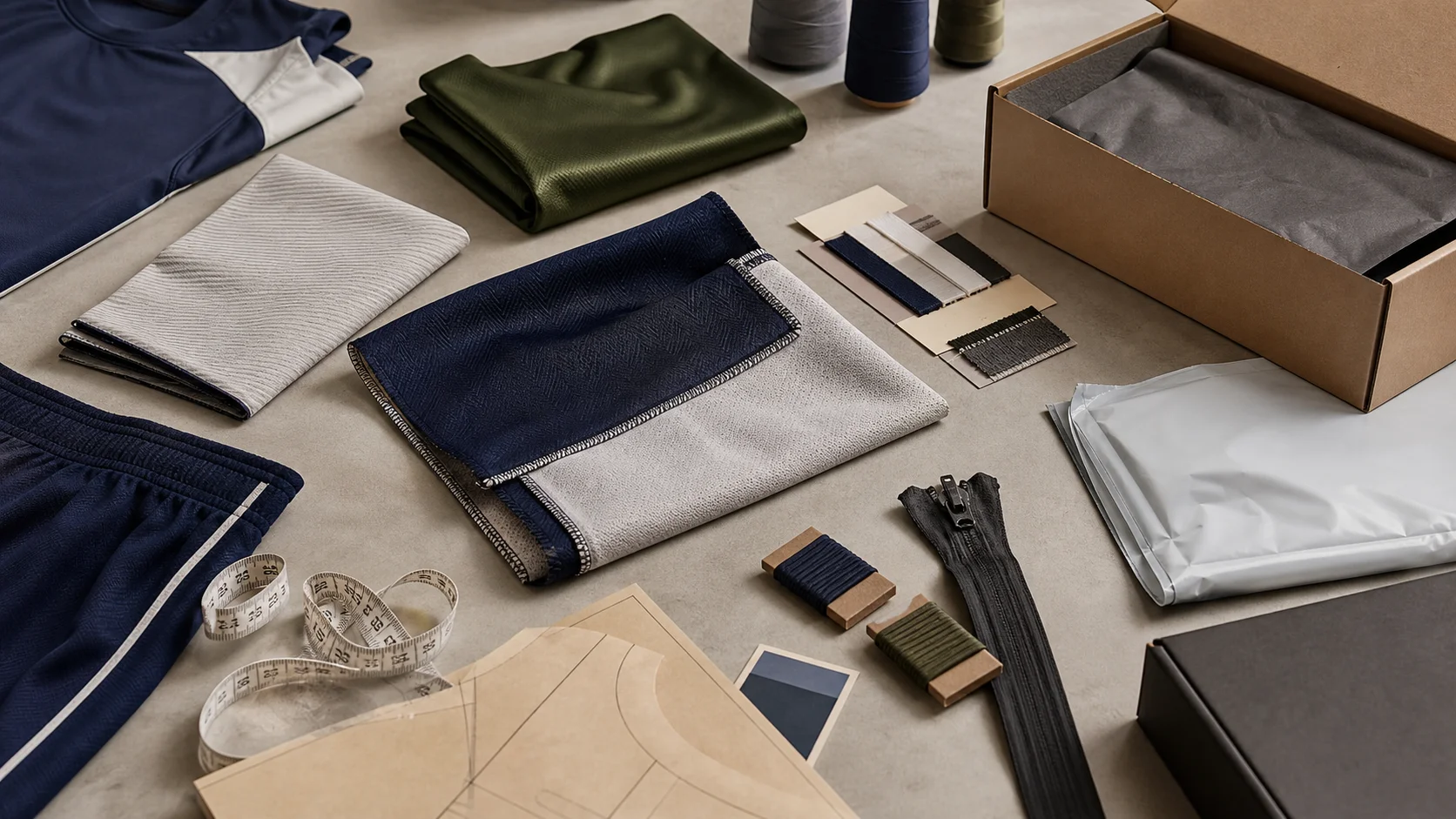
Plastic-Free Fashion Ecommerce Packaging with checks for samples, fit, MOQ, QC evidence, pricing terms, and delivery risk.
Fast answer: Plastic-Free Fashion Ecommerce Packaging: Paper, Adhesives, Proof, and Cost should be judged by production evidence, not by a generic sourcing promise. The buyer needs sample proof, cost breakdowns, QC checkpoints, and delivery buffers in writing.
Ask for recent sample photos, measurement tolerances, fabric or print test assumptions, decoration test notes, packing examples, and a named inspection checkpoint. These details show whether the team can repeat an approved sample at bulk volume.
Separate garment cost, decoration, labels, packaging, sampling, testing, freight, and rush charges. When every cost line is visible, it becomes easier to reduce colorways, adjust size depth, or reserve more time for sampling.
I have opened one shirt order to find six plastic parts hiding inside it, and that was before the outer shipper was counted. For plastic free packaging for fashion ecommerce, that is why the shift feels less like a nice-to-have and more like overdue housekeeping.
After 200-plus factory visits across 8 countries, the same pattern keeps showing up. Paper mailers, corrugated boxes, and molded pulp are easy to source; execution is what changes by region and order size. In Vietnam and Portugal, a 5,000-unit run can arrive with crisp print and consistent folds. In smaller facilities, the same spec can miss on glue alignment, and the carton opens in transit.
The commercial logic is uncomfortable. Premium brands often ship less material overall because their average order value is higher and their presentation is tighter. A $180 coat can absorb a $0.25 paper upgrade. A $24 tee cannot absorb much, yet fast fashion moves tens of thousands of units a week, so the monthly waste pile grows faster than the luxury stack ever will. Retailer packaging rules, EPR fees, buyer complaints, and social media scrutiny all hit the same margin line.
I have watched brands in London and Los Angeles ask the same question after a bad customer photo goes viral. Which swap survives daily ecommerce operations, and which one only looks clean in a pitch deck? That is the real test. Not color swatches. Not slogans.
Plastic-free packaging is not one material. It is a system. In practice, that system can include the mailer or box, an outer shipper, internal protection, tape, labels, inserts, and return packaging. If you remove plastic from only one layer, you have not solved much. You have simply moved the waste somewhere less visible.
The strongest options I have seen are FSC paper mailers, corrugated boxes, molded pulp inserts, paper tape, starch-based void fill, and compostable labels only where local collection systems can actually process them. A compostable adhesive on a label is meaningless if the carton gets sorted with mixed paper and sent to recycling. The surface may look paper-based, but coatings and laminates can block recovery. Mixed-material closures do the same. A glossy finish can be a trap.
Before anyone signs off, five things need testing: moisture resistance, tear strength, print quality, adhesive performance, and warehouse-speed compatibility. If a mailer takes 12 extra seconds to fold, seal, and scan, a warehouse shipping 3,000 orders a day will feel that immediately. On humid routes through Southeast Asia or long-haul ocean freight into West Africa, a paper pack that works in Berlin may fail in Port Klang. Regional conditions matter more than the sales deck admits.
According to ISO standards guidance on packaging and transport testing, barrier performance and mechanical integrity need to be verified under actual distribution conditions, not guessed from a sample table. For teams evaluating plastic free packaging for fashion ecommerce, that is the difference between a packaging idea and a packaging program.
At 500 units, paper alternatives usually cost more. At 5,000 units, the gap narrows. At 50,000 units, some paper systems come close to parity, especially if the artwork is simple and the supplier already runs the board size you need. In my factory notes, poly mailers often sit around $0.06 to $0.12 per piece at scale, while FSC paper mailers land closer to $0.12 to $0.24. Corrugated boxes range from $0.18 to $0.45 depending on flute, print, and size. Molded pulp inserts can add $0.08 to $0.30. Paper tape is usually $0.01 to $0.03 per meter equivalent, but labor can erase that savings fast.
Small runs pay a premium. I have seen 20% to 60% higher unit costs for paper options at 500 to 1,000 units because die-cutting, tooling, and freight are spread over fewer boxes. At 50,000 units, the spread can drop into single digits. The hidden costs matter more than the sticker. A mailer that increases dimensional weight by 0.2 kg can raise freight by $0.15 to $0.40 per order. A box that prevents corner crush on 1% of shipments may save more in returns than it costs in material.
Here’s what most people miss: in one denim client I advised last year, switching from a soft poly mailer to a heavier paper mailer added $0.09 per order, but damage-related refunds fell by 1.6% over 8,000 orders. The net effect was a lower total spend. The packaging looked pricier. The operation got cheaper. That is the kind of math sustainability teams should like, because it survives finance review.
Price point changes the equation. A $180 jacket can tolerate a $0.30 packaging upgrade without much drama. A $24 basic tee cannot, unless the packaging choice reduces carton breakage, rework, or customer complaints by measurable amounts. I have seen brands in Spain and Turkey save more by reducing packing labor from 42 seconds to 31 seconds per order than by shaving a cent off material cost. If you need help matching the right system to your categories, start with custom clothing packaging solutions built around order volume, not assumptions.
For context, OEKO-TEX publishes chemical safety requirements that many brands now request for labels and packaging adhesives. That matters when a pack is handled by skin-contact goods like lingerie or babywear. Cheap is not cheap if it creates compliance noise later.
Packaging switches fail on production details, not philosophy. Die-cutting must match the pack dimension exactly. Glue needs enough set time. Print registration has to survive repeat folds. Warehouse teams need a format they can close without slowing dispatch. I have seen a beautiful recycled mailer fail because the flap curled after 48 hours in a humid storeroom. I have seen another fail because the fold line was 3 mm off and the barcode sat under the crease.
When I audit suppliers, I ask for minimum order quantity, lead time, moisture testing, recycled fiber content, and certification documents. Europe often offers tighter compliance paperwork and better traceability from mill to converter. Some Asian suppliers move faster and quote lower base prices, especially on 10,000 to 25,000 unit orders. Both can work. Neither should be chosen on price alone. If a factory or supplier cannot show test reports for 85% RH exposure or a clear defect threshold, I move on.
Common failures from my factory visits are painfully ordinary. Weak folds. Scuffed print. Tape that lifts in cold storage. Inserts that shed dust onto dark garments. A paper divider can save a sweater from snagging, then stain it with fiber lint because the board was poorly calendered. I have watched teams spend $4,000 on a packaging redesign and ignore the $300 sampling run that would have exposed the flaw.
For brands with complex assortments, supplier capability matters as much as aesthetics. A cut and sew program that already handles structured product often understands how packaging should protect shape during transit; if that is part of your operation, coordinating with custom cut and sew manufacturing can reduce packaging surprises before they hit fulfillment. My scorecard tracks unit cost, defect rate, sampling speed, and changeover time from the current pack to the new one. A supplier that needs 6 weeks for samples and 2 days for revisions is usually safer than one that promises everything in 72 hours.
In China and other high-volume sourcing hubs, the best packaging factory partners are often the ones that can balance production speed with quality control. That means clear incoming inspection, line audits, and documented corrective actions. For wholesale and bulk programs, consistency matters more than a slightly lower quote.
Customers notice texture before they notice carbon language. Rigid boxes, uncoated kraft, and heavy paper tissue signal care. Thin, floppy mailers do the opposite. That matters most for premium categories where buyers are paying for reassurance as much as product. I have seen a $250 knitwear order feel underpriced because the packaging looked like it belonged to a discount outlet.
Less plastic can improve sentiment, but over-designed paper structures can backfire. Extra layers mean extra grams, extra freight, and more time at the bench. A box with an elaborate insert can create a beautiful reveal and a lousy margin. In my notes from luxury and mid-market brands, the best-performing packs were often the simplest ones that held shape and resisted scuffing. Performance wins. Theater is expensive.
Returns are where packaging quietly earns its keep. If a garment arrives creased, damp, or corner-damaged, the refund cost is usually much larger than the packaging upgrade. Denim, lingerie, footwear, and accessories each need different protection levels. A shoe box with molded pulp corners is not the right answer for a silk blouse. One template across the whole catalog is lazy procurement.
Buyers respond better to numbers than vague green claims. Say the mailer uses 90% recycled fiber, or that damage fell from 4.1% to 2.8% over 12,000 orders. That is a harder message to attack than “eco-friendly packaging.” Sustainability marketing gets sharper when it gets specific. If your product line needs branded labels, swing tags, and inserts that match the pack, private label clothing services can help align the story without inventing one. Last year I worked with a brand that cut return complaints by 11% after removing a brittle plastic insert nobody had questioned before.
My 90-day rollout starts with an audit. List every packaging component by SKU, vendor, and warehouse. Then pick one SKU cluster, usually tees or knitwear, and test three alternatives. I like one paper mailer, one corrugated box, and one hybrid paper-pulp option. Measure damage, packing speed, and customer complaints for 30 days. If the team ships 2,000 orders a week, you will get signal quickly. If it ships 200, you need longer.
The test protocol should be physical, not theoretical. Run drop tests from 75 cm and 100 cm. Expose samples to humidity for 48 hours. Check abrasion after 10 passes through a conveyor. Then time the line. If the new pack adds 7 seconds per order across 15 pack stations, that is a staffing issue, not a packaging footnote. Warehouse managers will tell you the truth if you ask them before the launch, not after the failure.
Rollout also means people, paperwork, and templates. Staff need revised SOPs. Art files need updating for new panel sizes. Customer-service teams need scripts for “Why did my order arrive in paper instead of plastic?” questions. I have seen an otherwise solid launch stumble because the barcode box moved 8 mm and the scanner needed manual override on 500 orders a day. That sort of error is avoidable with one dry run and one line audit.
A good dashboard tracks defect rate, complaints per 1,000 orders, packing seconds per order, and packaging cost as a share of COGS. If you want a quote for the switch, request a packaging quote only after you have unit volumes, shipment markets, and target lead times defined. Otherwise you are just buying optimism.
Start with three questions for every supplier this week. What is the exact material spec? What test reports do you have? What recycled content proof can you send? Then ask for pricing at 500, 5,000, and 50,000 units, plus two lead times, usually 3 to 4 weeks and 6 to 8 weeks. That reveals where the real cost jumps live.
Insist on end-of-life clarity. Recyclable where? Compostable where? Under which local system? A pack that is accepted in Germany may be rejected in Texas or Manila. If a manufacturer uses recycled board, ask whether the certification is chain-of-custody verified and whether the inks are water-based or UV-cured. Those details change recyclability more than marketing copy does.
Do not force one material across every category. Match pack risk to product risk. Light tees can move in a paper mailer. Structured jackets may need a stronger box. Shoes need corner protection. Accessories may need molded pulp or paper dividers. That is procurement discipline, not indecision. It also keeps the budget honest, which is where many sustainability programs fail.
The hard lesson from 8 countries and hundreds of factory floors is simple. A packaging swap that looks virtuous but raises damages by 3% is not progress. It is a cost shift with better branding. If you want plastic free packaging for fashion ecommerce to survive the quarterly review, make the numbers defend the story. Start with one category, one supplier, and one clean test plan, then scale only what proves itself.
FSC paper mailers, corrugated boxes, molded pulp inserts, and paper tape are the most reliable choices. Use compostable labels only where local systems can process them, and avoid mixed-material coatings that block recycling. In humid markets, test for moisture resistance before launch.
At 500 units, paper options often cost 20% to 60% more per unit than poly mailers. At 5,000 to 50,000 units, the gap usually narrows, especially with simple print and standard sizes. Damage reduction can offset the higher material spend.
Most brands need 3 to 8 weeks for sampling, testing, and artwork updates, then another 2 to 6 weeks for production, depending on MOQs and freight. If you are changing box sizes or barcode placement, add extra time for warehouse trials.
Yes, if the format matches the product. Paper mailers work for tees and knitwear, while structured garments and footwear often need corrugated boxes or molded pulp protection. Run drop tests, humidity tests, and abrasion checks before switching at scale.
Ask for exact material specs, recycled-content proof, test reports, defect-rate targets, and pricing at 500, 5,000, and 50,000 units. Also ask where the pack is recyclable or compostable, and under what local collection system.