
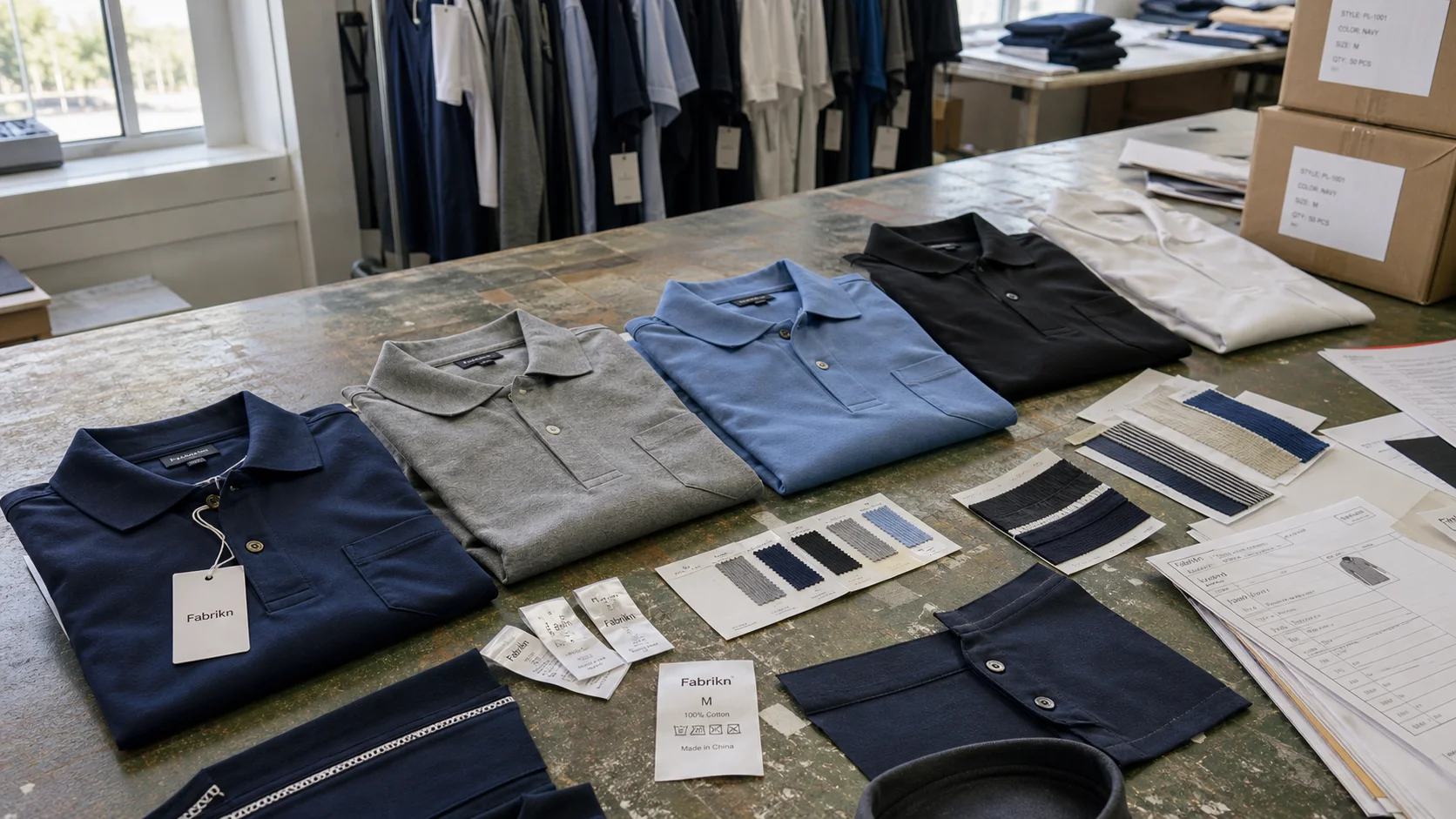
Premium Apparel Box Design for Startups with checks for samples, fit, MOQ, QC evidence, pricing terms, and delivery risk.
Fast answer: Premium Apparel Box Design for Startups: Board, Insert, Finish, and ROI should be judged by production evidence, not by a generic sourcing promise. The buyer needs sample proof, cost breakdowns, QC checkpoints, and delivery buffers in writing.
Ask for recent sample photos, measurement tolerances, fabric or print test assumptions, decoration test notes, packing examples, and a named inspection checkpoint. These details show whether the team can repeat an approved sample at bulk volume.
Separate garment cost, decoration, labels, packaging, sampling, testing, freight, and rush charges. When every cost line is visible, it becomes easier to reduce colorways, adjust size depth, or reserve more time for sampling.
A box has about seven seconds to make up its mind about your brand. That sounds dramatic until you watch a shopper lift the lid, run a thumb along the edge, and decide—before the garment is even touched—whether the package feels giftable, expensive, or forgettable. In direct-to-consumer apparel, premium apparel box design for startups can shape repeat purchase behavior before the first review is written. Vanity? No. Revenue.
Startups still treat packaging like a finishing touch. That’s a mistake. A box affects conversion because it signals value before the product is handled, it affects returns because damage and wrinkling rise when inserts are sloppy, and it affects recall because people photograph what feels worth sharing. A $4 box on an $80 order is hard to justify; on a $150 order, it often pays back through gifting, retention, and fewer support issues. At lower price points, premium apparel box design for startups needs to work harder and stay leaner.
Factory visits make the weak point obvious. In Guangdong, I watched a printer deliver crisp foil and perfect registration, then saw the folding line crack because the board spec was wrong. In Vietnam, a higher labor standard still produced dented corners because warehouse humidity sat above 70% for two weeks. In India, the print was beautiful, but the adhesive line was over-applied, creating bulges that ruined the lid fit. The problem rarely starts with the design file. It starts with the cheapest step in the chain.
Packaging is a commercial asset. It protects a French terry 320 GSM sweatshirt during a 3-4 week transit, makes a robe or set photo-worthy, and reduces damage claims that can eat 2% to 5% of revenue. If you already have private label clothing services in place, packaging should sit in the same planning conversation, not the last approval email.
Rigid boxes communicate premium immediately. They feel substantial, hold shape in transit, and suit hero SKUs, gifting, and subscription launches. Folding cartons cost less, ship flatter, and work for entry-level products, but they rarely deliver the same tactile authority. Corrugated mailers sit between the two: more protective, more practical, less delicate. Hybrid formats, with a rigid lid and corrugated base, are useful for brands balancing margin and unboxing theater.
I compare them this way. Rigid board at 1200-1800 GSM signals luxury and supports high perceived value. Paperboard at 300-600 GSM is efficient for tees, socks, and low-friction essentials. Corrugated E-flute or B-flute improves crush resistance for long-haul shipping and can lower damage rates by 15% to 25%. Semi-rigid hybrid formats cost more than plain cartons but less than full rigid builds, and they often make sense for knitwear, lingerie, and accessories where the product itself is light but presentation matters.
Finishes do a lot of signaling. Soft-touch lamination makes a box feel quiet and expensive, while foil stamping works best on logos and short text. Embossing and debossing add depth without relying on ink density. Spot UV can lift a mark or pattern, but I only recommend it where the brand can afford a slightly louder aesthetic. For minimalist labels, a matte board with one foil hit beats five competing effects. For premium apparel box design for startups, restraint usually photographs better than spectacle.
There’s a sustainability catch. Some “eco” finishes are only marginally better than plastic-heavy luxury packaging because they use mixed layers that are hard to recycle. A plastic-free aqueous coating or FSC-certified board is a stronger signal than vague green language. Inserts matter too. For shirts, a simple fold board and tissue is enough. For knitwear, a collar support or belly band prevents creasing. For lingerie, a flat insert keeps delicate straps from tangling. For accessories, die-cut compartments stop rattling and abrasion.
Packaging budgets should be built in tiers, because order size changes everything. In my notebooks, I separate entry-level, mid-tier, and premium programs. Entry-level custom cartons often land around $0.70-$1.40 per unit at 1,000-3,000 pieces. Mid-tier semi-custom builds usually run $1.80-$3.50 at 2,000-5,000 pieces. Premium rigid boxes can sit at $4.00-$8.50, sometimes higher, depending on board thickness, finish, and insert complexity. At 500 pieces, the same box can cost 30% to 60% more than at 5,000 pieces.
MOQ changes the economics fast. A startup that wants 300 boxes may be quoted like a one-off project rather than a production run, which pushes cost per unit up and narrows options on foil, embossing, or custom inserts. By 2,000 units, the price curve usually softens. By 10,000 units, tooling and setup costs begin to disappear into the volume. The hidden costs still remain: plates, dies, sampling, freight, warehouse space, and a 2% to 3% damage allowance for transit and fulfillment mistakes.
I’ve seen brands overpay by chasing the wrong savings. A box that costs $1.10 less per unit may arrive with weak glue or poor corner crush, then trigger returns or re-shipments that erase the win. If your average order value is $80 and premium packaging lifts conversion by just 1.5% while repeat purchase rises 3%, the box can be defended as a revenue tool rather than a vanity line item. On a $150 AOV, the math gets easier because the packaging share of margin falls.
Here’s the simplest framework I use. Stock packaging suits cash-strapped launches and fast tests. Semi-custom works when a brand needs visible identity without full tooling risk. Custom print becomes sensible when the SKU mix is stable, the annual volume is at least 5,000 units, and the team can absorb a 6-10 week production cycle. If you need help mapping packaging to product architecture, it can be smart to browse our product catalog for private label clothing services and align the box with the garment rather than treating them as separate purchases.
China remains the fastest route for complex finishing, with lead times often at 3-5 weeks for repeat orders and strong capacity for rigid boxes, foil, and detailed die-cuts. Vietnam is steadier on labor consistency and usually runs 4-6 weeks, though finishing options can be narrower. India can be highly competitive on paper-based structures and printed cartons, with 4-7 week cycles and strong value on labor-intensive work. Europe is the most expensive on paper, but quality control and compliance can be excellent, particularly for short runs and brands selling into premium retail.
The cheap quote is often the expensive quote. I’ve seen a factory in southern China offer a rigid box for 20% less than competitors, only for the sample to fail on corner alignment because the board supplier had switched caliper without warning. In Turkey, a higher-priced plant produced cleaner edges, yet the carton weights varied by 12 grams across the same order, which complicated shipping math. Price alone tells you very little. Glue application, die-cut accuracy, quality checks, and climate control matter more than a neat sales deck.
Here’s what most people miss: the final box usually fails at the weakest production step, not the visible one. A beautiful print file cannot fix a lamination line that bubbles at 28°C and 80% humidity, or a folding station that trims corners too tight. That’s why I ask for pre-production samples, line inspection photos, and a signed board spec before payment release.
For mass-market basics, the box can be simpler and sturdier. For designer-level apparel, the margins are often higher, but the tolerance for flaws is lower. I’ve seen brands that work with cut and sew manufacturing teams ignore packaging approvals until the last minute, then lose two weeks fixing board fit. The strongest suppliers treat packaging samples with the same discipline as garment fit samples.
Luxury and waste are no longer interchangeable. Paper-based packaging with recycled fiber content, FSC certification, and clean printing can feel expensive without relying on plastic-heavy laminates. According to Textile Exchange, material sourcing decisions matter because upstream impacts often dominate a product’s footprint. A box that uses 80% recycled board and a water-based coating usually outperforms one wrapped in laminated plastic sleeves that look rich but complicate recycling.
I’m skeptical of green claims that sound responsible but hide complexity. Compostable is not the same as commercially compostable. Recycled content does not guarantee low emissions if the box is oversized and shipped with excess void fill. A plastic-free soft-touch finish can be better than a mixed-material laminate, yet some brands still choose the latter because it photographs well. That is greenwashing by another name.
The smarter path is restraint. Fewer layers. Fewer coatings. More value per gram. A rigid lid with a single-color print, a debossed logo, and a recycled insert often feels more premium than a heavy box loaded with foil, film, and magnets. That approach also lowers freight density. A 15% reduction in board weight can trim shipping and storage costs in a way customers never notice, which is exactly the point. For premium apparel box design for startups, the calmest box usually wins.
Buyers should ask for FSC chain of custody documents, recycled content percentages, and tested recyclability claims. If a supplier cannot state whether the board is 60%, 80%, or 100% recycled, that is a signal to slow down. When a brand sells both apparel and accessories, one packaging system can often serve several product lines if the insert is redesigned rather than the whole box. That is where sustainability and commercial discipline meet. For additional due diligence on responsible sourcing and trade compliance, see the OEKO-TEX standards and the U.S. International Trade Administration.
A strong brief saves money before the first sample is made. I want dimensions in millimeters, product weight in grams, printing method, finish, target MOQ, shipping mode, and the full insert requirement. If the box will hold a 320 GSM hoodie, a silk shirt, or a lingerie set, say so. A supplier cannot engineer protection for an unspecified product. I also include acceptable tolerances, usually plus or minus 2 mm on key dimensions, because vague specs invite rework.
The sample chain should move in stages. Start with a dieline, then a plain prototype, then a printed sample, then a pre-production sample. Each stage should answer one question only. Does the product fit. Does the lid close cleanly. Does the finish read correctly under daylight. Does the box survive drop and compression tests. For carton testing, I like references to ASTM methods because they give the conversation structure instead of opinion.
Ask direct questions. What is the board caliper. Which glue type is used. What is the drying time. How is color matched, Pantone or digital proof. What happens if humidity rises during packing. Is the print line inspected every 500 units or only at the end. These answers tell you more than a polished price sheet. If you need to compare suppliers quickly, get a custom packaging quote from fabrikn.com and ask for sample-stage pricing broken out line by line.
The common briefing errors are easy to spot. Brands send mood boards without tolerances. They specify a luxury look but no shipping mode. They forget insert sizing for zips, buttons, or fragrance add-ons. They approve artwork before the structural fit. I rate suppliers on four points: responsiveness, documentation quality, sample accuracy, and willingness to flag risks. A factory that asks hard questions early is usually cheaper than one that agrees to everything.
I recommend a 30-day packaging pilot before a full run. Week one is concept validation: confirm structure, insert, and visual hierarchy. Week two is sample approval and a small internal drop test. Week three is a pilot shipment of 100-300 units, ideally across 2-3 hero SKUs. Week four is review. Track damage rate, open rate, photo share rate, and customer comments that mention packaging by name.
Use A/B testing with intention. Test the premium box against a stock mailer for one product category, not the whole catalog. Compare gifting-season orders against everyday basics. Compare a $40 accessory box, an $80 shirt box, and a $150 knitwear box, because the return curve is different at each tier. I’ve seen premium packaging work best on hero SKUs and bundles, where perceived value can lift the whole basket.
Measure what matters. Packaging cost as a percent of AOV should be visible from day one. I like a target band of 3% to 8% for premium apparel, depending on order value and finish complexity. Also track repeat purchase rate over 60-90 days, because the first sale is only half the story. If the box increases social shares but damage remains high, the structure is wrong. If damage falls but conversion does not move, the presentation is too plain.
Once you have three signals, decide quickly. Scale if the box lifts repeat sales and stays under budget. Simplify if the structure works but the finish is expensive. Redesign if sample approval was easy but fulfillment keeps failing. If you want to compare packaging with the garments themselves, cut and sew manufacturing details for apparel brands can help you align fit, fabric, and presentation. The box should earn its place in the margin sheet, not just the mood board.
At small volumes, custom cartons often run $0.70-$1.40 per unit, semi-custom builds $1.80-$3.50, and rigid boxes $4.00-$8.50 or more. MOQ, finish complexity, and insert design can move pricing by 30% to 60%.
Typical timelines are 3-5 weeks for repeat production and 5-8 weeks for a first project with sampling. Add 1-2 weeks if you need multiple prototype rounds or if the factory is building new tooling.
Rigid board, high-grade paperboard, and E-flute corrugated are the most common choices. For a premium feel, many brands use FSC-certified board, water-based coatings, and recycled content of 60% to 100%.
Yes, if the packaging improves perceived value, reduces damage, and photographs well enough to drive sharing. I have seen repeat purchase lift by 3% to 5% when packaging is aligned with the brand and product price point.
Ask for board caliper, glue type, finish method, tolerances, sample stages, and test results for compression or drop performance. Also confirm MOQ, freight mode, and whether the supplier can document recycled content and FSC chain of custody.