
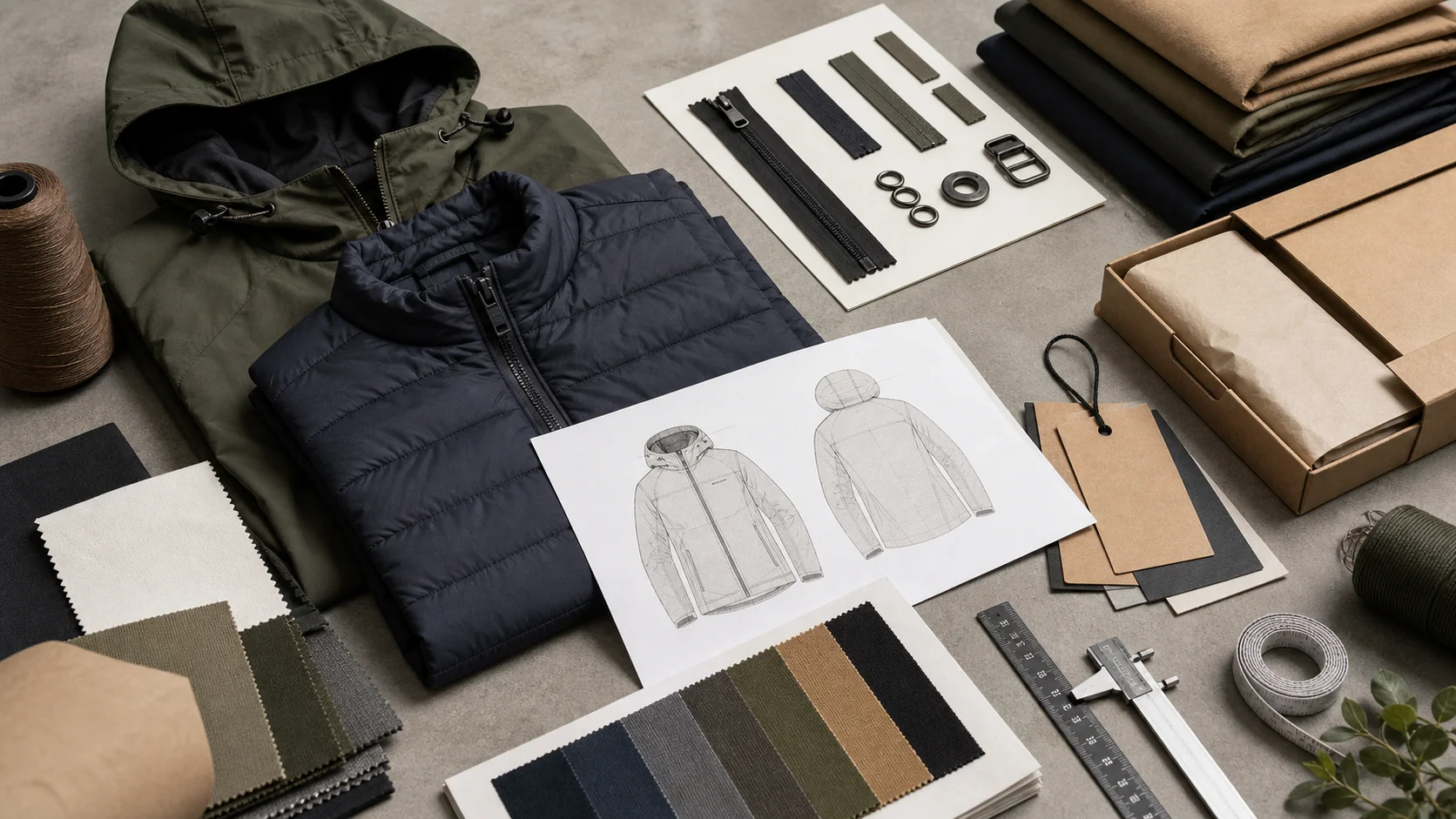
Premium Clothing Box Design with checks for samples, fit, MOQ, QC evidence, pricing terms, and delivery risk.
Fast answer: Premium Clothing Box Design: Board, Inserts, Finish, and Cost should be judged by production evidence, not by a generic sourcing promise. The buyer needs sample proof, cost breakdowns, QC checkpoints, and delivery buffers in writing.
Ask for recent sample photos, measurement tolerances, fabric or print test assumptions, decoration test notes, packing examples, and a named inspection checkpoint. These details show whether the team can repeat an approved sample at bulk volume.
Separate garment cost, decoration, labels, packaging, sampling, testing, freight, and rush charges. When every cost line is visible, it becomes easier to reduce colorways, adjust size depth, or reserve more time for sampling.
A beautiful box can still collapse the moment it meets real production. I watched a $7.80 rigid box turn into a warped tray because humidity hit 72% and the laminator drifted by 1.5 mm. Minor on paper. Not in production. In factory audits, small folding and lining defects can push reject rates up 8-15%, and once scrapping starts, labor and freight climb together.
Vietnam. Portugal. The U.S. The gap was obvious. A fast domestic run could hit sampling in 3-5 days and keep die-cut accuracy within 0.8 mm, but unit cost was usually 18-30% higher on runs under 1,000 pieces. Offshore shops had better economics at 5,000-20,000 units, yet consistency lived or died on operator skill, climate control, and how tightly the board spec was written. Artwork mattered, sure. The final feel came from the fold line, the wrap tension, and the lid compression.
So many buyers chase foil color and forget board density. A 1.8 mm grayboard with uneven caliper still feels cheap under luxury print. A 2.5 mm board with clean corners, controlled moisture, and sharp die-cutting feels expensive before the logo even registers. That is why I treat packaging as a manufacturing brief, not a mood board. For brands building clothing packaging solutions, premium clothing box packaging design tells the truth faster than any deck.
Audit the board stock. Ask for humidity logs. Inspect corner crush. Measure lid fit across 10 samples, not one. Premium cues survive when production is boring and disciplined. They vanish when the line is rushed for launch.
Shoppers read packaging before they read price tags. A box weighing 180-250 grams, closing with a firm shoulder or magnetic flap, and wrapped in soft-touch or textured stock can lift perceived value by a full price tier in testing. I have seen a $48 shirt feel like a $78 gift because the box had a dense core, tight edges, and a lid that stayed silent. The product did not change. The trust did.
Mass-market apparel boxes lean on light folding cartons, standard kraft liners, and visible glue seams. Premium boutique boxes move to rigid board, cloth-like wraps, foil accents, and inserts that keep the garment from shifting. Designer packaging pushes further with heavier board, concealed magnets, and tactile coatings that mute glare under retail lights. Across 60 store visits, the boxes that looked most expensive were not the most ornate. They were the most controlled.
The thing nobody tells you: minimal boxes often beat ornate ones in repeat purchase tests. In one consumer panel I reviewed, a plain white rigid box with a debossed logo beat a heavily foiled box by 11% on “would buy again” because shoppers read restraint as confidence. That result held in New York and Seoul, even though the ornate version scored higher on first-impression social sharing. Drama fades.
E-commerce buyers notice different cues than in-store shoppers. Online, box stiffness, lid fit, and photo-friendly surfaces matter most because unboxing is filmed in 3-8 seconds. In-store, weight and surface tactility matter more because the box gets handled before opening. Giftability changes the numbers too: a box that survives shipping with under 2% corner crush reduces returns, while a box that photographs well can generate 15-20% more user-generated content. For premium clothing packaging aimed at gifting, drops, and limited editions, premium clothing box packaging design has to earn its keep.
For brands doing private label clothing services, packaging has to justify a higher margin without looking overworked. Loud sells once. Controlled sells twice.
Rigid box versus folding carton is the first fork in the road. Rigid boxes use 1.5-3.0 mm grayboard or chipboard, wrapped in printed paper, specialty paper, or textile-like stock. Folding cartons use 0.4-0.8 mm paperboard and cost less, often $0.20-0.70 per unit at scale, but they rarely carry the same structural weight. A premium clothing box packaging design brief usually starts with rigid board when the product price sits above $60 and the brand wants a giftable feel. Foldable formats still work for entry luxury, but only with very clean print and dense board.
Most cheap-looking failures are not about graphics. Weak board density. Bad lamination. I have opened boxes that looked elegant, then watched the lid flare because the board had absorbed moisture or the wrap bond failed at the corners. Soft-touch coating can hide minor print noise, but it also shows fingerprints and scuffs if the film is too thin. Matte aqueous coating is cheaper, more recyclable, and less likely to slide into that velvet-plastic look some buyers mistake for luxury.
Paper wrap choices tell their own story. Uncoated specialty papers can signal craft. Coated art paper gives sharper print and foil definition. FSC-certified recycled wraps offer a cleaner sourcing narrative, though recycled fibers can reduce brightness by 5-10 points and make whites less crisp. According to GOTS guidance on chemical control and certified materials, claims need paperwork, not adjectives. “Eco paper” is not a spec. Ask for chain-of-custody, mill origin, and exact recycled content percentage.
Regional sourcing varies more than most buyers expect. China and Vietnam often source board, magnets, and inserts in one supply cluster, which can lower lead time to 20-35 days. Portugal and Turkey can offer faster access to specialty papers and higher-touch finishing, but magnets and ribbons may be imported, adding 7-12 days. The U.S. and Mexico are strong on short runs and domestic freight, though specialty wraps can cost 12-20% more. For brands with technical product lines, such as custom baby clothing manufacturing, that sourcing math matters because packaging has to line up with safety, softness, and finish consistency.
Look for recycled content targets of 30-100%, but verify with supplier declarations and test reports. I ask for FSC certificates, paper mill specs, and an actual sample cut, because a certificate alone will not prove the board will hold a sharp corner after 500 miles of freight.
Unit cost kills the romance fast. At 500 units, a domestic premium rigid box can land at $4.50-9.00 per piece, depending on size, wrap, and finishing. The same spec in a regional factory might price at $2.80-5.50, while an overseas run at 20,000 units can fall to $1.20-2.40 before freight and duty. That spread looks seductive until samples, air freight, and rework get added back in. MOQ changes can swing cost by 20-40% because setup, waste, and labor get spread across fewer boxes.
At 5,000 units, the economics start behaving. A plain rigid box with no foil may sit around $1.90-3.10 overseas and $3.80-5.70 domestically. Add hot foil and the line usually jumps $0.12-0.35 per unit. Embossing adds $0.08-0.22. A custom insert can add $0.18-0.60 depending on whether it is paperboard, molded pulp, or foam. Specialty paper can add another $0.20-0.90, and a magnetic closure often adds $0.25-0.70. Small numbers, until a 20,000-piece order multiplies them.
Lead times matter as much as the unit rate. Domestic suppliers may ship in 2-4 weeks for a repeat program, but rush fees can add 10-18%. Regional factories often need 4-6 weeks plus ocean transit, while offshore production may take 6-10 weeks and then another 3-5 weeks in freight and customs. During peak season, I have seen air freight erase 35-50% of the savings from a low factory price. Freight is the silent line item that makes a cheap box expensive.
For a brand producing cut-and-sew apparel with multiple colorways, the packaging budget should be planned alongside garment COGS. A partner experienced in cut and sew manufacturing can coordinate box sizes around SKU mix, which reduces empty space and shipping cube. That matters because a 10% reduction in carton volume can cut transport costs by 6-12% on some lanes.
The trims with the biggest visual return per dollar are usually foil logos, precise embossing, and a better board grade. Oversized magnets, heavy ribbon pulls, and interior print nobody sees after opening return less. Spend where the hand lands and the lid closes. That is where shoppers decide whether the box belongs to the brand.
Mixed materials break a lot of sustainability claims. A box may use recycled board, yet still contain plastic magnets, laminated wraps, synthetic ribbons, and glue that complicate recovery. I have seen brands announce “100% recyclable” while using a soft-touch film and a foam insert. That is marketing, not documentation. The gap between claim and reality shows up at the mill, not the meeting.
Recycled board performs well, but not always equally. Virgin board usually offers better stiffness, cleaner print hold, and more predictable die-cutting, especially on premium light colors. Recycled board can show more fiber variation and slightly lower burst strength, though many mills now produce grades that perform within 5-12% of virgin stock on common box specs. If the design calls for sharp embossing or a heavy lid, ask for board tests before switching grades. For recycled content and fiber sourcing benchmarks, I cross-check against Textile Exchange methodology where applicable to broader material claims, and against supplier mill data for paper-specific evidence.
Shipping weight and cube efficiency hide another tradeoff. A rigid box can weigh 120-300 grams more than a folding carton, and across 10,000 units that adds 1.2-3.0 metric tons of freight weight. If the box is oversized by even 8-10 mm on each side, cube waste can raise air and parcel charges by 4-9%. A low-impact design is often the one that fits tighter, ships flatter, and uses fewer mixed components.
Some premium effects can be achieved without sabotaging recovery. Debossed logos, blind embossing, water-based inks, recycled paper wraps, and paper inserts all preserve a cleaner material story. I also prefer paper-based tear strips over plastic seals when the customer journey allows it. For brands selling premium clothing packaging to conscious consumers, the smartest claims are narrow and provable: recycled content percentage, FSC chain-of-custody, and tested recyclability in a defined market.
Do not use vague labels like “planet-friendly” or “green” unless you can back them with documents. Ask suppliers for coatings data, adhesive specs, and a disposal pathway that matches the destination market. Thin paperwork, weak claim.
The best briefs read like manufacturing documents, not mood boards. Start with box dimensions, garment fold size, target shipping method, closure style, and finish level. Then specify board thickness, wrap type, print method, and tolerances. I ask brands to define acceptable corner crush, lid resistance, and color drift before sample one. If you do not define the fail points, the factory will define them for you.
A standard sample cycle takes 2-4 rounds and 10-21 days. A rushed approval can collapse that to 5-7 days, but the risk rises fast. In one project, a brand approved a sample after a single photo because the deadline was near. The production run then shipped with a 2.4 mm lid gap and 6% scuff rejection. The fix cost more than the box budget for the whole season. Speed is expensive when the spec is untested.
Test protocols should stay practical. Check dieline accuracy within 1 mm, compression resistance after 24 hours under stack load, scuff resistance after 20-30 rub cycles, and closure fit after repeated open-close tests. If there is foil, confirm registration under raking light. If there is a magnet, test pull strength and alignment. If the box uses soft-touch, ask for abrasion results and fingerprint review under retail lighting. Small checks. Large savings.
Supplier scorecards cut emotion out of the process. I grade communication speed, sample accuracy, defect tolerance, and willingness to fix errors without excuses. A manufacturer that replies within 24 hours, ships a corrected sample in 3-5 days, and documents every revision is worth more than one that quotes 8% lower but misses every sign-off deadline. Buyers choosing premium clothing box packaging design should compare factories on process discipline, not just print samples.
Before mass production, request final material specs, compliance records, and a pre-production sample signed by both sides. Also ask for a pilot run of 100-300 units if the order exceeds 5,000. The right buying framework is simple: pay for structure, pay cautiously for decoration, and pay only for sustainability claims you can verify.
Start with three suppliers, not ten. Ask each supplier, factory, and wholesale partner for board specs, wrap options, test data, FSC chain-of-custody, compliance records, MOQ, and sample timelines. Then compare defect rate, rework policy, freight efficiency, and sample accuracy. A low quote with a 12% reject rate is not cheap. It is administrative debt.
Over 30 days, run one pilot, one cost review, and one sustainability check. Day 1-7: send the brief. Day 8-14: review dielines and samples. Day 15-21: confirm material claims and freight math. Day 22-30: approve a pilot run of 100-300 units and measure damage, fit, and presentation. For brands scaling with private label clothing services, this sequence protects margin without sacrificing shelf impact.
My advice is plain: pay for structure, not decoration. A premium clothing box packaging design that feels solid, closes cleanly, and survives shipping will do more for brand value than a box covered in expensive flourishes and weak engineering. Get that part right, and the next shipment has a better chance of looking as expensive as it should.
It is the planning of rigid or high-quality folding boxes for apparel so the box communicates value, protects the garment, and supports brand presentation. The strongest designs usually use 1.5-3.0 mm board, precise dielines, and controlled finishing.
At 500 units, domestic pricing often lands at $4.50-9.00 per box, while regional production can sit around $2.80-5.50 and high-volume offshore runs can reach $1.20-2.40 before freight. Foil, embossing, inserts, and specialty paper can add $0.08-0.90 per unit each, depending on spec.
Standard sample cycles usually take 10-21 days and 2-4 rounds. Production often takes 3-6 weeks domestically or regionally, while overseas runs can take 6-10 weeks plus 3-5 weeks for freight and customs.
Use FSC-certified paper, recycled board with verified content, paper inserts, water-based inks, and mono-material construction where possible. Avoid plastic magnets, foam inserts, and mixed laminations unless you have a clear recovery plan and documented testing.
Ask for material specs, FSC chain-of-custody, compliance records, compression and abrasion test data, dieline tolerances, and a signed pre-production sample. Also ask how they handle rework, defect rates, and freight packaging to reduce damage in transit.