
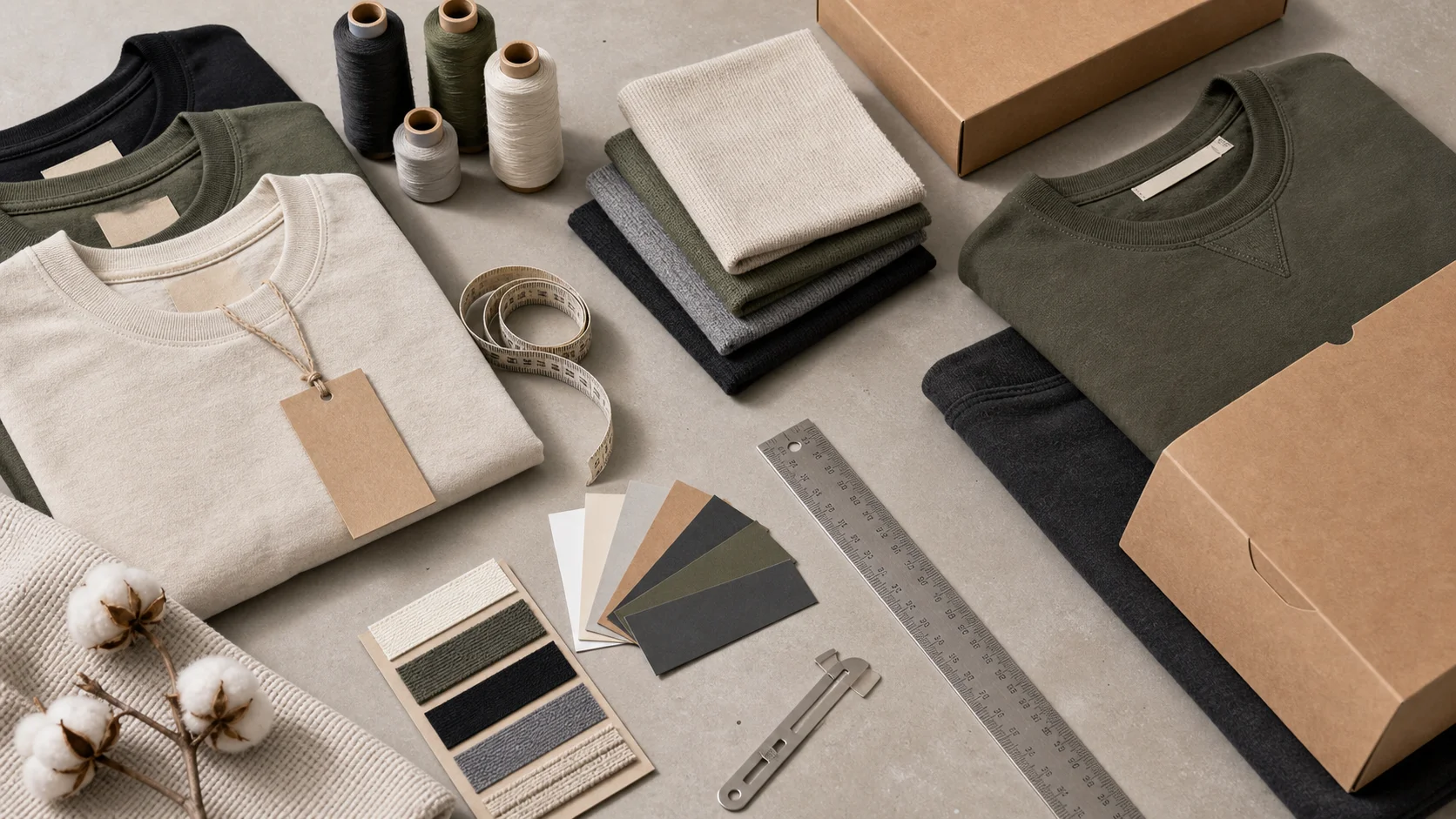
Custom Apparel Shipping Boxes with checks for samples, fit, MOQ, QC evidence, pricing terms, and delivery risk.
Fast answer: Custom Apparel Shipping Boxes: Board, Size, Print, and Damage Control should be judged by production evidence, not by a generic sourcing promise. The buyer needs sample proof, cost breakdowns, QC checkpoints, and delivery buffers in writing.
Ask for recent sample photos, measurement tolerances, fabric or print test assumptions, decoration test notes, packing examples, and a named inspection checkpoint. These details show whether the team can repeat an approved sample at bulk volume.
Separate garment cost, decoration, labels, packaging, sampling, testing, freight, and rush charges. When every cost line is visible, it becomes easier to reduce colorways, adjust size depth, or reserve more time for sampling.
The box that saves a few cents can cost you a few hundred dollars.
Apparel returns average 20% to 40% for many direct-to-consumer labels, and in several factory audits I’ve done, packaging was driving a painful share of that waste. For brands evaluating custom shipping boxes for apparel brands, the real issue is not just branding; it is whether the carton protects the product well enough to prevent damage, complaints, and repeat freight charges.
A crushed carton, a scuffed print, or a garment sliding around inside the box turns a $38 order into a complaint, then a replacement, then a second freight charge.
Vietnam. Portugal. Los Angeles. I’ve walked packing lines where teams were using two different box standards for the same SKU because one version survived transit better. Sounds inefficient. Then the numbers show up: a 12x9x4 plain mailer can ship at a lower unit cost than a custom box, but if the box is too flimsy, a 3% damage rate can wipe out the savings fast.
For a boutique brand shipping 500 orders a month, a $0.42 stock box may look clever. For a premium label moving jackets, denim, or multi-item sets, a $0.78 to $1.25 branded carton can be cheaper in practice if it cuts reships, gift-wrap complaints, and customer service time. I’ve seen support teams spend 8 to 12 minutes per damaged order, and that labor never appears on the packaging invoice.
Custom shipping boxes for apparel brands also change how the customer reads the product before opening it. A rigid box with clean registration tells a story of control. A floppy mailer with warped corners tells a different one. Theft risk rises, too, when packaging telegraphs what is inside and the box crushes easily in transit.
Here’s the part people miss: the slightly sturdier box often wins on total landed cost. Add $0.12 to $0.20 per unit and you can still come out ahead if reships, complaints, and printed insert losses drop enough. In my experience, the cheapest box is rarely the cheapest choice.
Most buyers start with artwork. I start with board grade. Ask the manufacturer or factory to quote flute type, paper weight, ECT, closure style, glue spec, and print method before you talk color. For apparel, a 32 ECT corrugated board is common for light knits, while 44 ECT or better is safer for denim, outerwear, and bundles that push weight toward 6 to 10 pounds.
For tees and light loungewear, 9x6x2 or 10x8x3 formats work well because they keep the garment flat and reduce void fill. Folded denim needs more crush resistance, and puffier items like fleece or quilted jackets often need deeper boxes with better panel recovery. A 1-piece shirt order and a 3-item set should not share the same carton spec. That is where margins leak.
Right-sizing matters more than most founders expect. A box that is 15% too large can raise dimensional weight charges, invite creasing, and force extra kraft paper or air pillows into the pack. That adds labor, not just material. I’ve measured fulfillment tables where right-sizing cut packing time by 20 to 30 seconds per order, which sounds tiny until you multiply it across 5,000 shipments.
Print finish should signal value, not vanity. A one-color flexo print or clean litho-laminate can do enough for mid-market labels. Soft-touch coating, foil, and heavy embossing make sense for luxury or limited drops, but they often add $0.30 to $1.10 per unit and rarely improve retention by themselves. If your repeat rate is driven by fit, not presentation, spend the money on better sizing notes first.
At a factory making packaging for custom bra manufacturing, the team showed me how closures and board thickness changed edge crush more than the artwork ever did. Same lesson here. Mechanics first. Branding second.
At 500 units, a plain stock mailer might cost $0.35 to $0.60, while a one-color custom box often lands around $0.85 to $1.40, and a fully printed carton can reach $1.60 to $2.80 depending on board, size, and finish. At 2,500 units, those numbers usually fall to about $0.28 to $0.48, $0.62 to $1.05, and $1.10 to $2.10 respectively. At 10,000 units, I’ve seen one-color custom packaging dip below $0.50, with premium versions settling near $0.85 to $1.60.
The visible quote is never the full quote. Tooling, printing plates, sampling, freight to your warehouse, and storage all sit outside the unit price. A plate charge may run $180 to $600. A dieline adjustment can add $75 to $250. Inland freight from port to fulfillment center can tack on another $0.04 to $0.18 per carton if you are moving palletized stock across regions.
I like to compare cost per order and cost per impression. A box that costs $0.30 more can be justified if it reduces a 4% damage rate to 1.5%, or if it replaces a separate branded sleeve worth $0.22. For a brand shipping 8,000 orders a quarter, shaving $0.07 in complaint-related costs per order yields $560 back. That is often enough to pay for better board or cleaner printing.
There is a hidden storage tax, too. Larger custom runs can save on unit cost but lock up cash and warehouse space. I’ve watched brands order 15,000 cartons to save $0.11 each, only to pay for 14 pallets of storage for 6 months. That can erase the gain. Small labels often do better with 500 to 2,500 units, especially if their assortment changes every 8 to 12 weeks.
For private label brands, the packaging choice should match the production system. If you are already coordinating fabric, trims, and labeling through private label clothing, add the box spec early so the container size matches the finished garment fold. I’ve seen a $1.08 box outperform a $0.79 option because it reduced overpacking, which trimmed labor by 11% and cut damage claims almost in half.
Recycled content is not the same as recyclability. A carton can contain 80% recycled fiber and still fail in a wet route, while a virgin-fiber box may recycle cleanly but carry a worse upstream footprint. FSC certification matters because it verifies responsible sourcing of paper fiber, and inks matter too. Soy-based inks reduce some petroleum inputs, but they are not a magic fix.
According to FSC, chain-of-custody standards only mean something when the supplier documents the paper source all the way through production. Data from ISO standards around packaging testing shows that compression and transport performance should be measured, not assumed. I’ve seen “eco” cartons fail in humid lanes between Southeast Asia and Gulf Coast warehouses because the coating absorbed moisture and the corners collapsed.
That is why coatings deserve scrutiny. Water-based coatings and light aqueous varnishes can protect graphics without making the carton unrecyclable in many paper streams, while heavy plastic lamination often blocks recovery. For humid routes, I prefer a stronger board and a lighter finish rather than a thin recycled board with a glossy film that traps moisture. A brown box is not automatically greener if it ships empty air or causes breakage.
By region, the trade-offs shift. European premium brands often pay 10% to 25% more for certified board and tighter print compliance. US mass-market labels usually trade more on price and speed, so recycled content and standard kraft finishes dominate. In parts of South Asia, the challenge is less the recycled claim and more consistent fiber quality from lot to lot, especially on runs below 2,000 units.
My skeptical view is simple. Sustainability copy should describe the material, the certification, and the actual recovery path. Saying “100% eco-friendly” tells me nothing. Saying “FSC-certified 32 ECT board, water-based ink, curbside recyclable in most markets” gives me something I can audit.
For brands sourcing custom shipping boxes for apparel brands from China or another overseas supplier, it also helps to verify quality and production standards with third-party documentation. If sustainability is central to your positioning, review programs like OEKO-TEX and trade and compliance guidance from the U.S. Department of Commerce alongside your packaging spec.
Domestic converters win on speed. In the US and UK, I’ve seen lead times of 2 to 4 weeks for repeat orders, with minimums as low as 250 to 500 units for simple structures. Offshore suppliers can price lower, especially at 5,000 units and above, but standard lead times often stretch to 6 to 10 weeks, plus ocean transit and customs clearance.
Quality consistency varies sharply. Local suppliers usually offer faster proof approval, easier corrections, and fewer language gaps on technical notes like burst strength, flute direction, and glue placement. Overseas factories can still produce excellent work, but the sample-approval loop is slower. One missed print registration by 1.5 mm can delay a launch by 2 weeks if the correction has to travel through three people and two time zones.
Hybrid sourcing sits between those poles. A brand can run cartons overseas, then warehouse them regionally for faster fulfillment. That model works well once demand is stable at 3,000 to 10,000 orders a month. It also helps with tariff swings and stock-outs. I’ve seen a hybrid setup save 14% on unit cost versus domestic production while keeping 5-day replenishment from a local distribution hub.
Factory visits reveal the real differences. In Portugal and Mexico, compression tests and carton fold memory are often checked with more care for premium labels. In parts of Asia, print registration can be excellent, but sample approval delays happen when buyers change details late in the process. I always ask for a pre-production sample, an unprinted structural sample, and a packed-drop test before signing off.
For cut-and-sew brands building complex assortments, package specs should sync with garment production. If you already work through cut and sew manufacturing, the box should reflect final folded dimensions, trim bundles, and polybag thickness. That coordination saves waste and cuts surprise freight charges.
When comparing a manufacturer, factory, or supplier, I also look at MOQ, wholesale pricing, and bulk storage support. The best partner for custom shipping boxes for apparel brands is not always the cheapest; it is the one that can hold quality across repeat production and adjust quickly when your assortment changes.
Packaging sells when it photographs well and opens cleanly. Minimalist branding can outperform full-coverage print for luxury and contemporary labels because it reads expensive without shouting. Streetwear often does better with bolder graphics and a stronger inside print moment. Mass-market brands should keep the front simple and reserve spending for structure, because the box must survive rough handling more often than it must impress on camera.
I’ve watched customers post unboxings of a plain kraft carton with one sharp black logo, then ignore a heavily printed box that looked busy and cheap. The difference was not ink coverage. It was proportion, board rigidity, and the way the lid opened with just enough resistance. A box that opens awkwardly feels accidental. A box that opens cleanly feels designed.
Return-friendly structures matter more than many founders admit. Tear strips, reseal tabs, and double-flap closures can reduce friction for exchanges, especially in categories with fit uncertainty. That is useful for subscription basics, denim, and occasionwear where the first purchase carries more risk. A smart closure can also lower tape use by 1 to 2 strips per order, which saves time across 10,000 shipments a month.
The thing nobody tells you: too many inserts can feel wasteful and slow packing by 6 to 10 seconds per order. I’ve seen brands add tissue, cards, stickers, and a booklet, then wonder why fulfillment labor rose without moving retention.
One well-placed care card, a size guide, and a return slip often do more than a pile of extras. If the garment itself is thoughtfully made, packaging should support the sale, not cosplay as a gift shop. The best custom shipping boxes for apparel brands make the product look ready before the lid is even fully open.
Start with data, not artwork. Before you place a box order, gather product dimensions for your top 5 SKUs, packed weight, warehouse packing method, print files, forecast volumes for 90 days, and the exact carton size limits your fulfillment partner can handle. If your team cannot state whether packs are folded with tissue, polybags, or belly bands, stop there and document it.
Your first test should include a dieline review, a plain white sample, and a packed sample with real garments. Drop test it from 30 inches on 6 faces, then do a crush test with 20 to 30 pounds of pressure for small cartons and more for outerwear. Check whether the lid bows, whether the corners split, and whether the product shifts more than 1 inch inside the box.
Timeline matters. A rush domestic run can be 10 to 14 days if the structure already exists and the art is final. A standard new-run production cycle is usually 3 to 5 weeks for proofing, 1 to 2 weeks for print approval, and another 1 to 3 weeks for delivery, depending on distance and inventory buildup. Offshore runs typically need 6 to 10 weeks before freight, so plan backward from launch.
Approval should be cross-functional. I want sign-off from merchandising, fulfillment, finance, and logistics, not just marketing. Finance should see the full landed cost. Fulfillment should confirm how many cartons fit on a pallet, because 1,200 boxes that stack badly can cost more than 1,500 that stack well. And if you need a quick starting point, request a custom packaging quote for apparel boxes after you have your measurements and forecast ready.
I’ve seen brands save their first run by ordering 300 test units, running them for 2 weeks, then revising the dieline before committing to 5,000 more. That is a smarter spend than discovering a fit flaw after the boxes are printed and sitting in a warehouse. Treat custom shipping boxes for apparel brands like part of the product, not an afterthought, and the first run stops being a gamble.
At 500 units, expect about $0.85 to $2.80 per box depending on board, print, and finish. At 10,000 units, many brands land closer to $0.50 to $1.60. Add $180 to $600 for tooling or plates, plus freight and sampling.
T-shirts usually fit well in 9x6x2 or 10x8x3 cartons. Denim needs stronger board and more depth, often 10x8x4 or larger, while jackets may need 12x10x4 or 14x10x5. The right box should keep void fill under 15% of internal space.
Domestic runs can take 2 to 5 weeks from approved artwork to delivery. Offshore production often takes 6 to 10 weeks before freight, then add transit time. Rush orders are possible, but they usually cost more and leave less room for sampling.
They can be, if the box uses certified recycled content, sensible coatings, and a size that avoids empty air. A recycled box that crushes in transit or ships with 30% void fill can create more waste than a sturdier alternative. Look for FSC or similar chain-of-custody proof.
Yes. Many domestic suppliers accept 250 to 500 units for simple designs, while offshore minimums often start at 1,000 to 3,000 units. Small runs are useful for seasonal launches, fit tests, and brands that change packaging every 8 to 12 weeks.