
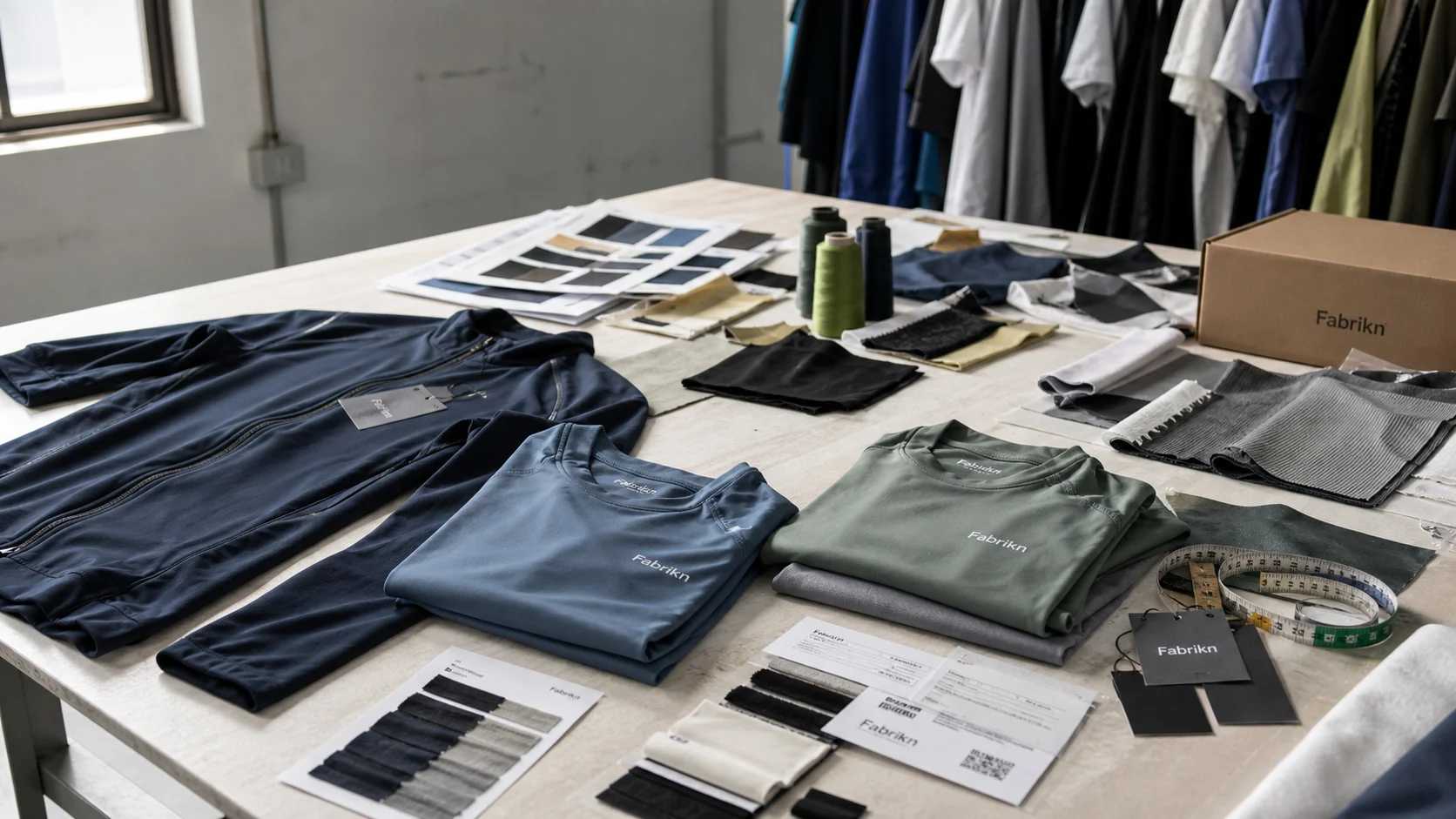
Premium Clothing Packaging Inserts with checks for samples, fit, MOQ, QC evidence, pricing terms, and delivery risk.
Fast answer: Premium Clothing Packaging Inserts: Material, Cost, Rules, and Packing should be judged by production evidence, not by a generic sourcing promise. The buyer needs sample proof, cost breakdowns, QC checkpoints, and delivery buffers in writing.
Ask for recent sample photos, measurement tolerances, fabric or print test assumptions, decoration test notes, packing examples, and a named inspection checkpoint. These details show whether the team can repeat an approved sample at bulk volume.
Separate garment cost, decoration, labels, packaging, sampling, testing, freight, and rush charges. When every cost line is visible, it becomes easier to reduce colorways, adjust size depth, or reserve more time for sampling.
A perfect silk shirt can still feel disappointingly ordinary if it arrives folded like office paper. Premium clothing packaging inserts are often the first tactile proof of quality, not the garment itself. I’ve seen them do more persuasion in five seconds than a full product page does in five minutes, especially when a customer opens a box at home after paying $120 for a blouse or $280 for tailoring.
Factories in Vietnam and Portugal showed the same pattern. Premium clothing packaging inserts reduced creasing, stabilized collars, and kept sleeve heads from collapsing during a 3,000-km transit or a 72-hour air shipment. Brands that treated them as an afterthought were dealing with 6% to 11% damaged returns on delicate categories, while better-structured pack-outs often sat closer to 2% to 4%. That gap matters.
If a return costs $14 to process and a replacement shipment runs another $6 to $18, the math gets ugly fast. The difference between a $0.08 insert and a $0.45 one sounds small until you scale it across 10,000 units. At that point, the extra spend is $3,700, but the avoided damage, fewer customer complaints, and stronger review scores can pay for it twice over.
Luxury brands use that logic to protect margin. Mid-market labels use it to defend price increases. DTC brands use it to keep unboxing photos looking intentional rather than improvised. If your apparel brand also manages clothing packaging solutions, premium clothing packaging inserts are not a small accessory. They are part of the product story, and the story starts before the garment is touched.
The thing nobody tells you: expensive materials do not always perform better. I’ve watched a $0.62 coated board fail because the die-cut was off by 2 mm and the fold memory was weak, while a $0.19 kraft piece with tighter scoring held shape through six handling steps.
That was the lesson from one Seoul factory and one in Guangzhou. The packaging room can be immaculate, the paper stock can be premium, and the result can still look sloppy if the crease geometry is wrong. Buyers love to compare paper weights. They should also be measuring tolerances.
Material choice should start with the garment, not the mood board. Tissue works for lightweight shirts and scarves, kraft board suits folded tees and denim, molded pulp handles shape retention, foam protects accessories and structured pieces, satin signals luxury, and nonwoven fabric sits somewhere between presentation and protection. Each option carries trade-offs in weight, cushioning, printability, and moisture control.
For a 180 GSM cotton tee, 17- to 22-gsm tissue is enough if the box is rigid and shipping is short. For a 320 GSM French terry hoodie, a board insert around 0.8 to 1.5 mm thick gives better structure and reduces collar crush. Tailored jackets and silk blouses need more precise support; foam or laminated board can prevent pressure marks, but heavier inserts add freight cost, especially in air shipments where every 100 grams matters.
Europe often favors tighter environmental rules and smaller MOQs. I’ve seen 2,000-piece minimums for printed board inserts in Spain, with lead times of 3 to 5 weeks. In parts of Asia, 5,000 to 10,000 pieces is more common, but the unit price can fall 15% to 30% at higher volume. North America sits between those two patterns, though recycled board and specialty finishes may extend lead times by 1 to 2 weeks.
The sustainability trade-offs are not tidy. Recycled paperboard with water-based ink can be recyclable, but a soft-touch coating or heavy adhesive strip can contaminate the fiber stream. Satin looks beautiful and often photographs well, yet it can be harder to recycle than plain board. Molded pulp uses less virgin fiber in many cases, but poor fiber sourcing or mixed coatings can still weaken end-of-life performance. Data from Textile Exchange shows how fiber sourcing decisions compound quickly once volume rises, even for packaging-adjacent material planning.
For babywear, the standard is even stricter. If a brand also works in custom baby clothing manufacturing, I push teams toward low-lint, low-odor, and low-ink options, because parents notice residue and scent faster than they notice a foil logo. That category punishes shortcuts. A soft matte insert can feel premium without introducing unnecessary coatings or fragrance transfer.
There is a contradiction here. Some premium-looking options are less recyclable than plain board, and some recycled-looking options perform badly in transit. The smart buyer measures both the first impression and the second life of the material instead of pretending those are the same decision.
Price acceptance is emotional, then mathematical. A customer sees a sharp fold, a centered logo, and a garment that sits flat in the box. That arrangement quietly argues for the price tag. A wrinkled insert does the opposite, especially for products priced at $65 to $180, where buyers still compare the item to mass-market alternatives and judge every cue for signs of care.
I’ve seen this in knitwear and tailoring most clearly. A blazer with shoulder support and a properly sized board insert traveled through four distribution points with fewer creases and fewer complaints. A similar jacket shipped without a support piece came back with edge crush, and the return rate was 7.8% compared with 3.1% on the controlled version. Silk tops behave the same way.
They can be beautiful on arrival or apologetic. The insert decides which one it is. Budget brands do not need the same finish standards as luxury houses, but they do need consistency. A simple kraft insert can raise the perceived quality of a $29 shirt if the folds are clean and the box fit is tight.
Luxury brands, by contrast, can’t hide behind material alone. Their customers notice a 1 to 2 mm misalignment in die cuts, a corner that lifts, or a print that runs too warm. Precision is the product. On factory floors, I’ve watched a supervisor reject 500 inserts because the crease line shifted by less than the thickness of a credit card.
That sounds severe until you see the customer version. The human eye reads asymmetry faster than it reads paper grade. Better premium clothing packaging inserts also lead to more photo-sharing, cleaner reviews, and higher repeat purchase behavior because the buyer remembers the package as part of the purchase value.
Last year I worked with a brand that moved from plain tissue to structured premium clothing packaging inserts across its premium line. Within 90 days, positive packaging mentions in reviews rose from 6% to 14%, and repeat orders on that line improved by 8%. For brands building private label clothing services, packaging is not a cosmetic extra. It is a controlled signal.
Unit price is only the first invoice. A paper insert that costs $0.11 at the factory can land at $0.23 after printing, packing, freight, and customs paperwork. A satin wrap that seems elegant at $0.34 can cross $0.60 once you add cutting waste, labor, and overpackaging. I’ve built cost sheets for brands ordering 1,000, 5,000, and 20,000 pieces, and the spread is usually wider than buyers expect.
At 1,000 pieces, premium board inserts often sit around $0.22 to $0.45 each depending on thickness, print coverage, and finish. At 5,000 pieces, that range can fall to $0.14 to $0.29. At 20,000 pieces, I’ve seen $0.09 to $0.19 on simple board, while foam or fabric-based versions stay much higher, often $0.28 to $0.75 because labor and packing complexity do not scale as efficiently. Tooling may add $120 to $600 upfront, with printing plates, dies, and sampling charged separately.
Hidden costs stack quickly. Coatings can add $0.02 to $0.05 per piece. Storage can add another $0.01 to $0.03 if cartons sit for 60 days. Freight from offshore mills may be cheap per unit at volume, but a 14-day delay can trigger air freight that multiplies cost by 3 to 6 times. Domestic production often shortens lead time to 10 to 15 days, but the unit price can be 20% to 40% higher than offshore sourcing.
For a brand shipping 8,000 units, the cheapest quote is often not the cheapest outcome. If a low-cost insert causes a 2% increase in damage, and each damaged order costs $18 to resolve, the apparent savings disappear. Rejects matter too. A 5% factory reject rate on 8,000 pieces means 400 extras, plus the labor to inspect, sort, and re-pack them.
In cut-and-sew-heavy categories, packaging needs to keep pace with the product itself. Brands that work with cut and sew manufacturing often underestimate the packaging line item because they are focused on fabric, trims, and sewing labor. Yet the last 30 seconds of the supply chain can protect the first 30 seconds of the customer experience.
Cheapest on paper can become most expensive in practice. I’ve seen that happen with a $0.07 insert that required 12% rework because the fold line split under pressure. The replacement and rush freight wiped out the savings in one shipment.
Size the insert to the garment and the box, not to the artwork. A slim knit in a 24 x 18 x 4 cm mailer needs different support than a blazer in a rigid 38 x 28 x 8 cm carton. If the insert is too large, it bows. Too small, and the garment shifts. I usually want a 2 to 4 mm tolerance on folded board and a little more slack for softer materials that expand under humidity.
Crush resistance matters more than many buyers admit. A 0.6 mm board may look tidy in the sample room and fail after two courier compressions. Fold memory matters too, especially for inserts traveling 1,500 km or more. Sleeve friction is another problem. Too slick, and the garment slides. Too rough, and it creates abrasion on delicate finishes like brushed viscose or enzyme-washed cotton.
Print restraint often reads as more premium than visual noise. Matte coatings, blind embossing, and one-color foil can feel expensive without shouting. Full-bleed graphics can work for some streetwear labels, but they can also make the insert look busy and less controlled. For luxury, fewer elements usually win. For mid-market brands, one sharp logo, one clean fold, and one accurate cut often outperform a crowded layout.
Compliance is not optional. Ink migration, adhesive choices, and recycled-content claims all need proof. If a supplier says 80% recycled board, ask for documentation. If they claim water-based inks, ask what standards they test against. The ISO framework is useful here because it forces teams to define tolerances, consistency, and testing before production starts. Vague sustainability language is where procurement mistakes hide.
If you want additional sourcing confidence, trade compliance and import planning guidance from the U.S. International Trade Administration can help teams navigate documentation and logistics. I’ve also seen beautiful premium clothing packaging inserts fail on automated packing lines because they jammed at the fold, or because the die line was designed for hand insertion only. The design looked lovely in a sample photo. It was a disaster at 600 units per hour.
Packaging should fit the line, not just the mockup.
The shortest clean timeline I’ve seen is 12 to 18 days for a simple board insert produced domestically, and 25 to 40 days offshore once sampling, printing, and freight are included. For satin, foam, or layered inserts, expect another 5 to 10 days because cutting and finishing are slower. Add 7 to 14 days if the artwork is being revised after the first proof.
Sampling should move in stages. First comes the flat sample, where dimensions and print are checked. Then the pre-production sample, which shows actual material, fold behavior, and finish. The final step is the golden sample, signed off and referenced during production. If that sequence is skipped, the factory will improvise, and improvisation is where errors multiply.
During factory visits, I check color consistency across three units, die accuracy against the spec sheet, moisture resistance after a 24-hour humidity test, pack-out speed on the actual line, and carton fit after 10 repeated openings. Those five checks expose most problems before mass production. I also want to see how the insert behaves after 20 to 30 minutes in a hot warehouse, because board that looks crisp in air conditioning can warp fast elsewhere.
Region affects timing more than many buyers expect. China and Vietnam can move quickly on higher-volume runs, but January and August often slow production because of holiday shifts and labor turnover. Europe can be faster on low MOQs, often 10 to 15 working days for simple pieces, though specialty coatings may stretch to 4 weeks. North America can win on urgent reorders, especially if freight is already domestic.
For teams still refining their packaging plan, the best starting point is a precise brief and a manufacturer that can actually execute it. Good briefs include board weight, finish, fold method, carton size, humidity expectations, target volume, and whether you need custom or wholesale/bulk production. A reliable supplier in China or elsewhere should be able to confirm quality, MOQ, and sampling steps clearly.
If you need a deeper reference point, the team building private label packages can often use the same discipline they apply to production planning. Delays usually come from avoidable issues: artwork changes after approval, vague dimensions written as “close to sample,” or a late switch from virgin fiber to recycled fiber without testing. I’ve seen all three turn a 3-week project into an 8-week scramble.
Start with a spec sheet that includes exact dimensions, material grade, print coverage, finish, insertion method, pack quantity, carton count, and target ship date. Then ask suppliers for separate pricing at 1,000, 5,000, and 20,000 pieces. That reveals where tooling, labor, and freight distort the quote. If a vendor gives only one number, the quote is incomplete.
My checklist is simple. Confirm material origin. Ask for test data on moisture, drop resistance, and fold durability. Request tolerance ranges in millimeters, not adjectives. Ask whether coatings or adhesives affect recyclability. Then ask how many days the sample stage will take and who signs off the golden sample. Those answers tell you more than a polished sales deck ever will.
Choose premium clothing packaging inserts for hero products, mid-tier inserts for core volume, and low-impact board or tissue for entry price points. That three-tier approach keeps spend aligned with margin. A $160 dress does not need the same finish as a $28 basic tee, but both need an insert that protects the garment and fits the box.
Here’s the practical move I recommend: pilot one SKU first. Run 500 to 1,000 units, measure damage, review sentiment, and packing speed for 30 days, then scale only if the numbers support it. That single test will tell you whether the insert is carrying its weight or just adding cost. If you are comparing a factory quote against a supplier quote, make sure the same spec, MOQ, and production assumptions are being used.
They stabilize folded garments, reduce creasing, and improve presentation during shipping and retail handling. In my experience, they also lower damage-related returns by 2% to 5% on delicate items like silk, knitwear, and tailoring.
At 1,000 pieces, many board-based inserts land around $0.22 to $0.45 each. At 20,000 pieces, simple board can drop to roughly $0.09 to $0.19, while foam or fabric versions often remain above $0.28 because labor and finishing costs stay high.
Simple domestic runs can take 12 to 18 days. Offshore production usually takes 25 to 40 days once sampling and freight are included, and specialty materials can add another 5 to 10 days.
Sometimes, but it depends on coatings, inks, adhesives, and laminations. Plain board is usually easier to recycle than satin, laminated foam, or heavily coated inserts, which may contaminate fiber recovery streams. For packaging materials and fiber guidance, see OEKO-TEX.
Start with products that are expensive, delicate, or high-return risk, such as silk tops, knit sets, blazers, and premium babywear. Pilot one SKU at 500 to 1,000 units before rolling the format across the full range.