
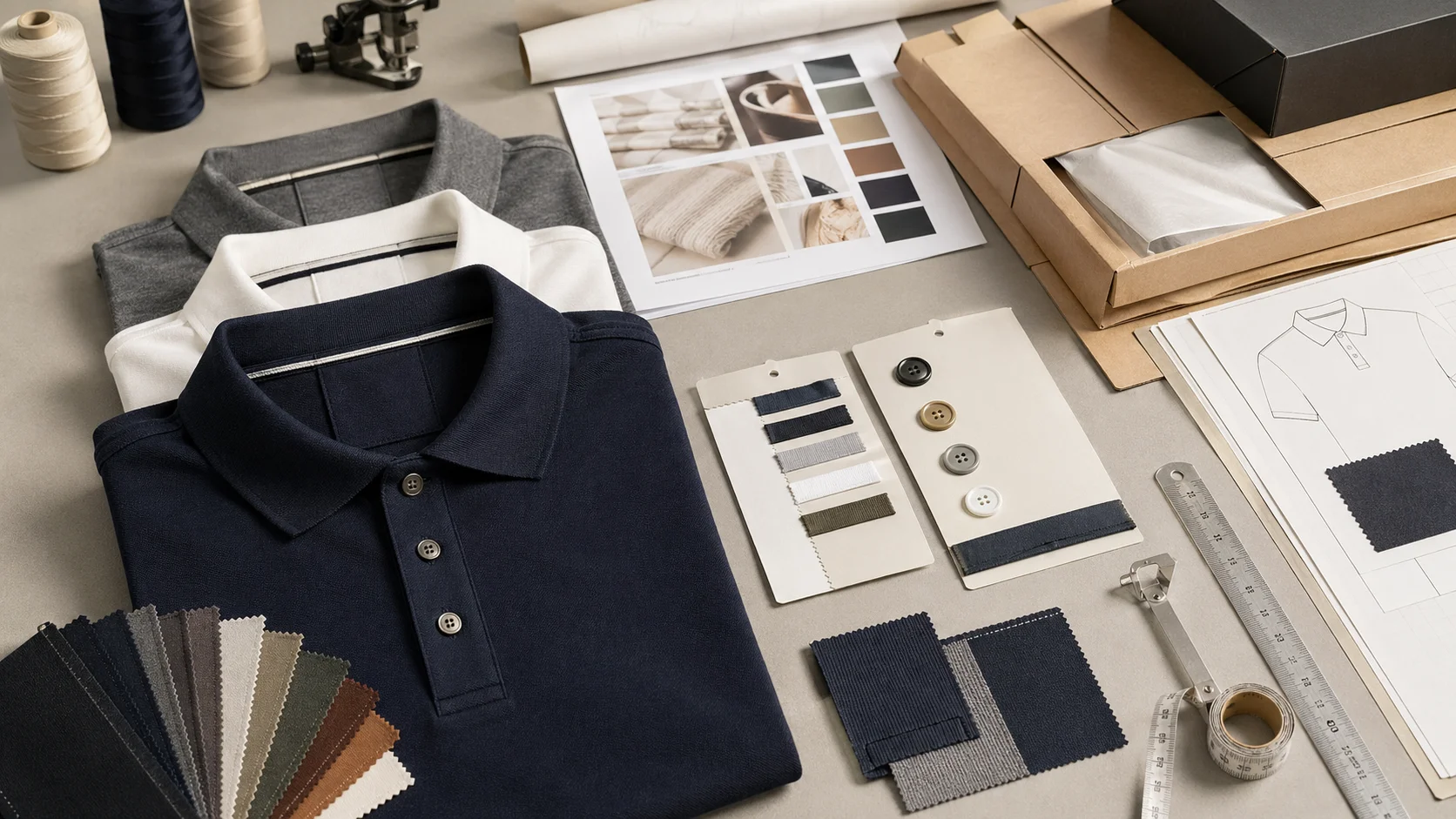
Premium T Shirt Manufacturer China with checks for samples, fit, MOQ, QC evidence, pricing terms, and delivery risk.
Fast answer: Premium T Shirt Manufacturer China: Quality, Cost, Sourcing should be judged by production evidence, not by a generic sourcing promise. The buyer needs sample proof, cost breakdowns, QC checkpoints, and delivery buffers in writing.
Ask for recent sample photos, measurement tolerances, fabric or print test assumptions, decoration test notes, packing examples, and a named inspection checkpoint. These details show whether the team can repeat an approved sample at bulk volume.
Separate garment cost, decoration, labels, packaging, sampling, testing, freight, and rush charges. When every cost line is visible, it becomes easier to reduce colorways, adjust size depth, or reserve more time for sampling.
The cheapest tee is often the most expensive mistake you’ll ever make. A premium t shirt manufacturer china partner usually wins because it can deliver scale, speed, and control without turning quality into a guessing game. In the factories I audit, first-round defect rates around 7.8% are not unusual, and the spread across China, Vietnam, Turkey, and Portugal is wider than most buyers expect. A premium t shirt manufacturer china operation often lands under 3% on repeat bulk runs, while a cheaper workshop can look fine on paper and still miss collar width by 8 mm, shade depth by half a point, or print registration by 2-3 mm.
That gap matters because a T-shirt is simple only until you measure it. I’ve stood on floors in Guangdong, Izmir, and Porto where two factories were quoting similar unit prices, yet one was producing consistent 220 GSM combed cotton with clean twin-needle topstitching and the other was losing shape after one wash. The first kept its size tolerance within ±1 cm. The second drifted to ±2.5 cm by the third lot.
China wins orders because it often combines scale, speed, and process control better than lower-cost rivals. A factory with 12 automatic cutting tables, 40-60 sewing operators per line, and in-house screen printing can hold color consistency across 5,000 pieces faster than a smaller competitor that outsources half the work. Printing accuracy is especially strong when the factory manages its own color separation, mesh counts, and curing temperatures. I’ve seen premium screen prints in Dongguan outperform more expensive workshops in Europe simply because the Chinese team tracked flash-curing time to the second.
Here’s what most people miss: some mid-priced factories produce a better handfeel than luxury-priced workshops. That sounds backward, but I have touched 320 GSM French terry tees from a $4.80 factory that felt softer and denser than $9.50 units made in a prestige mill. Price does not guarantee finish. Process does.
The buyer’s dilemma is simple. Paying more does not always buy better quality, but paying too little almost always buys risk. I’ve seen brands save $0.40 per shirt and spend $6,000 fixing shrinkage, color variance, and relabeling on a 10,000-piece order. That is not efficiency. That is expensive vanity.
A premium supplier is defined by numbers, not adjectives. For a premium t shirt manufacturer china factory, I usually look for 180-260 GSM in jersey, 220-320 GSM in French terry, combed cotton with compact yarn, and shrinkage under 5% after a controlled wash test. If the garment uses modal, organic cotton, or a recycled blend, the supplier should show fiber content, yarn count, and finishing method in writing.
Construction matters as much as fabric. Neck rib recovery should snap back after 10-15 stretches without waving out. Seam density should stay tight, often 8-11 stitches per 2 cm depending on style and machine type. Side seams must align within a few millimeters, and shoulder points should sit symmetrically after pressing. I’ve rejected samples where the fabric was beautiful but the side seams twisted 1.5 cm after laundering. Good cloth cannot rescue poor assembly.
Finishing separates premium from merely acceptable. Enzyme wash can soften compact cotton without destroying structure, while stone wash can create character but risks surface abrasion and uneven shade if the process is rushed. Colorfastness should be checked against rubbing and washing standards, and any supplier unwilling to test should be treated as a risk, not a partner. Data from the ASTM standards ecosystem and AATCC methods gives buyers a shared language for evaluating shrinkage, pilling, and color retention.
Certifications help, but they are not magic. OEKO-TEX or GOTS paperwork can support a claim, yet I still ask for lab dips, pre-production samples, and wash tests before I trust a mill. Marketing language says “soft handfeel” and “luxury grade.” Verifiable production standards say 240 GSM, reactive dye, ±1 cm tolerance, and 3% maximum shrinkage. One is advertising. The other is a contract.
When I work with brands on cut and sew manufacturing, I push them to demand measurement charts, test reports, and defect photos from sample approval. A serious factory will not hide behind adjectives. It will show you the numbers.
For buyers who want stronger sustainability claims, it also helps to verify claims through trusted sources like Textile Exchange and OEKO-TEX before placing bulk orders.
Premium pricing is a stack of small decisions, not one big margin. In China, a premium cotton tee in 180-220 GSM often lands around $2.80-$5.50 FOB depending on order size, print complexity, and finishing. In Bangladesh, comparable premium units may sit around $2.10-$4.20, though lead times can stretch by 2-4 weeks if fabric is not already booked. Vietnam commonly sits near $3.20-$5.80 for similar quality. Portugal can jump to $7.50-$12.00, and the U.S. often runs $9.00-$16.00 before domestic freight and overhead.
China is expensive in some places and cheaper in others. It is expensive if you need custom knitted fabric from scratch, because smaller orders can face yarn minimums of 300-500 kg and dye-house minimums of 1,000 meters per color. It is cheaper when you need a fast repeat order, because mills, trim suppliers, printers, and packers sit close together. I’ve watched a factory in Zhejiang cut 12 days out of a 5,000-piece order simply by moving fabric, sewing, and printing inside one industrial cluster.
Fabric weight shifts the bill fast. A 160 GSM ring-spun tee can be $0.35-$0.70 less than a 220 GSM version. Garment dyeing adds roughly $0.45-$1.10 per piece, depending on wash type, shade count, and washfastness target. Embroidery can add $0.30-$1.80 for a chest logo and much more for dense back motifs. Private label packaging, tissue, hangtags, and barcodes may add $0.18-$0.55 per unit. If you want premium t shirt manufacturer china pricing to stay sane, every detail needs a cost line.
Hidden costs are where buyers lose money. Sampling often costs $30-$120 per style, and when a brand makes 3-4 revisions, those fees stack fast. Freight can add $0.40-$1.20 per shirt on small air shipments, while duties vary by market and HS code. The biggest hidden cost is quality failure. A 6% defect rate on 20,000 shirts means 1,200 units to sort, rework, or discount. That is how a “cheap” order becomes a loss.
For brands building private label clothing services, I tell them to price the entire program, not just the shirt. Include prep, labels, polybags, carton markings, inspections, and the possibility of one failed lab test. That full picture is often 12%-18% higher than the factory quote. It is also far more honest.
The strongest value from China appears when you need moderate volume, repeatable quality, and fast corrective action. I’ve seen a 3,000-piece order with 2 wash approvals and 1 print revision finish cleaner in China than a lower quote in another country, because the team could fix issues in 48 hours instead of 10 days.
Before I trust any factory, I ask for five documents: business license, recent audit report, test certificates, production references, and a current product list with capacity numbers. If they cannot produce those within 24-48 hours, I slow down. Serious suppliers keep paperwork ready. Weak ones improvise.
Sample speed tells you more than a polished sales deck. A competent premium t shirt manufacturer china team can quote fabric sourcing in 1-3 days, send a first sample in 7-14 days if fabric is available, and explain pattern changes with measurement charts instead of vague promises. When I ask for fabric source details, I want mill name, composition, GSM, and finishing method. If the answer is “good supplier,” I assume they have not controlled the supply chain.
Red flags show up early. Vague MOQ answers. Measurements that change between messages. Refusal to discuss defect rates. No clarity on inspection points. I also watch for inconsistent seam allowances and sample photos that hide the collar or hem. One factory sent me three samples with the same label and three different neck widths. That was the interview stage, not even production.
A structured scorecard keeps emotion out of sourcing. I rate responsiveness, sample quality, and production transparency on a 1-5 scale. A factory that answers in 2 hours, nails the second sample, and shares inline inspection photos scores far higher than one that flatters the buyer but avoids specifics. If you need a quote fast, you can get a free quote for custom t-shirt manufacturing and compare how the team responds before you spend money on samples.
One more filter: ask how they handle defect reports. A disciplined factory will describe containment, root-cause analysis, and corrective action in plain language. A weak one blames fabric, workers, weather, or the buyer. I have seen that movie too many times. The ending is always the same.
Premium production is slower because good work needs checkpoints. For a standard tee, I usually see 7-14 days for development samples, 3-7 days for strike-offs if print or embroidery is involved, and 20-35 days for bulk production after approvals. Custom knitted fabrics can add 10-20 days. A rush order can compress the calendar, but rarely without cost to accuracy.
Delay usually starts before sewing. Fabric booking fails because mills are already committed to 5,000-20,000 meter lots. Dye approval drags because lab dips may take 2-4 rounds to match the target. Revision cycles eat time when the buyer changes collar width after sample 2 or swaps a 180 GSM jersey for 220 GSM French terry midstream. I have watched one “fast” project lose 11 days because the brand could not sign off on the pantone card.
Premium factories protect buyers with three checkpoints. Pre-production samples confirm the exact fabric, trims, and measurements. Inline checks catch problems during sewing, before 2,000 bad units stack up. Final AQL inspection, often at 2.5 or 4.0 depending on the contract, checks random cartons for measurement, stitching, stains, and packaging accuracy. According to ISO standards thinking, process discipline matters more than end-stage heroics. A bad batch discovered on the dock is already a failure.
Fast-turn programs can work, but only when the fabric is stock-supported and the design is simple. I have seen 8-12 day repeats for solid-color tees with screen prints, while a fully custom garment-dyed line needed 35-45 days and still missed one color target on the first run. Rushed orders fail because teams skip dye approval, reduce inline checks, or approve samples too quickly. Speed without checkpoints is just organized regret.
For buyers comparing trade terms and export readiness, the U.S. Commercial Service at trade.gov is also a useful reference for market-entry guidance and logistics basics.
When you browse options, browse our product catalog to see how fabric weight, trim choices, and finishing can change the schedule. The simpler the build, the fewer places quality can leak.
Small brands do not need giant MOQs to start smart. I often advise capsule runs of 300-500 pieces per color when the factory offers stock-supported fabrics, because that lowers risk while still testing fit, handfeel, and sell-through. A 2-color, 2-size-ratio launch can teach more than a 5,000-piece blind order. If the supplier supports private label clothing services, ask for existing fabric bases, standard neck ribs, and simple label swaps before demanding custom yarns.
Established buyers can negotiate very differently. Volume commitments of 10,000-50,000 pieces across seasons create room for better pricing, priority fabric bookings, and repeat lab approvals. Factories reward predictability. A brand that orders 8,000 tees every quarter often gets more attention than a brand that chases the lowest quote every season. I have seen repeat programs save 8%-14% once the buyer locked color standards and size specs.
Direct factory sourcing gives the best visibility, but it requires more time and tighter follow-up. Trading companies can move faster, especially for small quantities or mixed styles, yet they may compress communication and hide the real mill. Sourcing agents help with language, negotiation, and QC, but they add a fee and can blur accountability if the sample fails. My advice is blunt: if your design is simple and your team can manage detail, go direct. If you need speed, mixed categories, or frequent remakes, an agent can buy you time.
Packaging and design complexity change the model quickly. A plain tee with one woven label, one size tag, and a single print is straightforward. Add zipper bags, custom inserts, swing tags, neck prints, and carton labels in two languages, and you are suddenly managing six vendors, not one. Larger orders absorb that complexity better. Smaller brands should keep the first run lean.
The sourcing rule I use is practical. Start with one style, one fabric, one print method, and one ship date. Then expand. That is how you learn whether a supplier is truly a premium shirt manufacturer or just a polished estimator. A premium t shirt manufacturer china partner earns repeat business by making the second order easier than the first.
I start every sourcing project with a shortlist of 5-7 factories, then narrow to 2-3 serious candidates after sample review and document checks. The order is always the same: shortlist, sample, compare, inspect, pilot, scale. Skipping steps costs more than it saves. One brand I advised jumped straight to 8,000 pieces and spent 14 days fixing collar twist and print cracking. A 500-piece pilot would have exposed both problems for a fraction of the cost.
A useful RFQ asks for the same details from every factory. State fabric type, GSM, yarn count if known, fit measurements, shrinkage target, color standard, print method, packaging, carton count, and delivery window. Add MOQ, sample cost, and whether the factory can source trims in-house. That forces apples-to-apples quotes instead of theatrical discounts. If you want a clearer starting point, ask the factory to quote against one size set and one color standard first, then price variants separately.
Your pilot order should be large enough to reveal process flaws but small enough to absorb mistakes. For many brands, that means 300-800 pieces, or 1-2 colors across 2-4 sizes. Track five metrics after delivery: defect rate, measurement tolerance, wash performance, packaging accuracy, and on-time shipment. I also like to compare customer returns, because a 2% return rate on launch can reveal fit issues the factory never mentioned.
Here’s the one decision framework I trust: only scale after the factory passes sample accuracy, pilot consistency, and communication speed in real conditions, not in sales emails. That is how you separate a decent vendor from a lasting supplier.
When the numbers are clean, repeat the same spec. Change one variable at a time. That discipline protects margin, reduces waste, and keeps a premium tee premium after the third production cycle. The best premium t shirt manufacturer china partner is the one that still cares once the paperwork is signed.
A premium factory holds tighter tolerances, usually within ±1 cm on key measurements, and uses better fabric control, often 180-260 GSM for jersey. It also documents shrinkage, colorfastness, and stitch density instead of relying on sales language.
For premium cotton tees, typical FOB pricing in China is about $2.80-$5.50 per piece, depending on GSM, order size, printing, and finishing. Garment dyeing, embroidery, and custom packaging can add $0.45-$2.00 more per unit.
Most programs need 7-14 days for samples and 20-35 days for bulk after approvals. If you add custom fabric, garment dyeing, or multiple revision cycles, lead time can extend to 45 days or more.
Yes. Many factories accept 300-500 piece capsule runs if the fabric is stock-supported and the design is simple. Small brands should focus on one style, one print method, and one color to keep costs and risk controlled.
Ask for business licenses, audit reports, test certificates, and production references. Then compare sample speed, measurement accuracy, and whether the factory can explain defect rates and inspection steps in clear numbers.