
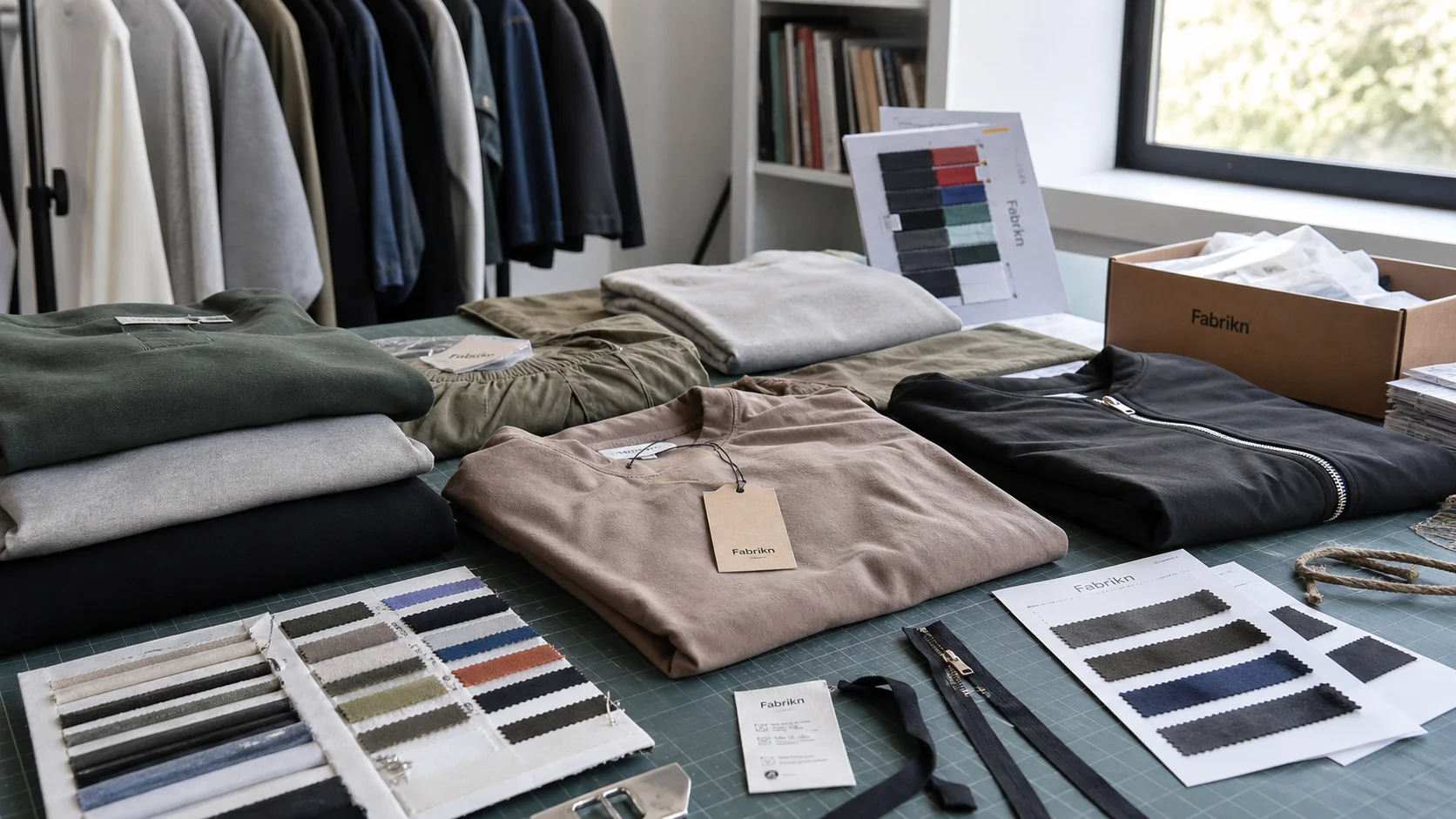
Clothing Manufacturer for Premium Cotton T-Shirts compared by sample evidence, fabric or trim specs, MOQ, AQL terms, cost lines, delivery timing, and...
Fast answer: Clothing Manufacturer for Premium Cotton T-Shirts: Fabric, Shrinkage, Fit, and QC Terms should be judged by production evidence, not by a generic sourcing promise. The buyer needs sample proof, cost breakdowns, QC checkpoints, and delivery buffers in writing.
Ask for recent sample photos, measurement tolerances, fabric or print test assumptions, decoration test notes, packing examples, and a named inspection checkpoint. These details show whether the team can repeat an approved sample at bulk volume.
Separate garment cost, decoration, labels, packaging, sampling, testing, freight, and rush charges. Clear cost lines make it easier to reduce colorways, adjust size depth, or reserve more time for sampling.
Premium tees can look flawless on day one and still unravel after five washes. I’ve seen that enough times to stop romanticizing a pretty sample. If you’re choosing a clothing manufacturer for premium cotton t shirts, start by asking a blunt question: can this factory build a shirt that lasts, or only one that photographs well? Cotton rarely gets the blame. Construction does. Miss that, and returns, markdowns, and irritated emails arrive on schedule.
After 200+ factory visits across 8 countries, one pattern keeps showing up: brands fall for “soft” samples, then approve specs that buckle in bulk. A neck rib waves after three laundries. The side seam twists. Shrinkage lands at 4% to 6% when the buyer expected 2%. Premium starts in production, not in a mood board.
Soft handfeel wins attention because you can feel it in seconds. Durability takes weeks, sometimes months, and that delay hides mistakes. Ring-spun yarn, long-staple cotton, knit density, and stitch choice all decide how a tee behaves after 10, 20, or 30 washes. A 180 GSM single jersey can outlast a thicker 220 GSM shirt if the yarn is better twisted and the seams are tighter.
South Asia often delivers strong fabric sourcing at aggressive prices. QC, though, can swing wildly from line to line. Portugal and Turkey usually give cleaner finishing and collars that sit properly, but the unit cost may run 15% to 30% higher. China sits in the middle for many buyers: large-scale consistency is possible, but only when audits are real and the spec is locked down.
Not “What looks premium?” What can be repeated? That is the real question. A premium cotton tee is high-repeat and margin-sensitive. If a reorder comes back 0.5 cm narrower in the chest or the shade shifts from lot to lot, customers notice fast. Finance does too.
A $4 FOB quote can feel like a win until the hidden bills arrive. Rework. Replacement freight. Markdown protection. I’ve watched brands celebrate cheap pricing and then spend another $1.20 per piece cleaning up the mess. A $9 shirt from a clothing manufacturer for premium cotton t shirts with solid process control can end up cheaper over a season because it brings fewer defects, fewer returns, and less sampling churn.
One brand I worked with cut landed cost by 18% on paper, then lost nearly all of it to seven weeks of delays and a 6% defect rate. Brutal lesson. The cheapest tee is often the most expensive one. If you want to see how that construction-first logic carries into adjacent categories, take a look at custom baby clothing manufacturing, where shrinkage, seam safety, and fabric stability are even less forgiving.
Cut and sew is only the surface. A clothing manufacturer for premium cotton t shirts should source fabric, control dye lots, support fit development, run wash tests, and produce paperwork a retailer or importer can audit without squinting. If the supplier only says “nice handfeel” and “good quality,” I keep digging. Numbers beat adjectives every time.
Premium is measurable. Long-staple cotton. Combed or ring-spun yarn. Pre-shrunk treatment. Collar recovery. Stitch density. Those are production choices, not marketing flourishes. For most premium tees, I look in the 160-220 GSM range. Heavier is not automatically better. A 240 GSM shirt can feel expensive and still wear hot and boxy when the customer wants drape and breathability.
Day one means asking for yarn count, fiber length, knit construction, fabric GSM tolerance, shrinkage targets, and measurement tolerances after wash. Good benchmark: shrinkage within 3% in length and width, colorfastness through at least 5 home launderings, and twist kept within an agreed sample standard. For neck rib recovery, I want the collar to spring back after repeated stretch, not just survive a photo test.
Ask for lab dips before bulk dye approval. Ask for seam strength data if the tee has a heavier body or a boxy block. A reliable factory should also show how it handles packaging, barcode labeling, fiber content, and compliance documentation. Sewing a shirt is one thing. Running a product program is another.
Luxury branding can hide weak production standards. I’ve toured glossy sample rooms with marble tables and polished hangers that presented tees failing shade matching across 1,200 units. A shirt becomes premium when it still holds shape, color, and collar structure after 20 washes. A shirt becomes merely expensive when it looks special on a sales rack and ordinary by week 6.
For brands using private label strategies, the factory’s ability to standardize matters more than its showroom. If you need repeatable bulk runs, the same discipline behind private label clothing services should show up in how they track yarn lots, shade bands, and finished measurements. Pretty samples are easy. Repeating them at 5,000 pieces is the hard part.
Price comparisons only work when you trace the full route from yarn to warehouse. Fabric often takes 35% to 55% of landed cost, cutting and sewing another 15% to 25%, trims and labels 5% to 10%, and packaging plus freight fills the rest. A lower FOB number can hide expensive sampling loops, extra QA visits, and rejection rates that show up later.
Same tee, different cost structure. That’s the trade reality. China may quote faster and more consistently at 3,000 to 10,000 pieces. India and Bangladesh often lower the labor line, but finishing variability can widen if the factory is juggling too many programs. Portugal and Turkey charge more upfront, yet their bulk consistency can save money when a brand cares about low return rates. Vietnam sits in the middle for a lot of medium-size programs with 2 to 4 colorways.
Here’s the comparison I use in sourcing reviews. A low-cost factory might quote $2.20 to $3.20 FOB for a 180 GSM tee at 5,000 pieces, but it may need 2 to 4 sampling rounds and a tighter eye on shrinkage. A mid-tier factory may sit at $3.50 to $5.50 FOB with cleaner communication and lower defect risk. Premium European production can run $6.50 to $10.00 FOB, especially with organic cotton, garment dye, or custom knit structures.
Smaller European mills sometimes beat larger Asian suppliers on consistency. Shorter line. Stricter batch control. I didn’t expect that the first time I saw it. High-volume Asian factories can become excellent too—once the spec is frozen and the buyer stops changing collar width, sleeve length, and wash formula every round. Discipline, or chaos. No middle ground.
For samples, I plan on 2 to 3 weeks for a clean first round, then another 7 to 14 days if the knit or trim needs correction. Bulk production at efficient factories usually takes 30 to 60 days, but custom knitting, reactive dyeing, or special washing can add 10 to 20 days. If a supplier promises everything in 12 days, I assume they’re undercounting something.
Compare value by total landed reliability, not just FOB. A $0.40 unit saving means little if the factory misses the ship date by 14 days and you end up paying air freight. For brands that want cut-and-sew precision at scale, cut and sew manufacturing can separate a controlled launch from a costly scramble.
A premium tee can fail in subtle ways. Collar wave. Side-seam torque. Shade variation across 800 pieces. Handfeel that changes from size M to XXL because the wash load was uneven. None of those defects looks catastrophic on a factory floor. Every single one can hurt sell-through at retail.
I want a QC plan that starts with yarn inspection and keeps going through fabric GSM verification, shrinkage testing, seam strength, neck rib recovery, wash durability, and final random inspection. If a factory can’t explain its defect thresholds, it is asking the buyer to absorb risk blindly. I don’t do blind.
Set acceptance thresholds before production begins. Measurement variance after wash should stay within agreed tolerances, such as +/- 1 cm in chest width and +/- 1.5 cm in body length, depending on size range. Defect rates need to be defined too. A 2.5% major defect threshold is not generous, but it is clear. Clarity kills arguments later.
According to the AATCC, standardized textile test methods are central to consistent performance evaluation, especially for colorfastness and dimensional stability. I also ask for fabric testing against known benchmarks from ISO standards where relevant, because a supplier that understands the test method is less likely to improvise once the order is live.
For sustainability and preferred fiber claims, I also check guidance from Textile Exchange and compliance resources from OEKO-TEX. Those references help separate marketing language from verifiable production claims.
Red flags show up early. Sample fits beautifully, but the bulk photo looks flatter? Ask for lay plans and marker efficiency. Collar clean in size M and wavy in size XL? The rib spec is probably too loose. Packaging arriving with mixed fold sizes, loose threads, or inconsistent label placement? The factory may be treating the order like a commodity run.
Compliance matters too, but certificates alone don’t prove much. I’ve seen factories with fewer glossy badges outperform heavily decorated suppliers because they document process control and allow third-party audits. I want traceability back to fabric lot, dye lot, and line number. I also want social compliance reports from recognized bodies such as WRAP, not just a PDF logo on a pitch deck.
Fabric choice changes touch, drape, and margin all at once. Compact cotton is usually smoother and more stable than open-end cotton. Organic cotton can command a higher price, but supply is tighter and lead times may stretch by 2 to 4 weeks during peak periods. Pima and Supima can feel richer and justify premium pricing, though they usually need sharper sourcing discipline and more careful claims language.
Blends can work. Buyers still overpay for “premium” tees that are basically ordinary cotton with a little marketing gloss. Real question: how does the fabric behave after 15 washes, not how does it read on a hangtag? A 95/5 cotton-elastane shirt may feel exceptional in hand, yet it can trap heat or shift recovery behavior if the knit is poorly balanced.
On a rack, most customers notice softness first, then structure, then color depth. Compact cotton and combed ring-spun yarn usually create the cleanest surface for print and embroidery. Pima and Supima can bring a smoother, longer-fiber feel, but only if the fabric mill keeps lot consistency. Organic cotton can be a strong story, though the real value comes from performance and traceability together.
And here’s the bit nobody tells you: too much softness can ruin the shirt. An aggressive enzyme wash or silicone finish may create a great first impression but weaken body and collar memory if the factory goes too far. I’ve seen tees feel luxurious on day one and look tired by week three because the finishing stripped the structure out of the knit.
Fit is commercial, not cosmetic. Boxy premium tees often reduce returns in streetwear and elevated basics because customers tolerate looser grading and size flexibility. Slim fits can work in fashion-driven markets, but they raise size-exchange risk by 8% to 12% when grading is inconsistent. The safer route is a fit block built from actual sales data, not mood boards.
Dye method matters too. Garment dye can create depth and a worn-in look, but it can also create shade variation if the load is uneven. Piece dye is cleaner for size consistency. I’ve seen brands save more than 5% in return costs simply by tightening sleeve length tolerances and cutting neck opening drift. That’s production economics, not styling.
Sampling reveals habits. The path should be orderly: tech pack review, fabric swatch approval, proto sample, fit sample, pre-production sample, then bulk approval. Skip steps, and somebody downstream eats the risk. Usually that somebody is the buyer.
Timelines tend to slip at the same pressure points: knit lab dips, shrinkage correction, label approvals, and packaging proofs. A clean cycle can take 3 to 4 rounds and 4 to 6 weeks total before bulk is ready. If a supplier says “approved” after one photo, I worry they’re optimizing for speed instead of repeatability.
For premium cotton tees, 3 to 5 sample stages are normal. A proto sample checks the idea. A fit sample checks the block. A pre-production sample checks bulk readiness. If the first round misses collar height or shoulder slope, one more iteration is not a failure. It is cheaper than fixing 2,000 units later.
Serious factories expect buyers to review measurements, fabric weight, print handfeel, and wash behavior before signing off. They also expect decisions to come quickly. A 48-hour feedback loop keeps the line moving. A 10-day silence can push your order behind someone else’s, especially in peak season.
MOQ is driven by fabric color minimums, knitting machine runs, trim sourcing, and cutting efficiency. A factory may accept 300 pieces on paper but price them like 1,000 because setup time stays the same. A 300-piece run can cost 30% to 70% more per unit than a 3,000-piece order, and the gap gets sharper if you need custom rib, custom dye, or branded packaging.
Trying to balance quantity with control? Negotiate one fabric, one fit block, and limited colorways for the pilot order. Ask for a clear cost ladder at 500, 1,500, 3,000, and 10,000 pieces. That gives you a real view of where scale starts paying back. If you want a starting point, you can get a free quote and compare how the factory structures development fees versus bulk pricing.
The fastest way to cut sourcing risk is simple: ask better questions before you place money. Request a tech pack review, recent test reports, capacity by line and shift, lead times during peak season, and examples of bulk photos from the last 90 days. If the answers are vague, production will be vague too.
I also want business registration, certifications, test reports, client references, and documented bulk photos before I send a deposit. A factory should show process control, not just a polished showroom. That is where good sourcing separates from hopeful sourcing.
If you are comparing suppliers in China, Europe, or South Asia, ask for the same evidence from each clothing manufacturer for premium cotton t shirts. The best partner will not just quote wholesale or bulk pricing; they will explain how they keep quality stable at scale.
My checklist stays short. Can the factory produce 3,000 to 10,000 pieces without disrupting current customers? Do they have a defined inspection system, a clear defect log, and traceability from yarn to carton? Can they explain why one tee costs $3.80 and another costs $6.90 without hiding behind vague “premium quality” language?
If the buyer needs broader apparel support too, I prefer suppliers who can move between categories without losing discipline. Strong private label clothing services and controlled sourcing usually point to a factory that understands repeat business, not just one-off samples.
Use a 3-stage decision process. Shortlist 5 factories. Sample 2 or 3. Run wash and wear tests for 2 weeks. Then place a controlled first order with limited colorways, one fabric, one fit block, and clear defect thresholds. The order should be big enough to test production discipline, but small enough that a mistake doesn’t sink the season.
In my experience, the right supplier isn’t the cheapest or the loudest. It’s the clothing manufacturer for premium cotton t shirts that can reproduce the same tee 10,000 times, with the same collar, the same handfeel, and the same measurement sheet. That is the standard worth paying for.
Most premium cotton tees fall around $2.20-$10.00 FOB depending on region, fabric, and order size. A 180 GSM shirt at 5,000 pieces may land near $3.50-$5.50 in Asia, while Portugal or Turkey can run higher for tighter finishing.
Many factories ask for 300-1,000 pieces per color, but true cost efficiency usually starts closer to 1,500-3,000 pieces. Custom yarns, garment dye, or special packaging can raise MOQ to 5,000 or more.
Plan for 2-3 weeks for the first sample round and 4-6 weeks total before bulk approval if revisions are needed. Knit development, lab dips, and shrinkage fixes are the usual delay points.
Compare FOB price, GSM, yarn type, shrinkage targets, defect tolerance, and lead time. A quote that is $0.60 cheaper can still cost more if it creates 4% rejects or adds 2 extra sampling rounds.
No. Certifications help, but I still want process records, test reports, and permission for third-party audits. A smaller factory with strong documentation can outperform a decorated supplier that cannot keep bulk within 1 cm or 3% shrinkage limits.